Provinces and regions, cities, ports and the frontier centres.
Provinces and regions 93 Achaia Separate Augustan province from 27 BCE · Southern Greece
Province centered on Corinth and incorporating many Greek communities with older civic traditions; imperial supervision coexisted with local prestige, benefaction and autonomy claims.
Read the province in Provinces →
See also Athens
Read further Pleiades ancient place gazetteer · Strabo Geography Books V-VII
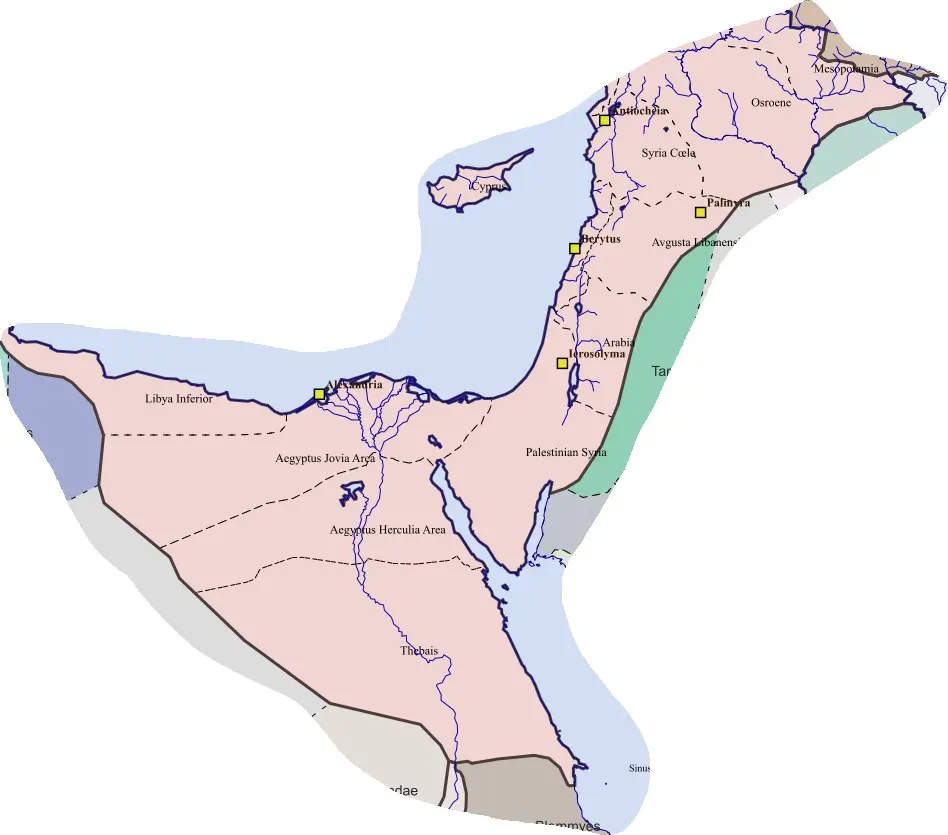
Aegyptus 30 BCE to Arab conquest in 7th century CE, with Sasanian occupation 619-629 CE · Nile valley and delta
Imperial province governed by an equestrian prefect, important for grain, taxation and Red Sea trade; late antiquity divided its civil administration into several provinces.
Read the province in Provinces →
See also Alexandria , Nile , Grain supply
Read further Pleiades ancient place gazetteer · Strabo Geography Books XVI-XVII · Notitia Dignitatum compilation study
Africa Nova From 46 BCE; later merged · North Africa
Julius Caesar organized former Numidian royal territory after defeating the Pompeian coalition; its later merger helped form imperial Africa Proconsularis.
Read the province in Provinces →
See also Julius Caesar , Numidia
Read further Pleiades ancient place gazetteer · Strabo Geography Books XVI-XVII · Notitia Dignitatum compilation study
Africa Proconsularis Augustan organization onward · Tunisia and neighboring North Africa
Wealthy senatorial province with Carthage as center, major grain and oil production, estates and prosperous cities; its extent shrank through later provincial divisions.
Read the province in Provinces →
See also Carthage , Grain supply , Olive oil
In the volumes Book VIII · Chapter 5: Aetius, Africa, and Attila
Read further Pleiades ancient place gazetteer · Strabo Geography Books XVI-XVII
Africa Vetus From 146 BCE · Northeastern modern Tunisia
Territory acquired after Carthage's destruction; later combined with other African lands. Its boundaries should not be equated with the modern African continent.
Read the province in Provinces →
See also Third Punic War , Carthage , Africa Proconsularis
Read further Pleiades ancient place gazetteer · Strabo Geography Books V-VII
Alpes Cottiae Client kingdom to annexation in 63 CE · Western Alps
Pass territory long governed through the Cottian dynasty before direct provincial administration; a good example of client authority becoming annexed government.
Read the province in Provinces →
See also Nero
Read further Pleiades ancient place gazetteer · Strabo Geography Books III-IV
Alpes Graiae et Poeninae Early imperial annexation and later combined administration · Northwestern Alps
Pass regions around the Great and Little St Bernard, important for communication between Italy, Gaul and the Rhine; their arrangements changed across the Empire.
Read the province in Provinces →
See also Lugdunum , Italia
Read further Pleiades ancient place gazetteer · Strabo Geography Books III-IV · Notitia Dignitatum compilation study
Alpes Maritimae Early imperial administration from Augustan/Claudian period · Southwestern Alps
Small Alpine province controlling routes between Italy and Mediterranean Gaul; its administrative history differs from the larger neighboring Gallic provinces.
Read the province in Provinces →
See also Gallia Narbonensis , Augustus
Read further Pleiades ancient place gazetteer · Strabo Geography Books III-IV
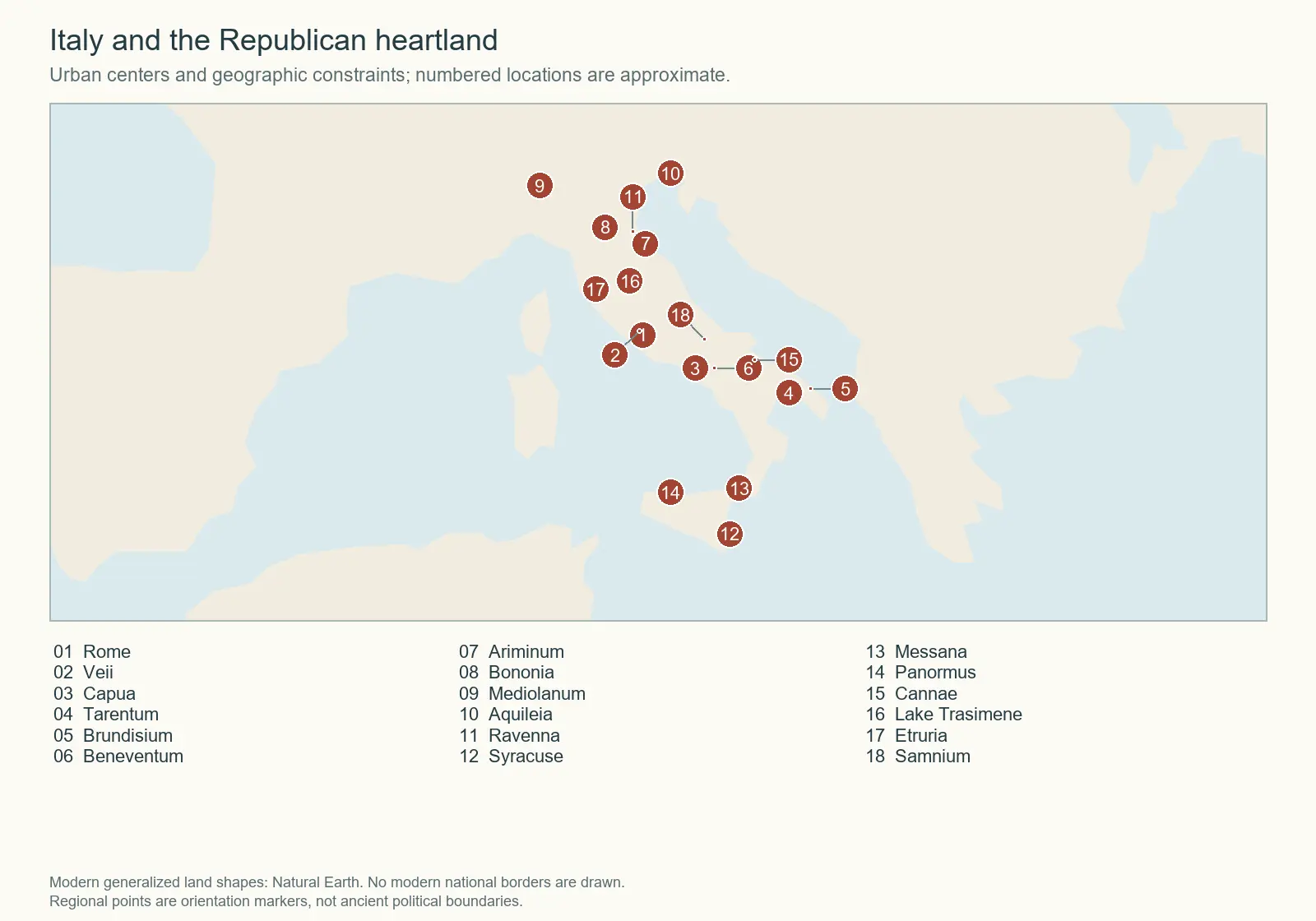
Map Index Archive Italy and the Republican Heartland Arabia Petraea 106 CE onward · Southern Levant and northwestern Arabia
Province created by annexing the Nabataean kingdom, with Bostra and Petra as principal cities. Later division transferred southern territory into Palaestina Tertia.
Read the province in Provinces →
See also Trajan , Nabataeans
Read further Pleiades ancient place gazetteer · Strabo Geography Books XVI-XVII · Roman province of Arabia Zbigniew Fiema
Arcadia Aegypti Late 4th century CE onward · Middle Egypt
Late Roman province in middle Egypt, distinct from the Greek region of Arcadia; agriculture, estate administration and monastic settlements shaped its economy.
See also Oxyrhynchus , Aegyptus , Monasticism
Read further Pleiades ancient place gazetteer · Strabo Geography Books XVI-XVII · Notitia Dignitatum compilation study
Armenia as Roman province 114-117 CE; later Roman Armenian provinces followed different settlements · Armenian highlands
Trajan briefly annexed the Armenian kingdom, but Hadrian abandoned direct provincial rule. Later Roman Armenia resulted from other partitions and should not be back-projected.
See also Trajan , Hadrian
Read further Pleiades ancient place gazetteer · Strabo Geography Books XI-XIV · Notitia Dignitatum compilation study
Armenia Minor Client arrangements before annexation in 72 CE · Eastern Anatolia
Territory west of the Euphrates was distinct from Greater Armenia and was incorporated into Roman frontier administration under the Flavians.
See also Vespasian , Cappadocia
Read further Pleiades ancient place gazetteer · Strabo Geography Books XI-XIV
Asia Roman organization from 129 BCE after Attalid bequest 133 BCE · Western Anatolia
Rich province of the former Pergamene kingdom, with major Greek cities, taxation and provincial imperial cult; its name denotes a province rather than all Asia.
Read the province in Provinces →
See also Pergamum , Ephesus
In the volumes Book IV · Chapter 2: The Syrian War: Antiochus, Thermopylae, and Magnesia · Book V · Chapter 6: Pompey and the Conquest of the East · Book V · Chapter 5: Wars in the Shadow of the Settlement: Mithridates, Sertorius, Spartacus · Book VII · Chapter 8: The Recovery, 260–284 · Book I · Chapter 4: The Coalition War: Sentinum and Its Antecedents · Book I · Epilogue: Rome in 264 BC · Book IV · Proem · Book IV · Epilogue: Rome in 146 BC and 4 more
Read further Pleiades ancient place gazetteer · Strabo Geography Books XI-XIV
Assyria as Trajanic province Claimed for 116-117 CE; status and location disputed · Mesopotamian east
Later sources mention a Trajanic province named Assyria, but its existence, borders and administrative substance remain debated; it should not be mapped as a secure lasting unit.
See also Trajan , Mesopotamia , Parthians
Read further Pleiades ancient place gazetteer · Strabo Geography Books XVI-XVII
Augustamnica Fourth century CE onward · Eastern Nile delta
Late Roman Egyptian province covering eastern-delta districts and routes toward Palestine; provincial divisions changed further within late antiquity.
Read the province in Provinces →
See also Aegyptus , Nile
Read further Pleiades ancient place gazetteer · Strabo Geography Books XVI-XVII · Notitia Dignitatum compilation study
Plate Provinces The Nile country and its eastern Mediterranean connections Baetica Augustan settlement from 27 BCE · Southern Iberia
Senatorial province centered on the Baetis valley, with wealthy cities, estates and olive-oil exports. Its provincial elite contributed heavily to imperial administration.
Read the province in Provinces →
See also Corduba , Hispania Ulterior , Olive oil
In the volumes Book VII · Chapter 4: The Antonine Noon and Its Wars
Read further Pleiades ancient place gazetteer · Strabo Geography Books III-IV
Bithynia et Pontus Bithynian annexation 74 BCE; combined provincial settlement in 60sBCE · Northern Anatolia
A combined jurisdiction formed from Bithynian royal territory and parts of conquered Pontus; coastal cities and inland regions retained varied institutions.
Read the province in Provinces →
See also Nicomedia , Pompey , Mithridatic Wars
Read further Pleiades ancient place gazetteer · Strabo Geography Books XI-XIV
Britannia Conquest began 43 CE; Roman government receded in early 5th century CE · Britain
Imperial province created by Claudius' invasion, with changing northern frontiers. Roman authority never amounted to permanent incorporation of the whole modern British Isles.
Read the province in Provinces →
See also Claudius , Londinium , Hadrian's Wall
In the volumes Book VI · Chapter 4: Britain: Conquest and Revolt
Read further Pleiades ancient place gazetteer · Strabo Geography Books III-IV · English Heritage Romans Power and Politics
Britannia Superior and Inferior Division in early 3rd century CE · Britain
Severan-era division separated southern and northern commands, reducing a governor's combined military power; later reforms subdivided Britain further.
See also Septimius Severus , Eboracum , Britannia
Read further Pleiades ancient place gazetteer · Strabo Geography Books III-IV · English Heritage Romans Power and Politics
Byzacena Late 3rd century CE onward · Central and southern Tunisia
Late Roman subdivision of Africa, containing rich agricultural districts and towns. It later passed through Vandal and Justinianic regimes.
Read the province in Provinces →
See also Vandals , Justinian I
In the volumes Book VIII · Chapter 5: Aetius, Africa, and Attila
Read further Pleiades ancient place gazetteer · Strabo Geography Books V-VII · Notitia Dignitatum compilation study
Cappadocia 17 CE onward · Eastern central Anatolia
Former client kingdom annexed by Tiberius, later a major eastern military province facing Armenia; temporary unions with other territories complicate its administrative chronology.
Read the province in Provinces →
See also Tiberius , Armenia
In the volumes Book V · Chapter 6: Pompey and the Conquest of the East · Book VI · Chapter 5: The Eastern Question: Corbulo, Armenia, and Parthia · Book VI · Chapter 8: The Flavian Consolidation and the Wars of Domitian
Read further Pleiades ancient place gazetteer · Strabo Geography Books XI-XIV · Cappadocia Encyclopaedia Iranica
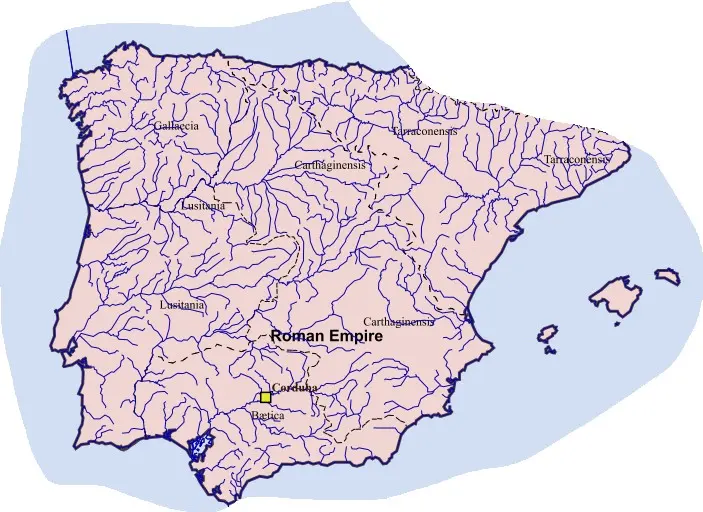
Carthaginiensis Late 3rd/early 4th century CE onward · Southeastern Iberia
Late Roman subdivision of Tarraconensis named for Carthago Nova, linking inland agriculture, mining districts and Mediterranean ports.
Read the province in Provinces →
See also Carthago Nova , Diocletian , Hispania Tarraconensis
Read further Pleiades ancient place gazetteer · Strabo Geography Books III-IV · Notitia Dignitatum compilation study
Plate Provinces Late Roman Iberia: rivers and provincial subdivision Cilicia Republican military command from 102 BCE; territorial forms changed; unified province in 72 CE · Southern Anatolia
Its coastal plain, mountain districts and pirate-suppression command were never identical categories. Flavian consolidation followed centuries of mixed direct and client rule.
Read the province in Provinces →
See also Pompey
In the volumes Book V · Chapter 6: Pompey and the Conquest of the East · Book VII · Chapter 2: The Eastern Maximum and the Great Recoil · Book VIII · Chapter 2: The House of Constantine at War: Persia, Strasbourg, and the Road to Ctesiphon
Read further Pleiades ancient place gazetteer · Strabo Geography Books XI-XIV
Commagene Client kingdom to annexation in 72 CE · Upper Euphrates
Dynastic kingdom at a strategic crossing zone, incorporated into Syria under Vespasian; Samosata became an important military base.
Read the province in Provinces →
See also Vespasian , Legio XVI Flavia Firma
In the volumes Book VI · Chapter 5: The Eastern Question: Corbulo, Armenia, and Parthia · Book VI · Chapter 8: The Flavian Consolidation and the Wars of Domitian
Read further Pleiades ancient place gazetteer · Strabo Geography Books V-VII
Creta et Cyrenaica Late Republic to late 3rd-century reforms · Crete and northeastern Libya
A geographically separated combined province joining Crete with Cyrenaica; later reforms gave the two regions separate administrative frameworks.
Read the province in Provinces →
See also Cyrene , Mediterranean shipping
Read further Pleiades ancient place gazetteer · Strabo Geography Books XVI-XVII · Notitia Dignitatum compilation study
Cyprus Annexed 58 BCE; senatorial province from 22 BCE · Eastern Mediterranean
Island province with copper, agriculture and ports; it had earlier connections to Cilician administration and Ptolemaic royal politics.
Read the province in Provinces →
In the volumes Book VII · Chapter 2: The Eastern Maximum and the Great Recoil
Read further Pleiades ancient place gazetteer · Strabo Geography Books V-VII
Cyrenaica and Libya Pentapolis Republican bequest 96 BCE; provincial organization in 1st century BCE; later separate province · Northeastern Libya
Greek-founded cities and agricultural hinterland were first linked with Crete, then reorganized separately in late antiquity; Pentapolis denotes the five-city region.
See also Cyrene , Creta et Cyrenaica
In the volumes Book VII · Chapter 2: The Eastern Maximum and the Great Recoil
Read further Pleiades ancient place gazetteer · Strabo Geography Books XVI-XVII · Notitia Dignitatum compilation study
Dacia Aureliana From the 270sCE · South of the lower Danube
Aurelian reused the Dacian provincial name after evacuation north of the river. This southern province must be distinguished from Trajan's conquered Dacia.
Read the province in Provinces →
See also Aurelian , Danube
In the volumes Book VII · Chapter 8: The Recovery, 260–284
Read further Pleiades ancient place gazetteer · Strabo Geography Books V-VII · Notitia Dignitatum compilation study
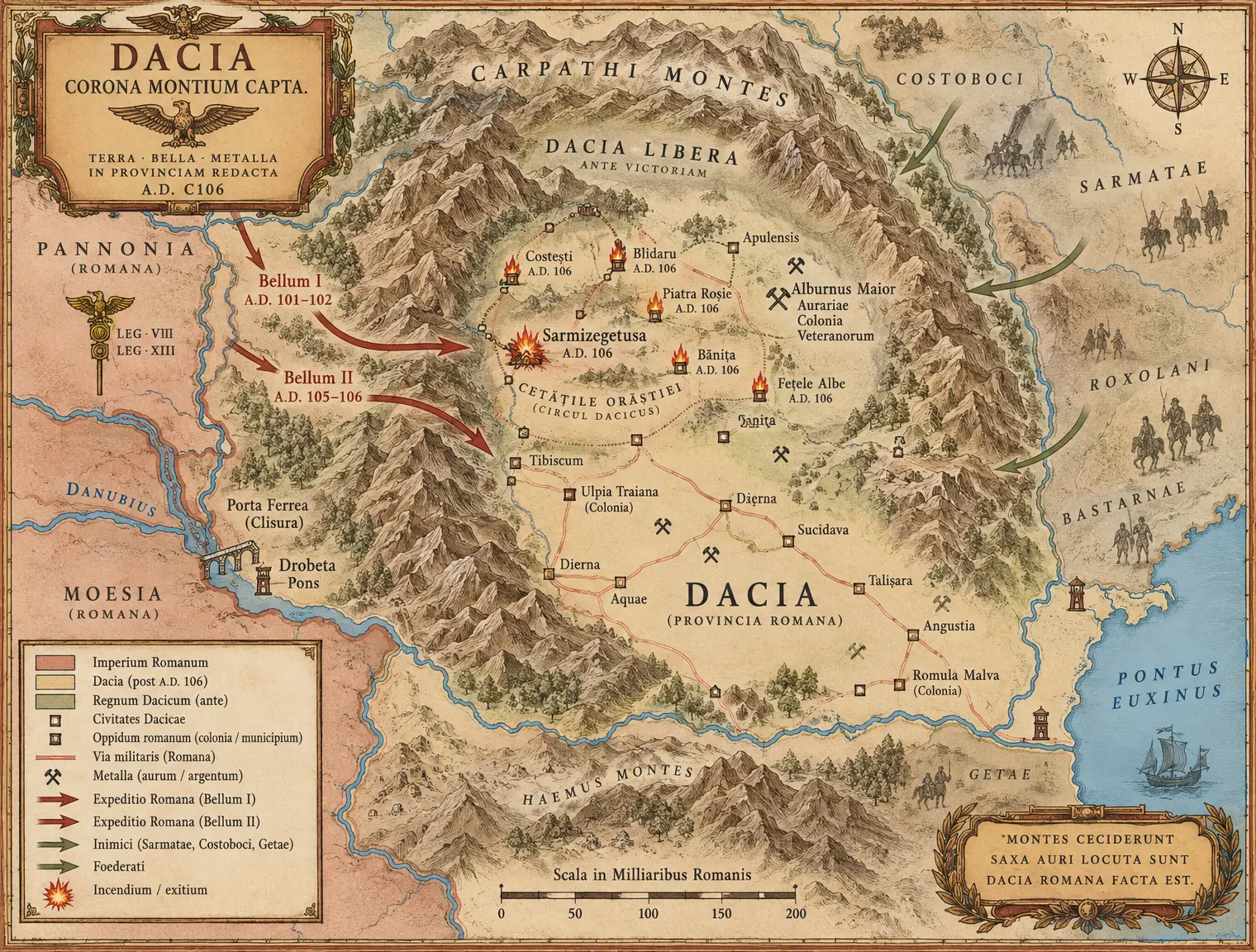
Dacia north of the Danube 106 CE to withdrawal in the 270sCE · Carpathian basin
Trajan's conquered province included valuable mines and a dense military network. Subdivision changed over time; abandonment of imperial government did not empty the land of people.
See also Trajan , Decebalus
Read further Pleiades ancient place gazetteer · Strabo Geography Books V-VII · Notitia Dignitatum compilation study
Map Book VII DACIA — The Carpathian Atlas Dacia Ripensis and Mediterranea Early 4th century CE onward · Northern and inland Balkans
Successor provinces divided river defense from the inland region around Serdica. Their names preserve administrative continuity rather than identical geography with northern Dacia.
See also Dacia Aureliana
Read further Pleiades ancient place gazetteer · Strabo Geography Books V-VII · Notitia Dignitatum compilation study
Dalmatia Early 1st century CE provincial form · Adriatic Balkans
Province linking coastal cities such as Salona with mountainous inland communities. Roads and military recruitment tied the interior to imperial structures.
Read the province in Provinces →
See also Salona , Illyricum
In the volumes Book VIII · Chapter 6: The Dissolution · Book VII · Epilogue: The World-State at 284
Read further Pleiades ancient place gazetteer · Strabo Geography Books V-VII
Danube Republic and Empire · Central and southeastern Europe
Major transport and military corridor connecting frontier provinces and neighboring peoples; campaigns, settlement and supply crossed as well as followed the river.
See also Pannonia , Moesia , Dacia north of the Danube
In the volumes Book VI · Chapter 8: The Flavian Consolidation and the Wars of Domitian · Book VII · Chapter 1: The Dacian Wars of Trajan · Book VI · Proem · Book VI · Chapter 1: The Augustan Conquests · Book VI · Chapter 7: The Year of the Four Emperors and the Batavian Revolt · Book VI · Epilogue: The World-State at 96 · Book VII · Proem · Book VII · Chapter 5: Marcus Aurelius: The Double Emergency and 12 more
Dardania Late 3rd century CE onward · Central Balkans
Late Roman province separated from Upper Moesia, important for routes through the interior Balkans and later military recruitment.
Read the province in Provinces →
See also Naissus , Moesia Superior , Constantine I
Read further Pleiades ancient place gazetteer · Strabo Geography Books V-VII · Notitia Dignitatum compilation study
Eastern themes Developed mainly from 7th century CE onward · Eastern Roman Empire
Military-administrative districts emerged through a gradual transformation of eastern armies and territories; they were not simply new names for every classical province.
See also Heraclius , Eastern Roman Empire
Read further Pleiades ancient place gazetteer · Strabo Geography Books V-VII · Notitia Dignitatum compilation study
Epirus Separate province under Trajan; later divided · Western Balkans
Adriatic region facing Italy, later divided into Epirus Vetus and Nova; coastal routes and the Via Egnatia connected it to wider imperial communications.
Read the province in Provinces →
See also Dyrrhachium , Trajan
In the volumes Book I · Chapter 5: The Pyrrhic War · Book V · Chapter 8: The Civil Wars and the End of the Republic
Read further Pleiades ancient place gazetteer · Strabo Geography Books V-VII · Notitia Dignitatum compilation study
Exarchates of Ravenna and Africa Late 6th century CE onward · Italy and North Africa
Regional commands combined extensive civil and military authority amid Lombard and other pressures; Ravenna and Carthage anchored these late eastern imperial systems.
See also Ravenna , Carthage , Maurice
Read further Pleiades ancient place gazetteer · Strabo Geography Books XVI-XVII · Notitia Dignitatum compilation study
Galatia 25 BCE onward · Central Anatolia
Province formed after the death of client king Amyntas, including lands beyond ethnic Galatia; later subdivisions separated several Anatolian regions.
Read the province in Provinces →
See also Augustus , Galatians
In the volumes Book V · Chapter 6: Pompey and the Conquest of the East
Read further Pleiades ancient place gazetteer · Strabo Geography Books XI-XIV
Gallaecia Separate late Roman province by early 4th century CE · Northwestern Iberia
Administrative unit formed from northwestern Tarraconensis, containing important gold-mining districts and later a Suevic kingdom; distinct from every earlier use of the regional name.
Read the province in Provinces →
See also Suebi
In the volumes Book VIII · Proem
Read further Pleiades ancient place gazetteer · Strabo Geography Books III-IV · Notitia Dignitatum compilation study
Gallia Aquitania Augustan organization from 27 BCE · Southwestern Gaul
Province between the Pyrenees and Loire in its early imperial form, broader than Caesar's ethnographic Aquitania; Bordeaux became a major commercial center.
Read the province in Provinces →
See also Burdigala , Gauls , Augustus
Read further Pleiades ancient place gazetteer · Strabo Geography Books III-IV
Slide NotebookLM Orbis Terrarum Caesaris: The World of the Three Dynasts, slide 5 Gallia Belgica Augustan organization from 27 BCE · Northeastern Gaul
Province incorporating varied northern communities and routes toward the Rhine armies; Belgic literary identity and later provincial boundaries were not identical.
Read the province in Provinces →
See also Belgae , Rhine
Read further Pleiades ancient place gazetteer · Strabo Geography Books III-IV
Gallia Cisalpina Republican command; absorbed into Italia in 42 BCE · Northern Italy
Gaul on Rome's side of the Alps became a recruitment and settlement zone. Its integration into citizen Italy transformed the political geography of the late Republic.
Read the province in Provinces →
See also Julius Caesar , Roman citizenship
Read further Pleiades ancient place gazetteer · Strabo Geography Books V-VII
Gallia Lugdunensis Augustan organization from 27 BCE · Central and western Gaul
Province named for Lugdunum, a major administrative and cult center. Its early boundaries extended far beyond the city's immediate region.
Read the province in Provinces →
See also Lugdunum , Imperial cult , Gauls
Read further Pleiades ancient place gazetteer · Strabo Geography Books III-IV
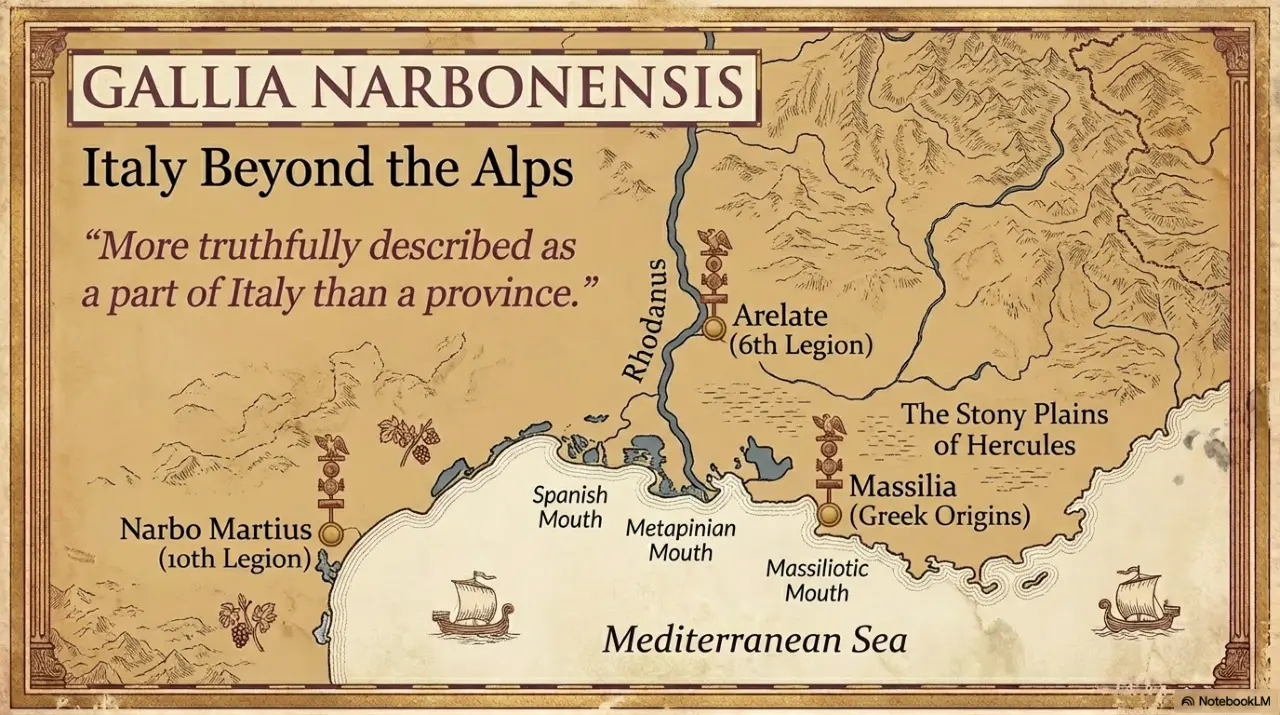
Gallia Narbonensis Roman conquest in 120sBCE; Augustan provincial form · Southern Gaul
The Mediterranean corridor between Italy and Spain, anchored by Narbo and later prominent cities such as Nemausus and Arelate; separate from Caesar's later northern conquests.
Read the province in Provinces →
See also Narbo Martius , Arelate
Read further Pleiades ancient place gazetteer · Strabo Geography Books III-IV · Roman Inscriptions of Britain Gallia Narbonensis authority record
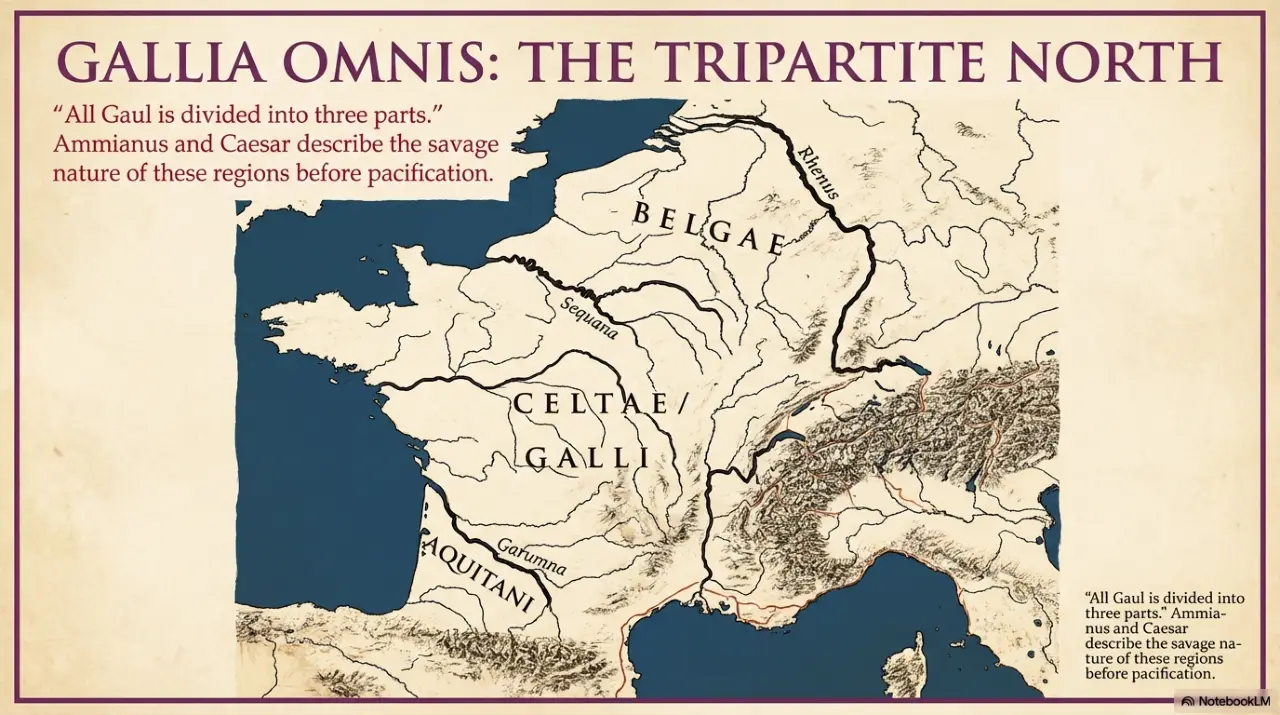
Slide NotebookLM GALLIA NARBONENSIS Italy Beyond the Alps from Plinys Geographic Survey of Europe Gaul Republic and Empire · Western Europe
Broad regional designation rather than one unchanged province; distinguishes Cisalpine and Transalpine histories and later Narbonensis, Aquitania, Lugdunensis and Belgica.
See also Gallic War , Gallia Narbonensis , Gallia Aquitania , Gallia Lugdunensis , Gallia Belgica
In the volumes Book V · Chapter 7: Caesar in Gaul · Book I · Chapter 1: The Gallic Catastrophe · Book II · Chapter 3: The Interwar Years: Mercenary War, Sardinia, Gauls, and Illyrians · Book II · Chapter 4: The Coming of Hannibal: From Saguntum to the Alps · Book VIII · Chapter 2: The House of Constantine at War: Persia, Strasbourg, and the Road to Ctesiphon · Book VIII · Chapter 4: Stilicho, the Rhine Crossing, and the Sack of Rome · Book III · Chapter 4: Hasdrubal's March and the Metaurus · Book V · Proem and 17 more
Germania Inferior Military district before formal province in later 1st century CE · Lower Rhine
Lower Rhine frontier province centered on Colonia Claudia Ara Agrippinensium, with major bases at Bonn and Xanten and close auxiliary-recruitment ties to local peoples.
Read the province in Provinces →
See also Batavi , Colonia Agrippinensis , Legio I Minervia
Read further Pleiades ancient place gazetteer · Strabo Geography Books III-IV · Notitia Dignitatum compilation study
Germania Superior Military district before formal province in later 1st century CE · Upper Rhine
Upper Rhine province with headquarters at Mogontiacum; legionary bases and the limes linked river defense, roads and lands east of the Rhine.
Read the province in Provinces →
See also Mogontiacum , Legio XXII Primigenia , Chatti
Read further Pleiades ancient place gazetteer · Strabo Geography Books III-IV · Notitia Dignitatum compilation study
Hellespontus Late Roman province · Northwestern Anatolia
Province around the Asian shores of the Hellespont and Propontis, including Cyzicus; vital crossings connected Anatolian and European routes.
Read the province in Provinces →
See also Constantinople
Read further Pleiades ancient place gazetteer · Strabo Geography Books XI-XIV · Notitia Dignitatum compilation study
Hispania Republic and Empire · Iberian peninsula
Broad geographical name covering changing provinces, cities and peoples; Roman conquest proceeded unevenly from the Punic-war footholds to the northern campaigns.
See also Hispania Citerior , Hispania Ulterior , Hispania Tarraconensis , Baetica , Lusitania
Hispania Citerior 197 BCE to Augustan reorganization · Iberia
The nearer Spanish command developed from Rome's northeastern conquests. Its expanding jurisdiction should not be confused with a fixed modern eastern-Spain boundary.
Read the province in Provinces →
See also Second Punic War , Celtiberians , Tarraco
In the volumes Book III · Chapter 5: Ilipa and the End of Carthaginian Spain · Book IV · Chapter 4: The Spanish Wars: Lusitanians, Celtiberians, Viriathus, and Numantia
Read further Pleiades ancient place gazetteer · Strabo Geography Books III-IV
Hispania Tarraconensis Augustan settlement; later subdivided · Iberia
Large imperial province covering much of northern and eastern Iberia, with Tarraco as administrative center and major military and mining districts.
Read the province in Provinces →
See also Tarraco , Legio VII Gemina
In the volumes Book VI · Chapter 7: The Year of the Four Emperors and the Batavian Revolt
Read further Pleiades ancient place gazetteer · Strabo Geography Books III-IV · Notitia Dignitatum compilation study
Hispania Ulterior 197 BCE to Augustan reorganization · Iberia
The farther Spanish province incorporated southern and western territories through prolonged wars and negotiated submission; Augustus divided its jurisdiction between Baetica and Lusitania.
Read the province in Provinces →
See also Lusitanians , Viriathus , Julius Caesar
In the volumes Book III · Chapter 5: Ilipa and the End of Carthaginian Spain · Book IV · Chapter 4: The Spanish Wars: Lusitanians, Celtiberians, Viriathus, and Numantia
Read further Pleiades ancient place gazetteer · Strabo Geography Books III-IV
Illyricum Republican command; reorganized into Dalmatian and Pannonian jurisdictions in early Empire · Adriatic and western Balkans
A changing Roman command and later broader administrative/geographical name, not a permanently bounded nation; the great revolt of 6-9 CE reshaped its military governance.
Read the province in Provinces →
See also Great Illyrian Revolt , Dalmatia , Pannonia
In the volumes Book V · Chapter 7: Caesar in Gaul · Book VI · Chapter 1: The Augustan Conquests · Book VII · Chapter 8: The Recovery, 260–284 · Book VII · Epilogue: The World-State at 284
Read further Pleiades ancient place gazetteer · Strabo Geography Books V-VII
Insulae province Late 3rd century CE onward · Aegean islands
Late Roman island province centered on Rhodes, illustrating how maritime communication could define an administrative network distinct from mainland provinces.
See also Diocletian
Read further Pleiades ancient place gazetteer · Strabo Geography Books V-VII · Notitia Dignitatum compilation study
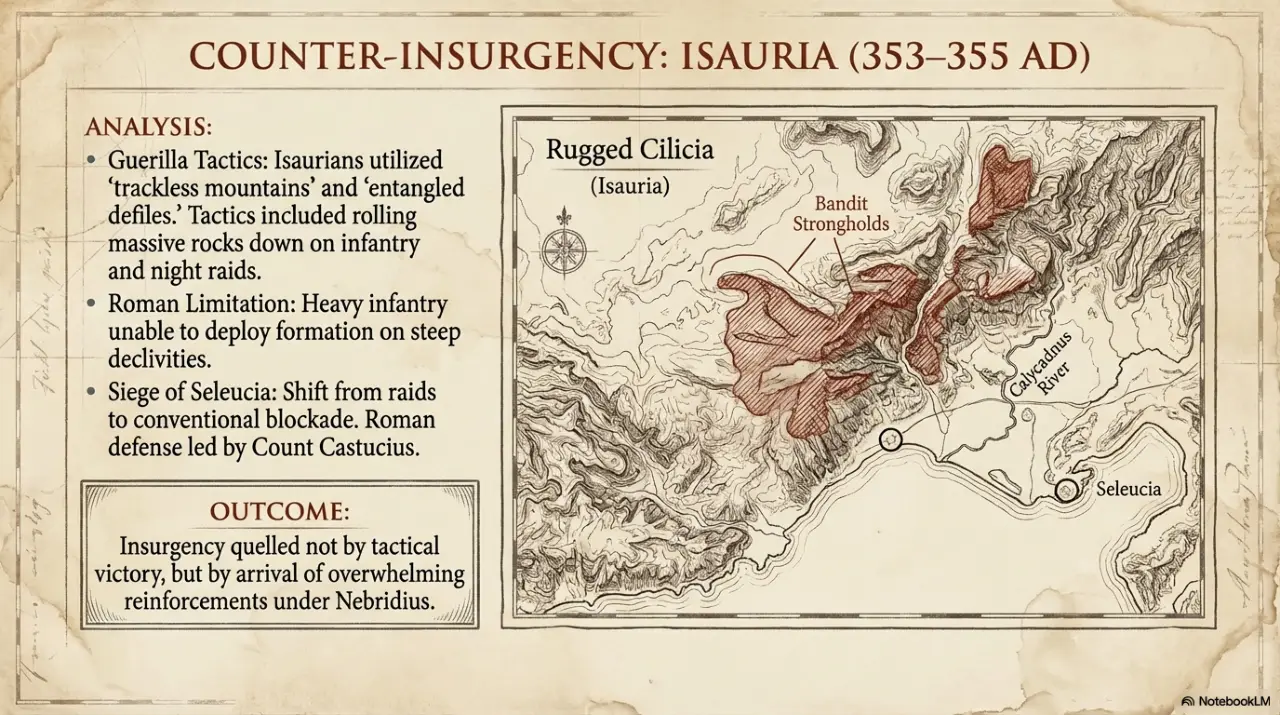
Isauria Older region; separate late Roman province · Southern Anatolian mountains
Mountain region and late Roman province whose communities supplied soldiers and emperors; ancient claims of endemic brigandage reflect administrative and literary viewpoints.
Read the province in Provinces →
See also Zeno , Cilicia
Read further Pleiades ancient place gazetteer · Strabo Geography Books XI-XIV · Notitia Dignitatum compilation study
Slide NotebookLM Counter-insurgency: Isauria (353-355 AD) from Ammianus Marcellinus Operational Data Italia Republic to late Empire; provincial subdivision in late 3rd century CE · Italy
The citizen heartland was not an ordinary overseas province under the Republic or early Principate. Late Roman reforms divided it into governed provincial units.
Read the province in Provinces →
See also Rome , Roman citizenship , Diocletian
Read further Pleiades ancient place gazetteer · Strabo Geography Books V-VII · Notitia Dignitatum compilation study
Judaea Direct rule 6-41 CE and from 44 CE; renamed Syria Palaestina after Bar Kokhba revolt · Southern Levant
Territory alternated between client monarchy and direct administration. War transformed Jerusalem, taxation and provincial government; Jewish society was never reducible to rebellion alone.
Read the province in Provinces →
See also Jerusalem
In the volumes Book V · Chapter 6: Pompey and the Conquest of the East · Book VI · Chapter 6: The Jewish War · Book VI · Chapter 7: The Year of the Four Emperors and the Batavian Revolt · Book VII · Chapter 2: The Eastern Maximum and the Great Recoil · Book VII · Chapter 3: Hadrian: The Wall, the Army in Being, and the Last Jewish War
Read further Pleiades ancient place gazetteer · Strabo Geography Books XVI-XVII
Late Roman British provinces contested Early 4th century CE onward; details partly uncertain · Britain
Britannia Prima, Secunda, Maxima Caesariensis and Flavia Caesariensis appear in late lists; Valentia was added later. Exact borders and some capitals remain disputed.
See also Notitia Dignitatum , Londinium
Read further Pleiades ancient place gazetteer · Strabo Geography Books III-IV · Notitia Dignitatum compilation study
Lusitania Augustan reorganization from 27 BCE · Western Iberia
Province centered on Emerita Augusta, including much of modern Portugal south of the Douro and neighboring Spanish territory; provincial and ethnic Lusitanian boundaries differed.
Read the province in Provinces →
See also Lusitanians , Augustus
Read further Pleiades ancient place gazetteer · Strabo Geography Books III-IV · Spanish Ministry of Culture Lusitania historical gazetteer
Lycia 43 CE annexation; later combined with Pamphylia · Southwestern Anatolia
Region with a prominent federation of cities before direct Roman annexation. Its civic traditions continued within changing provincial arrangements.
Read the province in Provinces →
See also Claudius
Read further Pleiades ancient place gazetteer · Strabo Geography Books XI-XIV · Notitia Dignitatum compilation study
Lycia et Pamphylia Combined province from Flavian period, commonly dated 74 CE · Southern Anatolia
Joined Lycian and Pamphylian districts, with ports, fertile plains and inland connections; later late Roman reforms separated their administrations.
Read the province in Provinces →
See also Vespasian , Lycia
Read further Pleiades ancient place gazetteer · Strabo Geography Books XI-XIV
Macedonia Roman province from 148 BCE · Southern Balkans
Province formed after the fourth Macedonian conflict; its jurisdiction initially included extensive neighboring territories and changed as Greece and Balkan provinces were reorganized.
Read the province in Provinces →
See also Thessalonica , Via Egnatia
In the volumes Book IV · Chapter 3: The Third Macedonian War: Aemilius Paullus and Pydna · Book IV · Chapter 1: The Second Macedonian War: Flamininus and Cynoscephalae · Book IV · Proem · Book IV · Epilogue: Rome in 146 BC · Book V · Chapter 8: The Civil Wars and the End of the Republic · Book VI · Chapter 2: The Great Illyrian Revolt and the Varian Disaster · Book III · Chapter 7: Zama and the Peace · Book III · Epilogue: Rome in 201 BC and 4 more
Read further Pleiades ancient place gazetteer · Strabo Geography Books V-VII
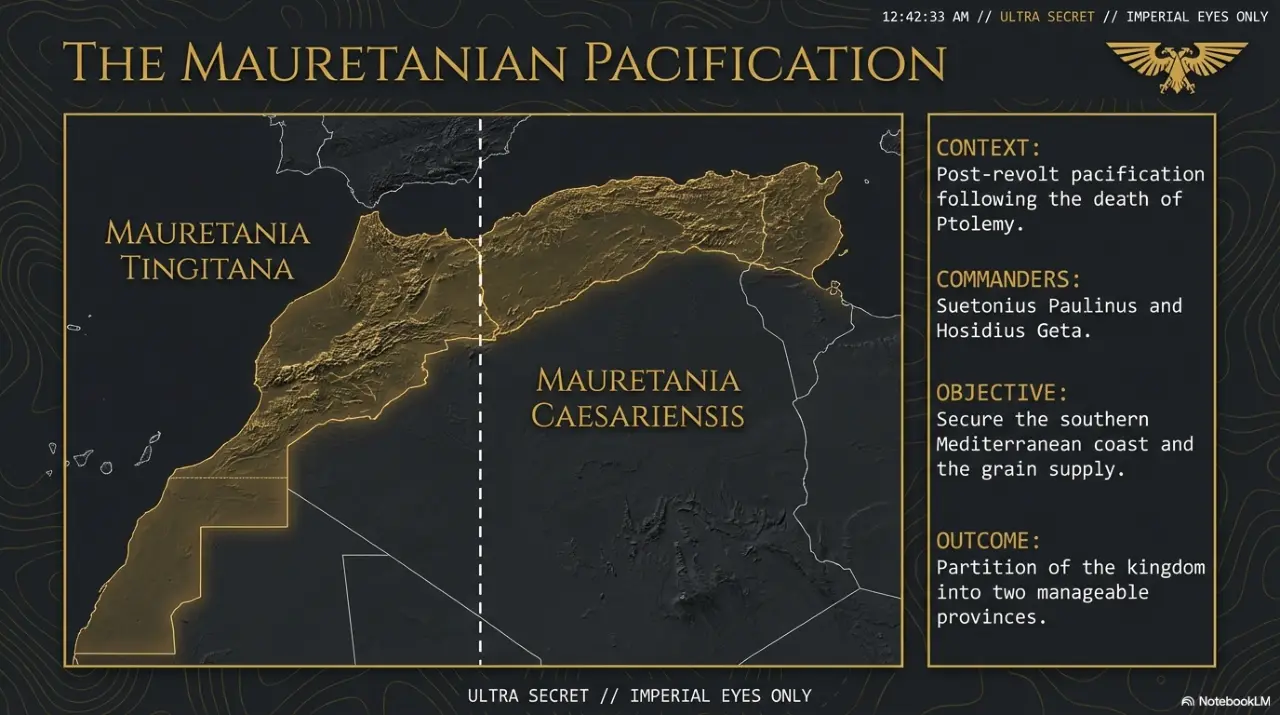
Mauretania Caesariensis Early 40sCE onward · Central and western Algeria
Eastern half of annexed Mauretanian royal territory, named for Caesarea; coastal cities and inland defense depended on negotiated relations as well as force.
Read the province in Provinces →
See also Mauretanians , Claudius
Read further Pleiades ancient place gazetteer · Strabo Geography Books V-VII
Mauretania Tingitana Early 40sCE onward · Northern Morocco
Western Mauretanian province around Tingis and Volubilis, linked across the straits to Iberia; Roman control was geographically limited and variable.
Read the province in Provinces →
See also Baetica
Read further Pleiades ancient place gazetteer · Strabo Geography Books V-VII
Slide NotebookLM The Mauretanian Pacification from Claudius War Expansion And Empire Mesopotamia Short-lived Trajanic province 116-117 CE; northern province from 198 CE · Upper Tigris and Euphrates
Roman provincial identity applied to different territories in the second and third centuries; Severan Mesopotamia centered on northern strongholds, not all modern Iraq.
Read the province in Provinces →
See also Septimius Severus , Nisibis , Parthians
In the volumes Book VII · Chapter 2: The Eastern Maximum and the Great Recoil · Book VII · Chapter 6: The Auction and the Severan Reconstruction · Book IV · Chapter 2: The Syrian War: Antiochus, Thermopylae, and Magnesia · Book VII · Chapter 3: Hadrian: The Wall, the Army in Being, and the Last Jewish War · Book VII · Chapter 5: Marcus Aurelius: The Double Emergency · Book VII · Chapter 7: The Breaking, 235–260 · Book VIII · Chapter 1: The Tetrarchy and the Wars of Constantine
Read further Pleiades ancient place gazetteer · Strabo Geography Books V-VII
Moesia Early 1st century CE; divided 86 CE · Lower Danube
Danubian command and province controlling communications between the Balkans and Black Sea; a major base for operations north of the river.
Read the province in Provinces →
See also Danube , Moesia Superior
In the volumes Book VI · Chapter 8: The Flavian Consolidation and the Wars of Domitian · Book VII · Chapter 1: The Dacian Wars of Trajan
Read further Pleiades ancient place gazetteer · Strabo Geography Books V-VII
Moesia Inferior 86 CE to late Roman reforms · Lower Danube and western Black Sea
Lower Moesian province included Novae, Durostorum and coastal communities; military and river transport tied its settlements to the frontier.
Read the province in Provinces →
See also Legio I Italica , Legio XI Claudia
Read further Pleiades ancient place gazetteer · Strabo Geography Books V-VII · Notitia Dignitatum compilation study
Moesia Superior 86 CE to late Roman reforms · Central Balkans
Upper Moesian province with Viminacium and Singidunum, guarding approaches to the central Danube and supplying troops for Dacian and eastern wars.
Read the province in Provinces →
See also Legio VII Claudia , Dacia
Read further Pleiades ancient place gazetteer · Strabo Geography Books V-VII · Notitia Dignitatum compilation study
Nile Ptolemaic, Roman and Late Roman periods · Egypt
Floodplain and river transport system underpinning Egyptian agriculture, revenue and urban provisioning; harvests and shipping connected local communities with imperial demands.
See also Aegyptus , Alexandria , Grain supply
In the volumes Book VI · Chapter 1: The Augustan Conquests · Book V · Proem · Book VI · Proem
Noricum Incorporated under Augustus; province by Claudian period · Eastern Alps
Former kingdom whose mining, iron production and Alpine roads were incorporated into Roman government; later divided into inland and riverine provinces.
Read the province in Provinces →
See also Legio II Italica
Read further Pleiades ancient place gazetteer · Strabo Geography Books V-VII
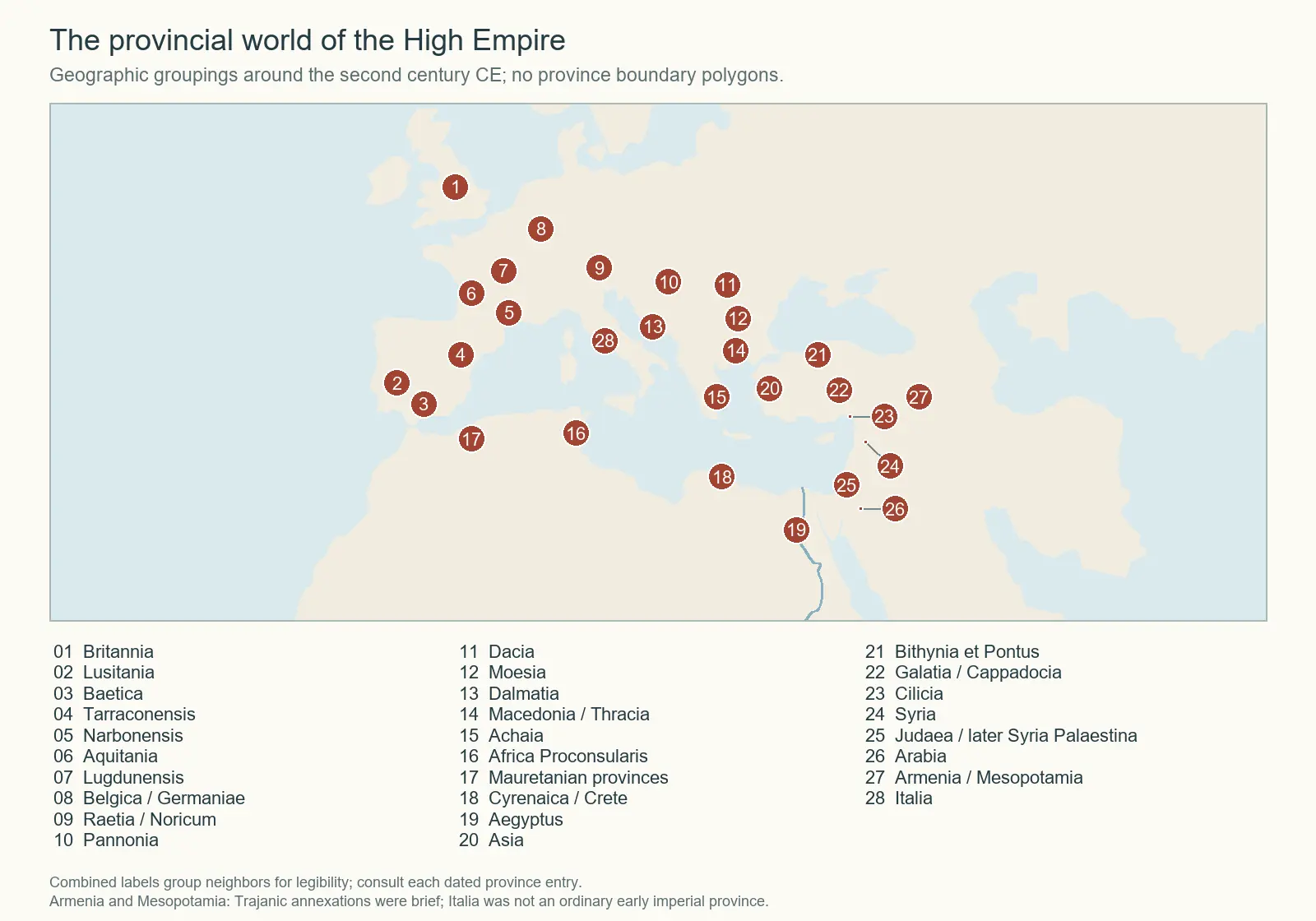
Map Index Archive The Provincial World of the High Empire Numidia Military district before separate province around 200 CE · Northeastern Algeria
Region of former Numidian kingdoms and the African army, with III Augusta at Lambaesis; military administration and civil provincial boundaries evolved separately.
Read the province in Provinces →
See also Legio III Augusta , Numidians
In the volumes Book V · Chapter 2: The Jugurthine War and the Rise of Marius · Book III · Chapter 7: Zama and the Peace · Book IV · Chapter 5: The Third Punic War and the Destruction of Carthage · Book V · Proem · Book V · Chapter 8: The Civil Wars and the End of the Republic · Book VI · Chapter 3: Germanicus and the Julio-Claudian North · Book VII · Chapter 3: Hadrian: The Wall, the Army in Being, and the Last Jewish War · Book VIII · Chapter 5: Aetius, Africa, and Attila
Read further Pleiades ancient place gazetteer · Strabo Geography Books V-VII
Osrhoene Client kingdom centered on Edessa; annexation in early 3rd century CE · Upper Mesopotamia
A frontier kingdom became a Roman administrative unit while Edessa's royal status and provincial arrangements changed; precise phases must be dated separately.
Read the province in Provinces →
See also Edessa , Mesopotamia
In the volumes Book VII · Chapter 3: Hadrian: The Wall, the Army in Being, and the Last Jewish War · Book VII · Chapter 6: The Auction and the Severan Reconstruction
Read further Pleiades ancient place gazetteer · Strabo Geography Books XVI-XVII
Palaestina Tertia Fourth century CE onward · Southern Palestine Sinai and former southern Arabia province
Late Roman province also called Palaestina Salutaris, linking Petra, the Negev and Sinai; distinct from the surviving northern province of Arabia.
Read the province in Provinces →
See also Petra , Arabia Petraea
Read further Pleiades ancient place gazetteer · Strabo Geography Books XVI-XVII · Roman province of Arabia Zbigniew Fiema
Pannonia Early 1st century CE; divided early 2nd century · Middle Danube
Military province around the middle Danube and Sava corridor, important for frontier garrisons, recruitment and the rise of military emperors.
Read the province in Provinces →
See also Carnuntum , Aquincum , Marcomannic Wars
In the volumes Book VI · Chapter 3: Germanicus and the Julio-Claudian North · Book VI · Chapter 8: The Flavian Consolidation and the Wars of Domitian · Book VI · Chapter 4: Britain: Conquest and Revolt · Book VII · Chapter 6: The Auction and the Severan Reconstruction · Book VII · Epilogue: The World-State at 284 · Book VIII · Chapter 2: The House of Constantine at War: Persia, Strasbourg, and the Road to Ctesiphon · Book VIII · Chapter 5: Aetius, Africa, and Attila
Read further Pleiades ancient place gazetteer · Strabo Geography Books V-VII
Pannonia Inferior Early 2nd century CE to late Roman subdivision · Middle Danube
Lower Pannonian province centered on Aquincum, facing Sarmatian neighbors across the river; later divided again into smaller jurisdictions.
Read the province in Provinces →
See also Aquincum , Iazyges , Legio II Adiutrix
Read further Pleiades ancient place gazetteer · Strabo Geography Books V-VII · Notitia Dignitatum compilation study
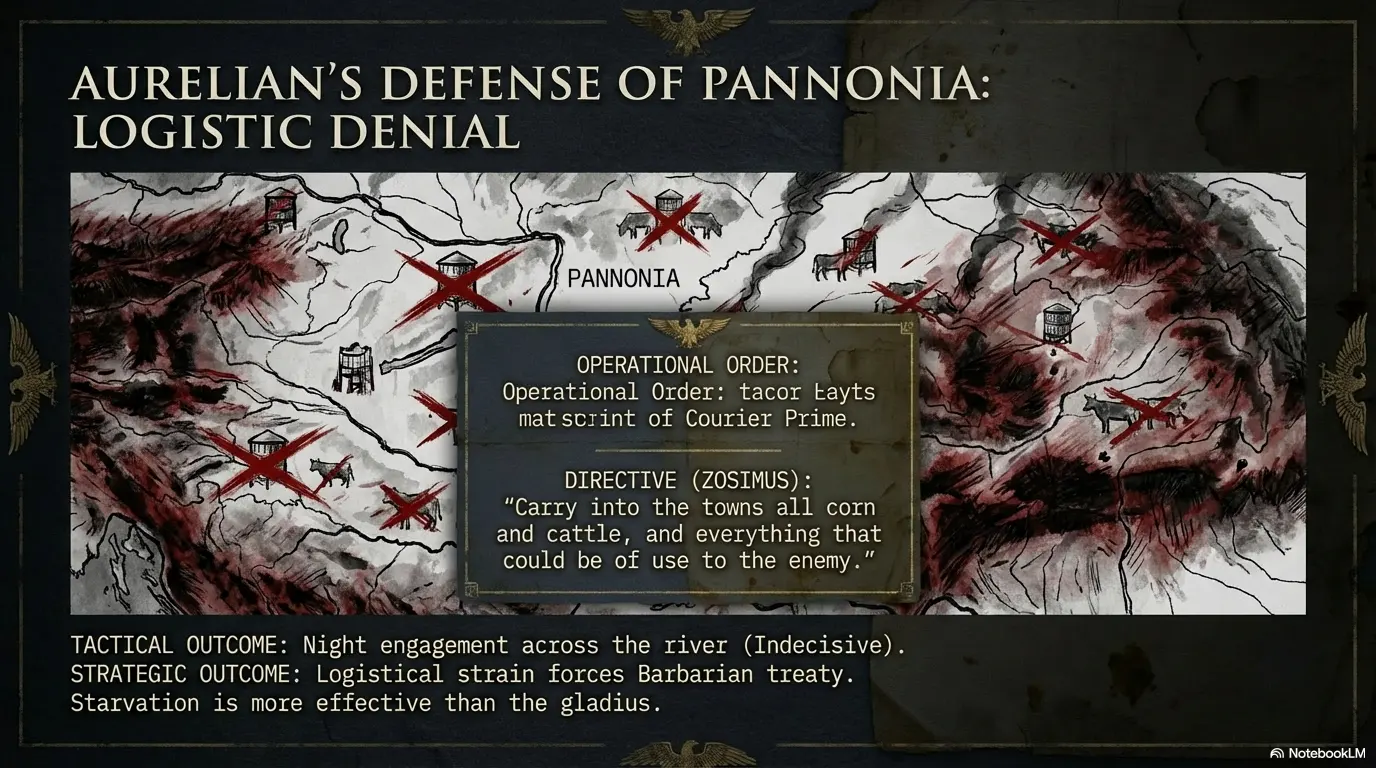
Slide NotebookLM Defense of Pannonia from The Dominate Forged in Iron Pannonia Superior Early 2nd century CE to late Roman subdivision · Middle Danube
Upper Pannonian province with major legionary bases, including Carnuntum; command changes reflected the strategic importance of the Danubian army.
Read the province in Provinces →
See also Carnuntum , Legio XIV Gemina , Septimius Severus
Read further Pleiades ancient place gazetteer · Strabo Geography Books V-VII · Notitia Dignitatum compilation study
Phrygia Pacatiana and Salutaris Late Roman provincial divisions · Western and central Anatolia
Two administrative subdivisions of the older Phrygian region; their Christian episcopal geography became important while older local identities persisted.
See also Asia
Read further Pleiades ancient place gazetteer · Strabo Geography Books XI-XIV · Notitia Dignitatum compilation study
Pisidia Older region; late 3rd-century provincial form · Southwestern Anatolian interior
Highland region with cities and military colonies, reorganized as a late Roman province; regional labels and provincial borders did not always align.
Read the province in Provinces →
See also Galatia , Augustus
Read further Pleiades ancient place gazetteer · Strabo Geography Books XI-XIV · Notitia Dignitatum compilation study
Pontus Polemoniacus Client territory annexed in 64 CE · Southern Black Sea
Eastern Pontic royal lands entered direct Roman administration under Nero; later provincial boundaries changed repeatedly along the Black Sea frontier.
Read the province in Provinces →
See also Nero , Pontus , Trapezus
Read further Pleiades ancient place gazetteer · Strabo Geography Books V-VII
Praetorian prefectures and dioceses Principally 4th-6th centuries CE · Empire-wide
Higher administrative groupings coordinated multiple provinces. Their names and extent changed, and civil prefectures should not be confused with the early imperial Praetorian Guard.
See also Diocletian , Constantine I , Notitia Dignitatum
Read further Pleiades ancient place gazetteer · Strabo Geography Books V-VII · Notitia Dignitatum compilation study
Praevalitana Late 3rd century CE onward · Southeastern Adriatic
Late Roman province carved from southern Dalmatian territory, with coastal and inland routes; its name is administrative rather than a timeless ethnic designation.
Read the province in Provinces →
See also Dalmatia , Diocletian
Read further Pleiades ancient place gazetteer · Strabo Geography Books V-VII · Notitia Dignitatum compilation study
Raetia Conquered 15 BCE; provincial government in early Empire · Alpine and upper Danubian region
Alpine approaches and the upper Danube linked Italy with northern frontiers; later divided into Raetia Prima and Secunda. Legion III Italica anchored its second-century defense.
Read the province in Provinces →
See also Legio III Italica
Read further Pleiades ancient place gazetteer · Strabo Geography Books V-VII
Rhine Republic and Empire · Western and northern Europe
River corridor associated with military bases, transport and shifting frontier arrangements; neither an impermeable ethnic border nor a permanent limit in every period.
See also Germania Superior , Germania Inferior , Batavian revolt
In the volumes Book VI · Chapter 1: The Augustan Conquests · Book VI · Chapter 3: Germanicus and the Julio-Claudian North · Book V · Chapter 7: Caesar in Gaul · Book VI · Chapter 2: The Great Illyrian Revolt and the Varian Disaster · Book VI · Chapter 8: The Flavian Consolidation and the Wars of Domitian · Book VI · Chapter 7: The Year of the Four Emperors and the Batavian Revolt · Book VIII · Chapter 2: The House of Constantine at War: Persia, Strasbourg, and the Road to Ctesiphon · Book VIII · Chapter 5: Aetius, Africa, and Attila and 14 more
Sardinia et Corsica Annexed 238/237 BCE; province from 227 BCE · Western Mediterranean
Island province acquired after the First Punic War; coastal cities, grain and mines coexisted with difficult interior control. Its administrative relationship later varied.
Read the province in Provinces →
See also Carthage
Read further Pleiades ancient place gazetteer · Strabo Geography Books V-VII
Scythia Minor Late 3rd century CE onward · Dobruja and Danube delta
Late Roman province separated from Lower Moesia, with Tomis and delta defenses; its name does not mean that all inhabitants were ethnic Scythians.
Read the province in Provinces →
See also Legio I Iovia , Legio II Herculia
Read further Pleiades ancient place gazetteer · Strabo Geography Books V-VII · Notitia Dignitatum compilation study
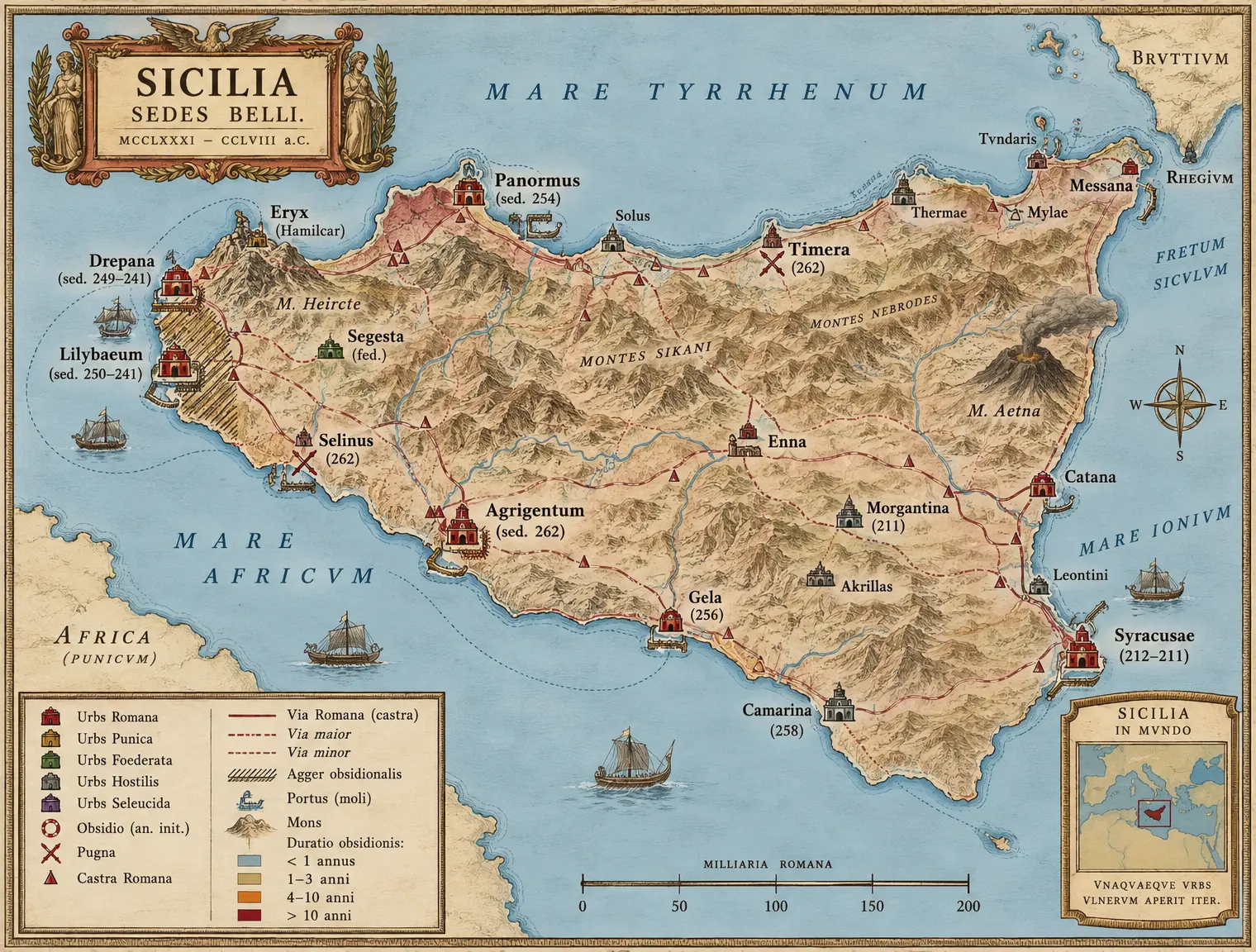
Sicilia Roman control from 241 BCE; regular praetorian province from 227 BCE · Central Mediterranean
Rome's first overseas territorial province, enlarged after Syracuse fell. Grain taxation and maritime routes made it central to Republican imperial government.
Read the province in Provinces →
See also First Punic War , Syracuse , Cicero
In the volumes Book II · Chapter 2: The First Punic War: Africa, Sicily, and the Long Resolution
Read further Pleiades ancient place gazetteer · Strabo Geography Books V-VII
Map Book II SICILIA — The Island War Spania contested Justinianic conquests in 550sCE to loss in 620sCE · Southern Iberian coast
Limited eastern Roman possessions recovered from Visigothic territory, not restoration of Roman government over all Iberia; their precise limits remain uncertain.
Read the province in Provinces →
See also Justinian I , Visigoths , Carthago Nova
Read further Pleiades ancient place gazetteer · Strabo Geography Books V-VII
Syria Roman provincial settlement 64 BCE · Levant
Pompey's annexation of the Seleucid remnant produced a major eastern province centered on Antioch, with powerful armies, wealthy cities and diverse communities.
Read the province in Provinces →
See also Pompey , Antioch , Seleucid kingdom
In the volumes Book VI · Chapter 2: The Great Illyrian Revolt and the Varian Disaster · Book V · Chapter 6: Pompey and the Conquest of the East · Book V · Chapter 8: The Civil Wars and the End of the Republic · Book VI · Chapter 5: The Eastern Question: Corbulo, Armenia, and Parthia · Book VII · Chapter 5: Marcus Aurelius: The Double Emergency · Book II · Chapter 3: The Interwar Years: Mercenary War, Sardinia, Gauls, and Illyrians · Book III · Chapter 7: Zama and the Peace · Book IV · Proem and 11 more
Read further Pleiades ancient place gazetteer · Strabo Geography Books XVI-XVII
Syria Coele and Syria Phoenice Division in 194 CE onward · Northern and central Levant
Septimius Severus divided Syria after civil war, separating military and civic jurisdictions; later reforms produced further subdivisions.
Read the province in Provinces →
See also Septimius Severus , Antioch
Read further Pleiades ancient place gazetteer · Strabo Geography Books XVI-XVII
Syria Palaestina Second century CE onward; late Roman subdivisions · Southern Levant
Provincial name following the second-century revolts, later divided into Palaestina Prima, Secunda and Tertia; these administrative labels differ from modern state boundaries.
Read the province in Provinces →
See also Caesarea Maritima , Bar Kokhba revolt , Palaestina Tertia
In the volumes Book VII · Chapter 3: Hadrian: The Wall, the Army in Being, and the Last Jewish War
Read further Pleiades ancient place gazetteer · Strabo Geography Books XVI-XVII · Notitia Dignitatum compilation study
Thebaid Late Roman province and older regional name · Upper Egypt
Southern Nile region with agriculture, quarries, monasteries and frontier contacts; its late Roman provincial identity should be distinguished from the wider geographical term.
See also Legio III Diocletiana
In the volumes Book VI · Chapter 1: The Augustan Conquests
Read further Pleiades ancient place gazetteer · Strabo Geography Books XVI-XVII · Notitia Dignitatum compilation study
Thracia Annexed 46 CE · Eastern Balkans
Former client kingdom made a province under Claudius, later divided into several provinces; its routes linked the Danube, Aegean and Constantinople.
Read the province in Provinces →
See also Claudius , Thracians
Read further Pleiades ancient place gazetteer · Strabo Geography Books V-VII
Tres Daciae Second-century CE administrative grouping · Carpathian basin
Collective administration of Dacian subdivisions, commonly known as Apulensis, Porolissensis and Malvensis in the later second century; their borders and names changed.
See also Dacia , Legio XIII Gemina
Read further Pleiades ancient place gazetteer · Strabo Geography Books V-VII
Tripolitania Late 3rd century CE onward · Northwestern Libya
Province of the three great coastal cities and their hinterlands, connecting olive-growing districts, caravan routes and desert-frontier communities.
Read the province in Provinces →
See also Garamantes , Sabratha
In the volumes Book VIII · Chapter 6: The Dissolution
Read further Pleiades ancient place gazetteer · Strabo Geography Books XVI-XVII · Notitia Dignitatum compilation study
Cities, ports and frontier centres 89 Agrigentum Republic and Empire · Mediterranean and frontiers
Major Sicilian agricultural and urban center; its capture marked an important phase of the First Punic War.
See also Sicilia , First Punic War
Alexandria Hellenistic and Roman periods · Mediterranean and frontiers
Egyptian metropolis and great port; grain shipment administration scholarship and religious conflict made it central to imperial politics.
See also Aegyptus , Annona , Serapis
In the volumes Book V · Chapter 8: The Civil Wars and the End of the Republic · Book I · Chapter 5: The Pyrrhic War · Book V · Epilogue: Rome in 31/30 BC · Book VI · Chapter 6: The Jewish War · Book VII · Chapter 2: The Eastern Maximum and the Great Recoil · Book VII · Chapter 6: The Auction and the Severan Reconstruction · Book VIII · Chapter 1: The Tetrarchy and the Wars of Constantine
Amida Late Empire · Mediterranean and frontiers
Fortified upper-Tigris city, modern Diyarbakir; major sieges exposed the strategic and civilian pressures of Roman-Persian war.
See also Siege of Amida
In the volumes Book VIII · Proem · Book VIII · Chapter 2: The House of Constantine at War: Persia, Strasbourg, and the Road to Ctesiphon
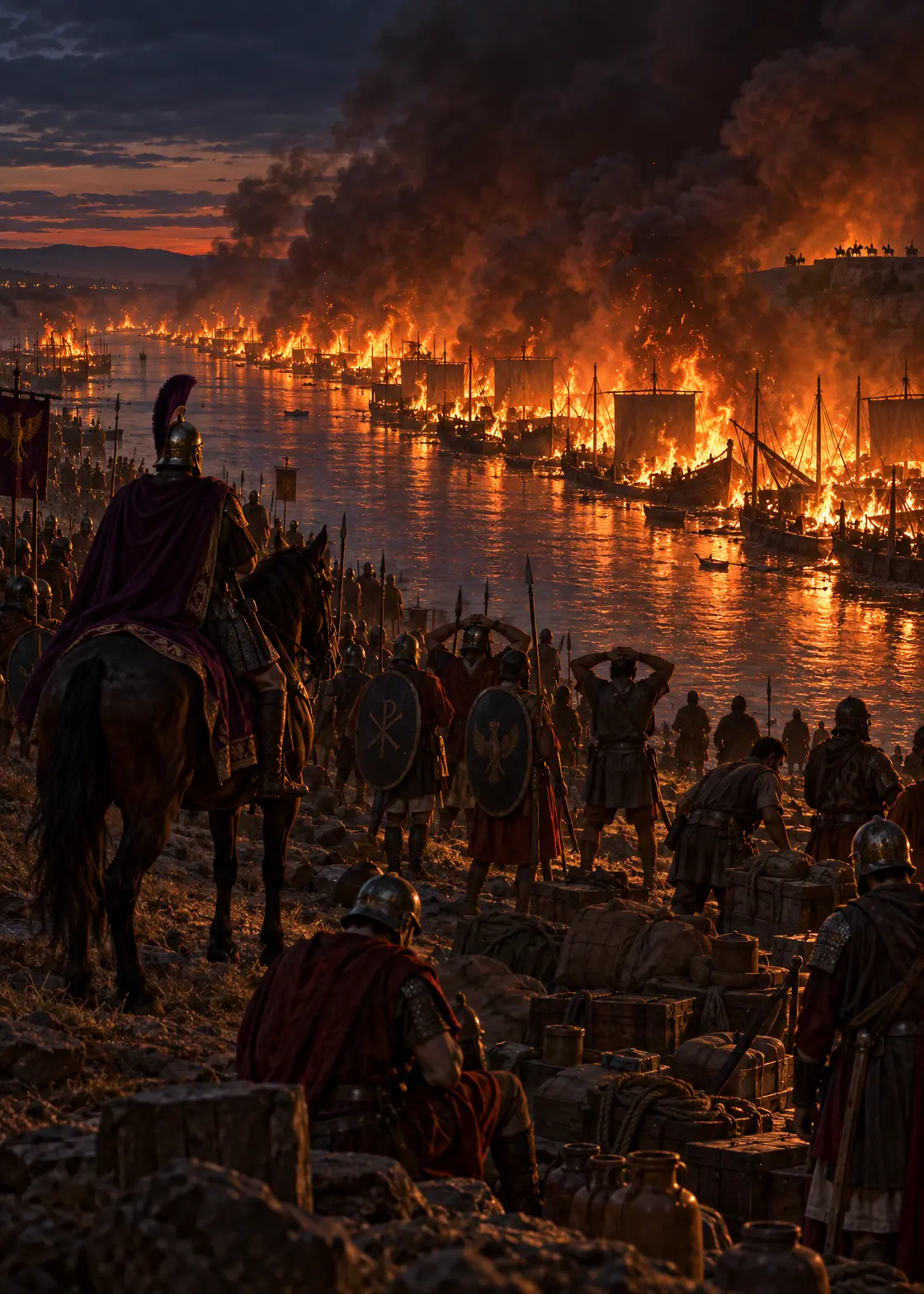
Plate Book VIII The fleet burning on the Tigris — June 363 Antinoopolis from 130 CE · Mediterranean and frontiers
Hadrian's Egyptian foundation commemorating Antinous; a useful case of imperial patronage Greek civic identity and local administration.
See also Hadrian , Antinous , Aegyptus
Antioch Hellenistic and Roman periods · Mediterranean and frontiers
Syrian metropolis and eastern military/court base; commerce Christian institutions and imperial residence shaped its prominence.
See also Syria , Julian
In the volumes Book I · Epilogue: Rome in 264 BC · Book III · Chapter 7: Zama and the Peace · Book IV · Chapter 2: The Syrian War: Antiochus, Thermopylae, and Magnesia · Book VI · Chapter 3: Germanicus and the Julio-Claudian North · Book VII · Chapter 5: Marcus Aurelius: The Double Emergency · Book VII · Chapter 7: The Breaking, 235–260 · Book VII · Chapter 8: The Recovery, 260–284 · Book VIII · Chapter 3: Adrianople and the Gothic Settlement
Aquileia Republic and Late Empire · Mediterranean and frontiers
Northeastern Italian commercial and military gateway to the Alps and Balkans; siege resistance ended Maximinus's reign.
See also Maximinus Thrax
In the volumes Book VII · Chapter 5: Marcus Aurelius: The Double Emergency · Book VII · Chapter 7: The Breaking, 235–260 · Book VIII · Chapter 2: The House of Constantine at War: Persia, Strasbourg, and the Road to Ctesiphon · Book VIII · Chapter 5: Aetius, Africa, and Attila
Aquincum Empire · Mediterranean and frontiers
Danubian legionary and civilian center at modern Budapest; governor army and urban economy shared a frontier setting.
See also Pannonia Inferior , Legio II Adiutrix
Arelate Empire and Late Empire · Mediterranean and frontiers
Modern Arles, Rhone port and imperial/administrative center with important late-antique Christian connections.
See also Gaul , Constantine I
Ariminum Republic and Empire · Mediterranean and frontiers
Northern Adriatic colony at a strategic road junction near the boundary crossed by Caesar in 49 BCE.
In the volumes Book I · Chapter 6: The Consolidation of Italy · Book II · Chapter 5: The Year of Hannibal: Ticinus, Trebia, Trasimene, and the Fabian Strategy · Book I · Epilogue: Rome in 264 BC · Book II · Chapter 3: The Interwar Years: Mercenary War, Sardinia, Gauls, and Illyrians · Book VIII · Chapter 5: Aetius, Africa, and Attila
Artaxata Republic and Empire · Mediterranean and frontiers
Armenian royal capital whose control figured in Roman-Parthian rivalry; royal succession mattered as much as direct occupation.
See also Armenia
In the volumes Book VI · Chapter 5: The Eastern Question: Corbulo, Armenia, and Parthia · Book V · Chapter 6: Pompey and the Conquest of the East · Book VII · Chapter 5: Marcus Aurelius: The Double Emergency
Athens Republic and Empire · Mediterranean and frontiers
Greek city whose philosophical educational and sacred prestige survived political subordination; schools and patronage changed under imperial rule.
See also Achaia
In the volumes Book V · Chapter 5: Wars in the Shadow of the Settlement: Mithridates, Sertorius, Spartacus · Book IV · Chapter 1: The Second Macedonian War: Flamininus and Cynoscephalae · Book IV · Chapter 6: The Achaean War and the Sack of Corinth · Book VII · Proem · Book VII · Chapter 7: The Breaking, 235–260 · Book VII · Chapter 8: The Recovery, 260–284
Augusta Emerita from 25 BCE · Mediterranean and frontiers
Modern Merida, veteran colony and capital of Lusitania; monumental civic life reveals imperial investment in Iberia.
See also Lusitania , Veterans
Augusta Treverorum Empire and Late Empire · Mediterranean and frontiers
Modern Trier, a northern imperial residence and administrative/mint center, illustrating government beyond Rome.
See also Gallia Belgica , Constantine I
Augusta Vindelicorum Empire · Mediterranean and frontiers
Modern Augsburg, a Raetian administrative and communications center linking Alpine and Danubian regions.
See also Raetia
Bononia Republic and Empire · Mediterranean and frontiers
Modern Bologna; colony and road node on the Via Aemilia, linking northern Italy's settlements and agricultural hinterlands.
In the volumes Book I · Chapter 1: The Gallic Catastrophe · Book V · Chapter 8: The Civil Wars and the End of the Republic
Bostra Empire and Late Empire · Mediterranean and frontiers
Capital of the province Arabia and base associated with III Cyrenaica; linked military administration and regional trade.
See also Arabia Petraea , Legio III Cyrenaica
Brundisium Republic and Empire · Mediterranean and frontiers
Adriatic departure port linking Italian roads to Balkan sea routes; repeatedly important in civil-war movements.
See also Via Appia , Dyrrachium
In the volumes Book V · Chapter 8: The Civil Wars and the End of the Republic · Book I · Chapter 3: The Long Samnite War · Book I · Chapter 6: The Consolidation of Italy · Book V · Chapter 4: The Social War and the Civil Wars of Marius and Sulla · Book V · Chapter 6: Pompey and the Conquest of the East · Book V · Epilogue: Rome in 31/30 BC
Burdigala Empire and Late Empire · Mediterranean and frontiers
Modern Bordeaux, an Aquitanian commercial and educational center, associated with Ausonius's literary world.
See also Gallia Aquitania
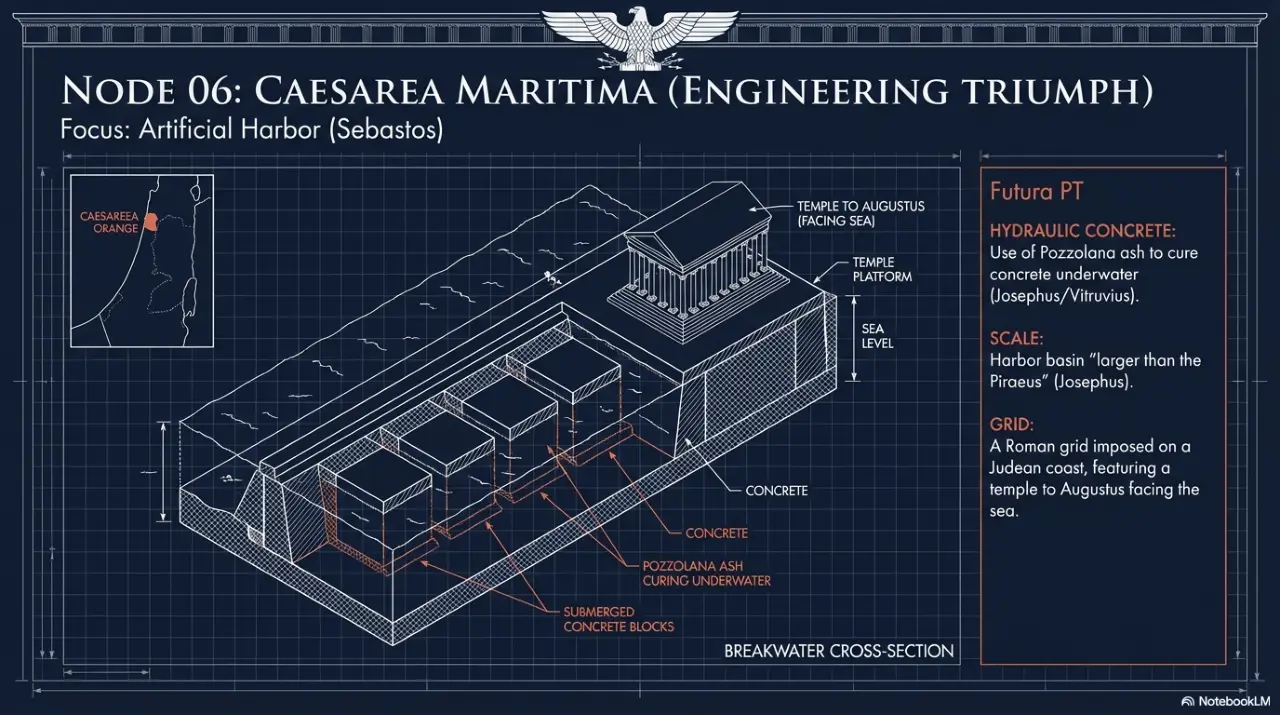
Caesarea Maritima Empire · Mediterranean and frontiers
Herodian port and Roman administrative center in Judaea; civic communal and imperial claims intersected in a major coastal city.
See also Judaea
Slide NotebookLM Node 06: Caesarea Maritima (Engineering Triumph) from Anatomy of the Empire: Twelve Cities, c. AD 150 Camulodunum first century CE onward · Britain
Modern Colchester, former royal center and Roman veteran colony whose imperial temple became a focus during Boudica's revolt.
See also Boudica , Imperial cult
In the volumes Book VI · Chapter 4: Britain: Conquest and Revolt
Read further Pleiades ancient place gazetteer
Capua Republic and Empire · Mediterranean and frontiers
Wealthy Campanian center with a contested relationship to Rome; Hannibalic allegiance and gladiatorial connections made it historically prominent.
See also Second Punic War , Spartacus
In the volumes Book III · Chapter 2: The Sicilian Theater: Syracuse and the Recovery of the Italian South · Book I · Chapter 3: The Long Samnite War · Book III · Chapter 1: The Aftermath of Cannae: Recovery, Capua, and the Macedonian Threat · Book I · Chapter 2: The Latin Twilight and the Samnite Dawn · Book V · Chapter 5: Wars in the Shadow of the Settlement: Mithridates, Sertorius, Spartacus · Book II · Chapter 6: Cannae · Book III · Chapter 7: Zama and the Peace · Book V · Proem
Carnuntum Empire · Mediterranean and frontiers
Danubian legionary and provincial center associated with trade military acclamations and the tetrarchic conference of 308.
See also Pannonia , Septimius Severus , Tetrarchy
In the volumes Book VII · Chapter 5: Marcus Aurelius: The Double Emergency
Carthage Punic and Roman periods · Mediterranean and frontiers
Punic metropolis destroyed in 146 BCE and later refounded as a Roman colony; became a major African administrative commercial and Christian center.
See also Third Punic War , Africa Proconsularis
In the volumes Book III · Chapter 7: Zama and the Peace · Book IV · Chapter 5: The Third Punic War and the Destruction of Carthage · Book III · Chapter 6: Scipio in Africa · Book II · Chapter 2: The First Punic War: Africa, Sicily, and the Long Resolution · Book II · Chapter 3: The Interwar Years: Mercenary War, Sardinia, Gauls, and Illyrians · Book I · Chapter 6: The Consolidation of Italy · Book II · Chapter 1: The First Punic War: Opening and the Birth of Roman Sea-Power · Book I · Chapter 5: The Pyrrhic War and 28 more
Carthago Nova Punic and Roman periods · Mediterranean and frontiers
Modern Cartagena, strategic southeastern Iberian harbor near mining resources; captured by Scipio in 209 BCE.
See also Second Punic War
In the volumes Book III · Chapter 3: The Spanish Theater: The Elder Scipios and the Rise of the Younger · Book III · Chapter 4: Hasdrubal's March and the Metaurus · Book II · Chapter 4: The Coming of Hannibal: From Saguntum to the Alps · Book II · Chapter 3: The Interwar Years: Mercenary War, Sardinia, Gauls, and Illyrians · Book III · Chapter 5: Ilipa and the End of Carthaginian Spain · Book III · Chapter 6: Scipio in Africa
Chalcedon Empire and Late Empire · Mediterranean and frontiers
City across the Bosporus from Constantinople; the council of 451 became a defining point in Christian doctrinal division.
See also Council of Chalcedon , Marcian
In the volumes Book V · Chapter 6: Pompey and the Conquest of the East
Colonia Agrippinensis Empire · Mediterranean and frontiers
Modern Cologne, a colony and Lower German center; major events included Agrippina's patronage and Postumus's rising.
See also Germania Inferior , Postumus
Constantinople 330-1453 CE · Mediterranean and frontiers
Refounded from Byzantium as an imperial capital; straits defenses administration and a great court sustained eastern Roman government.
See also Constantine I
In the volumes Book VIII · Chapter 6: The Dissolution · Book VIII · Epilogue: The Audit of the Eight Hundred Years · Book VIII · Chapter 5: Aetius, Africa, and Attila · Book VII · Epilogue: The World-State at 284 · Book VIII · Proem · Book VIII · Chapter 1: The Tetrarchy and the Wars of Constantine · Book VIII · Chapter 2: The House of Constantine at War: Persia, Strasbourg, and the Road to Ctesiphon · Book VIII · Chapter 4: Stilicho, the Rhine Crossing, and the Sack of Rome
Corduba Republic and Empire · Mediterranean and frontiers
Modern Cordoba, leading Baetican city linked to provincial elites and the Senecan literary family.
See also Baetica
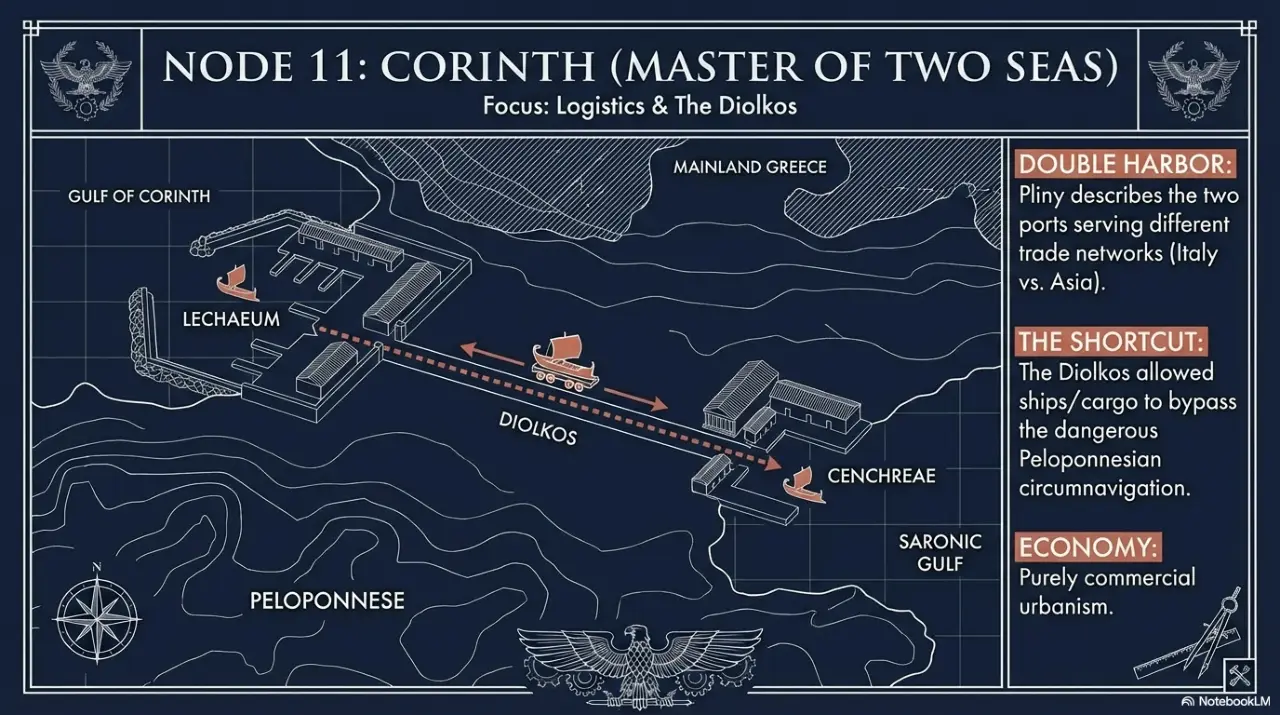
Corinth Republic and Empire · Mediterranean and frontiers
Destroyed in 146 BCE and refounded as a Roman colony; isthmian location sustained trade provincial administration and religious diversity.
See also Achaia , Achaean War
Slide NotebookLM Node 11: Corinth (Master of Two Seas) from Anatomy of the Empire: Twelve Cities, c. AD 150 Cremona Republic and Empire · Mediterranean and frontiers
Po-valley colony associated with the battles of 69 CE; its destruction exposed the civilian costs of imperial civil war.
See also Year of the Four Emperors
In the volumes Book VI · Chapter 7: The Year of the Four Emperors and the Batavian Revolt · Book II · Chapter 5: The Year of Hannibal: Ticinus, Trebia, Trasimene, and the Fabian Strategy · Book II · Chapter 3: The Interwar Years: Mercenary War, Sardinia, Gauls, and Illyrians · Book VI · Epilogue: The World-State at 96 · Book VIII · Chapter 4: Stilicho, the Rhine Crossing, and the Sack of Rome
Ctesiphon Parthian and Sasanian periods · Mediterranean and frontiers
Royal center near the Tigris, repeatedly targeted by Roman expeditions; its capture did not automatically mean Persia's lasting subjugation.
See also Parthians , Sasanians , Julian
In the volumes Book VII · Chapter 2: The Eastern Maximum and the Great Recoil · Book VI · Epilogue: The World-State at 96 · Book VII · Chapter 5: Marcus Aurelius: The Double Emergency · Book VII · Chapter 6: The Auction and the Severan Reconstruction · Book VII · Chapter 8: The Recovery, 260–284 · Book VII · Epilogue: The World-State at 284 · Book VIII · Proem
Cyrene Hellenistic and Roman periods · Mediterranean and frontiers
Greek city in eastern Libya, center of a distinctive regional economy and religious culture, later paired administratively with Crete.
In the volumes Book VII · Chapter 2: The Eastern Maximum and the Great Recoil · Book I · Epilogue: Rome in 264 BC · Book V · Chapter 8: The Civil Wars and the End of the Republic
Damascus Republic and Empire · Mediterranean and frontiers
Ancient Syrian city integrated into Roman provincial networks; a crossroads of commerce local cult and later Christian tradition.
See also Syria
In the volumes Book VII · Chapter 1: The Dacian Wars of Trajan
Dara from early sixth century CE · Mediterranean and frontiers
Anastasian fortress-city near the Sasanian frontier, developed in the early sixth century as a Roman military counterweight to nearby Nisibis.
See also Anastasius I , Nisibis
Read further Columbia Mapping Mesopotamian Monuments: Dara
Deva Empire · Britain
Modern Chester, legionary fortress with an associated civilian economy and regional military role.
See also Legio XX Valeria Victrix , Britannia
Read further Pleiades ancient place gazetteer
Dura-Europos Parthian and Roman periods · Mediterranean and frontiers
Euphrates frontier town with military religious and domestic evidence, including synagogue and Christian building paintings; captured by Sasanians.
See also Sasanians
In the volumes Book VII · Proem · Book VII · Chapter 5: Marcus Aurelius: The Double Emergency · Book VII · Chapter 7: The Breaking, 235–260
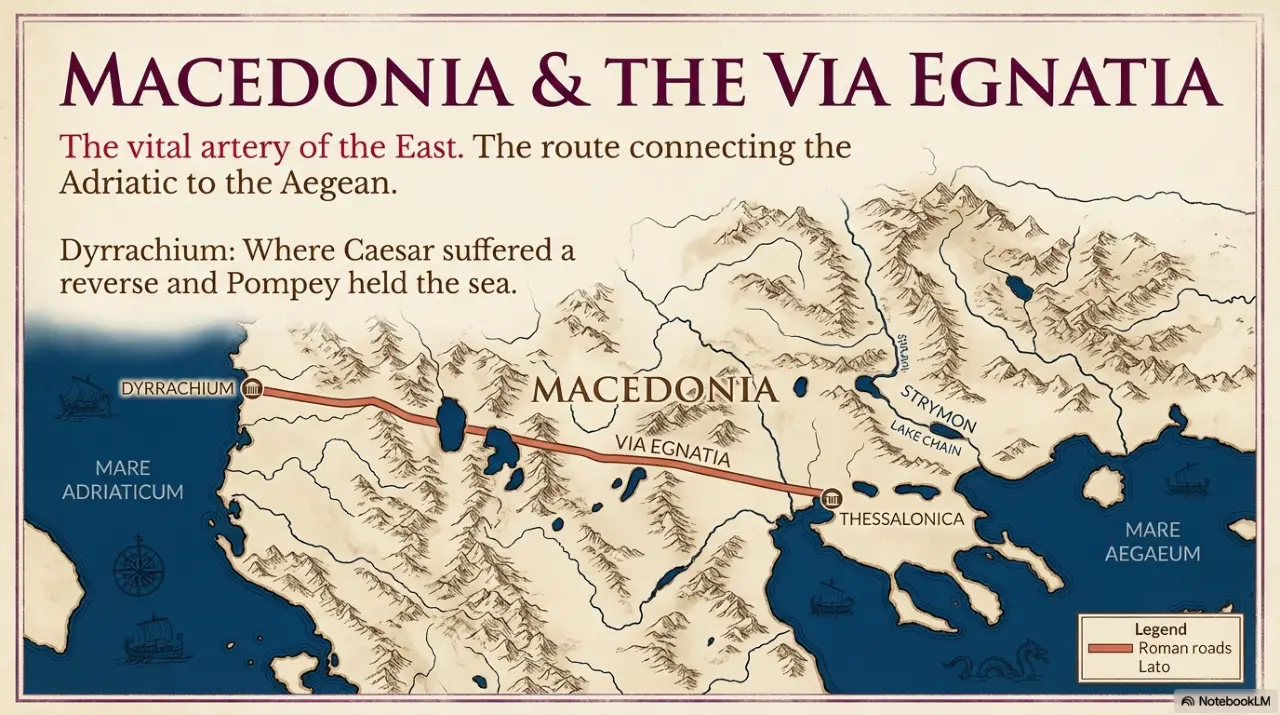
Dyrrachium Republic and Empire · Mediterranean and frontiers
Adriatic port at the western end of the Via Egnatia, linking Italy to Balkan military and commercial routes.
See also Via Egnatia
In the volumes Book V · Chapter 2: The Jugurthine War and the Rise of Marius · Book V · Chapter 8: The Civil Wars and the End of the Republic
Slide NotebookLM Macedonia & the Via Egnatia from Orbis Terrarum Caesaris: The World of the Three Dynasts Eboracum from 71 CE · Britain
Modern York, legionary and political center where Severus died and Constantine was acclaimed.
See also Legio VI Victrix , Constantine I
Read further Pleiades ancient place gazetteer
Edessa Empire and Late Empire · Mediterranean and frontiers
Osrhoenian royal and later Roman city; diplomacy Christian literature and repeated eastern warfare made it a key frontier center.
See also Osrhoene , Valerian , Shapur I
In the volumes Book VII · Chapter 2: The Eastern Maximum and the Great Recoil · Book VII · Chapter 7: The Breaking, 235–260
Ephesus Republic and Empire · Mediterranean and frontiers
Major Asian port and provincial center with Artemis's sanctuary; trade civic patronage and Christian disputes shaped its history.
See also Asia , Council of Ephesus
In the volumes Book VII · Chapter 7: The Breaking, 235–260
Gades Republic and Empire · Mediterranean and frontiers
Modern Cadiz, old Phoenician foundation with Atlantic and Mediterranean commerce and a celebrated Melqart/Hercules sanctuary.
See also Hercules , Baetica
In the volumes Book III · Chapter 5: Ilipa and the End of Carthaginian Spain · Book III · Chapter 3: The Spanish Theater: The Elder Scipios and the Rise of the Younger
Hatra Empire · Mediterranean and frontiers
Fortified Mesopotamian city and regional kingdom combining local cult and eastern political connections; resisted Roman sieges before Sasanian conquest.
See also Parthians , Sasanians
In the volumes Book VII · Chapter 2: The Eastern Maximum and the Great Recoil · Book VII · Chapter 6: The Auction and the Severan Reconstruction · Book VII · Chapter 7: The Breaking, 235–260
Herculaneum Republic-79 CE · Mediterranean and frontiers
Vesuvian town preserved in distinctive volcanic conditions; houses wooden objects and papyri illuminate elite and ordinary life.
See also Vesuvius eruption , Slavery
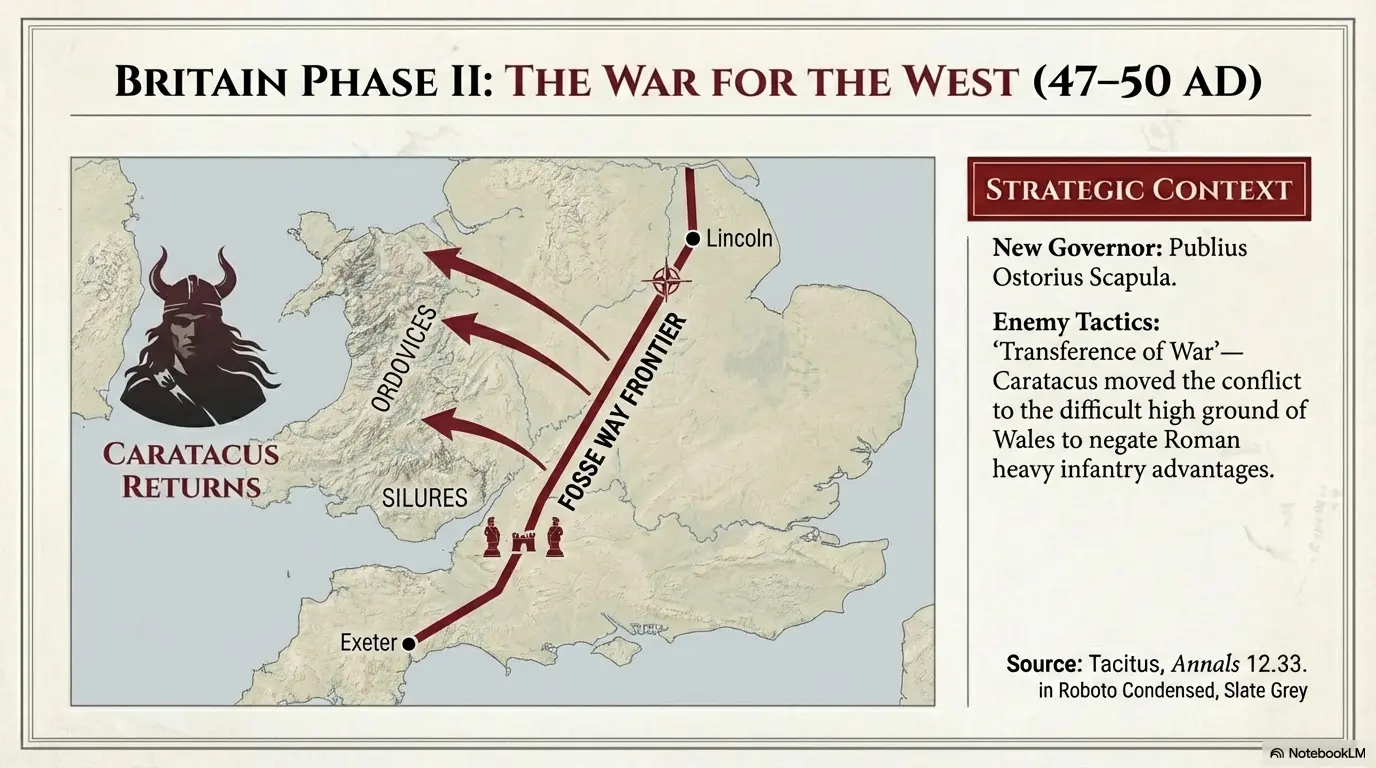
Isca Augusta Empire · Britain
Caerleon in Wales, base of II Augusta; distinct from Isca Dumnoniorum at Exeter.
See also Legio II Augusta , Britannia
Read further Pleiades ancient place gazetteer
Slide NotebookLM Britain Phase II the War for the West (47-50 AD) from Claudius War and Empire Jerusalem Republic and Empire · Mediterranean and frontiers
Judean religious and political center; temple destruction in 70 CE and refoundation as Aelia Capitolina altered its institutions and sacred geography.
See also Judaea
In the volumes Book VI · Chapter 6: The Jewish War · Book VII · Chapter 3: Hadrian: The Wall, the Army in Being, and the Last Jewish War · Book V · Chapter 6: Pompey and the Conquest of the East · Book VI · Proem · Book VI · Chapter 2: The Great Illyrian Revolt and the Varian Disaster · Book VI · Chapter 8: The Flavian Consolidation and the Wars of Domitian · Book VI · Epilogue: The World-State at 96 · Book VIII · Proem and 2 more
Leptis Magna Empire · Mediterranean and frontiers
Prosperous North-African city enriched by agriculture and commerce; Septimius Severus's birthplace received exceptional monumental patronage.
See also Septimius Severus , Tripolitania
Londinium from first century CE · Britain
Commercial river-crossing center and later provincial administrative hub; Boudica's revolt destroyed its early settlement.
See also Britannia , Boudica
In the volumes Book VI · Chapter 4: Britain: Conquest and Revolt
Read further Pleiades ancient place gazetteer
Lugdunum from 43 BCE · Mediterranean and frontiers
Modern Lyon, colonial foundation and Gallic administrative religious and commercial hub, near the confluence of Rhone and Saone.
See also Imperial cult , Gaul , Clodius Albinus
In the volumes Book VII · Chapter 6: The Auction and the Severan Reconstruction
Massalia Greek and Roman periods · Mediterranean and frontiers
Modern Marseille, a Greek maritime city allied with Rome before civil-war defeat; retained a distinctive cultural identity.
See also Caesar , Gallia Narbonensis
In the volumes Book II · Chapter 5: The Year of Hannibal: Ticinus, Trebia, Trasimene, and the Fabian Strategy
Mediolanum Empire and Late Empire · Mediterranean and frontiers
Modern Milan; northern Italian road and court center important to fourth-century imperial government and Christian politics.
See also Constantine I
In the volumes Book VII · Chapter 8: The Recovery, 260–284 · Book II · Chapter 3: The Interwar Years: Mercenary War, Sardinia, Gauls, and Illyrians · Book I · Chapter 1: The Gallic Catastrophe · Book VIII · Chapter 1: The Tetrarchy and the Wars of Constantine
Memphis Roman Egypt · Mediterranean and frontiers
Old Egyptian royal and cult center remaining important under Roman rule, especially through enduring local religious institutions.
See also Aegyptus
Messana Republic and Empire · Mediterranean and frontiers
Strait-side city whose Mamertine crisis helped trigger the First Punic War; controlled a crucial crossing between Italy and Sicily.
See also First Punic War
In the volumes Book I · Chapter 6: The Consolidation of Italy · Book II · Chapter 1: The First Punic War: Opening and the Birth of Roman Sea-Power · Book I · Epilogue: Rome in 264 BC · Book II · Proem · Book I · Proem
Mogontiacum Empire · Mediterranean and frontiers
Modern Mainz, a major Rhine military base and provincial administrative center whose garrisons repeatedly affected imperial politics.
See also Germania Superior , Rhine frontier
In the volumes Book VI · Chapter 1: The Augustan Conquests · Book VII · Chapter 6: The Auction and the Severan Reconstruction · Book VIII · Chapter 4: Stilicho, the Rhine Crossing, and the Sack of Rome
Naissus Empire and Late Empire · Mediterranean and frontiers
Balkan road junction, Constantine's birthplace and a name associated with Gothic warfare; battle dating and attribution need care.
See also Constantine I
In the volumes Book VII · Chapter 8: The Recovery, 260–284 · Book VIII · Chapter 3: Adrianople and the Gothic Settlement
Narbo Martius from 118 BCE · Mediterranean and frontiers
Roman colony in southern Gaul, important to roads administration and Mediterranean trade.
See also Gallia Narbonensis
Neapolis Republic and Empire · Mediterranean and frontiers
Greek-founded city in Campania whose language education and urban culture remained conspicuous under Roman rule.
See also Puteoli
In the volumes Book I · Chapter 3: The Long Samnite War
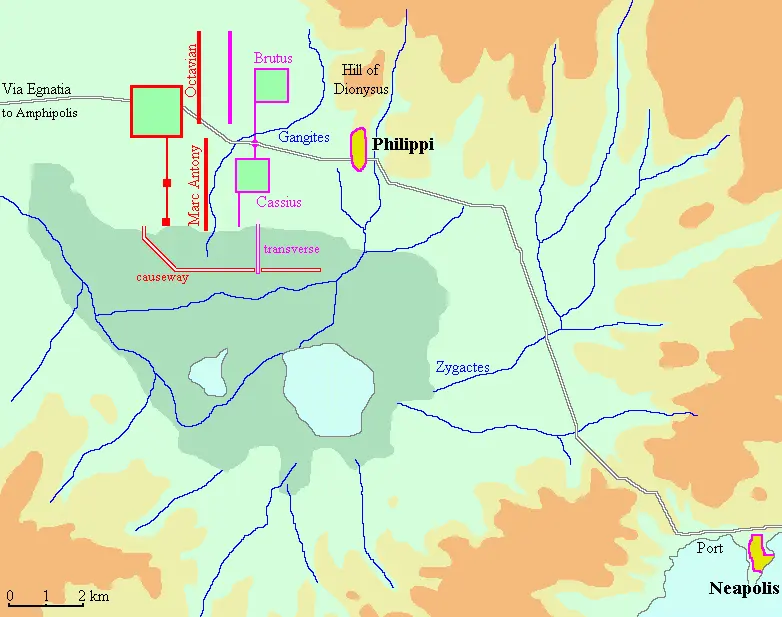
Battle plan Provinces Philippi, 42 BCE: civil war within a provincial landscape Nicaea Empire and Late Empire · Mediterranean and frontiers
Bithynian city famous for the council of 325; later a Byzantine successor capital after 1204, a different historical setting.
In the volumes Book IV · Chapter 1: The Second Macedonian War: Flamininus and Cynoscephalae
Nicomedia Empire and Late Empire · Mediterranean and frontiers
Bithynian city serving as a major eastern residence under Diocletian and his successors before Constantinople's predominance.
See also Diocletian , Bithynia et Pontus
In the volumes Book VIII · Chapter 1: The Tetrarchy and the Wars of Constantine · Book VII · Chapter 8: The Recovery, 260–284 · Book VII · Epilogue: The World-State at 284 · Book VIII · Proem
Nicopolis in Epirus Founded after Actium, 31 BCE · Mediterranean and frontiers
Augustus's foundation commemorating Actium; a planned victory-city whose population and prestige reshaped its surrounding region.
See also Actium , Augustus
Read further Nicopolis Archaeological Museum: foundation and victory monument
Nisibis Empire and Late Empire · Mediterranean and frontiers
Strategic Mesopotamian city contested with Persia; its surrender in 363 shifted the frontier and displaced its Roman inhabitants.
See also Jovian , Mesopotamia , Sasanians
In the volumes Book VII · Chapter 2: The Eastern Maximum and the Great Recoil · Book VIII · Chapter 2: The House of Constantine at War: Persia, Strasbourg, and the Road to Ctesiphon · Book VII · Chapter 6: The Auction and the Severan Reconstruction · Book VIII · Chapter 1: The Tetrarchy and the Wars of Constantine · Book VII · Chapter 5: Marcus Aurelius: The Double Emergency
Olisipo Empire · Mediterranean and frontiers
Modern Lisbon, a Lusitanian Atlantic port connected to regional production and maritime exchange.
See also Lusitania
Ostia Republic and Empire · Mediterranean and frontiers
Tiber-mouth town and port linking Rome with Mediterranean commerce; warehouses mills associations and housing reveal economic and social change.
See also Portus , Annona , Rome
In the volumes Book V · Chapter 6: Pompey and the Conquest of the East
Read further Grain and Bread in Ancient Ostia archaeological park · Ancient Ostia history and urban development archaeological park
Oxyrhynchus Roman and Late Roman Egypt · Mediterranean and frontiers
Provincial city whose papyri preserve taxation contracts petitions literature and everyday relationships across legal and religious change.
See also Papyri , Aegyptus
In the volumes Book VII · Chapter 2: The Eastern Maximum and the Great Recoil
Palmyra Empire · Mediterranean and frontiers
Syrian oasis city connecting caravan networks; Odaenathus and Zenobia built a powerful regional regime during imperial crisis.
See also Zenobia , Odaenathus
In the volumes Book VII · Chapter 8: The Recovery, 260–284 · Book VII · Chapter 7: The Breaking, 235–260
Panormus Republic and Empire · Mediterranean and frontiers
Modern Palermo; north-Sicilian harbor contested during the First Punic War and integrated into Rome's island network.
See also First Punic War , Sicilia
In the volumes Book II · Chapter 2: The First Punic War: Africa, Sicily, and the Long Resolution · Book II · Chapter 1: The First Punic War: Opening and the Birth of Roman Sea-Power
Pergamum Hellenistic and Roman periods · Mediterranean and frontiers
Attalid capital transferred into Rome's Asian sphere; prominent through sanctuaries civic institutions and intellectual patronage.
See also Asia
In the volumes Book IV · Chapter 2: The Syrian War: Antiochus, Thermopylae, and Magnesia · Book IV · Chapter 1: The Second Macedonian War: Flamininus and Cynoscephalae · Book I · Epilogue: Rome in 264 BC · Book IV · Epilogue: Rome in 146 BC · Book V · Chapter 1: The Gracchan Crisis: The Return of Political Violence · Book V · Chapter 5: Wars in the Shadow of the Settlement: Mithridates, Sertorius, Spartacus · Book V · Chapter 8: The Civil Wars and the End of the Republic
Petra Nabataean and Roman periods · Mediterranean and frontiers
Nabataean capital and trading center incorporated into the empire with Arabia's annexation; local traditions continued under Roman government.
See also Nabataeans , Arabia Petraea
Philippi late Republic and Empire · Mediterranean and frontiers
Macedonian battle site and Roman veteran colony; civic status and the memory of 42 BCE shaped its imperial identity.
See also Colonia
Pompeii Republic-79 CE · Mediterranean and frontiers
Campanian town preserved by Vesuvius; shops houses graffiti shrines and political notices provide unusually detailed urban evidence.
See also Vesuvius eruption
Portus from first century CE · Mediterranean and frontiers
Artificial harbor complex expanded under Claudius and Trajan; large ships transferred cargo toward Rome through a connected port system.
See also Ostia , Trajan , Annona
In the volumes Book V · Chapter 8: The Civil Wars and the End of the Republic
Read further Grain and Bread in Ancient Ostia archaeological park · Ancient Ostia history and urban development archaeological park
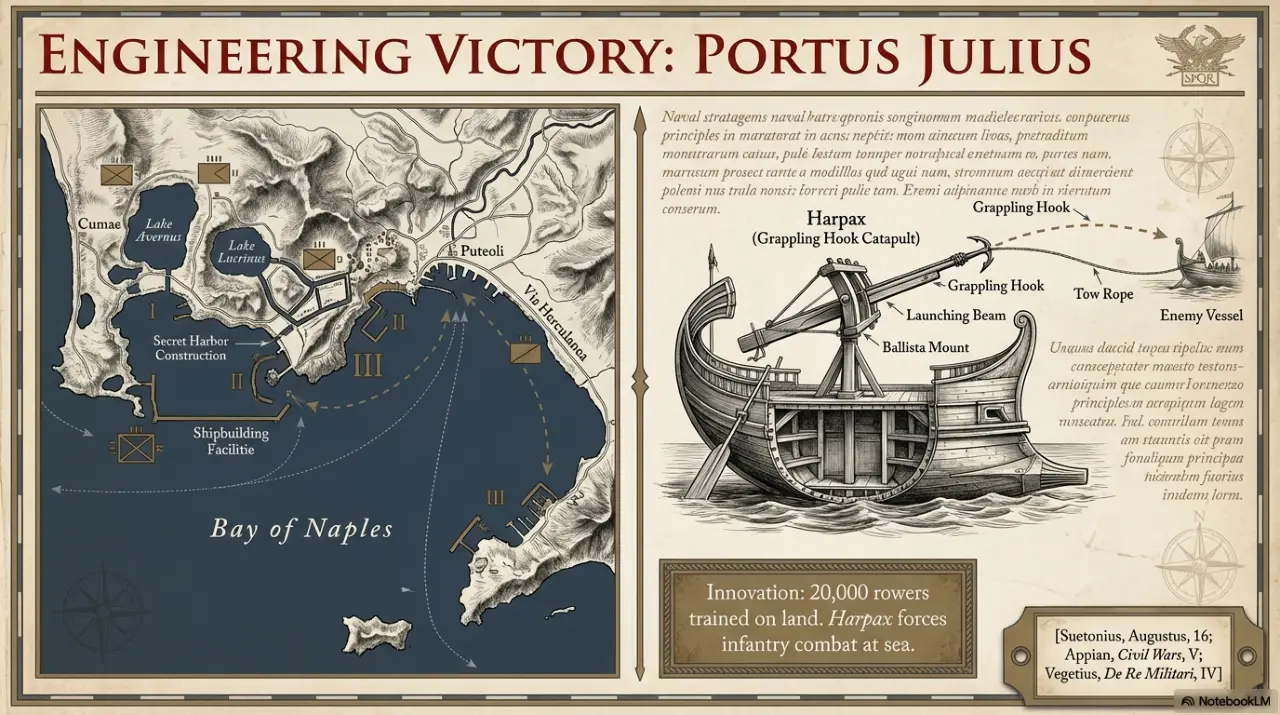
Puteoli Republic and Empire · Mediterranean and frontiers
Major Bay of Naples harbor and commercial center, especially important to Mediterranean exchange before Portus expanded.
See also Neapolis , Grain supply
Slide NotebookLM Engineering Victory: Portus Julius from Augustus: A Military Chronology, 44 BC – AD 14 Ravenna Empire and Late Empire · Mediterranean and frontiers
Adriatic fleet base and protected western court center from Honorius's reign; later Ostrogothic and Byzantine administration continued its importance.
See also Honorius , Theodoric , Exarchate
In the volumes Book VIII · Chapter 4: Stilicho, the Rhine Crossing, and the Sack of Rome · Book VIII · Chapter 5: Aetius, Africa, and Attila · Book V · Chapter 8: The Civil Wars and the End of the Republic · Book VI · Chapter 2: The Great Illyrian Revolt and the Varian Disaster · Book VI · Chapter 3: Germanicus and the Julio-Claudian North · Book VIII · Chapter 6: The Dissolution
Rome Republic and Empire · Mediterranean and frontiers
Political ritual and monumental center; its population depended on imported food water systems labor and a wide imperial revenue network.
See also Senate , Annona , Ostia
Sabratha Empire · Mediterranean and frontiers
Tripolitanian port participating in Mediterranean and inland trade; surviving monuments demonstrate provincial civic investment.
See also Tripolitania , Leptis Magna
Salona Empire and Late Empire · Mediterranean and frontiers
Dalmatian provincial center near Diocletian's retirement palace; commercial military and Christian networks tied it to the Adriatic.
See also Dalmatia , Diocletian
In the volumes Book VI · Chapter 2: The Great Illyrian Revolt and the Varian Disaster
Seleucia on the Tigris Hellenistic and Roman periods · Mediterranean and frontiers
Hellenistic metropolis opposite the later royal zone around Ctesiphon; commerce and repeated warfare shaped its relations with Roman armies.
See also Ctesiphon , Parthians
Sirmium Empire and Late Empire · Mediterranean and frontiers
Pannonian city and imperial residence controlling Balkan routes; an important center in fourth-century military and religious politics.
See also Pannonia , Tetrarchy
In the volumes Book VII · Chapter 5: Marcus Aurelius: The Double Emergency · Book VII · Chapter 8: The Recovery, 260–284 · Book VIII · Chapter 1: The Tetrarchy and the Wars of Constantine
Siscia Empire · Mediterranean and frontiers
Pannonian river and road center with mint and military significance, connecting Italian and Danubian regions.
See also Pannonia , Coinage
Smyrna Empire · Mediterranean and frontiers
Aegean commercial city distinguished by civic competition imperial cult and literary/religious networks.
See also Asia , Imperial cult
In the volumes Book IV · Chapter 2: The Syrian War: Antiochus, Thermopylae, and Magnesia
Syracuse Republic and Empire · Mediterranean and frontiers
Sicilian Greek metropolis captured by Rome in 212 BCE; later an important provincial city and temporary residence of Constans II.
See also Sicilia , Constans II
In the volumes Book III · Chapter 2: The Sicilian Theater: Syracuse and the Recovery of the Italian South · Book I · Chapter 5: The Pyrrhic War · Book II · Chapter 1: The First Punic War: Opening and the Birth of Roman Sea-Power · Book I · Chapter 6: The Consolidation of Italy · Book II · Epilogue: Rome in the Late Summer of 216 · Book II · Chapter 2: The First Punic War: Africa, Sicily, and the Long Resolution · Book III · Proem · Book III · Chapter 3: The Spanish Theater: The Elder Scipios and the Rise of the Younger and 2 more
Tarentum Republic and Empire · Mediterranean and frontiers
Greek city and strategic harbor in southern Italy; its conflict with Rome brought Pyrrhus into Italian warfare.
See also Pyrrhic War
In the volumes Book I · Chapter 5: The Pyrrhic War · Book I · Chapter 6: The Consolidation of Italy · Book III · Chapter 2: The Sicilian Theater: Syracuse and the Recovery of the Italian South · Book I · Chapter 3: The Long Samnite War · Book II · Chapter 6: Cannae · Book III · Chapter 1: The Aftermath of Cannae: Recovery, Capua, and the Macedonian Threat · Book III · Chapter 4: Hasdrubal's March and the Metaurus · Book III · Chapter 7: Zama and the Peace
Tarraco Republic and Empire · Mediterranean and frontiers
Modern Tarragona, military foundation and major administrative center of Roman Spain.
See also Hispania Tarraconensis , Augustus
In the volumes Book III · Chapter 3: The Spanish Theater: The Elder Scipios and the Rise of the Younger · Book VI · Chapter 1: The Augustan Conquests
Thessalonica Empire and Late Empire · Mediterranean and frontiers
Macedonian port and Balkan communications center; imperial residence and Christian institutions made it a regional hub.
See also Macedonia , Via Egnatia , Galerius
In the volumes Book VIII · Chapter 1: The Tetrarchy and the Wars of Constantine
Tigranocerta late Republic onward · Mediterranean and frontiers
Royal foundation associated with Tigranes II and Lucullus's campaign; exact identification and geography require care.
Slide NotebookLM TACTICAL ANALYSIS: THE BATTLE OF TIGRANOCERTA (69 B.C.) "If they are here as ambassadors, they are too many… from The Mithridatic Wars: A Military Chronology, 88–63 BC Trapezus Empire and Eastern continuation · Mediterranean and frontiers
Black Sea port and military supply center; later capital of the separate empire of Trebizond after 1204.
See also Pontus , Trebizond
Utica Republic and Empire · Mediterranean and frontiers
North-African port and early Roman provincial center; associated with Cato's death after Caesar's African victory.
See also Cato the Younger , Africa Proconsularis
In the volumes Book III · Chapter 6: Scipio in Africa · Book IV · Chapter 5: The Third Punic War and the Destruction of Carthage · Book V · Chapter 8: The Civil Wars and the End of the Republic · Book III · Chapter 7: Zama and the Peace · Book III · Epilogue: Rome in 201 BC
Verona Republic and Empire · Mediterranean and frontiers
Adige crossing and northern Italian communications center, repeatedly significant to military movement and control of approaches.
In the volumes Book VI · Chapter 7: The Year of the Four Emperors and the Batavian Revolt · Book VII · Chapter 7: The Breaking, 235–260 · Book VIII · Chapter 1: The Tetrarchy and the Wars of Constantine · Book VIII · Chapter 4: Stilicho, the Rhine Crossing, and the Sack of Rome
Vindobona Empire · Mediterranean and frontiers
Frontier military center at modern Vienna; the surrounding civilian settlement formed part of the Danubian supply network.
See also Danube frontier , Legio X Gemina
In the volumes Book VII · Chapter 5: Marcus Aurelius: The Double Emergency
Vindolanda Empire · Britain
Auxiliary fort south of Hadrian's Wall; writing tablets preserve personnel supply household and personal correspondence.
See also Auxilia , Hadrian's Wall
In the volumes Book VI · Epilogue: The World-State at 96 · Book VI · Proem · Book VII · Chapter 3: Hadrian: The Wall, the Army in Being, and the Last Jewish War
Read further Pleiades ancient place gazetteer