Provinces · Egypt and Roman Africa
RP-48 Mauretania Caesariensis
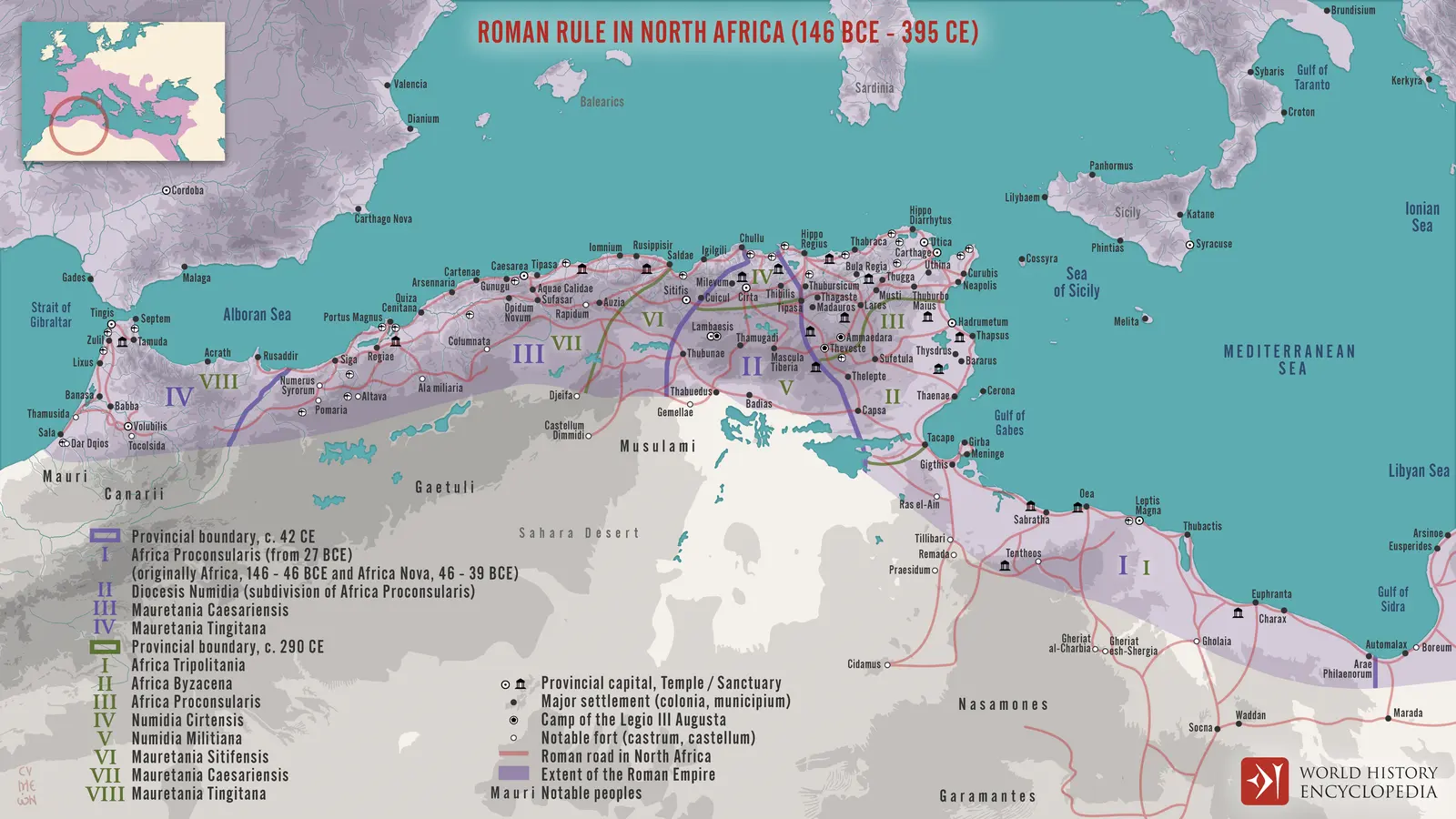
From royal Caesarea to the Roman province
Mauretania’s monarchy under Juba II and Ptolemy connected North African societies to Rome through dynastic alliance, elite culture, and royal government. Caesarea, formerly Iol, became an important royal centre with Mediterranean connections. The kingdom included varied coastal, mountain, and interior communities whose relationships with royal authority were not uniform.
Ptolemy’s killing under Gaius in 40 CE disrupted this arrangement. Rebellion and Roman campaigning followed before Claudius’s settlement divided the kingdom. The eastern province took its name from Caesarea, while the western province centred on Tingis. Direct rule therefore emerged through crisis and war as well as administrative decision.
Coast and interior
The coastal chain included Caesarea, Icosium, Tipasa, Saldae, and other settlements. Harbours linked them to Spain, Italy, and neighbouring African provinces. Inland roads connected these cities to farming areas, military installations, mountain communities, and routes farther south.
The province did not consist of a uniformly controlled rectangular band. Mountains and semi-arid districts could support communities whose relationship with officials involved negotiation, military service, market exchange, tribute, and resistance. Roman authority extended more strongly along some routes and settlements than across every intervening landscape.
Equestrian government and the army
The procuratorial governor combined significant military and civil responsibilities. Auxiliary units and local recruitment played major roles in maintaining security. The absence of a permanent legionary establishment comparable to Numidia’s did not mean the province lacked a military infrastructure or serious security concerns.
Road building, forts, patrols, and relationships with local leaders supported control. Campaigns could reach beyond the more continuously administered zone, but temporary military penetration should not be converted into a permanently occupied frontier. Officials relied upon practical cooperation as well as force.
Production and provincial communities
Agriculture, olive production, livestock, woodland, fishing, crafts, and trade sustained different districts. Colonies and municipalities created opportunities for elite advancement and public benefaction. The movement of veterans, merchants, officials, and workers connected provincial towns with broader imperial networks.
Local religious traditions coexisted with Roman public cults. Christianity later became important in coastal and inland centres, with bishops participating in wider African disputes. Tipasa’s Christian landscape illustrates one regional trajectory, but its monuments cannot stand for the experience of every mountain or rural community.
Sitifensis and late conflict
The separation of Mauretania Sitifensis gave the eastern districts a distinct provincial identity. The reduced Caesariensis retained its coastal centre and inland relationships. Fourth-century revolts, including the movement associated with Firmus, exposed tensions involving local aristocracies, imperial officials, military authority, and regional communities.
Later Vandal control was uneven, and local Romano-African rulers maintained power in some areas. Their adoption of Roman titles and institutions shows continuity without requiring direct subordination to a western emperor. Eastern Roman recovery created renewed coastal and strategic footholds, while much of the old hinterland remained politically complex. The province’s name outlived the earlier conditions of imperial control, preserving a geographical memory within a transformed North African world.
Settlement geography
| Ancient place | Modern location |
|---|---|
| Caesarea | Cherchell, Algeria |
| Icosium | Algiers, Algeria |
| Tipasa | Tipaza, Algeria |
| Saldae | Béjaïa, Algeria |
| Sitifis | Sétif, Algeria |
| Auzia | Sour El-Ghozlane, Algeria |