Provinces · Egypt and Roman Africa
RP-47 Numidia
Numidian kings and Roman power
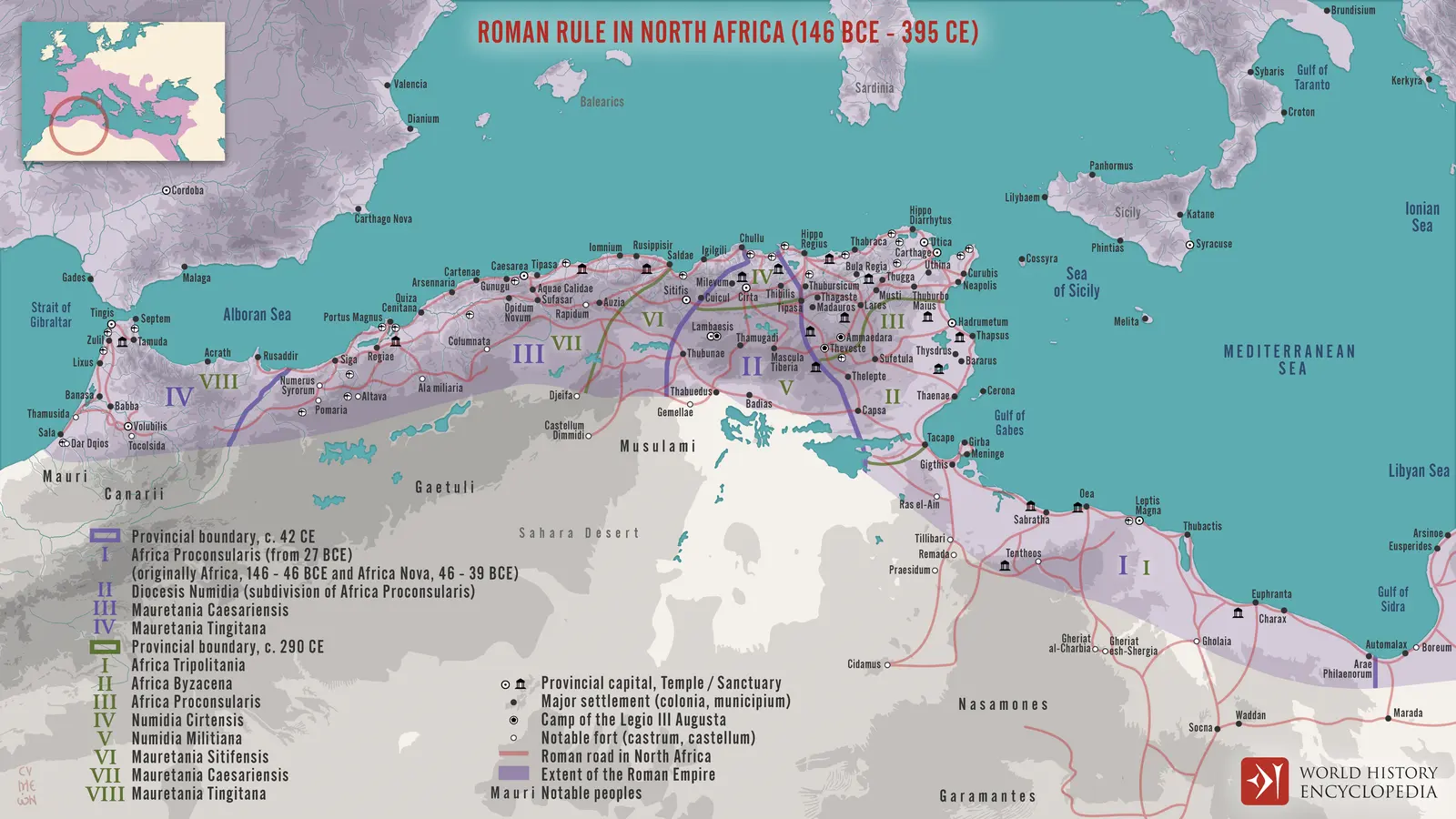
Numidia’s history begins with kingdoms and regional societies rather than a ready-made Roman province. Masinissa’s alliance with Rome during the defeat of Carthage strengthened a monarchy whose agricultural, military, and political ambitions extended across a changing territory. Successors and rival royal branches negotiated Roman influence while pursuing their own power.
Jugurtha’s war exposed corruption, faction, and the limits of Roman intervention. His defeat removed a ruler but did not annex the entire kingdom. Remaining royal arrangements and later conflicts continued until Caesar’s victory over Juba I and the creation of Africa Nova. The province’s eventual separate identity emerged through still later military and administrative developments.
The military district and Legio III Augusta
Numidia’s imperial history was closely tied to the army’s African establishment. The separation of legionary command from the proconsul under Gaius created a military authority distinct from ordinary civil government, although the territory had not yet become the fully separate Severan province. The army’s base moved through different locations before Lambaesis acquired its long prominence.
Forts, roads, recruitment, engineering, and relations with neighbouring populations gave the command responsibilities extending beyond one fortress. Soldiers and veterans created communities, markets, families, religious institutions, and civic identities. Thamugadi’s foundation exemplifies veteran settlement and planned urban development in this environment.
Cirta, towns, and rural production
Cirta’s royal and regional importance preceded its Roman provincial prominence. Its surrounding urban network and productive districts connected it with coastal ports and interior routes. Other towns such as Cuicul, Calama, Madauros, and the military centres developed distinctive civic lives.
Cereals, olives, livestock, and regional manufacture supported the economy. Inland towns depended on rural production, while roads linked their output to military consumers and maritime markets. Monumental architecture and elite inscriptions reveal wealth, but they do not measure the experience of tenants, labourers, enslaved people, and poorer households.
Culture and religious change
Latin public life developed alongside Punic and other regional traditions. Local elites entered imperial service and literary culture while maintaining strong provincial connections. Apuleius’s association with Madauros illustrates the breadth of education and social ambition available to some African families, not the literacy or wealth of the population as a whole.
Christian communities became numerous and influential. Bishops, martyrs’ shrines, doctrinal conflicts, and the Donatist dispute shaped the region’s late history. Religious affiliation could be closely connected to locality, patronage, and political authority. The resulting Christian landscape was neither uniform nor insulated from imperial intervention.
Separate province and later divisions
The Severan separation gave Numidia a formal provincial identity under the commander-governor. Late imperial experiments divided the territory into northern and military-associated jurisdictions before reunification. The shifting names and offices reflect attempts to manage a region whose civil and military histories had long been entangled.
Vandal expansion and local North African rulers changed the political geography in the fifth century. Eastern Roman recovery reached important districts but did not restore uninterrupted control over all the older province. Numidia’s towns, rural communities, and Christian institutions continued under varied political conditions. Its long trajectory demonstrates that royal territory, military zone, separate province, and later regional society are related but distinct historical stages.
Settlement geography
| Ancient place | Modern location |
|---|---|
| Cirta | Constantine, Algeria |
| Lambaesis | Tazoult, Algeria |
| Thamugadi | Timgad, Algeria |
| Cuicul | Djémila, Algeria |
| Madauros | Mdaourouch, Algeria |
| Calama | Guelma, Algeria |
| Rusicade | Skikda, Algeria |