Aediles
Magistrates associated with markets urban care and games; expensive public display could advance elite careers.
See also Euergetism, Games and spectacle
The offices, laws and institutions, and the economy and daily life behind the armies.
Magistrates associated with markets urban care and games; expensive public display could advance elite careers.
See also Euergetism, Games and spectacle
Augustus came to mark senior imperial rank; Caesar later often denoted a junior ruler, while usages varied with period and claimant.
See also Tetrarchy, Co-emperorship
Officials traditionally conducting census and moral/status review; their role and survival differed across periods.
In the volumes Book I · Chapter 3: The Long Samnite War · Book I · Chapter 5: The Pyrrhic War · Book II · Chapter 3: The Interwar Years: Mercenary War, Sardinia, Gauls, and Illyrians · Book V · Chapter 1: The Gracchan Crisis: The Return of Political Violence
Registration and assessment of citizens or provincial populations supported status, taxation and obligations; citizen censuses and provincial assessments were related but distinct procedures.
See also Censors, Roman citizenship, Taxation
In the volumes Book V · Chapter 1: The Gracchan Crisis: The Return of Political Violence · Book V · Chapter 2: The Jugurthine War and the Rise of Marius · Book IV · Chapter 2: The Syrian War: Antiochus, Thermopylae, and Magnesia · Book V · Chapter 7: Caesar in Gaul · Book VI · Chapter 5: The Eastern Question: Corbulo, Armenia, and Parthia · Book VI · Chapter 6: The Jewish War · Book VI · Chapter 8: The Flavian Consolidation and the Wars of Domitian · Book VIII · Chapter 1: The Tetrarchy and the Wars of Constantine
Multiple rulers shared imperial rank while allocating territories and responsibilities; overlapping reign dates need not indicate rival sovereign states.
See also Lucius Verus, Tetrarchy
Titles used for different court and military offices; a dux's territorial command and a comes's role require precise date and jurisdiction.
See also Magister militum, Notitia Dignitatum
Citizen assembly organized through centuries; elected major magistrates and decided specified matters, with unequal voting influence linked to property organization.
In the volumes Book IV · Chapter 1: The Second Macedonian War: Flamininus and Cynoscephalae
Read further Polybius Histories VI 11-18
Citizen assembly organized by tribes for elections and legislation; distinct from the exclusively plebeian council.
Plebeian assembly electing tribunes and passing plebiscites, which eventually bound all citizens under the lex Hortensia.
See also Tribunes of the plebs, Lex Hortensia
Imperial advisory council drawing senior officials into deliberation; court ceremony and documentation structured the exercise of personal rule.
See also Imperial household and court
Caracalla's grant extended citizenship to most free imperial inhabitants; exceptions terminology and effects remain debated.
See also Caracalla, Roman citizenship
In the volumes Book VII · Chapter 6: The Auction and the Severan Reconstruction
Normally two annual chief magistrates; under the Republic they held major civil and military authority, while imperial appointments preserved prestige with reduced autonomy.
See also Imperium, Comitia centuriata
In the volumes Book I · Chapter 3: The Long Samnite War · Book V · Chapter 4: The Social War and the Civil Wars of Marius and Sulla · Book II · Chapter 1: The First Punic War: Opening and the Birth of Roman Sea-Power · Book II · Chapter 6: Cannae · Book II · Chapter 5: The Year of Hannibal: Ticinus, Trebia, Trasimene, and the Fabian Strategy · Book IV · Chapter 3: The Third Macedonian War: Aemilius Paullus and Pydna · Book IV · Chapter 4: The Spanish Wars: Lusitanians, Celtiberians, Viriathus, and Numantia · Book V · Chapter 3: The Northern Peril: The Cimbri, the Teutones, and the Marian Army and 30 more
Read further Polybius Histories VI 11-18
Modern collective name for Justinianic codification including Code Digest Institutes and later Novels; not a single ancient book compiled at once.
See also Justinian I, Roman law
Conventional sequence of elite offices with age and eligibility rules that changed over time; exceptional commands often disrupted its ideal order.
See also Quaestors, Praetors, Consuls
In the volumes Book V · Chapter 4: The Social War and the Civil Wars of Marius and Sulla
Extraordinary magistracy for specified tasks, conventionally time-limited; Sulla's and Caesar's dictatorships transformed its political meaning.
See also Sulla, Julius Caesar
In the volumes Book II · Chapter 5: The Year of Hannibal: Ticinus, Trebia, Trasimene, and the Fabian Strategy · Book I · Chapter 1: The Gallic Catastrophe · Book V · Chapter 8: The Civil Wars and the End of the Republic · Book I · Chapter 3: The Long Samnite War · Book I · Chapter 2: The Latin Twilight and the Samnite Dawn · Book II · Chapter 6: Cannae · Book V · Epilogue: Rome in 31/30 BC
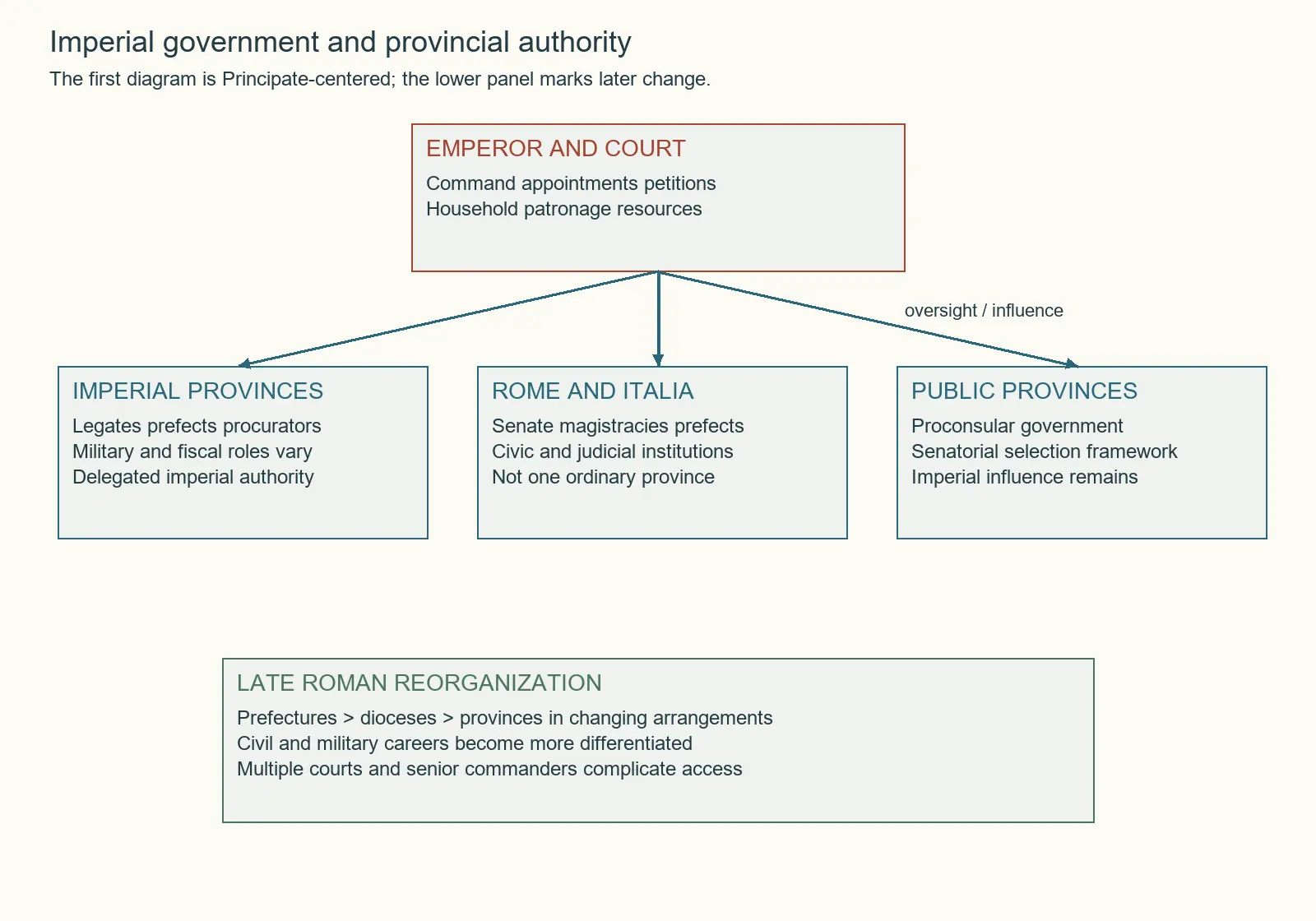
Groups of provinces under vicars in the late administrative system; boundaries and relationships changed rather than remaining uniform across centuries.
See also Praetorian prefectures, Notitia Dignitatum
In the volumes Book VII · Chapter 8: The Recovery, 260–284 · Book VIII · Chapter 1: The Tetrarchy and the Wars of Constantine · Book VIII · Chapter 3: Adrianople and the Gothic Settlement · Book VIII · Chapter 4: Stilicho, the Rhine Crossing, and the Sack of Rome · Book VIII · Chapter 5: Aetius, Africa, and Attila · Book VIII · Chapter 6: The Dissolution
Modern label emphasizing more overt court monarchy and reorganization; useful as a contrast with the Principate but not an ancient constitutional replacement enacted in one moment.
See also Diocletian, Tetrarchy, Consistorium
In the volumes Book VII · Chapter 8: The Recovery, 260–284
Regional government combining substantial civil and military authority, especially at Ravenna and Carthage; a response to changing imperial conditions.
Family freedmen slaves secretaries guards officers and advisers shaped access and decisions; office and personal proximity often interacted.
See also Praetorian prefect
Legally recognized command authority, especially military, whose holders powers and geographic limits varied by office and settlement.
In the volumes Book II · Epilogue: Rome in the Late Summer of 216 · Book III · Chapter 3: The Spanish Theater: The Elder Scipios and the Rise of the Younger · Book III · Chapter 7: Zama and the Peace · Book III · Epilogue: Rome in 201 BC · Book IV · Proem · Book IV · Epilogue: Rome in 146 BC · Book V · Chapter 5: Wars in the Shadow of the Settlement: Mithridates, Sertorius, Spartacus · Book V · Epilogue: Rome in 31/30 BC and 7 more
Read further Polybius Histories VI 11-18
Senatorial representative governing an imperial province or commanding a legion under delegated authority; exact role depends on the appointment.
See also Provincial governors
Enacted measures arising through different assemblies; after the lex Hortensia plebiscites bound the citizen body, though procedure and politics remained consequential.
See also Concilium plebis
Senior military office whose holders could control armies and imperial access; fifth-century western commanders often became decisive political brokers.
Destruction alteration or omission of a condemned person's public memory, often grouped under the modern label damnatio memoriae; application varied.
See also Geta
Appeals to ancestral custom used to legitimate conduct and resist innovation; a contested political resource rather than one codified constitution.
See also Senate
In the volumes Book I · Epilogue: Rome in 264 BC
Prestige of families with eminent officeholding ancestry; political influence was neither identical to patrician birth nor a fixed modern aristocratic legal estate.
Flexible political labels and methods of seeking support, not stable modern parties with permanent membership and platforms.
See also Cicero
Unequal relationships exchanging assistance access loyalty and reputation, operating among individuals cities and emperors without replacing formal law.
See also Euergetism
Subjects or officials sought decisions from emperors and governors; written replies could become important legal and administrative precedents.
See also Papyri, Provincial governors
Official responsible for Rome's supply system, coordinating an administration dependent on producers carriers ports and storage.
Urban prefect with judicial and policing responsibilities at Rome and later Constantinople; municipal authority was not simply identical to city-council government.
See also Rome, Constantinople
Initially commander of the imperial guard, later a major administrative office; fourth-century prefectures chiefly handled civil functions.
See also Praetorian Guard, Tetrarchy
In the volumes Book VII · Chapter 7: The Breaking, 235–260 · Book VII · Chapter 8: The Recovery, 260–284 · Book VI · Chapter 7: The Year of the Four Emperors and the Batavian Revolt · Book VI · Chapter 8: The Flavian Consolidation and the Wars of Domitian · Book VII · Chapter 5: Marcus Aurelius: The Double Emergency · Book VII · Chapter 6: The Auction and the Severan Reconstruction
Large civil administrative jurisdictions supervising dioceses and fiscal systems; they must be distinguished from the earlier guard command.
See also Dioceses, Praetorian prefect
Magistrates chiefly associated with jurisdiction and commands; provincial service followed through prorogation or later imperial appointment systems.
See also Provincial governors, Roman law
In the volumes Book IV · Chapter 4: The Spanish Wars: Lusitanians, Celtiberians, Viriathus, and Numantia · Book II · Chapter 5: The Year of Hannibal: Ticinus, Trebia, Trasimene, and the Fabian Strategy · Book V · Chapter 4: The Social War and the Civil Wars of Marius and Sulla · Book V · Chapter 6: Pompey and the Conquest of the East · Book II · Chapter 2: The First Punic War: Africa, Sicily, and the Long Resolution · Book II · Chapter 6: Cannae · Book III · Chapter 1: The Aftermath of Cannae: Recovery, Capua, and the Macedonian Threat · Book III · Chapter 2: The Sicilian Theater: Syracuse and the Recovery of the Italian South and 8 more
First-citizen style expressing imperial precedence within retained Republican forms; actual power rested on commands resources appointments and relationships.
See also Augustus, Principate
In the volumes Book V · Epilogue: Rome in 31/30 BC · Book VI · Chapter 1: The Augustan Conquests · Book V · Chapter 1: The Gracchan Crisis: The Return of Political Violence · Book VI · Proem
Modern period label for imperial rule expressed through the princeps and retained Republican forms; historians choose different endpoints, including 235 or 284.
See also Augustus, Princeps, Dominate
In the volumes Book VI · Chapter 5: The Eastern Question: Corbulo, Armenia, and Parthia · Book VI · Epilogue: The World-State at 96 · Book V · Epilogue: Rome in 31/30 BC · Book VI · Proem · Book V · Proem · Book VI · Chapter 1: The Augustan Conquests · Book VI · Chapter 2: The Great Illyrian Revolt and the Varian Disaster · Book VI · Chapter 3: Germanicus and the Julio-Claudian North and 8 more
Holder of proconsular authority; under the Principate governed many public provinces through a system distinct from imperial legates.
See also Provincial governors, Senate
In the volumes Book V · Chapter 5: Wars in the Shadow of the Settlement: Mithridates, Sertorius, Spartacus · Book V · Chapter 7: Caesar in Gaul · Book IV · Chapter 4: The Spanish Wars: Lusitanians, Celtiberians, Viriathus, and Numantia · Book V · Chapter 6: Pompey and the Conquest of the East · Book II · Chapter 2: The First Punic War: Africa, Sicily, and the Long Resolution · Book II · Chapter 6: Cannae · Book V · Chapter 2: The Jugurthine War and the Rise of Marius · Book V · Chapter 3: The Northern Peril: The Cimbri, the Teutones, and the Marian Army and 3 more
Imperial agents often handling revenue property or specialized administration; not all procurators governed provinces or commanded armies.
See also Fiscus
In the volumes Book VI · Chapter 4: Britain: Conquest and Revolt · Book VI · Chapter 6: The Jewish War · Book VII · Chapter 1: The Dacian Wars of Trajan
Extension of a command beyond the ordinary magistracy, enabling proconsular and propraetorian government and longer military operations.
Official listing of enemies permitting killing and property seizure, most notoriously under Sulla and the triumvirs; both terror and redistribution followed.
See also Sulla, Second Triumvirate
In the volumes Book V · Proem · Book V · Epilogue: Rome in 31/30 BC · Book V · Chapter 4: The Social War and the Civil Wars of Marius and Sulla · Book V · Chapter 8: The Civil Wars and the End of the Republic
Originally a magistrate's assigned responsibility, often becoming a territorial command; the term should not imply an unchanged modern administrative province.
See also Provincial governors
In the volumes Book IV · Chapter 1: The Second Macedonian War: Flamininus and Cynoscephalae · Book I · Chapter 6: The Consolidation of Italy · Book II · Chapter 2: The First Punic War: Africa, Sicily, and the Long Resolution · Book III · Proem · Book III · Chapter 2: The Sicilian Theater: Syracuse and the Recovery of the Italian South · Book III · Chapter 6: Scipio in Africa · Book VI · Chapter 3: Germanicus and the Julio-Claudian North
Administrative judicial fiscal and military responsibilities differed between imperial legates proconsuls prefects and later civil governors.
See also Provincia, Legatus Augusti
In the volumes Book III · Chapter 5: Ilipa and the End of Carthaginian Spain · Book V · Chapter 1: The Gracchan Crisis: The Return of Political Violence
Contractors and tax-farming companies performing state business; their authority and abuses were shaped by contracts law and changing fiscal practice.
See also Taxation
In the volumes Book V · Chapter 5: Wars in the Shadow of the Settlement: Mithridates, Sertorius, Spartacus · Book VI · Chapter 2: The Great Illyrian Revolt and the Varian Disaster
Junior magistrates with financial and administrative duties, serving treasuries commanders or provincial administrations.
See also Aerarium, Cursus honorum
In the volumes Book III · Chapter 2: The Sicilian Theater: Syracuse and the Recovery of the Italian South · Book IV · Chapter 4: The Spanish Wars: Lusitanians, Celtiberians, Viriathus, and Numantia · Book V · Chapter 1: The Gracchan Crisis: The Return of Political Violence · Book V · Chapter 2: The Jugurthine War and the Rise of Marius · Book V · Chapter 4: The Social War and the Civil Wars of Marius and Sulla · Book V · Chapter 6: Pompey and the Conquest of the East
Legal membership carrying variable rights obligations and privileges; its expansion culminated broadly in 212 without making every person free or socially equal.
See also Constitutio Antoniniana, Social War
In the volumes Book I · Chapter 6: The Consolidation of Italy · Book I · Chapter 2: The Latin Twilight and the Samnite Dawn · Book V · Chapter 1: The Gracchan Crisis: The Return of Political Violence
An empire of territories and dependent relationships preceded Augustus; imperial monarchy subsequently joined court, armies, taxation and diverse provincial communities.
See also Roman Republic, Principate, Provincial governors
In the volumes Book VIII · Chapter 6: The Dissolution
Evolving statutes juristic interpretation imperial enactments and procedures; surviving compilations preserve layers rather than one timeless code.
See also Twelve Tables, Corpus iuris civilis
In the volumes Book I · Chapter 2: The Latin Twilight and the Samnite Dawn · Book VII · Chapter 6: The Auction and the Severan Reconstruction
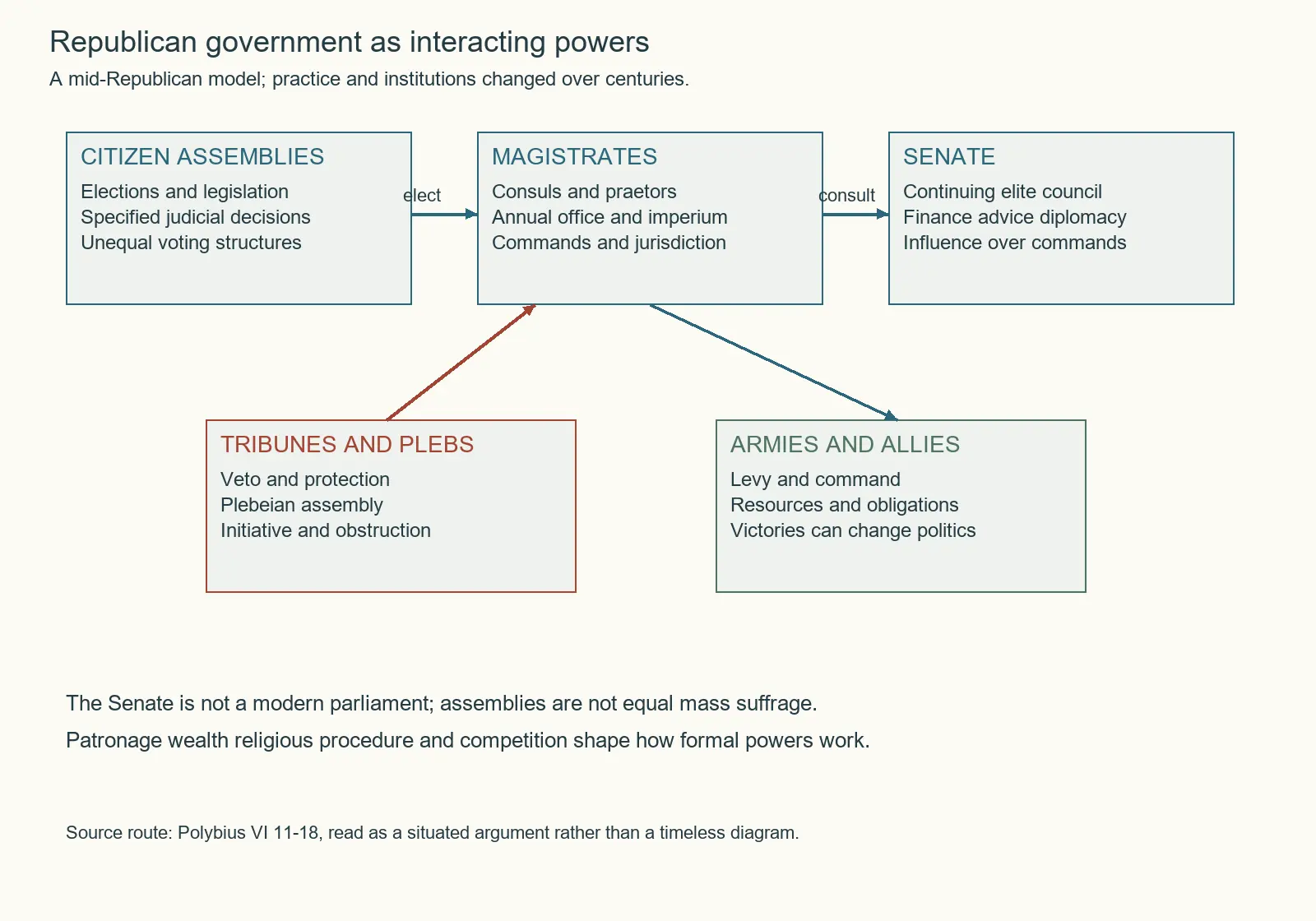
Political order with elected magistrates, Senate and citizen assemblies; conquered provinces formed an empire long before the establishment of imperial monarchy.
See also Consuls, Senate, Comitia centuriata, Roman citizenship
In the volumes Book I · Chapter 6: The Consolidation of Italy · Book V · Proem · Book V · Chapter 8: The Civil Wars and the End of the Republic
Elite council whose influence over finance diplomacy commands and status changed under imperial rule; neither a modern parliament nor a powerless ceremonial relic.
In the volumes Book V · Chapter 8: The Civil Wars and the End of the Republic · Book I · Chapter 5: The Pyrrhic War · Book II · Chapter 3: The Interwar Years: Mercenary War, Sardinia, Gauls, and Illyrians · Book IV · Chapter 1: The Second Macedonian War: Flamininus and Cynoscephalae · Book IV · Chapter 5: The Third Punic War and the Destruction of Carthage · Book V · Chapter 1: The Gracchan Crisis: The Return of Political Violence · Book I · Chapter 6: The Consolidation of Italy · Book II · Chapter 4: The Coming of Hannibal: From Saguntum to the Alps and 37 more
Read further Polybius Histories VI 11-18
Evolving collegiate arrangement of two Augusti and two Caesars intended to manage defense and succession; not four sovereign modern nation-states.
See also Diocletian, Maximian, Galerius, Constantius I Chlorus
In the volumes Book VIII · Chapter 1: The Tetrarchy and the Wars of Constantine · Book VII · Epilogue: The World-State at 284
Imperial compilation of constitutions since Constantine, valuable for legal policy and dates but not automatic evidence of uniform enforcement.
See also Theodosius II, Roman law
Sacrosanct plebeian representatives with veto and legislative initiative; imperial tribunician power borrowed authority without making the emperor an ordinary tribune.
See also Tribunician power
Imperial authority derived from the powers of tribunes, annually numbered and useful for dating reigns; separate from holding the plebeian office.
See also Augustus, Tribunes of the plebs
Early written legal collection preserved through later quotations; foundational status should not be mistaken for a surviving complete original inscription.
See also Roman law
Obstruction exercised by magistrates, especially tribunes, against official action; its reach depended on office context and political enforcement.
See also Tribunes of the plebs
Public treasury traditionally associated with Saturn's temple; imperial fiscal arrangements reduced but did not erase its distinct institutional identity.
In the volumes Book VI · Proem
The economic foundation for most households and revenues; production included grain vines olives livestock and diverse regional crops.
See also Taxation
Transport and table vessels document production distribution and consumption, but surviving containers disproportionately represent certain goods.
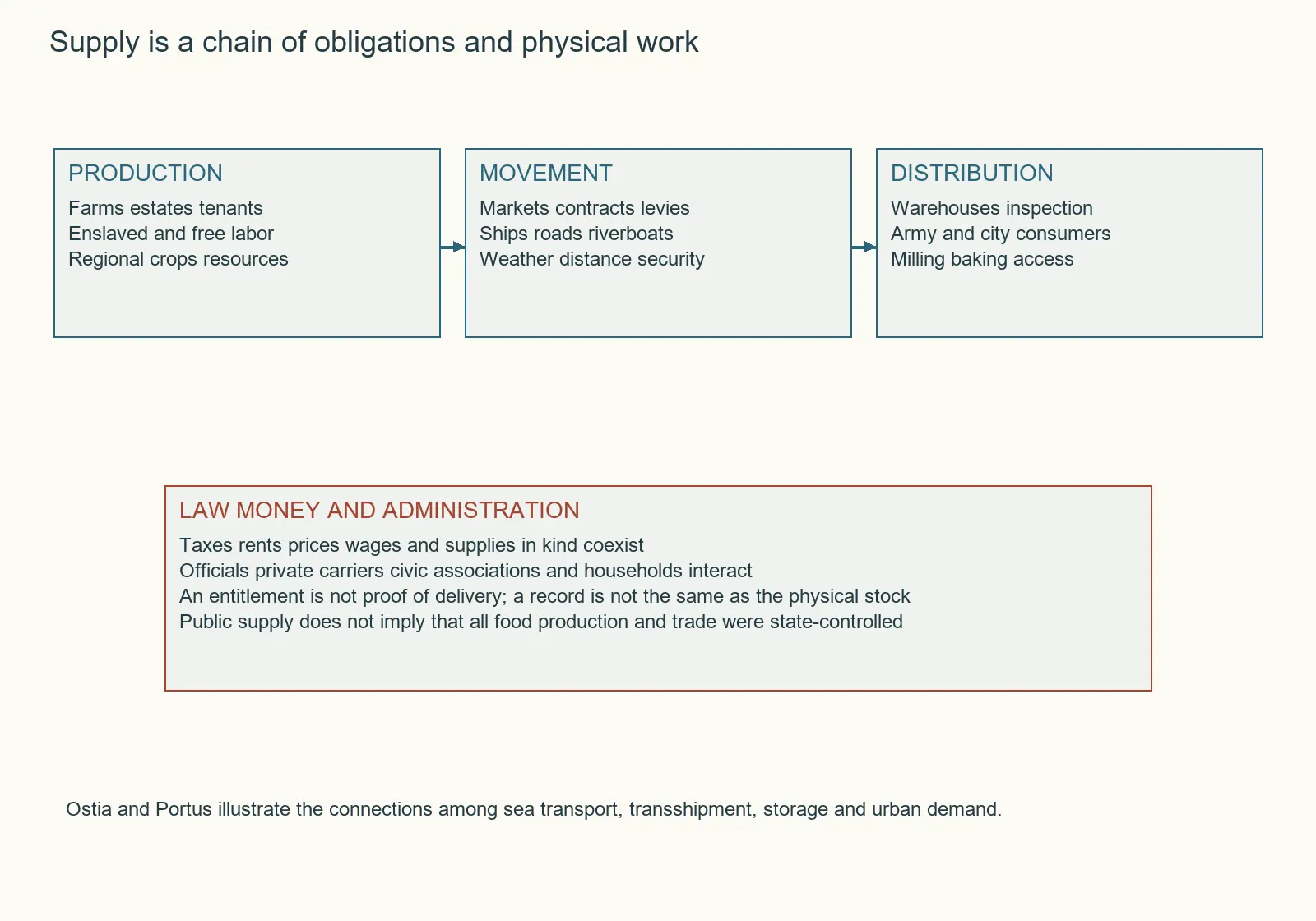
Supply and distribution arrangements for cities or armies; public administration and private commerce overlapped rather than forming one wholly state-run economy.
See also Praefectus annonae, Ostia, Military annona
In the volumes Book V · Chapter 1: The Gracchan Crisis: The Return of Political Violence · Book VII · Chapter 6: The Auction and the Severan Reconstruction · Book VII · Chapter 8: The Recovery, 260–284 · Book VIII · Chapter 1: The Tetrarchy and the Wars of Constantine
Gravity-fed water systems requiring sources gradients distribution rights and maintenance labor; ancient examples are not a single standardized engineering design.
See also Rome
Food fodder animals transport pay replacement troops and local cooperation constrained operations; fighting strength depended on more than a nominal roster.
See also Military annona, Roads and milestones
Gold denominations of different periods; Constantine's solidus became a durable high-value standard without eliminating copper silver or in-kind exchange.
See also Constantine I, Coinage
Read further Roman Provincial Coinage Oxford reign catalog
Non-legionary units of infantry cavalry and mixed formations, often recruited beyond the citizen legionary pool; citizenship grants are documented in diplomas.
In the volumes Book VI · Chapter 4: Britain: Conquest and Revolt · Book VI · Epilogue: The World-State at 96 · Book VII · Chapter 1: The Dacian Wars of Trajan · Book VI · Proem · Book VI · Chapter 2: The Great Illyrian Revolt and the Varian Disaster · Book VI · Chapter 8: The Flavian Consolidation and the Wars of Domitian · Book VII · Proem · Book VII · Chapter 3: Hadrian: The Wall, the Army in Being, and the Last Jewish War
Lending deposits accounting partnerships and enforcement enabled commerce; surviving evidence supports varied arrangements, not one standardized banking system.
Infrastructure linked water distribution hygiene sociability display and maintenance; access was uneven and systems were not modern universal sanitation.
See also Aqueducts
Modern shorthand for related late Roman assessment systems combining land and productive/taxable capacity; details varied and remain debated.
See also Diocletian, Taxation
Professional command positions within evolving legion structures; the senior centurion's career could lead to wider administrative influence.
In the volumes Book III · Chapter 6: Scipio in Africa · Book V · Chapter 7: Caesar in Gaul · Book V · Chapter 8: The Civil Wars and the End of the Republic · Book VII · Chapter 5: Marcus Aurelius: The Double Emergency
Learning ranged from household and apprenticeship to grammar and rhetoric; literacy was uneven and not reducible to a single imperial rate.
Periodic levy affecting trade and occupations, abolished by Anastasius; sources emphasize its burdens, which need contextual interpretation.
See also Anastasius I
Money financed exchange taxation and military payments while communicating authority; mint output is evidence requiring archaeological and numismatic context.
Read further Roman Provincial Coinage Oxford reign catalog
Associations organized around occupations worship burial or sociability, regulated unevenly; they were not uniformly modern labor unions.
Agricultural tenants; some later legal categories restricted movement or attached obligations to estates, but one uniform instantaneous serfdom transition is misleading.
See also Smallholders and tenants, Roman law
Broad field-army and frontier-service categories with varied organization and quality; not a simple professional army versus inferior militia binary.
See also Magister militum
In the volumes Book VIII · Proem · Book VIII · Chapter 1: The Tetrarchy and the Wars of Constantine · Book VIII · Chapter 2: The House of Constantine at War: Persia, Strasbourg, and the Road to Ctesiphon
Textiles pottery metalwork food processing and service trades supported towns and armies through mixed household and commercial organization.
See also Collegia
Reduction of precious-metal content, especially pronounced in parts of the third century; prices and trust cannot be explained by metal content alone.
See also Coinage
Local council elites responsible for civic government and increasing fiscal obligations; their incentives and burdens changed with imperial structures.
See also Euergetism, Taxation
Silver denomination central to Republican and early imperial money; weight fineness and economic role changed substantially.
See also Coinage, Debasement
In the volumes Book VI · Chapter 7: The Year of the Four Emperors and the Batavian Revolt · Book VII · Chapter 6: The Auction and the Severan Reconstruction
Read further Roman Provincial Coinage Oxford reign catalog
Diocletianic price and wage ceilings survive in fragments; a normative intervention, not a reliable universal record of actual transactions.
See also Diocletian, Prices and wages
Antonine Cyprianic and Justinianic outbreaks affected communities differently; pathogens mortality and empire-wide effects require distinct evidence.
See also Justinianic plague
Public benefaction funding buildings festivals distributions or services in exchange for honor influence and civic belonging.
See also Collegia
Imperial financial administration and resources, evolving alongside other treasuries; not simply the emperor's unrestricted modern private bank account.
See also Procurators, Taxation
In the volumes Book VI · Chapter 5: The Eastern Question: Corbulo, Armenia, and Parthia · Book VI · Chapter 6: The Jewish War · Book VII · Chapter 3: Hadrian: The Wall, the Army in Being, and the Last Jewish War
Mediterranean and river forces moved troops goods and messages and controlled waterways; naval organization changed with imperial strategy.
Freed slaves could acquire differentiated citizenship and opportunities while retaining obligations to former owners; stigma and elite anxieties persisted.
See also Patronage, Roman citizenship
Circus theater gladiatorial events and hunts mediated politics status religion and entertainment; their forms and institutions changed across periods.
See also Euergetism
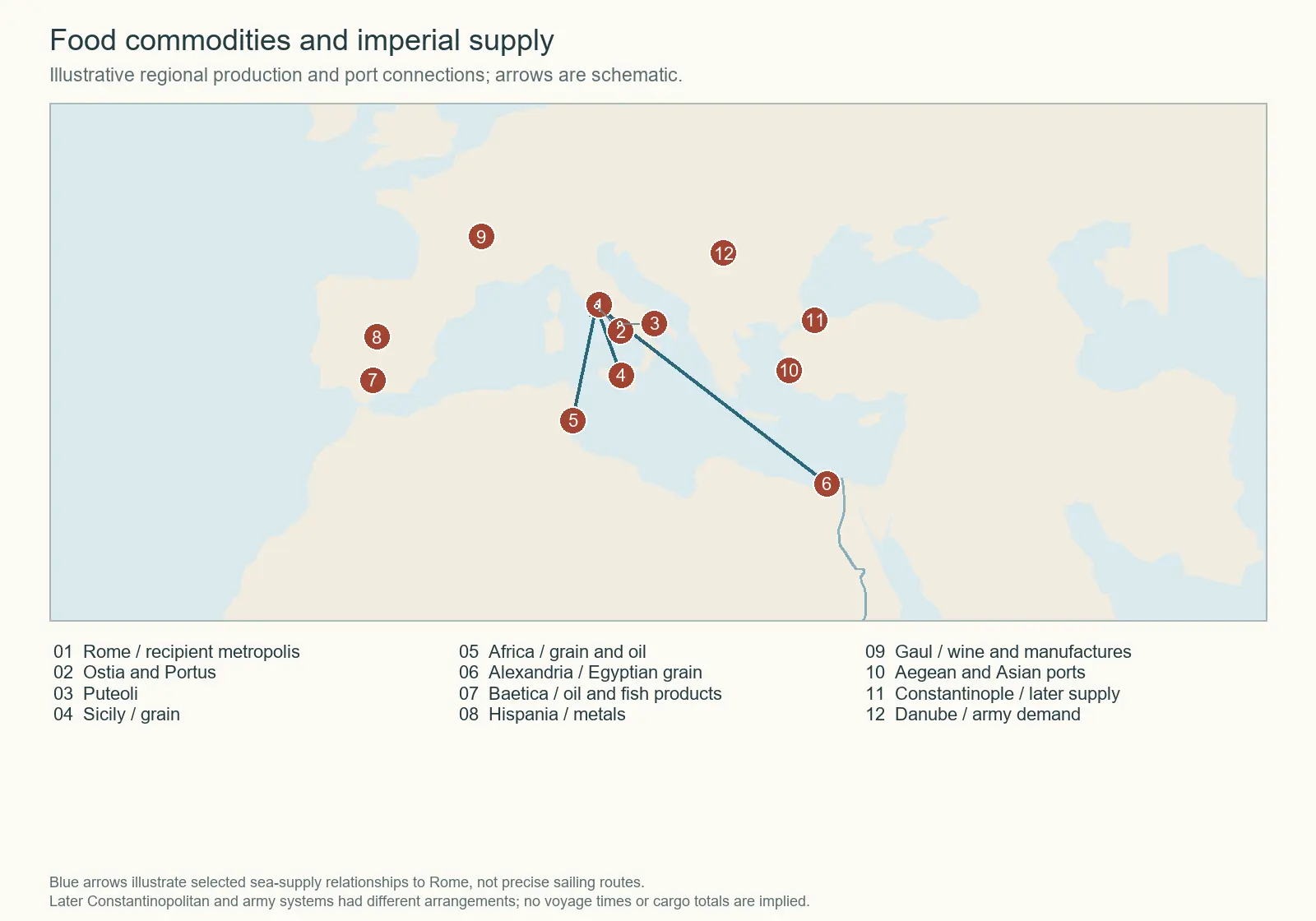
Processed fish products traded through coastal production centers; a useful material trace of regional specialization and taste.
See also Baetica
Rome relied on regional and overseas food networks; entitlement to distributions covered specified recipients rather than the entire empire's population.
See also Aegyptus, Africa Proconsularis, Sicilia
Read further Grain and Bread in Ancient Ostia archaeological park
Warehouses held grain and other commodities; location security inspection and transport relationships mattered as much as total capacity.
Read further Grain and Bread in Ancient Ostia archaeological park
Public private and official records preserve careers grants dedications and dates; formulae and survival bias require interpretation.
See also Roman citizenship
Terms commonly used for apartment blocks and elite houses, but buildings and occupancy patterns varied; archaeology reveals mixed uses and status.
Assignments of public or confiscated land settled citizens and veterans while potentially displacing existing communities.
Large landed holdings, a flexible ancient and modern category; their prevalence organization and labor mix varied by region and period.
See also Villa estates
In the volumes Book V · Chapter 5: Wars in the Shadow of the Settlement: Mithridates, Sertorius, Spartacus
Latin and Greek had different administrative and cultural distributions, alongside Punic Egyptian Aramaic Celtic and other languages.
Units of different periods and levels; their nominal strengths and relationships changed, making one timeless legion organization diagram misleading.
Periodic and permanent exchange linked countryside towns and interregional commerce; political control and local customs shaped participation.
See also Agriculture
Family alliances property transmission dowry and succession connected private law to civic and imperial politics.
See also Roman law
Sea transport connected ports and regional production; season weather piracy capacity and transshipment shaped costs and reliability.
See also Ostia, Alexandria, Portus
Collection and delivery of supplies for troops, often in kind or commuted; an important link between taxation transport and military presence.
See also Taxation, Army logistics
Silver gold copper iron and other resources supplied coinage tools and weapons; labor regimes included coercion and varied free arrangements.
Civic status categories tied to citizenship law and settlement histories; titles alone do not establish identical constitutions or populations.
See also Roman citizenship, Veterans
Food fuel grooming and ritual commodity, produced especially in Mediterranean regions and moved in major commercial and fiscal networks.
See also Baetica, Africa Proconsularis
Documentary texts preserve transactions petitions rosters and personal voices, especially in favorable survival environments; fragments are not representative samples of everyone.
See also Oxyrhynchus, Vindolanda
Paternal legal authority operated within evolving family property and marriage systems; legal ideals cannot describe every household practice.
See also Roman law
Hereditary civic orders whose initial distinctions mattered politically and religiously; plebeian did not simply mean poor.
See also Nobilitas
Imperial guard with military and political roles; repeatedly affected succession and was abolished by Constantine after defeating Maxentius.
See also Constantine I
In the volumes Book VII · Chapter 6: The Auction and the Severan Reconstruction
Evidence is uneven across place and time; a wage or price from one inscription or papyrus is not an empire-wide modern equivalent.
See also Papyri, Edict on Maximum Prices
Building materials traveled through imperial private and civic systems; expensive stone advertised patronage and required major transport labor.
See also Euergetism
State civic and military routes connected settlements and armies; inscriptions mark construction and authority but do not prove constant travel conditions.
See also Via Appia, Via Egnatia
A debated modern interpretive term; law language objects and customs changed through unequal interaction without erasing every local identity.
See also Roman citizenship
Wealth and status groups with changing eligibility and officeholding roles; neither maps neatly onto a modern class or business-sector division.
See also Senate, Procurators
Unit of account and denomination whose material form changed; large bronze imperial issues provide rich political and civic imagery.
See also Coinage
Read further Roman Provincial Coinage Oxford reign catalog
Camps roads bridges artillery mining and supply works enabled campaigns; surviving manuals prescribe methods rather than documenting universal practice.
See also Alesia
Legal unfreedom embedded in households agriculture mines craft and administration; experiences and possibilities varied without removing coercion and exploitation.
See also Roman law
Independent owners and renters cultivated land under varied local arrangements; tenant status did not automatically mean slavery or later legal immobility.
See also Coloni, Agriculture
Land poll customs inheritance and other levies operated through changing systems; legal exemptions and local burdens differed markedly.
Terms for land and personal assessments whose bases and application varied; later fiscal combinations should not be imposed unchanged on every province.
See also Taxation, Capitatio-iugatio
Crowded rental accommodation insecure work and unequal access coexisted with workshops and prosperous households; monumental ruins underrepresent vulnerability.
See also Grain supply
Former soldiers whose grants citizenship settlements and patronage linked military service to land and provincial society.
See also Colonia, Land distribution and veterans
Detachment serving separately from its parent unit; detached evidence does not prove an entire legion moved permanently.
See also Army logistics
Major Italian road initially linking Rome and Capua, extended toward Brundisium and Adriatic connections.
See also Appius Claudius Caecus, Brundisium
In the volumes Book I · Chapter 3: The Long Samnite War · Book I · Chapter 4: The Coalition War: Sentinum and Its Antecedents · Book V · Chapter 5: Wars in the Shadow of the Settlement: Mithridates, Sertorius, Spartacus · Book V · Epilogue: Rome in 31/30 BC
Roads linking southern Gaul and northern Italy respectively; conquest colonization and commerce shaped their histories.
See also Narbo Martius, Bononia
Trans-Balkan road connecting Adriatic ports with Macedonia and later Constantinople's networks; maintenance and security varied.
See also Dyrrachium, Thessalonica
In the volumes Book V · Chapter 8: The Civil Wars and the End of the Republic
Rural residences and production complexes linking elite consumption land management markets and coerced or free labor.
See also Agriculture, Slavery
Agricultural and cultural staple with strongly differentiated regional quality markets and social uses.
See also Gaul
Women's property family and civic roles differed by status period and legal arrangement; exclusion from magistracy did not mean absence of influence.