Romulus traditional
Legendary founder and first king; asylum fratricide and the incorporation of neighboring groups express Roman origin traditions, not a secure biography.
See also Rome
Kings, emperors and claimants, the women of the imperial houses, and the politicians and commanders of the wars.
Legendary founder and first king; asylum fratricide and the incorporation of neighboring groups express Roman origin traditions, not a secure biography.
See also Rome
Traditionally the Sabine successor credited with religious institutions and ritual order; foundation attributions are retrospective.
See also Pontifices, Vestal Virgins
Warrior king in later narratives, associated with Alba Longa's destruction and incorporation into Rome.
Tradition connects him with territorial consolidation and Ostia; archaeological development cannot be reduced to one founder's act.
First of the traditionally Etruscan-connected kings; monumental and political innovations were attributed to his reign.
Credited with census and citizen organization; later institutions should not all be securely dated to one sixth-century ruler.
See also Census, Comitia centuriata
In the volumes Book I · Chapter 1: The Gallic Catastrophe
Last king in Republican origin narratives; his expulsion defines the traditional transition to the Republic.
See also Lucius Junius Brutus
Octavian consolidated sole rule after civil war while preserving Republican offices; the settlement combined army command patronage and political authority.
See also Actium, Principate, Agrippa
In the volumes Book VI · Chapter 1: The Augustan Conquests · Book VI · Chapter 2: The Great Illyrian Revolt and the Varian Disaster · Book VI · Proem · Book VI · Chapter 3: Germanicus and the Julio-Claudian North
Augustus's adopted successor and experienced commander; his reign tested whether the new regime could survive its founder.
See also Germanicus, Principate
Gaius succeeded Tiberius and was assassinated by conspirators; hostile anecdotal traditions require discrimination from securely established events.
See also Praetorian Guard, Claudius
In the volumes Book VI · Chapter 3: Germanicus and the Julio-Claudian North · Book VI · Proem
Succeeded after Caligula's murder; Britain was invaded and imperial administration expanded through senators equestrians and freedmen.
See also Britannia, Agrippina the Younger
Last Julio-Claudian; faced the fire of Rome revolts and elite conspiracies before losing support and dying by suicide.
See also Great Fire of Rome, Vespasian, Boudica
In the volumes Book VI · Chapter 5: The Eastern Question: Corbulo, Armenia, and Parthia · Book VI · Chapter 7: The Year of the Four Emperors and the Batavian Revolt · Book VI · Chapter 6: The Jewish War
Provincial governor elevated amid Nero's collapse; fiscal and succession decisions alienated soldiers and helped provoke Otho's challenge.
See also Year of the Four Emperors, Otho
In the volumes Book VI · Chapter 7: The Year of the Four Emperors and the Batavian Revolt
Seized power from Galba and killed himself after defeat by Vitellian forces in northern Italy.
See also First Bedriacum, Vitellius
In the volumes Book VI · Chapter 7: The Year of the Four Emperors and the Batavian Revolt
Founded the Flavian dynasty after civil war; restored finances and authority while the Jewish war continued under Titus.
In the volumes Book VI · Chapter 6: The Jewish War · Book VI · Chapter 7: The Year of the Four Emperors and the Batavian Revolt · Book VI · Proem · Book VI · Chapter 8: The Flavian Consolidation and the Wars of Domitian
Backed by Rhine armies; defeated Otho but was overthrown by Vespasian's supporters during fighting in Italy and Rome.
See also Vespasian
In the volumes Book VI · Chapter 7: The Year of the Four Emperors and the Batavian Revolt · Book VI · Chapter 8: The Flavian Consolidation and the Wars of Domitian
Former commander at Jerusalem; his short reign included Vesuvius's eruption and disasters at Rome, with extensive later commemorative praise.
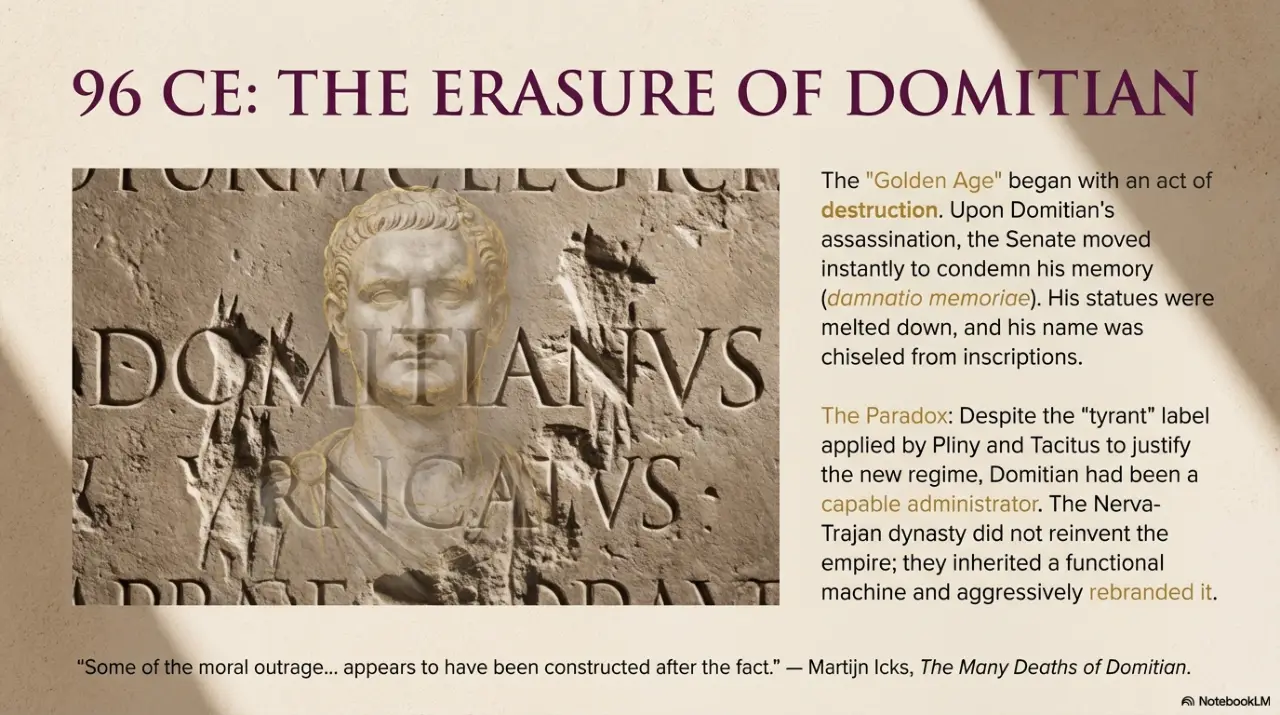
Assertive Flavian ruler associated with Rhine-Danube warfare and tense senatorial relations; assassinated in a palace conspiracy.
In the volumes Book VI · Chapter 8: The Flavian Consolidation and the Wars of Domitian · Book VI · Epilogue: The World-State at 96
Senatorial successor after Domitian; adoption of Trajan helped secure military support and the succession.
See also Trajan
In the volumes Book VI · Chapter 8: The Flavian Consolidation and the Wars of Domitian · Book VI · Epilogue: The World-State at 96
Conquered Dacia and campaigned against Parthia; imperial territorial reach peaked briefly before eastern annexations were relinquished.
See also Dacian Wars, Dacia
In the volumes Book VII · Chapter 1: The Dacian Wars of Trajan · Book VII · Chapter 2: The Eastern Maximum and the Great Recoil · Book VI · Epilogue: The World-State at 96 · Book VII · Proem · Book VI · Chapter 8: The Flavian Consolidation and the Wars of Domitian · Book VII · Chapter 3: Hadrian: The Wall, the Army in Being, and the Last Jewish War
Consolidated the frontier system and traveled widely; his reign included the Bar Kokhba revolt and major provincial construction.
See also Hadrian's Wall, Bar Kokhba revolt
In the volumes Book VII · Chapter 3: Hadrian: The Wall, the Army in Being, and the Last Jewish War · Book VII · Proem · Book VII · Chapter 4: The Antonine Noon and Its Wars
Governed largely from Italy through established institutions; Britain saw a temporary frontier advance to the Antonine Wall.
See also Marcus Aurelius
In the volumes Book VII · Chapter 4: The Antonine Noon and Its Wars
Co-emperor with Marcus Aurelius, associated with the Parthian war conducted by subordinate commanders; died during renewed military pressures.
See also Avidius Cassius, Parthians
In the volumes Book VII · Chapter 5: Marcus Aurelius: The Double Emergency
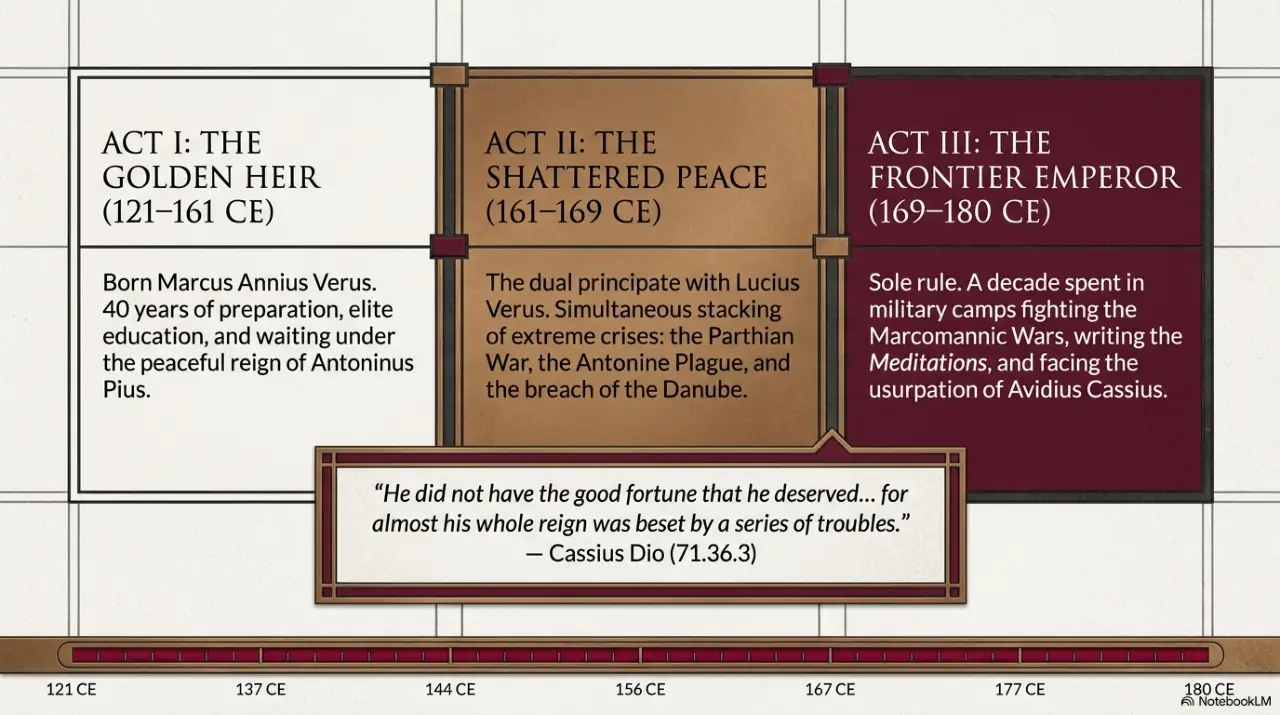
Co-ruled first with Lucius Verus then Commodus; faced eastern war epidemic and Danubian conflict while composing philosophical exercises.
See also Marcomannic Wars, Stoicism
In the volumes Book VI · Epilogue: The World-State at 96
Son and co-emperor of Marcus; cultivated extraordinary personal and Herculean imagery before assassination and renewed succession crisis.
In the volumes Book VII · Chapter 5: Marcus Aurelius: The Double Emergency · Book VII · Proem · Book VII · Chapter 6: The Auction and the Severan Reconstruction
Obtained imperial recognition through the praetorians but lacked sufficient wider military backing; removed as Severus approached Rome.
See also Septimius Severus
In the volumes Book VII · Chapter 6: The Auction and the Severan Reconstruction
Brief successor to Commodus; attempts to restore discipline ended with his murder by praetorian soldiers.
See also Praetorian Guard, Didius Julianus
In the volumes Book VII · Chapter 6: The Auction and the Severan Reconstruction
Defeated rival claimants and founded a dynasty; strengthened military patronage and campaigned in the east and Britain.
See also Pescennius Niger, Clodius Albinus, Caracalla
Co-emperor who eliminated Geta; the citizenship grant of 212 transformed legal membership while eastern campaigning continued.
See also Constitutio Antoniniana, Geta
In the volumes Book VII · Chapter 6: The Auction and the Severan Reconstruction
Severan co-emperor murdered after his father's death; sanctions against his memory left widespread physical traces.
See also Caracalla, Memory sanctions
In the volumes Book VII · Chapter 6: The Auction and the Severan Reconstruction
Praetorian prefect elevated after Caracalla's murder; defeated by forces supporting Elagabalus after an eastern settlement.
See also Elagabalus, Parthians
In the volumes Book VII · Chapter 6: The Auction and the Severan Reconstruction
Macrinus's young son and brief co-emperor during the final crisis of his father's regime; previously held the rank Caesar.
Young ruler whose promotion of the Emesene solar god became central to hostile accounts; killed and replaced by Severus Alexander.
See also Julia Maesa, Severus Alexander
In the volumes Book VII · Chapter 6: The Auction and the Severan Reconstruction
Last Severan emperor; faced Sasanian and Germanic threats before soldiers killed him and elevated Maximinus.
See also Julia Mamaea, Sasanians, Maximinus Thrax
In the volumes Book VII · Chapter 6: The Auction and the Severan Reconstruction
Military-backed ruler whose regime faced fiscal opposition and the African revolt; killed during the unsuccessful siege of Aquileia.
In the volumes Book VII · Chapter 7: The Breaking, 235–260 · Book VII · Chapter 6: The Auction and the Severan Reconstruction
Co-emperor with Pupienus in a fragile senatorial settlement; murdered by soldiers, leaving Gordian III sole ruler.
See also Pupienus, Gordian III
In the volumes Book VII · Chapter 7: The Breaking, 235–260
African provincial governor briefly proclaimed emperor alongside his son; revolt collapsed after military defeat.
See also Gordian II, Africa Proconsularis
Co-emperor with Gordian I during the African revolt; killed fighting the forces of Numidia's governor.
See also Gordian I
Young emperor whose Persian campaign ended amid defeat and disputed accounts of his death; succeeded by Philip.
In the volumes Book VII · Chapter 7: The Breaking, 235–260
Senatorial emperor appointed against Maximinus with Balbinus; the praetorians killed both after Maximinus's fall.
See also Balbinus, Gordian III
In the volumes Book VII · Chapter 7: The Breaking, 235–260
Emperor from Arabia; settled with Persia and celebrated Rome's traditional millennium before defeat by Decius.
In the volumes Book VII · Chapter 7: The Breaking, 235–260
Philip I's son and co-emperor, killed in the collapse of the dynasty after Decius's victory.
See also Philip I, Co-emperorship
Ordered empire-wide sacrificial compliance and fought Gothic forces; killed at Abritus with his son.
See also Goths
In the volumes Book VII · Chapter 7: The Breaking, 235–260
Son and brief co-emperor of Decius; died during the campaign that culminated at Abritus.
See also Decius
Decius's surviving son briefly shared imperial rank under Trebonianus Gallus; the circumstances of his death remain uncertain.
See also Trebonianus Gallus
Succeeded after Abritus amid epidemic and frontier pressures; overthrown when his troops abandoned him.
Son and co-emperor of Gallus, killed with him during Aemilian's challenge.
See also Trebonianus Gallus, Aemilian
Danubian commander briefly elevated after military success; lost support when Valerian's forces approached.
See also Valerian, Danube frontier
Maintained the central regime amid secession and invasion; associated with changes in command and mobile cavalry before assassination.
In the volumes Book VII · Chapter 8: The Recovery, 260–284
Co-emperor with Gallienus; captured by Shapur I near Edessa, a major Roman political and military humiliation.
See also Edessa, Shapur I, Gallienus
In the volumes Book VII · Chapter 7: The Breaking, 235–260 · Book VII · Chapter 8: The Recovery, 260–284
Gallienus's son briefly acclaimed Augustus at Cologne during Postumus's revolt; killed as the breakaway regime formed.
See also Postumus, Colonia Agrippinensis
Soldier emperor associated with victories over Gothic forces; died during epidemic conditions, later idealized in dynastic propaganda.
Reunified the Palmyrene and Gallic territories with the central empire; fortified Rome and promoted Sol's state cult.
See also Zenobia, Tetricus I
In the volumes Book VII · Chapter 8: The Recovery, 260–284 · Book VII · Proem
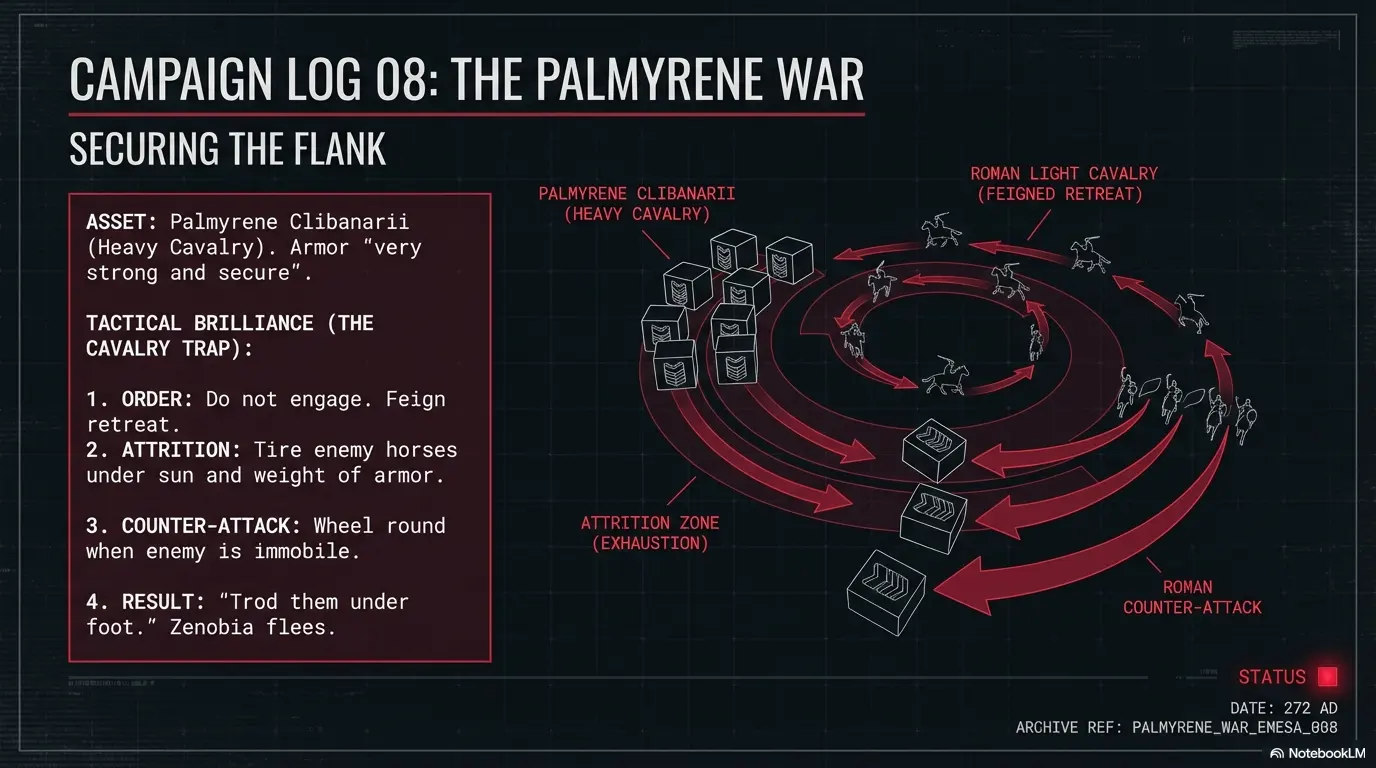
Claudius II's brother and very brief successor, displaced by Aurelian; exact reign length and circumstances of death are uncertain.
See also Aurelian
Short-lived successor to Aurelian; campaigned in Asia Minor before dying amid uncertain circumstances.
In the volumes Book VII · Chapter 8: The Recovery, 260–284
Brief claimant after Tacitus; army support shifted to Probus and his regime collapsed.
See also Probus
Military emperor active against frontier threats and internal revolts; remembered for reconstruction and troop labor before assassination.
See also Rhine frontier, Carus
In the volumes Book VII · Chapter 8: The Recovery, 260–284
Advanced against Persia after Probus's death; died on campaign, with the cause obscured by later reports.
See also Numerian, Carinus, Ctesiphon
In the volumes Book VII · Chapter 8: The Recovery, 260–284
Carus's western son and co-emperor; defeated or lost support during the conflict ending in Diocletian's supremacy.
See also Diocletian
In the volumes Book VII · Chapter 8: The Recovery, 260–284
Carus's son and eastern co-emperor; died during the return from Persia, preceding Diocletian's elevation.
See also Diocletian, Carinus
In the volumes Book VII · Chapter 8: The Recovery, 260–284
Reorganized imperial government and expanded collegiate rule; taxation military administration and persecution policies marked an enduring transformation.
See also Tetrarchy, Galerius, Maximian
In the volumes Book VIII · Chapter 1: The Tetrarchy and the Wars of Constantine · Book VII · Epilogue: The World-State at 284 · Book VIII · Proem
Diocletian's western colleague, later returning to dynastic contests after abdication; his successive claims were interrupted and disputed.
In the volumes Book VIII · Chapter 1: The Tetrarchy and the Wars of Constantine
Caesar from 293; recovered Britain and became western Augustus before his death at York prompted Constantine's elevation.
See also Carausius, Allectus, Constantine I
In the volumes Book VIII · Chapter 1: The Tetrarchy and the Wars of Constantine
Caesar from 293 and victor over Persia; struggled to control succession and issued a toleration edict shortly before death.
See also Tetrarchy, Diocletian, Maximinus Daia
In the volumes Book VIII · Chapter 1: The Tetrarchy and the Wars of Constantine
Won successive civil wars, patronized Christianity and refounded Constantinople; imperial consolidation did not immediately end traditional cults.
See also Constantinople, Nicaea, Milvian Bridge
In the volumes Book VIII · Chapter 1: The Tetrarchy and the Wars of Constantine
Ruler at Rome outside the original succession design; defeated by Constantine at the Milvian Bridge.
See also Milvian Bridge, Constantine I
In the volumes Book VIII · Chapter 1: The Tetrarchy and the Wars of Constantine
Western Augustus whose attempt to suppress Maxentius failed through defections; captured and killed.
In the volumes Book VIII · Chapter 1: The Tetrarchy and the Wars of Constantine
Eastern imperial colleague and rival of Constantine; defeated in 324 after years of alternating cooperation and conflict.
See also Constantine I, Chrysopolis
In the volumes Book VIII · Chapter 1: The Tetrarchy and the Wars of Constantine
Eastern tetrarch previously Caesar; rival of Licinius and associated with renewed persecution before defeat.
Youngest ruling son of Constantine, eventually governing much of the west; killed in Magnentius's revolt.
See also Magnentius, Constantine II
In the volumes Book VIII · Chapter 2: The House of Constantine at War: Persia, Strasbourg, and the Road to Ctesiphon
One of Constantine's sons who inherited an imperial share; killed invading Constans's territory.
See also Constans, Co-emperorship
In the volumes Book VIII · Chapter 2: The House of Constantine at War: Persia, Strasbourg, and the Road to Ctesiphon
Ruled chiefly in the east before defeating Magnentius; faced Persian war and recurrent Christian doctrinal conflict.
See also Magnentius, Julian, Antioch
In the volumes Book VIII · Chapter 2: The House of Constantine at War: Persia, Strasbourg, and the Road to Ctesiphon
Commander in Gaul and last non-Christian emperor; attempted religious revival and died during his Persian invasion.
See also Argentoratum
In the volumes Book VIII · Chapter 2: The House of Constantine at War: Persia, Strasbourg, and the Road to Ctesiphon · Book VIII · Proem
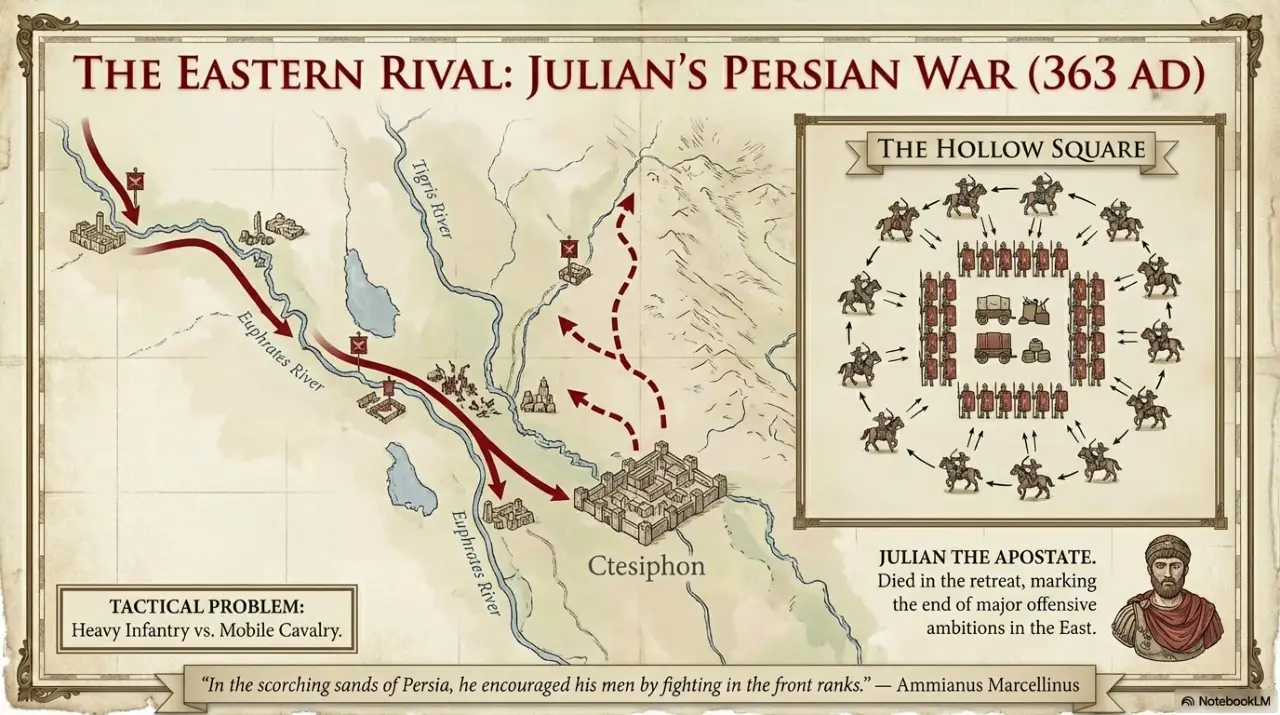
Chosen after Julian's death; secured the army's withdrawal by a treaty surrendering territory before dying en route west.
In the volumes Book VIII · Chapter 2: The House of Constantine at War: Persia, Strasbourg, and the Road to Ctesiphon · Book VIII · Chapter 3: Adrianople and the Gothic Settlement
Eastern emperor facing Persian and Gothic pressures; died with much of his field army at Adrianople.
See also Adrianople
In the volumes Book VIII · Chapter 3: Adrianople and the Gothic Settlement
Western emperor whose brother Valens ruled the east; concentrated on frontier defense and administrative authority.
See also Valens, Rhine frontier
In the volumes Book VIII · Chapter 3: Adrianople and the Gothic Settlement
Western co-emperor who appointed Theodosius after Adrianople; displaced by Magnus Maximus's revolt.
See also Theodosius I, Magnus Maximus
In the volumes Book VIII · Chapter 3: Adrianople and the Gothic Settlement
Child emperor whose authority depended on family and powerful commanders; his death preceded Eugenius's elevation.
See also Justina, Arbogast, Eugenius
In the volumes Book VIII · Chapter 3: Adrianople and the Gothic Settlement
Read further DIR: Valentinian II
Rebuilt eastern authority after Adrianople, defeated western rivals and strengthened Nicene imperial policy; sons inherited separate courts.
See also Frigidus, Arcadius, Honorius
In the volumes Book VIII · Chapter 3: Adrianople and the Gothic Settlement · Book VIII · Chapter 4: Stilicho, the Rhine Crossing, and the Sack of Rome
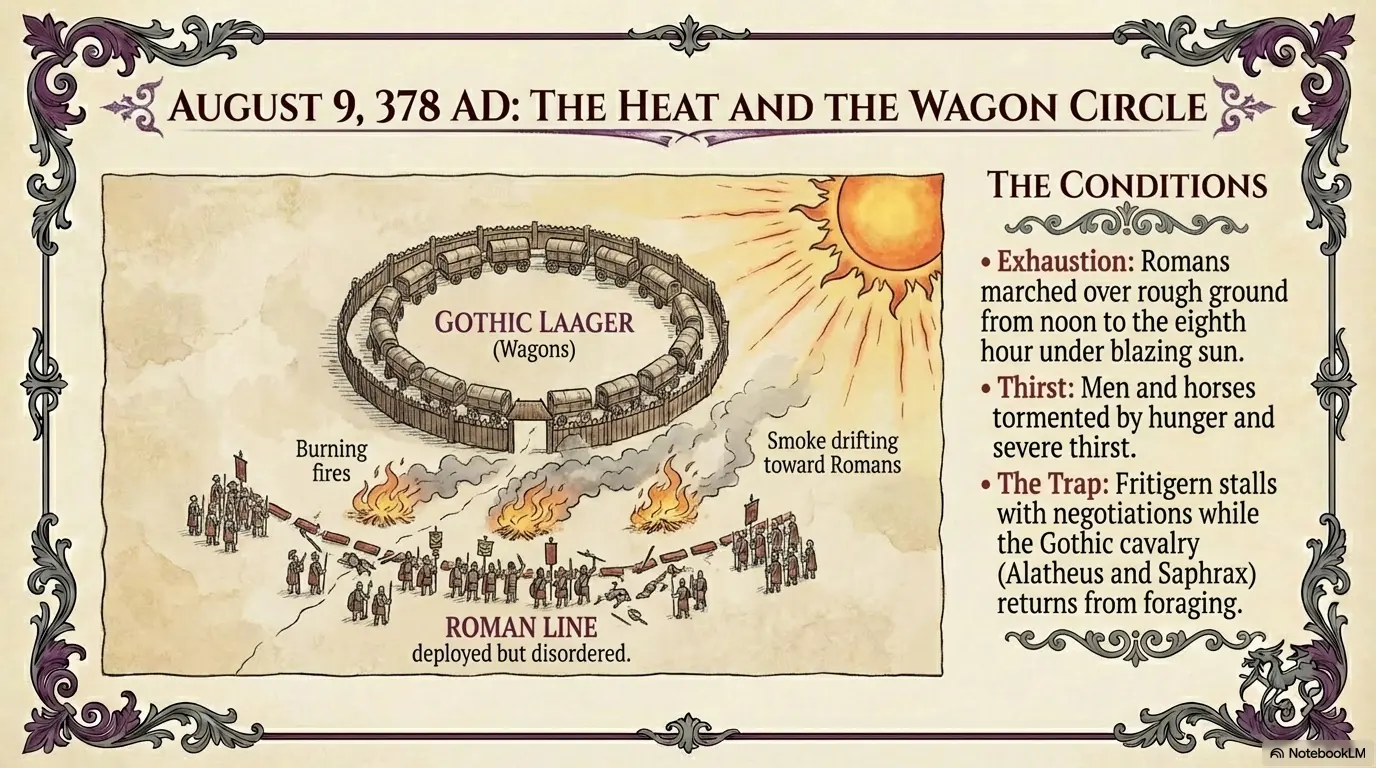
Theodosius I's son, ruling through an eastern court shaped by powerful ministers officers and imperial family relationships.
See also Constantinople
In the volumes Book VIII · Chapter 3: Adrianople and the Gothic Settlement
Western emperor whose reign included usurpation territorial contraction and Rome's sack; court power shifted among commanders and relatives.
See also Stilicho, Alaric, Ravenna
In the volumes Book VIII · Chapter 4: Stilicho, the Rhine Crossing, and the Sack of Rome · Book VIII · Chapter 3: Adrianople and the Gothic Settlement
Long-reigning eastern emperor associated with Constantinople's walls legal codification and major doctrinal councils.
In the volumes Book VIII · Chapter 5: Aetius, Africa, and Attila
Successful western commander elevated as Honorius's colleague shortly before death; husband of Galla Placidia and father of Valentinian III.
See also Galla Placidia, Valentinian III
Western emperor during Aetius's ascendancy and the loss of Africa; killed after ordering Aetius's murder.
See also Aetius, Gaiseric, Africa Proconsularis
In the volumes Book VIII · Chapter 5: Aetius, Africa, and Attila · Book VIII · Chapter 6: The Dissolution
Eastern emperor linked to Pulcheria; the Council of Chalcedon shaped enduring religious disputes during his reign.
In the volumes Book VIII · Chapter 5: Aetius, Africa, and Attila
Gallic aristocrat elevated with Visigothic support; deposed amid Italian opposition and the rise of Ricimer.
In the volumes Book VIII · Chapter 6: The Dissolution
Brief western emperor after Valentinian's murder; killed as Vandal forces approached Rome.
See also Gaiseric
In the volumes Book VIII · Chapter 6: The Dissolution
Eastern emperor who sought independence from military kingmakers; the great naval expedition against the Vandals failed.
Attempted to restore western authority and recover Africa; removed and killed after his relationship with Ricimer collapsed.
In the volumes Book VIII · Chapter 6: The Dissolution
Western emperor backed by Ricimer but not accepted by the eastern court; effective authority remained contested.
In the volumes Book VIII · Chapter 6: The Dissolution
Eastern-backed western emperor; the failed Vandal expedition damaged his position before war with Ricimer ended his reign.
See also Ricimer
In the volumes Book VIII · Chapter 6: The Dissolution
Brief western emperor during the final conflict between Anthemius and Ricimer; connected to the Theodosian family by marriage.
In the volumes Book VIII · Chapter 6: The Dissolution
Western emperor supported by Gundobad; deposed by Julius Nepos and became a bishop.
See also Julius Nepos, Burgundians
Recognized western emperor who continued in Dalmatia after Orestes's coup; 476 did not end every western imperial claim.
See also Romulus Augustulus, Dalmatia, Odoacer
In the volumes Book VIII · Chapter 6: The Dissolution
Child emperor and grandson of Leo I; briefly shared rule with his father Zeno before dying.
See also Zeno
Survived Basiliscus's usurpation and negotiated rival military and religious pressures; Theodoric moved into Italy under his authority.
See also Basiliscus, Theodoric
In the volumes Book VIII · Chapter 6: The Dissolution
Seized the eastern throne while Zeno fled; religious and political opposition helped Zeno return.
Orestes's young appointee in Italy, deposed by Odoacer; a conventional terminal date for western emperorship, not the end of Roman society.
See also Odoacer, Julius Nepos, Ravenna
In the volumes Book VIII · Chapter 6: The Dissolution
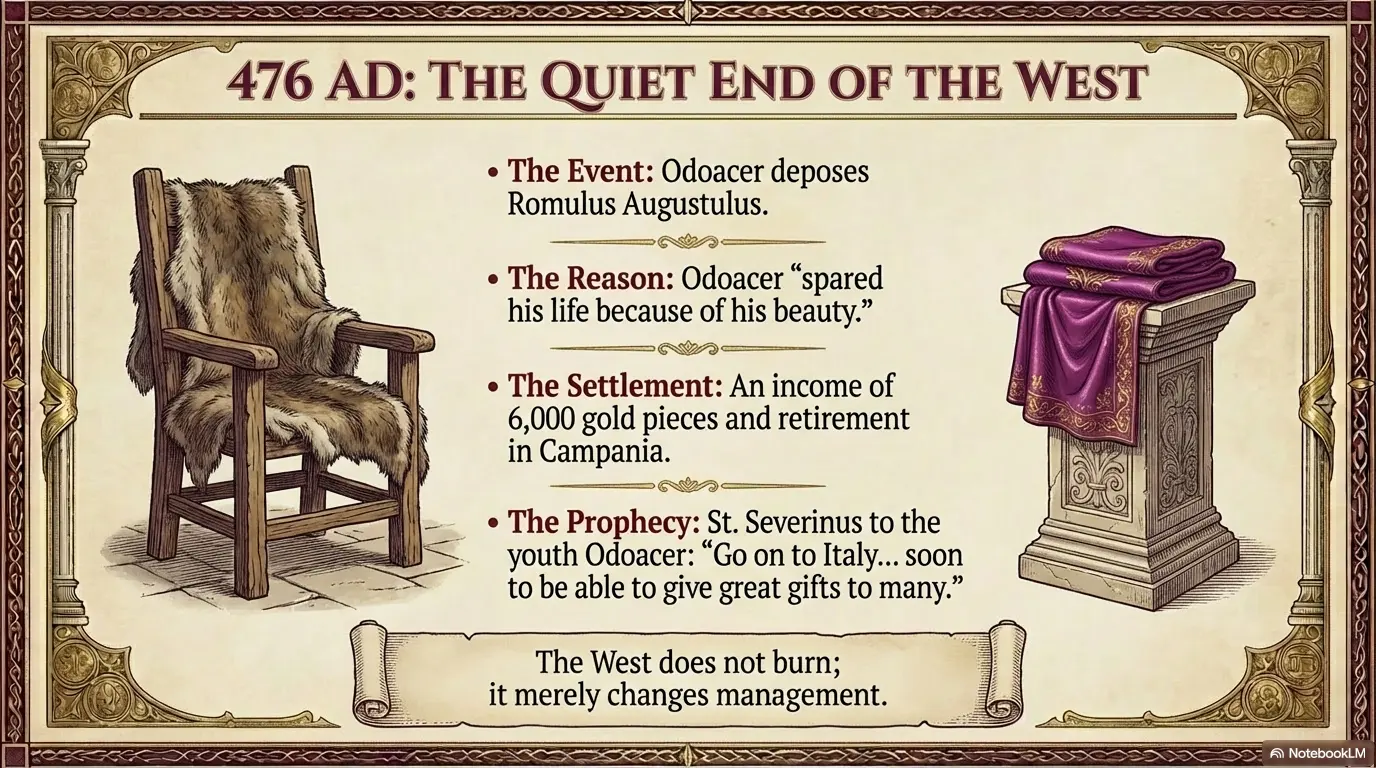
Stabilized currency and fiscal administration while confronting Isaurian Persian and religious conflicts.
See also Chrysargyron, Justin I
Former guards commander whose accession preceded his nephew Justinian's; promoted a Chalcedonian religious settlement.
See also Justinian I
Law codification construction and western reconquests reshaped the empire; plague and Persian warfare imposed severe burdens.
See also Belisarius, Narses, Corpus iuris civilis
Reversed aspects of Justinian's diplomacy; war with Persia resumed and Lombard expansion transformed Italy.
See also Lombards, Sasanians, Tiberius II Constantine
Read further DIR Phocas essay
Governed during Justin II's incapacity before becoming emperor; eastern warfare and fiscal commitments remained pressing.
Read further DIR Phocas essay
Ended a Persian war favorably and campaigned in the Balkans; military revolt led to his overthrow and execution.
See also Phocas, Avars, Khosrow II
Read further DIR Phocas essay
Army-backed emperor whose rule faced revolt and renewed Persian invasion; overthrown by Heraclius.
See also Heraclius, Khosrow II
Read further DIR Phocas essay
Recovered from Persian conquest through counteroffensives, then lost major eastern provinces to Arab armies; institutions continued adapting.
See also Nineveh, Yarmouk, Sasanians
Read further DIR: Heraclius
Heraclius's son and briefly senior emperor, distinct from the fifth-century western usurper of the same conventional name.
See also Heraclonas, Constans II
Read further DIR: Heraclius
Heraclius's son by Martina, briefly ruling after his half-brother's death; overthrown in the succession struggle.
See also Constantine III of the eastern empire, Constans II
Read further DIR: Heraclius
Eastern claimant defeated by Septimius Severus after civil war; his support illustrates the political weight of provincial armies.
See also Septimius Severus
In the volumes Book VII · Chapter 6: The Auction and the Severan Reconstruction
Previously Severus's Caesar, then rival emperor in the west; defeated at Lugdunum.
See also Septimius Severus, Lugdunum
In the volumes Book VII · Chapter 6: The Auction and the Severan Reconstruction
Established the western breakaway regime conventionally called the Gallic Empire, ruling Britain Gaul and at times Spain.
See also Gallienus
In the volumes Book VII · Chapter 7: The Breaking, 235–260 · Book VII · Chapter 8: The Recovery, 260–284
Palmyrene dynast whose titles escalated as his mother Zenobia's regime expanded; imperial claims collapsed under Aurelian.
In the volumes Book VII · Chapter 8: The Recovery, 260–284
Brief rebel against Postumus whose rising accelerated instability within the Gallic regime.
See also Postumus, Mogontiacum
Very short-lived successor in the Gallic regime; famous stories about his reign length and earlier trade require caution.
See also Victorinus
Gallic emperor after the upheavals of 269; killed before Tetricus assumed authority.
See also Tetricus I
Final senior Gallic emperor; defeated by Aurelian at Chalons, ending the separate regime.
See also Aurelian
In the volumes Book VII · Chapter 8: The Recovery, 260–284
Commander who established a separate regime in Britain and parts of northern Gaul; killed by Allectus.
In the volumes Book VIII · Chapter 1: The Tetrarchy and the Wars of Constantine
Succeeded Carausius in Britain; defeated during Constantius I's reconquest.
See also Constantius I Chlorus, Britannia
In the volumes Book VIII · Chapter 1: The Tetrarchy and the Wars of Constantine
Western usurper who displaced Constans; defeated by Constantius II after costly civil war.
See also Constantius II
In the volumes Book VIII · Chapter 2: The House of Constantine at War: Persia, Strasbourg, and the Road to Ctesiphon
Short-lived claimant at Rome during Magnentius's ascendancy; killed as the revolt was suppressed.
See also Magnentius, Rome
Brief Danubian imperial claimant who surrendered his rank to Constantius II.
See also Constantius II
Relative of Julian who seized Constantinople and challenged Valens; defeated after defections.
See also Valens, Constantinople
Western emperor originating in Britain; killed after Theodosius defeated his expansion into Italy.
See also Gratian, Theodosius I
In the volumes Book VIII · Chapter 3: Adrianople and the Gothic Settlement
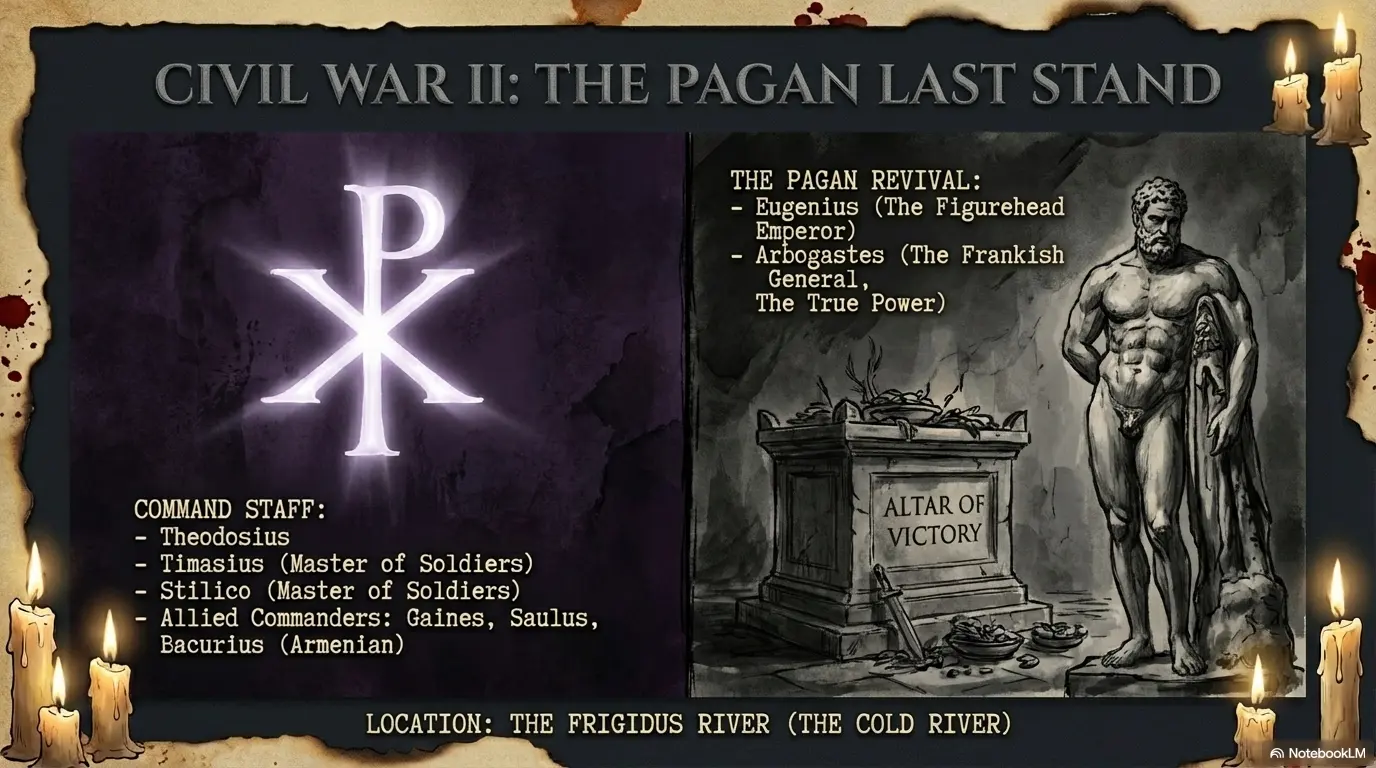
Western claimant supported by Arbogast after Valentinian II's death; defeated at the Frigidus.
See also Arbogast, Theodosius I
In the volumes Book VIII · Chapter 3: Adrianople and the Gothic Settlement
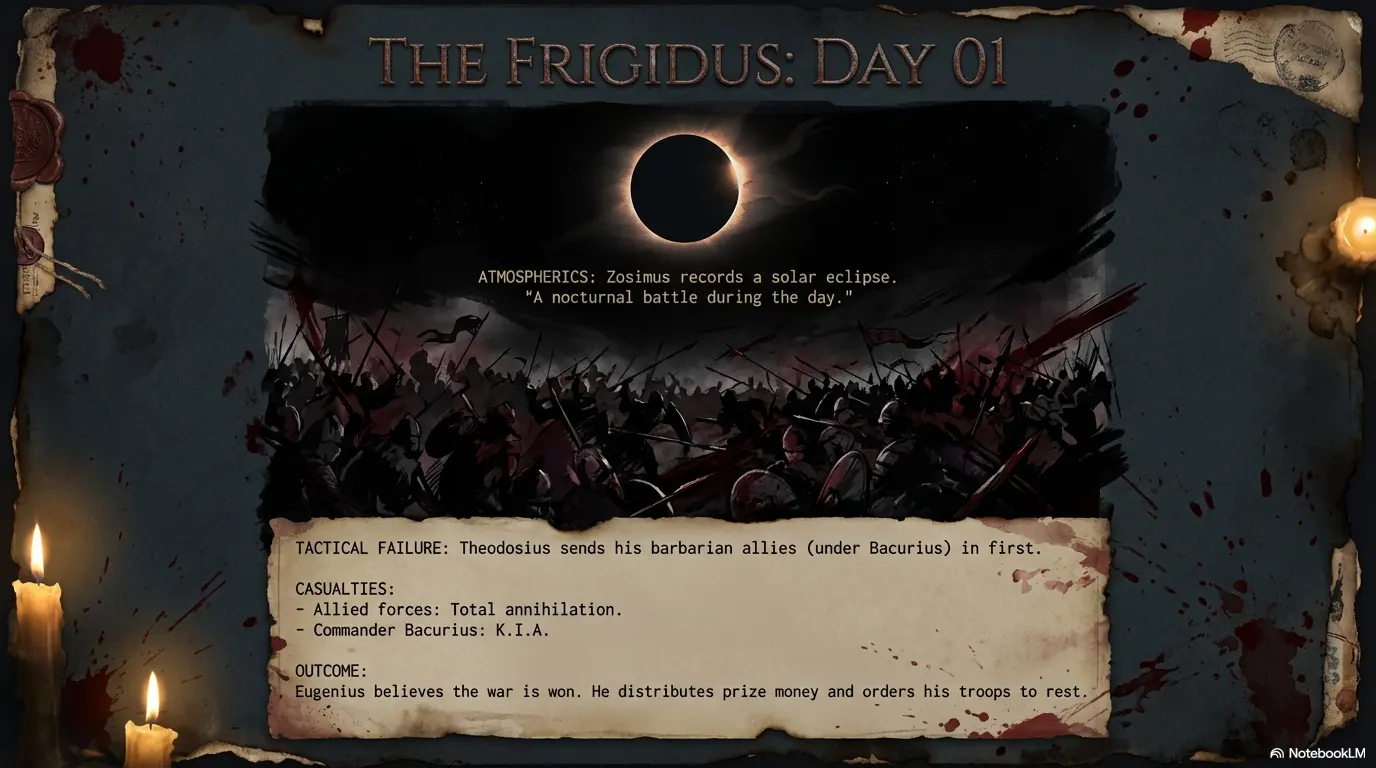
Usurper raised in Britain who established authority in Gaul before military reverses and execution.
In the volumes Book VIII · Chapter 4: Stilicho, the Rhine Crossing, and the Sack of Rome
Senatorial claimant promoted twice in Gothic power struggles; ultimately deposed and exiled.
See also Alaric, Athaulf, Honorius
In the volumes Book VIII · Chapter 4: Stilicho, the Rhine Crossing, and the Sack of Rome
Gallic claimant supported initially by Burgundian and Alan forces; defeated during changing Visigothic alliances.
See also Burgundians, Alans, Athaulf
Brother and co-claimant of Jovinus whose elevation formed part of the same failed Gallic regime.
See also Jovinus
Western claimant after Honorius's death, defeated by an eastern expedition installing Valentinian III.
See also Valentinian III, Galla Placidia
Augustus's sister and Mark Antony's wife; a major dynastic intermediary whose public image stressed family and civic virtue.
See also Mark Antony, Augustus
In the volumes Book V · Chapter 8: The Civil Wars and the End of the Republic
Augustus's wife and Tiberius's mother; household influence dynastic memory and later deification made her central to imperial legitimacy.
Augustus's daughter and an essential dynastic link; her marriages and exile reveal the political regulation of imperial family conduct.
Germanicus's wife and Caligula's mother; political conflict with Tiberius's court ended in exile and death.
See also Germanicus, Caligula
In the volumes Book VI · Chapter 3: Germanicus and the Julio-Claudian North
Daughter of Germanicus, wife of Claudius and mother of Nero; exercised conspicuous dynastic influence before Nero ordered her death.
Claudius's wife, executed after a crisis involving Gaius Silius; lurid ancient portrayals are politically charged.
See also Claudius
Trajan's wife, associated with patronage and Hadrian's succession; specific claims about decisive intervention remain source-dependent.
Wife of Septimius Severus and mother of Caracalla and Geta; prominent in dynasty administration and intellectual patronage.
See also Septimius Severus, Caracalla
Severan dynastic matriarch instrumental in Elagabalus's accession and the transition to Severus Alexander.
See also Elagabalus, Severus Alexander
Mother of Severus Alexander and central to his court; killed with him during the military revolt.
See also Severus Alexander, Maximinus Thrax
In the volumes Book VII · Chapter 6: The Auction and the Severan Reconstruction
Constantine's mother, associated with Christian pilgrimage and imperial religious patronage; later relic traditions require chronological separation.
See also Constantine I, Jerusalem
Read further DIR Constantine I essay
Maximian's daughter and Constantine's wife, whose execution belongs to a poorly explained dynastic crisis.
See also Constantine I, Maximian
Read further DIR Constantine I essay
Valentinian I's wife and Valentinian II's mother; her dynastic role and support for Homoian Christianity brought her court into conflict with Ambrose.
See also Valentinian I, Valentinian II, Eugenius
Read further DIR: Valentinian II
Theodosian princess, wife first of Athaulf then Constantius III, and mother/regent of Valentinian III; connected Gothic and imperial politics.
See also Athaulf, Constantius III, Valentinian III
In the volumes Book VIII · Chapter 4: Stilicho, the Rhine Crossing, and the Sack of Rome · Book VIII · Chapter 5: Aetius, Africa, and Attila
Theodosius II's sister and influential Augusta; linked to Marcian's accession and Chalcedonian religious patronage.
See also Theodosius II, Marcian, Chalcedon
Wife of Theodosius II, poet and patron, later resident in Jerusalem; court conflict intersects with religious and literary activity.
See also Theodosius II, Jerusalem
Justinian's empress, a significant court and religious actor; especially associated with protection of anti-Chalcedonian networks.
See also Justinian I, Miaphysitism
Read further DIR Justinian essay
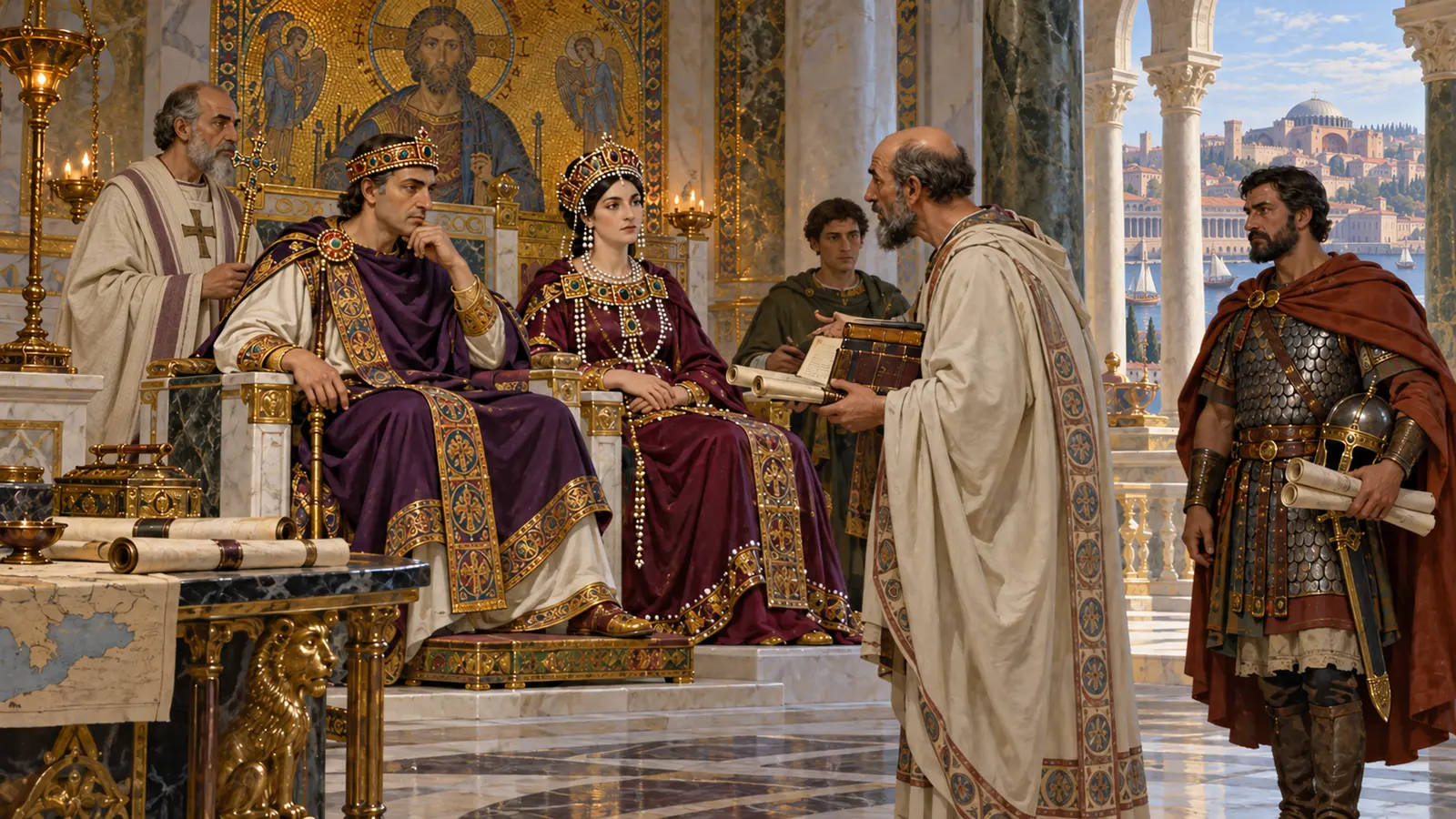
Belisarius's wife and influential campaign/court participant; Procopius's hostile portrayals need genre and motive controls.
See also Belisarius, Theodora
Read further DIR Justinian essay
Heraclius's wife and mother of Heraclonas; contested regency and succession ended in deposition and mutilation.
See also Heraclius, Heraclonas
Read further DIR: Heraclius
Traditional expeller of the Tarquins and first consul; the later republican foundation story gives him an exemplary defense of liberty.
See also Roman Republic, Tarquinius Superbus
Read further Livy History of Rome Book 2
Commander associated with the conquest of Veii and Rome recovery after the Gallic sack; later stories magnify his founding role.
In the volumes Book I · Chapter 1: The Gallic Catastrophe · Book I · Proem
Read further Plutarch Life of Camillus
Name attached to the Gallic leader in later accounts of Rome's sack; narrative details and chronology are reconstructed and must be distinguished from the later Balkan Brennus.
See also Gallic sack of Rome, Gauls or Celts, Marcus Furius Camillus
In the volumes Book I · Chapter 1: The Gallic Catastrophe
Consul in the Latin War; Roman tradition made his punishment of his son an example of military command overriding family loyalty.
In the volumes Book I · Chapter 2: The Latin Twilight and the Samnite Dawn · Book III · Chapter 1: The Aftermath of Cannae: Recovery, Capua, and the Macedonian Threat
Read further Livy History of Rome Book 8
Consul whose reported self-devotion in battle became a central Roman example of devotio; distinguish him from his namesake son.
See also Devotio
In the volumes Book I · Chapter 2: The Latin Twilight and the Samnite Dawn · Book I · Proem
Read further Livy History of Rome Book 8
Repeated consul and commander in the Samnite conflicts, sharing Roman command at Sentinum with the younger Decius Mus.
In the volumes Book I · Chapter 4: The Coalition War: Sentinum and Its Antecedents · Book I · Chapter 3: The Long Samnite War
Read further Livy History of Rome Book 10
Hellenistic king who challenged Roman expansion for Tarentum; victories in Italy did not produce a durable strategic settlement.
See also Pyrrhic War, Asculum
In the volumes Book I · Chapter 5: The Pyrrhic War · Book I · Chapter 6: The Consolidation of Italy · Book I · Proem · Book I · Chapter 3: The Long Samnite War · Book I · Epilogue: Rome in 264 BC
Read further Plutarch Life of Pyrrhus
Censor associated with the Via Appia and Aqua Appia; remembered as a political reformer and opponent of accommodation with Pyrrhus.
See also Via Appia
In the volumes Book I · Chapter 3: The Long Samnite War · Book I · Chapter 4: The Coalition War: Sentinum and Its Antecedents · Book I · Chapter 5: The Pyrrhic War · Book I · Epilogue: Rome in 264 BC · Book II · Chapter 2: The First Punic War: Africa, Sicily, and the Long Resolution
Read further Livy History of Rome Book 9 · Plutarch Life of Pyrrhus
Conqueror of Samnites and Sabines and Roman commander against Pyrrhus at Beneventum; later writers emphasized his austere public virtue.
See also Beneventum, Samnites
In the volumes Book I · Chapter 6: The Consolidation of Italy · Book I · Proem · Book I · Chapter 4: The Coalition War: Sentinum and Its Antecedents · Book I · Chapter 5: The Pyrrhic War · Book I · Epilogue: Rome in 264 BC
Read further Plutarch Life of Pyrrhus
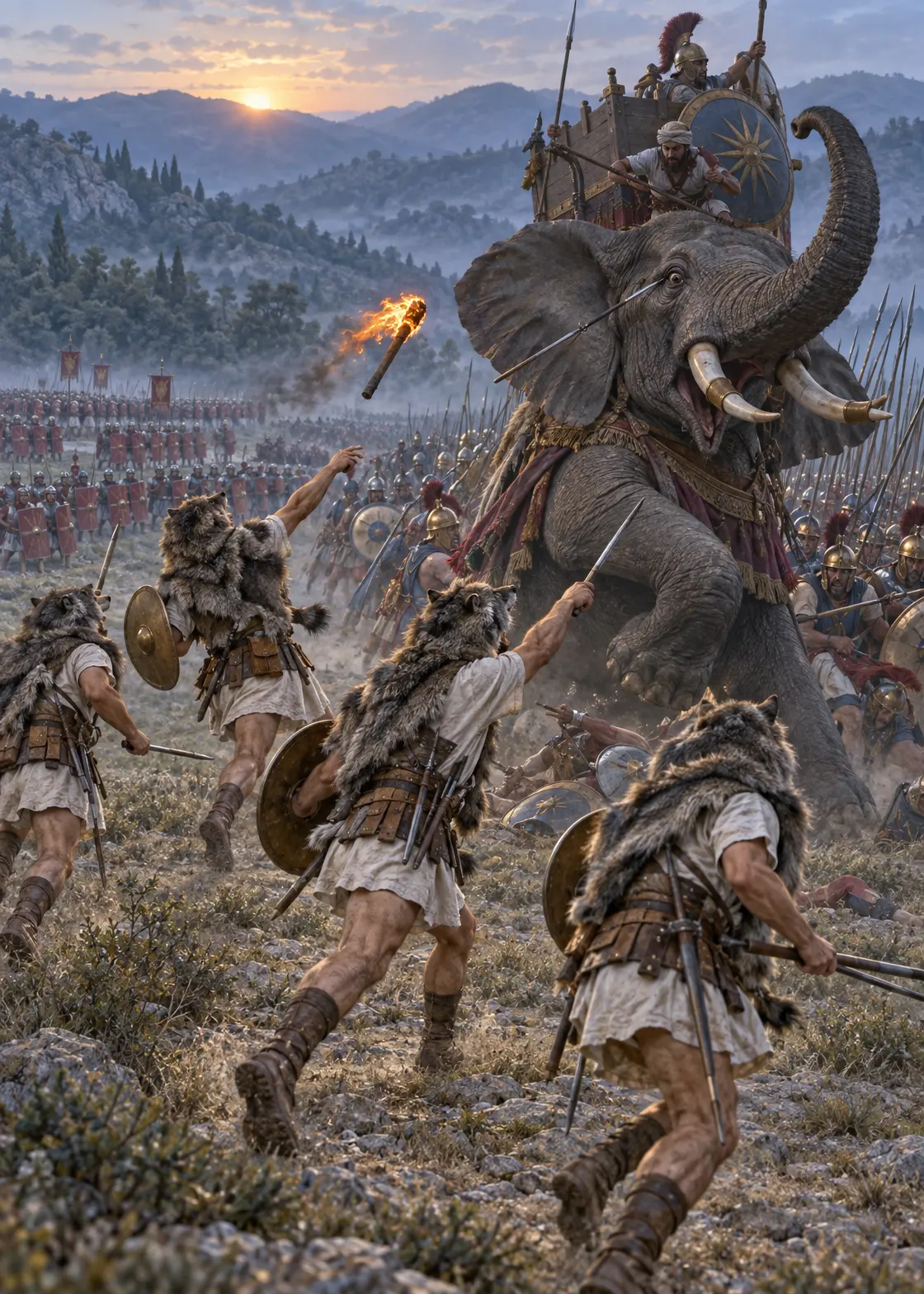
Dictator whose avoidance of decisive battle constrained Hannibal; his delaying strategy depended on resources, allied loyalty and political support.
See also Second Punic War, Hannibal
In the volumes Book II · Chapter 4: The Coming of Hannibal: From Saguntum to the Alps · Book II · Chapter 5: The Year of Hannibal: Ticinus, Trebia, Trasimene, and the Fabian Strategy · Book II · Epilogue: Rome in the Late Summer of 216 · Book III · Chapter 2: The Sicilian Theater: Syracuse and the Recovery of the Italian South · Book III · Chapter 6: Scipio in Africa
Read further Plutarch Life of Fabius Maximus
Carthaginian commander in Sicily and the Mercenary War who expanded Carthaginian power in Iberia; father of Hannibal.
In the volumes Book II · Chapter 2: The First Punic War: Africa, Sicily, and the Long Resolution · Book II · Chapter 3: The Interwar Years: Mercenary War, Sardinia, Gauls, and Illyrians · Book III · Chapter 5: Ilipa and the End of Carthaginian Spain · Book II · Chapter 4: The Coming of Hannibal: From Saguntum to the Alps · Book III · Chapter 3: The Spanish Theater: The Elder Scipios and the Rise of the Younger
Read further Polybius Histories Book 2
Five-time consul, captor of Syracuse and vigorous opponent of Hannibal; associated with the spolia opima after Clastidium.
See also Syracuse, Second Punic War
In the volumes Book III · Chapter 2: The Sicilian Theater: Syracuse and the Recovery of the Italian South · Book III · Chapter 1: The Aftermath of Cannae: Recovery, Capua, and the Macedonian Threat · Book II · Chapter 3: The Interwar Years: Mercenary War, Sardinia, Gauls, and Illyrians · Book III · Proem · Book II · Epilogue: Rome in the Late Summer of 216 · Book III · Chapter 6: Scipio in Africa · Book IV · Chapter 4: The Spanish Wars: Lusitanians, Celtiberians, Viriathus, and Numantia
Read further Plutarch Life of Marcellus
Consul who invaded Carthaginian Africa and was defeated and captured; later traditions about his death require caution.
See also First Punic War
In the volumes Book II · Chapter 2: The First Punic War: Africa, Sicily, and the Long Resolution · Book II · Chapter 1: The First Punic War: Opening and the Birth of Roman Sea-Power
Read further Polybius Histories Book 1
Consul credited with Rome naval victory at Mylae; his commemorative column celebrated a major early success at sea.
See also Mylae
In the volumes Book II · Chapter 1: The First Punic War: Opening and the Birth of Roman Sea-Power
Read further Polybius Histories Book 1
Carthaginian commander whose invasion of Italy and victories at Trebia, Trasimene and Cannae challenged Rome alliance system.
See also Second Punic War, Cannae
In the volumes Book III · Chapter 7: Zama and the Peace · Book II · Chapter 5: The Year of Hannibal: Ticinus, Trebia, Trasimene, and the Fabian Strategy · Book II · Chapter 4: The Coming of Hannibal: From Saguntum to the Alps · Book II · Chapter 6: Cannae · Book III · Chapter 4: Hasdrubal's March and the Metaurus · Book III · Chapter 1: The Aftermath of Cannae: Recovery, Capua, and the Macedonian Threat · Book III · Chapter 2: The Sicilian Theater: Syracuse and the Recovery of the Italian South · Book III · Chapter 6: Scipio in Africa and 11 more
Read further Polybius Histories Book 3
Hannibal brother fought Roman armies in Iberia, then crossed into Italy and was defeated and killed at the Metaurus.
In the volumes Book III · Chapter 4: Hasdrubal's March and the Metaurus · Book III · Chapter 3: The Spanish Theater: The Elder Scipios and the Rise of the Younger · Book III · Chapter 5: Ilipa and the End of Carthaginian Spain · Book II · Chapter 2: The First Punic War: Africa, Sicily, and the Long Resolution · Book II · Epilogue: Rome in the Late Summer of 216 · Book III · Proem · Book III · Chapter 6: Scipio in Africa
Read further Livy History of Rome Book 27
Roman naval commander at the Aegates Islands; the victory enabled the peace ending the First Punic War.
See also Aegates Islands, First Punic War
In the volumes Book II · Chapter 2: The First Punic War: Africa, Sicily, and the Long Resolution
Read further Polybius Histories Book 1
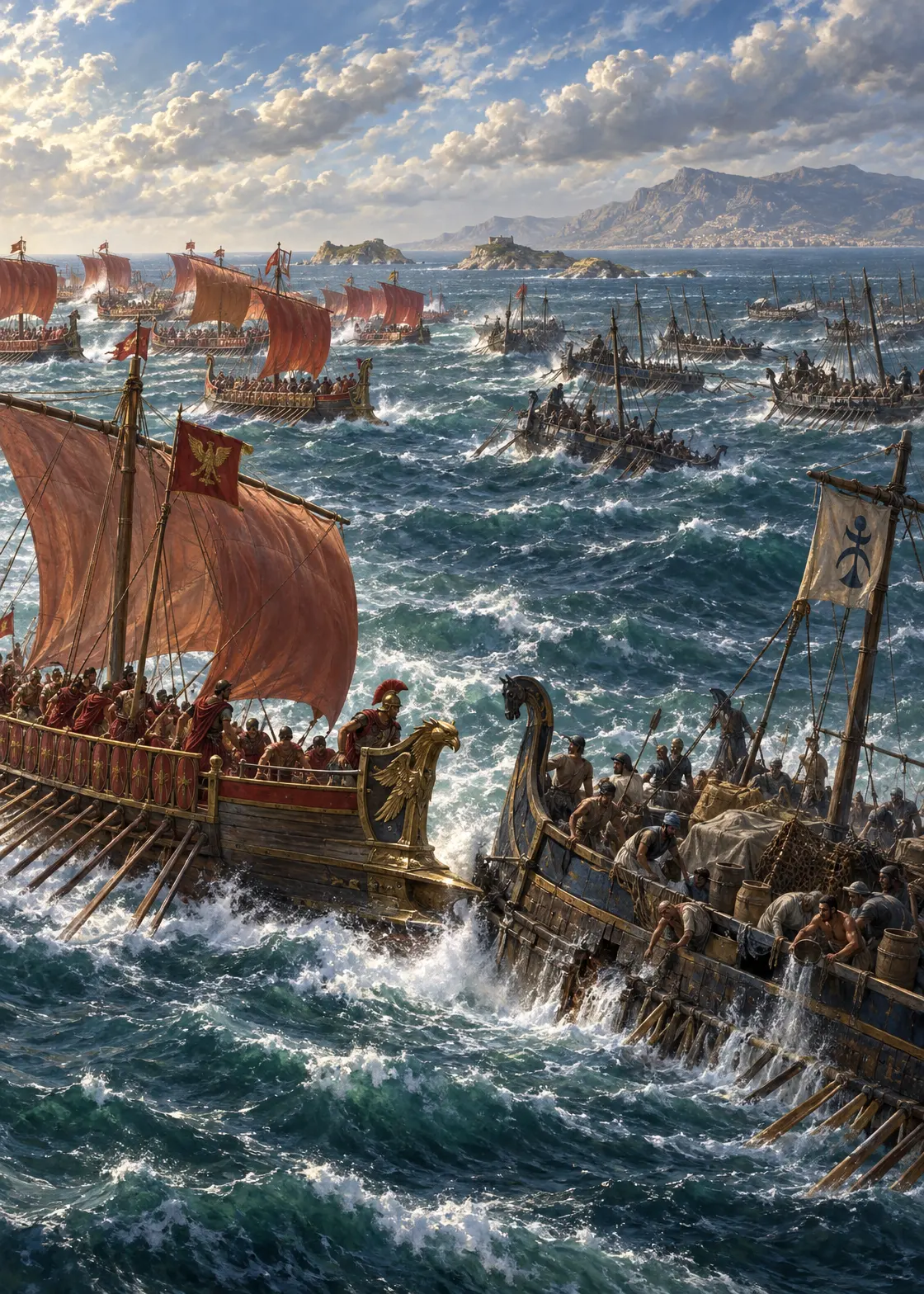
Numidian ruler whose alliance and cavalry helped Scipio defeat Carthage; later expansion intensified pressures preceding the Third Punic War.
In the volumes Book III · Chapter 6: Scipio in Africa · Book III · Chapter 7: Zama and the Peace · Book IV · Chapter 5: The Third Punic War and the Destruction of Carthage
Read further Polybius Histories Book 15
Publius Cornelius Scipio shifted the war to Carthaginian territories, captured New Carthage and defeated Hannibal at Zama.
In the volumes Book III · Chapter 6: Scipio in Africa · Book III · Chapter 7: Zama and the Peace · Book III · Chapter 3: The Spanish Theater: The Elder Scipios and the Rise of the Younger · Book III · Chapter 5: Ilipa and the End of Carthaginian Spain · Book II · Chapter 5: The Year of Hannibal: Ticinus, Trebia, Trasimene, and the Fabian Strategy · Book IV · Chapter 2: The Syrian War: Antiochus, Thermopylae, and Magnesia · Book III · Chapter 4: Hasdrubal's March and the Metaurus · Book III · Proem and 12 more
Read further Polybius Histories Book 11 · Polybius Histories Book 15
Marcus Porcius Cato combined military and censorial office with writing on agriculture, ancestral conduct and opposition to Carthage.
See also Third Punic War
In the volumes Book IV · Chapter 2: The Syrian War: Antiochus, Thermopylae, and Magnesia · Book IV · Chapter 5: The Third Punic War and the Destruction of Carthage · Book IV · Proem · Book II · Chapter 6: Cannae · Book III · Chapter 2: The Sicilian Theater: Syracuse and the Recovery of the Italian South · Book III · Chapter 7: Zama and the Peace · Book IV · Chapter 1: The Second Macedonian War: Flamininus and Cynoscephalae · Book IV · Chapter 3: The Third Macedonian War: Aemilius Paullus and Pydna and 1 more
Read further Plutarch Life of Cato Major
Consul who defeated Perseus at Pydna; the victory dismantled the Macedonian monarchy and produced large transfers of wealth and captives.
See also Pydna, Perseus of Macedon
Read further Plutarch Life of Aemilius
Roman commander at Cynoscephalae and proclaimer of Greek freedom in 196 BCE, a freedom framed within Roman predominance.
See also Cynoscephalae
In the volumes Book IV · Chapter 1: The Second Macedonian War: Flamininus and Cynoscephalae · Book IV · Proem · Book III · Chapter 7: Zama and the Peace
Read further Plutarch Life of Flamininus
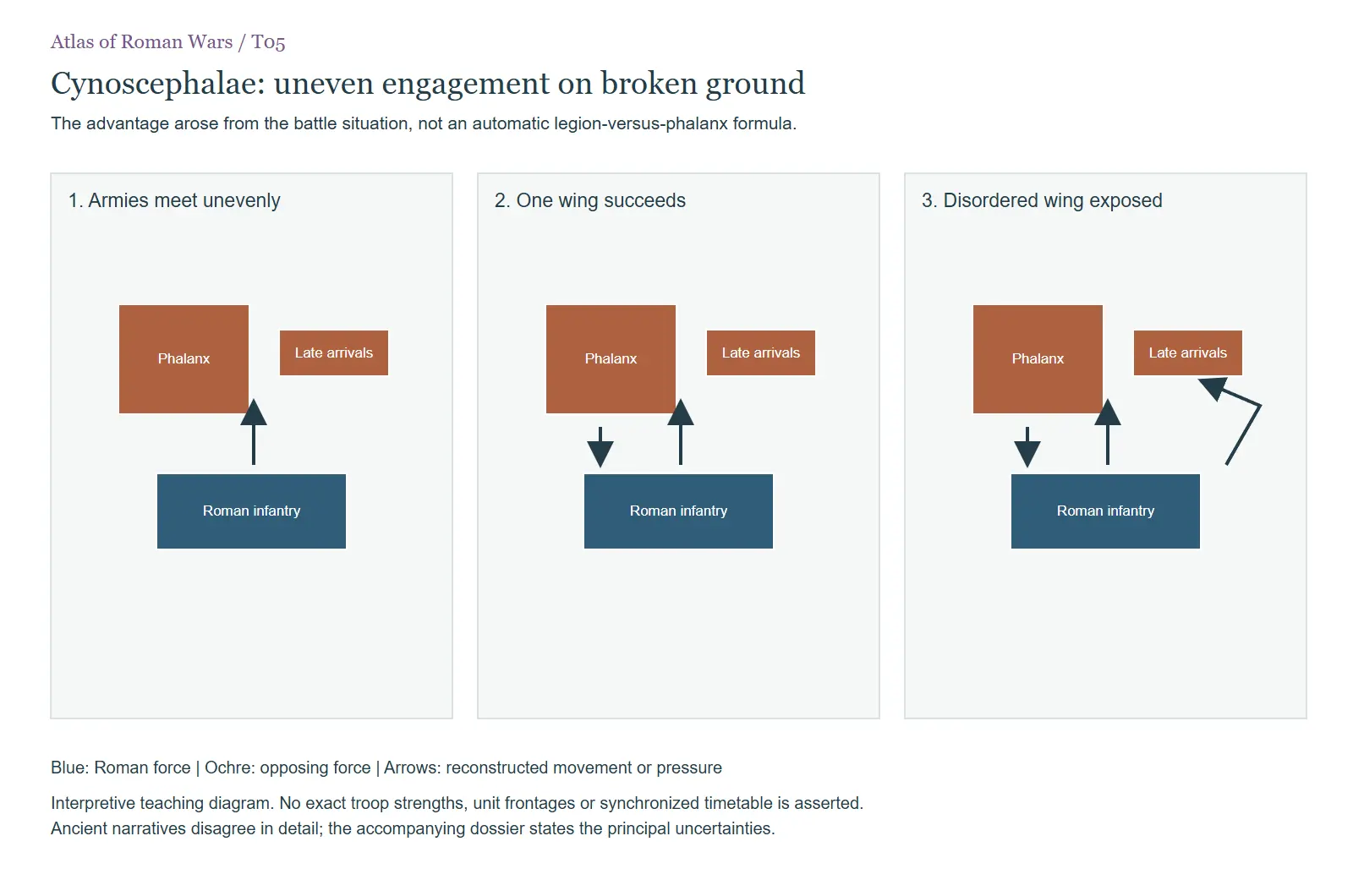
Seleucid ruler whose recovery of royal power preceded defeat by Rome and its allies; the Apamea settlement imposed territorial and financial constraints.
See also Roman Seleucid War, Magnesia, Seleucid kingdom, Eumenes II of Pergamum
In the volumes Book IV · Chapter 2: The Syrian War: Antiochus, Thermopylae, and Magnesia · Book III · Chapter 7: Zama and the Peace · Book IV · Chapter 1: The Second Macedonian War: Flamininus and Cynoscephalae · Book III · Epilogue: Rome in 201 BC
Read further Livy History of Rome Book 37
Antigonid king confronting Rome in the first two Macedonian wars; defeat at Cynoscephalae reduced his power, though he remained king and later cooperated with Rome.
See also First Macedonian War, Second Macedonian War, Cynoscephalae, Macedonian kingdom
In the volumes Book IV · Chapter 1: The Second Macedonian War: Flamininus and Cynoscephalae · Book III · Chapter 1: The Aftermath of Cannae: Recovery, Capua, and the Macedonian Threat · Book II · Chapter 3: The Interwar Years: Mercenary War, Sardinia, Gauls, and Illyrians · Book IV · Proem · Book IV · Chapter 2: The Syrian War: Antiochus, Thermopylae, and Magnesia
Read further Polybius Histories Book 18 · Plutarch Life of Flamininus
Numidian king who allied with Carthage against Scipio and Masinissa before defeat and capture.
See also Numidia, Second Punic War
In the volumes Book III · Chapter 6: Scipio in Africa · Book III · Chapter 7: Zama and the Peace
Read further Livy History of Rome Book 30
Attalid ruler and Roman ally against Antiochus III; benefited from the Apamea settlement, although later relations with Rome became more strained.
See also Attalid kingdom of Pergamum, Antiochus III the Great, Roman Seleucid War
In the volumes Book IV · Chapter 2: The Syrian War: Antiochus, Thermopylae, and Magnesia · Book IV · Chapter 3: The Third Macedonian War: Aemilius Paullus and Pydna
Read further Livy History of Rome Book 37
Adoptive Scipio who destroyed Carthage in 146 BCE and captured Numantia in 133 BCE.
See also Third Punic War, Numantine War
In the volumes Book IV · Chapter 5: The Third Punic War and the Destruction of Carthage · Book IV · Chapter 4: The Spanish Wars: Lusitanians, Celtiberians, Viriathus, and Numantia · Book IV · Proem · Book IV · Epilogue: Rome in 146 BC · Book IV · Chapter 3: The Third Macedonian War: Aemilius Paullus and Pydna · Book IV · Chapter 6: The Achaean War and the Sack of Corinth · Book V · Chapter 1: The Gracchan Crisis: The Return of Political Violence · Book III · Chapter 7: Zama and the Peace and 3 more
Read further Appian Punic Wars · Appian Spanish Wars
Last Antigonid king, defeated at Pydna in the Third Macedonian War; Rome abolished the monarchy and initially organized Macedonia into separate republics.
See also Third Macedonian War, Pydna, Macedonian kingdom
In the volumes Book IV · Chapter 3: The Third Macedonian War: Aemilius Paullus and Pydna · Book IV · Proem
Read further Plutarch Life of Aemilius
Tribune in 133 BCE who pursued redistribution of public land; his violent death marked a major escalation in elite political conflict.
In the volumes Book II · Chapter 6: Cannae · Book III · Chapter 1: The Aftermath of Cannae: Recovery, Capua, and the Macedonian Threat · Book IV · Chapter 4: The Spanish Wars: Lusitanians, Celtiberians, Viriathus, and Numantia · Book V · Proem · Book V · Chapter 1: The Gracchan Crisis: The Return of Political Violence
Read further Plutarch Life of Tiberius Gracchus
Numidian king whose war with Rome exposed competition and corruption among Roman commanders; captured through Bocchus and Sulla.
See also Jugurthine War
In the volumes Book V · Chapter 2: The Jugurthine War and the Rise of Marius · Book IV · Chapter 4: The Spanish Wars: Lusitanians, Celtiberians, Viriathus, and Numantia
Read further Sallust Jugurthine War
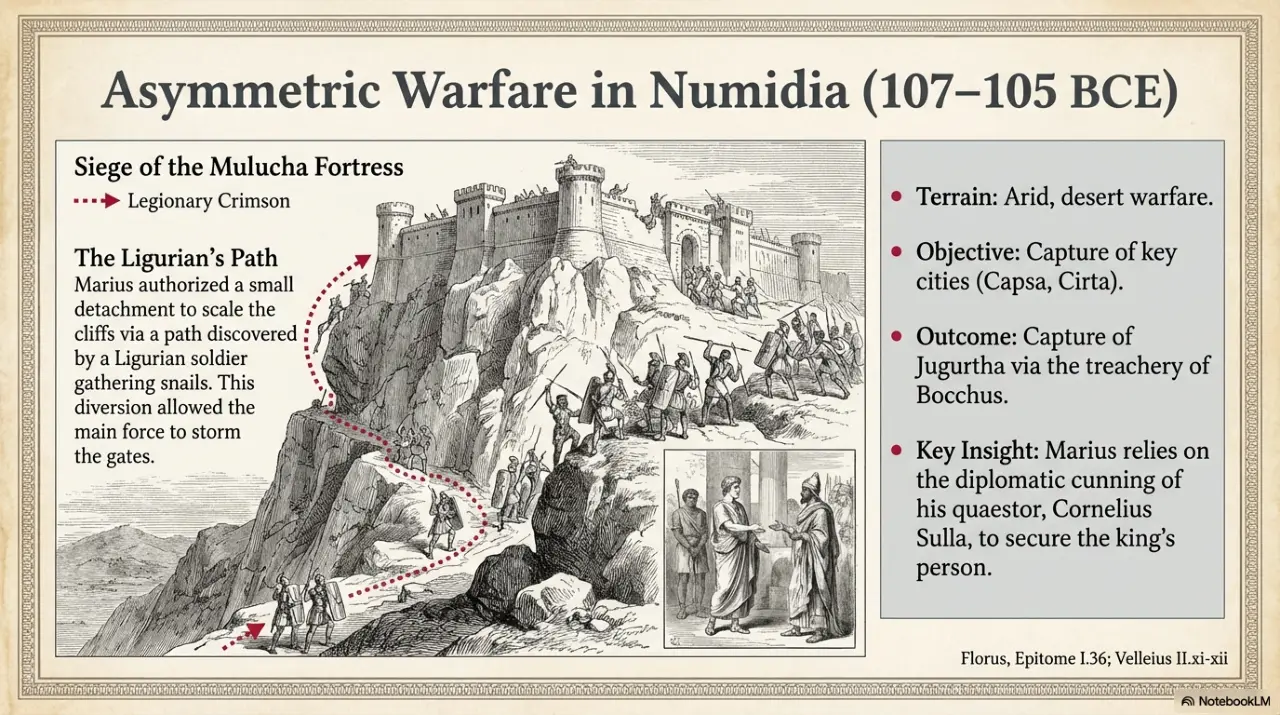
Commander against Jugurtha before Marius; his career illustrates aristocratic rivalry, military reputation and exile during political conflict.
See also Jugurthine War, Gaius Marius
In the volumes Book V · Chapter 2: The Jugurthine War and the Rise of Marius · Book V · Chapter 3: The Northern Peril: The Cimbri, the Teutones, and the Marian Army
Read further Sallust Jugurthine War
Repeated consul and victor over Jugurtha, Teutones and Cimbri; his rivalry with Sulla helped turn military command into civil war.
See also Jugurthine War, Cimbrian War
In the volumes Book V · Chapter 2: The Jugurthine War and the Rise of Marius · Book V · Chapter 3: The Northern Peril: The Cimbri, the Teutones, and the Marian Army · Book V · Chapter 4: The Social War and the Civil Wars of Marius and Sulla · Book V · Proem · Book IV · Epilogue: Rome in 146 BC · Book IV · Proem · Book IV · Chapter 4: The Spanish Wars: Lusitanians, Celtiberians, Viriathus, and Numantia · Book V · Chapter 1: The Gracchan Crisis: The Return of Political Violence
Read further Plutarch Life of Marius
Tribune whose program joined grain provision, courts, colonies and wider citizenship questions; killed amid political violence in 121 BCE.
See also Grain supply, Tiberius Sempronius Gracchus
In the volumes Book V · Chapter 1: The Gracchan Crisis: The Return of Political Violence
Read further Plutarch Life of Caius Gracchus
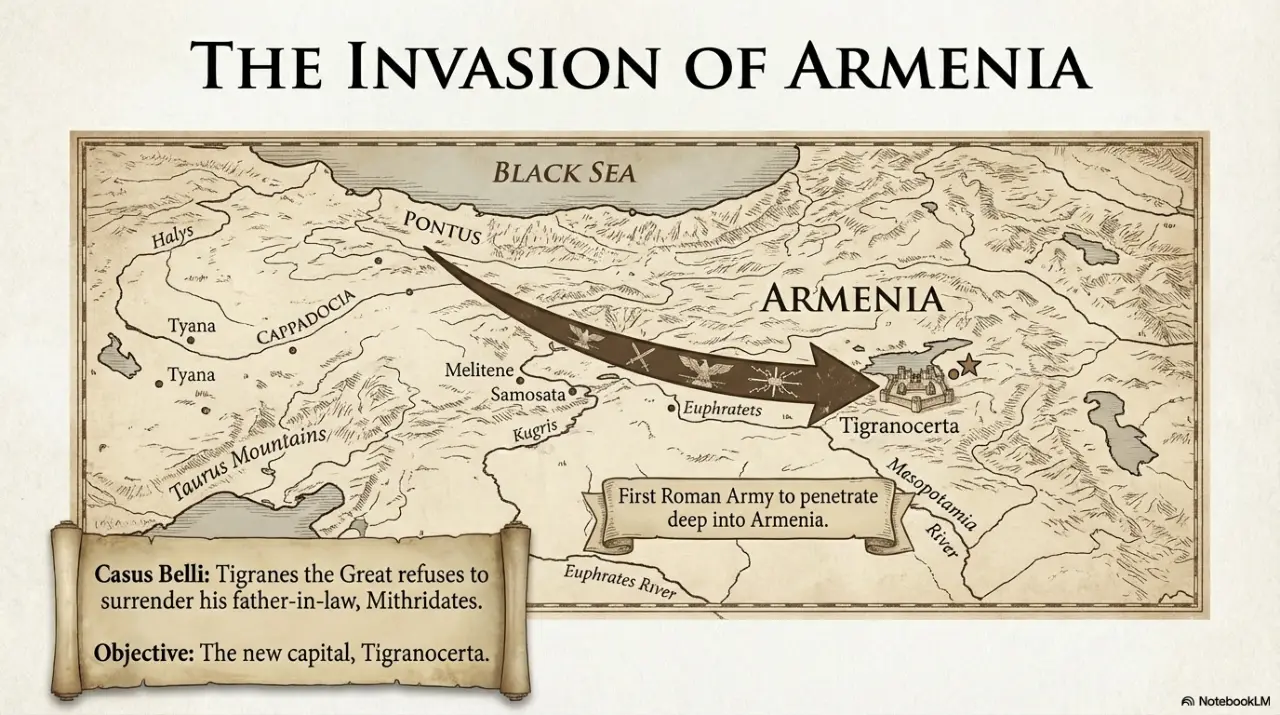
Armenian king whose territorial expansion and alliance with Mithridates brought war with Lucullus; later submitted to Pompey.
See also Armenia
In the volumes Book V · Chapter 6: Pompey and the Conquest of the East
Read further Plutarch Life of Lucullus
Leader of resistance to Roman expansion whose successes secured a treaty before Roman-backed assassination ended his leadership.
See also Lusitanian War, Hispania
In the volumes Book IV · Chapter 4: The Spanish Wars: Lusitanians, Celtiberians, Viriathus, and Numantia
Read further Appian Spanish Wars
General and dictator who marched on Rome, defeated Mithridatic forces, proscribed opponents and attempted an oligarchic constitutional settlement.
See also First Mithridatic War, Sullan civil wars
In the volumes Book V · Chapter 4: The Social War and the Civil Wars of Marius and Sulla · Book V · Chapter 5: Wars in the Shadow of the Settlement: Mithridates, Sertorius, Spartacus · Book V · Chapter 2: The Jugurthine War and the Rise of Marius · Book V · Proem · Book V · Chapter 6: Pompey and the Conquest of the East · Book V · Chapter 3: The Northern Peril: The Cimbri, the Teutones, and the Marian Army
Read further Plutarch Life of Sulla
Pontic king who assembled shifting coalitions against Rome in three wars; defeated successively by Sulla, Lucullus and Pompey.
See also Mithridatic Wars, Pontus
In the volumes Book V · Chapter 6: Pompey and the Conquest of the East · Book V · Chapter 5: Wars in the Shadow of the Settlement: Mithridates, Sertorius, Spartacus · Book V · Chapter 4: The Social War and the Civil Wars of Marius and Sulla
Read further Appian Mithridatic Wars
Enslaved Syrian religious figure and rebel king, styled Antiochus, who led the First Servile War.
See also First Servile War, Sicilia
Read further Diodorus Library Books 34-35 fragments
Anti-Sullan Roman commander who built an Iberian coalition and rival administration before assassination by associates.
See also Sertorian War, Pompey
In the volumes Book V · Chapter 5: Wars in the Shadow of the Settlement: Mithridates, Sertorius, Spartacus · Book V · Proem · Book V · Chapter 4: The Social War and the Civil Wars of Marius and Sulla · Book V · Chapter 6: Pompey and the Conquest of the East
Read further Plutarch Life of Sertorius
Commander who broke Mithridates operations at Cyzicus and defeated Tigranes at Tigranocerta before Pompey replaced him.
See also Third Mithridatic War
In the volumes Book V · Chapter 6: Pompey and the Conquest of the East · Book IV · Chapter 4: The Spanish Wars: Lusitanians, Celtiberians, Viriathus, and Numantia · Book V · Proem · Book V · Chapter 4: The Social War and the Civil Wars of Marius and Sulla · Book V · Chapter 5: Wars in the Shadow of the Settlement: Mithridates, Sertorius, Spartacus
Read further Plutarch Life of Lucullus
Wealthy Roman magnate, victor over Spartacus and member of the informal alliance with Caesar and Pompey; killed after Carrhae.
See also Third Servile War, Carrhae
In the volumes Book V · Chapter 5: Wars in the Shadow of the Settlement: Mithridates, Sertorius, Spartacus · Book V · Chapter 7: Caesar in Gaul · Book V · Chapter 4: The Social War and the Civil Wars of Marius and Sulla · Book V · Proem
Read further Plutarch Life of Crassus
Aristocratic conspirator who assembled an armed challenge after electoral defeats; fell fighting near Pistoria.
See also Cicero
In the volumes Book V · Chapter 6: Pompey and the Conquest of the East
Read further Sallust War with Catiline
Consul, advocate and political writer who suppressed the Catilinarian conspiracy; his opposition to Antony ended in proscription and execution.
In the volumes Book V · Chapter 6: Pompey and the Conquest of the East · Book V · Chapter 8: The Civil Wars and the End of the Republic · Book V · Proem · Book V · Chapter 7: Caesar in Gaul · Book V · Chapter 2: The Jugurthine War and the Rise of Marius
Read further Plutarch Life of Cicero
Gnaeus Pompeius Magnus defeated pirates, reorganized the eastern provinces and became Caesar chief rival in civil war.
See also Pharsalus
In the volumes Book V · Chapter 8: The Civil Wars and the End of the Republic · Book V · Chapter 5: Wars in the Shadow of the Settlement: Mithridates, Sertorius, Spartacus · Book V · Chapter 6: Pompey and the Conquest of the East · Book V · Chapter 7: Caesar in Gaul · Book V · Proem · Book V · Chapter 4: The Social War and the Civil Wars of Marius and Sulla · Book IV · Epilogue: Rome in 146 BC
Read further Plutarch Life of Pompey
Rebel commander and later king during the Second Servile War; killed fighting the consul Manius Aquillius.
See also Second Servile War, Sicilia
Read further Diodorus Library Book 36 fragments
Consul, conqueror of Gaul and civil-war victor whose dictatorship concentrated power; assassinated in 44 BCE, leaving a contested succession and further civil wars.
See also Gallic War, Caesar civil war, Pompey the Great, Augustus
In the volumes Book V · Chapter 8: The Civil Wars and the End of the Republic · Book V · Chapter 7: Caesar in Gaul · Book V · Chapter 6: Pompey and the Conquest of the East · Book V · Proem · Book V · Chapter 4: The Social War and the Civil Wars of Marius and Sulla · Book V · Chapter 2: The Jugurthine War and the Rise of Marius
Tribune allied with Marius whose land and grain measures became bound to coercive politics; killed after senatorial suppression.
See also Gaius Marius, Grain supply
In the volumes Book V · Chapter 3: The Northern Peril: The Cimbri, the Teutones, and the Marian Army
Read further Plutarch Life of Marius
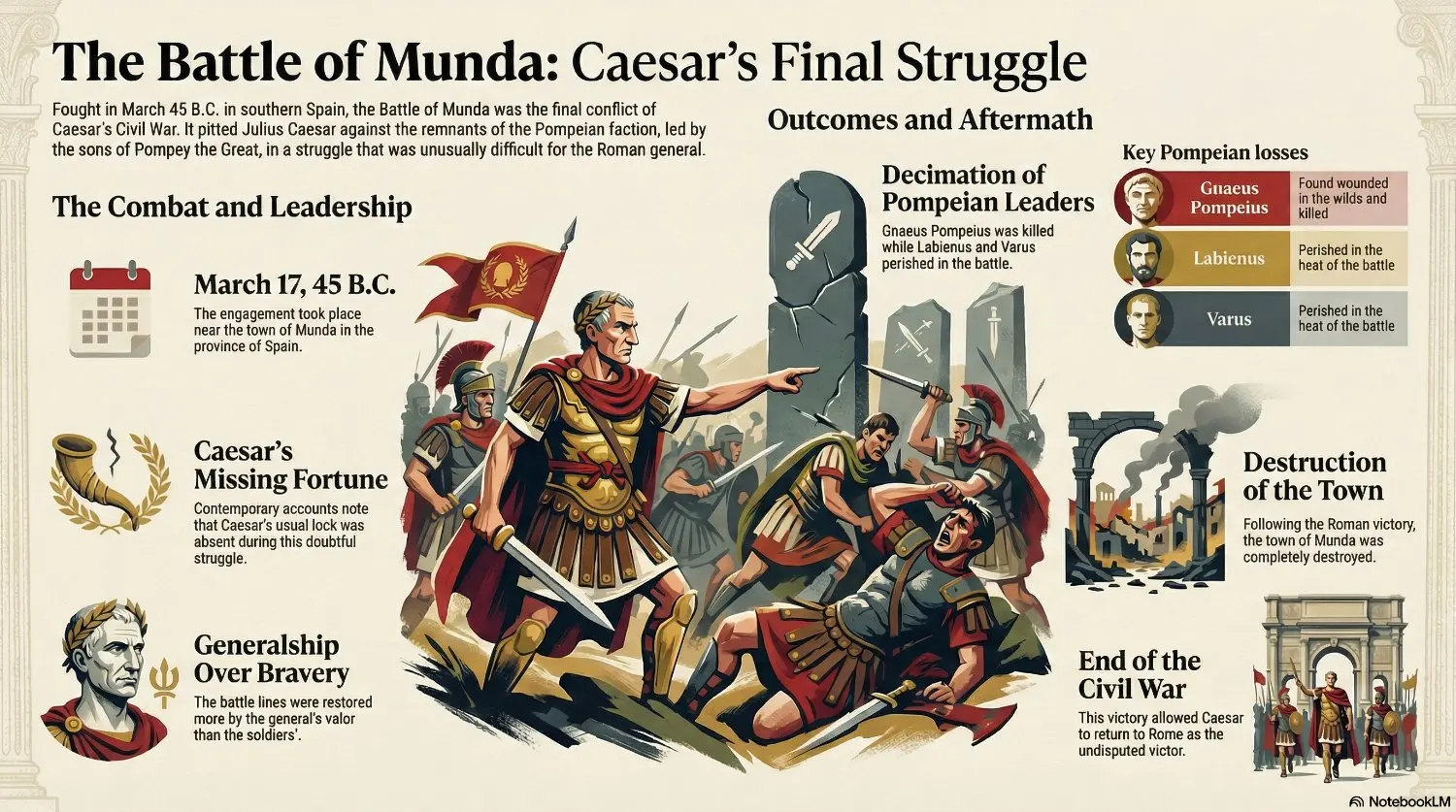
Caesar senior lieutenant in Gaul later joined Pompey; a major cavalry commander in the civil war, killed at Munda.
See also Gallic War, Munda
In the volumes Book V · Chapter 8: The Civil Wars and the End of the Republic
Read further Caesar Gallic War Book 7 · Caesar Civil War Book III
Marcus Porcius Cato was a Stoic-associated opponent of Caesar; his suicide at Utica became a symbol of republican resistance.
See also Utica, Caesar civil war
In the volumes Book V · Chapter 8: The Civil Wars and the End of the Republic · Book V · Chapter 6: Pompey and the Conquest of the East · Book V · Chapter 7: Caesar in Gaul · Book V · Proem
Read further Plutarch Life of Cato Minor
Tribune and political organizer who mobilized urban associations and legislation; killed in a clash with Milo supporters.
See also Titus Annius Milo
Read further Plutarch Life of Cicero
Tribune whose reform coalition included Italian citizenship; his assassination preceded the Social War.
See also Social War, Roman citizenship
In the volumes Book V · Chapter 4: The Social War and the Civil Wars of Marius and Sulla
Read further Appian Civil Wars Book 1
Caesarian commander and triumvir whose military power was eliminated by Octavian after the Sicilian war.
See also Second Triumvirate, Sextus Pompey
In the volumes Book V · Chapter 8: The Civil Wars and the End of the Republic · Book IV · Chapter 1: The Second Macedonian War: Flamininus and Cynoscephalae · Book IV · Chapter 4: The Spanish Wars: Lusitanians, Celtiberians, Viriathus, and Numantia · Book V · Epilogue: Rome in 31/30 BC
Read further Appian Civil Wars Book 5
Consul who opposed Sulla and dominated Rome with allies after Marius death; killed by mutinous soldiers.
See also Sullan civil wars, Gaius Marius
In the volumes Book V · Chapter 4: The Social War and the Civil Wars of Marius and Sulla
Read further Appian Civil Wars Book 1
Survivor of Carrhae, opponent and assassin of Caesar, then co-commander against the triumvirs at Philippi.
See also Marcus Junius Brutus
In the volumes Book V · Chapter 8: The Civil Wars and the End of the Republic
Read further Appian Civil Wars Book 4
Leading conspirator against Caesar and commander of the republican armies defeated at Philippi; died by suicide.
In the volumes Book V · Chapter 8: The Civil Wars and the End of the Republic · Book V · Proem
Read further Plutarch Life of Brutus
Caesarian general and triumvir who governed eastern territories in alliance with Cleopatra; defeated by Octavian coalition at Actium.
See also Second Triumvirate, Actium
In the volumes Book V · Chapter 8: The Civil Wars and the End of the Republic · Book V · Proem · Book VI · Chapter 1: The Augustan Conquests
Read further Plutarch Life of Antony
Leader of the largest Italian slave rebellion; his forces defeated Roman armies before Crassus ended the rising.
See also Third Servile War, Slavery
In the volumes Book V · Chapter 5: Wars in the Shadow of the Settlement: Mithridates, Sertorius, Spartacus
Read further Plutarch Life of Crassus · Appian Civil Wars Book 1
Trusted Augustan intermediary and literary patron who helped manage politics while Octavian campaigned.
Read further Cassius Dio Roman History Book 49
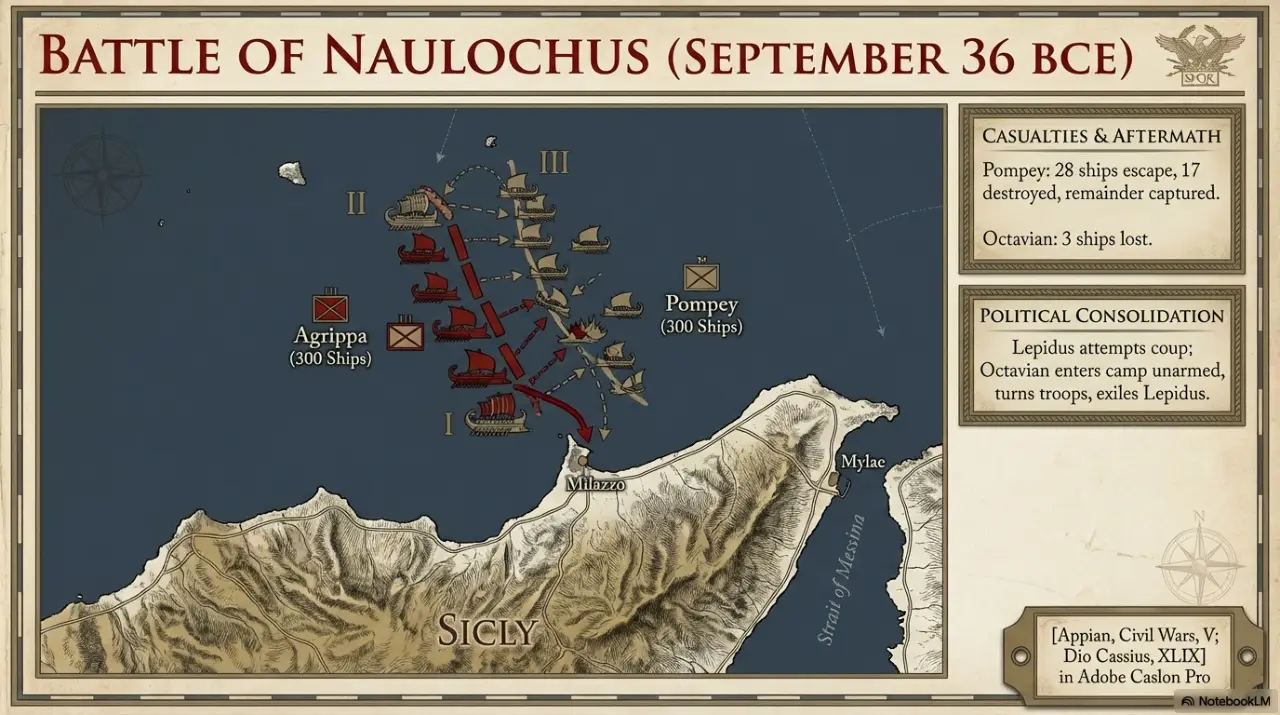
Pompey son held Sicily and a powerful fleet, challenging triumviral grain supply before Agrippa defeated him at Naulochus.
See also Naulochus
Read further Appian Civil Wars Book 5
Octavian principal military associate, naval victor at Naulochus and Actium, and sponsor of major urban works.
In the volumes Book V · Chapter 8: The Civil Wars and the End of the Republic · Book VI · Chapter 1: The Augustan Conquests
Read further Cassius Dio Roman History Book 49 · Cassius Dio Roman History Book 51
Germanic ruler and Roman-recognized king whose forces Caesar expelled from Gaul during his first campaign.
See also Battle against Ariovistus, Suebi
In the volumes Book V · Chapter 7: Caesar in Gaul
Read further Caesar Gallic War Book 1
Politician and organizer of armed followers, tried after Clodius death and later killed during resistance to Caesarian control.
See also Publius Clodius Pulcher
Read further Plutarch Life of Cicero
Parthian aristocrat and commander whose cavalry defeated Crassus at Carrhae; executed by Orodes II afterward.
See also Carrhae
In the volumes Book V · Chapter 7: Caesar in Gaul
Read further Plutarch Life of Crassus
Ptolemaic queen allied successively with Caesar and Antony; her defeat and death preceded Roman annexation of Egypt, while hostile Roman narratives shaped her later image.
See also Gaius Julius Caesar, Mark Antony, Actium, Ptolemaic kingdom
In the volumes Book V · Chapter 8: The Civil Wars and the End of the Republic · Book V · Proem
Read further Plutarch Life of Antony · Cassius Dio Roman History Book 51
Senatorial governor whose army was destroyed under Arminius coalition in the Teutoburg disaster.
See also Teutoburg Forest, Arminius
In the volumes Book VI · Chapter 2: The Great Illyrian Revolt and the Varian Disaster
Read further Cassius Dio Roman History Book 56
Arvernian noble who coordinated the major Gallic coalition of 52 BCE, won at Gergovia and surrendered after Alesia.
In the volumes Book V · Chapter 8: The Civil Wars and the End of the Republic
Read further Caesar Gallic War Book 7
Augustus stepson conducted campaigns beyond the Rhine and died in Germania; father of Germanicus and Claudius.
See also Germanicus
In the volumes Book VI · Chapter 1: The Augustan Conquests
Read further Cassius Dio Roman History Book 54
Cheruscan aristocrat with Roman military experience who organized the coalition that destroyed Varus army; later killed by rivals.
See also Teutoburg Forest, Cherusci
In the volumes Book VI · Chapter 3: Germanicus and the Julio-Claudian North · Book VI · Chapter 2: The Great Illyrian Revolt and the Varian Disaster
Read further Cassius Dio Roman History Book 56 · Tacitus Annals Book 2A
Dynastic prince and commander whose Rhine campaigns and eastern mission generated intense public loyalty and succession anxiety.
See also Idistaviso, Tiberius
In the volumes Book VI · Chapter 3: Germanicus and the Julio-Claudian North · Book VI · Chapter 2: The Great Illyrian Revolt and the Varian Disaster · Book VI · Chapter 1: The Augustan Conquests
Read further Tacitus Annals Book 2A
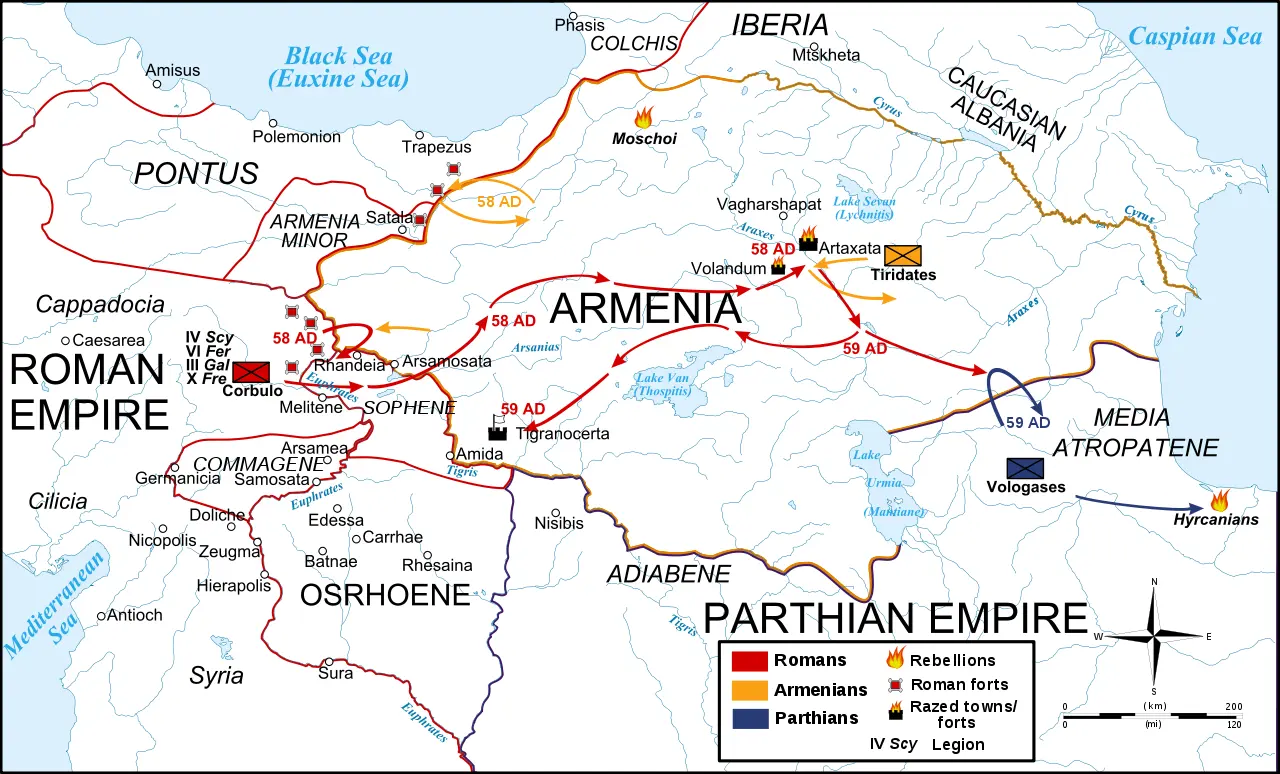
General whose Armenian campaigns and diplomacy restored Roman prestige after reverses; ordered to die under Nero.
See also Roman Parthian War 58-63 CE, Armenia
In the volumes Book VI · Chapter 5: The Eastern Question: Corbulo, Armenia, and Parthia · Book VI · Chapter 3: Germanicus and the Julio-Claudian North
Read further Tacitus Annals Book 15A
Led the initial Claudian invasion of Britain in 43 CE, establishing the bridgehead for provincial occupation.
See also Medway
In the volumes Book VI · Chapter 4: Britain: Conquest and Revolt
Read further Cassius Dio Roman History Book 60
Praetorian prefect under Tiberius whose concentration of influence ended in arrest and execution.
See also Praetorian Guard, Tiberius
In the volumes Book VI · Proem
Read further Tacitus Annals Book 4A
Governor who advanced Roman forces in northern Britain; his son-in-law Tacitus made his career the subject of a literary biography.
See also Mons Graupius, Britannia
In the volumes Book VI · Chapter 4: Britain: Conquest and Revolt
Read further Tacitus Agricola
Governor who campaigned on Mona and defeated Boudica revolt; later served Otho during the civil war.
See also First Bedriacum
In the volumes Book VI · Chapter 4: Britain: Conquest and Revolt · Book VI · Chapter 3: Germanicus and the Julio-Claudian North · Book VI · Chapter 7: The Year of the Four Emperors and the Batavian Revolt
Read further Tacitus Annals Book 14B
British ruler who resisted conquest in southeastern Britain and Wales before capture and transfer to Rome.
See also Britannia
In the volumes Book VI · Chapter 4: Britain: Conquest and Revolt
Read further Tacitus Annals Book 12B
Iceni queen who led a revolt after Roman abuses, destroying major settlements before defeat by Suetonius Paulinus.
See also Iceni
In the volumes Book VI · Chapter 4: Britain: Conquest and Revolt
Read further Tacitus Annals Book 14B
Batavian aristocrat and former auxiliary officer who led a revolt during the Roman succession crisis.
See also Batavian revolt, Batavi
In the volumes Book VI · Chapter 7: The Year of the Four Emperors and the Batavian Revolt · Book VI · Chapter 8: The Flavian Consolidation and the Wars of Domitian
Read further Tacitus Histories Book 4A
Moorish cavalry commander prominent under Trajan; involved in suppressing eastern revolts before removal under Hadrian.
See also Trajan Parthian campaign, Kitos War
In the volumes Book VII · Chapter 2: The Eastern Maximum and the Great Recoil · Book VII · Chapter 1: The Dacian Wars of Trajan · Book VII · Chapter 3: Hadrian: The Wall, the Army in Being, and the Last Jewish War
Read further Cassius Dio Roman History Book 68
Dacian king who negotiated with Domitian and fought Trajan; his defeat and suicide preceded provincial annexation.
See also Dacian Wars
In the volumes Book VII · Chapter 1: The Dacian Wars of Trajan · Book VII · Proem
Read further Cassius Dio Roman History Book 68
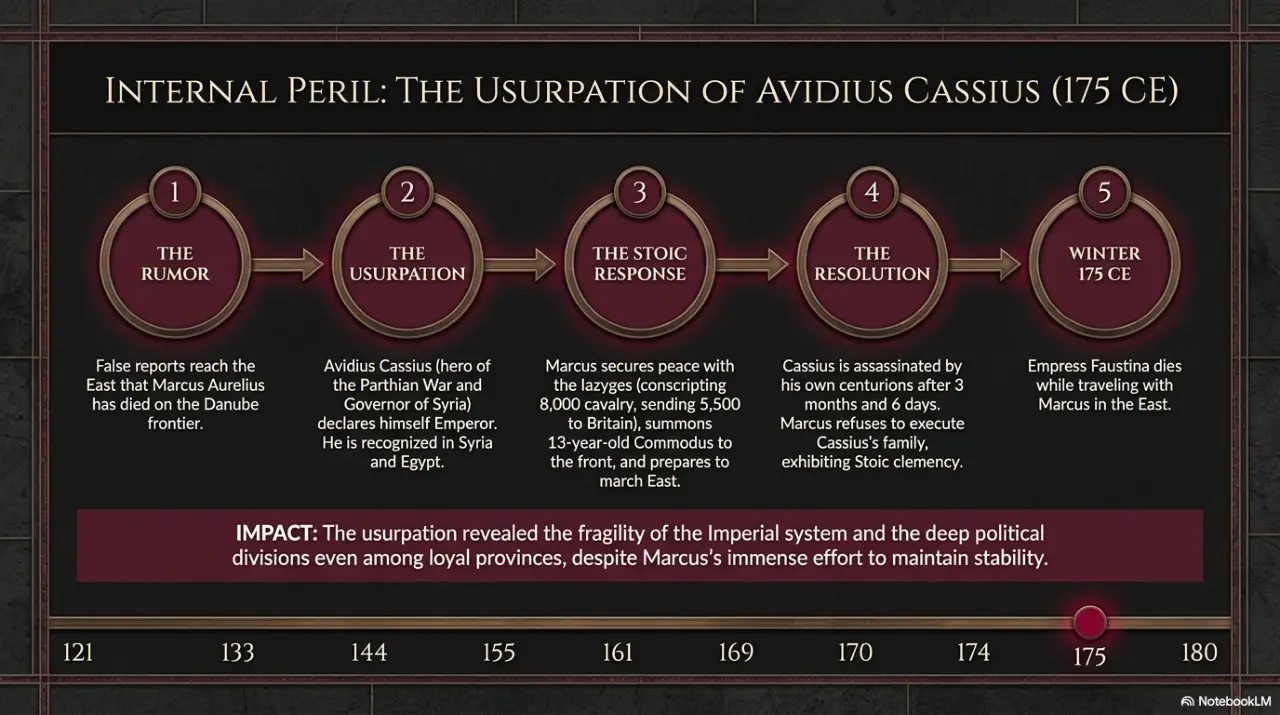
Victorious commander in the eastern war under Lucius Verus; proclaimed emperor in 175 and killed when his revolt failed.
See also Roman Parthian War 161-166 CE, Marcus Aurelius
In the volumes Book VII · Chapter 5: Marcus Aurelius: The Double Emergency
Read further Cassius Dio Roman History Book 71
Leader styled prince of Israel in the final major revolt against Hadrian; known through Roman accounts and contemporary rebel documents.
See also Bar Kokhba revolt, Judaea
In the volumes Book VII · Chapter 3: Hadrian: The Wall, the Army in Being, and the Last Jewish War · Book VII · Proem
Read further Cassius Dio Roman History Book 69
Sasanian king whose campaigns captured Valerian; his own inscription and reliefs provide an essential counterpoint to Roman accounts.
See also Edessa 260 CE, Sasanian Empire
In the volumes Book VII · Chapter 7: The Breaking, 235–260 · Book VII · Chapter 8: The Recovery, 260–284
Read further Shapur I History by A Shapur Shahbazi
Palmyrene ruler who fought Sasanian forces while exercising Roman authority in the East; assassinated before Zenobia ascendancy.
In the volumes Book VII · Chapter 8: The Recovery, 260–284
Read further Shapur I History by A Shapur Shahbazi
Palmyrene queen and regent whose regime expanded across eastern provinces and Egypt before Aurelian defeated it; later stories of her fate conflict.
See also Vaballathus, Aurelian, Palmyra
In the volumes Book VII · Chapter 8: The Recovery, 260–284
Long-reigning Sasanian ruler who fought Constantius II and Julian, captured Amida and benefited from the settlement of 363 CE.
See also Amida, Julian Persian campaign
In the volumes Book VIII · Chapter 2: The House of Constantine at War: Persia, Strasbourg, and the Road to Ctesiphon
Read further Shapur II by Touraj Daryaee
Leading western general and imperial kinsman whose wars against Alaric and Radagaisus ended in political overthrow and execution.
In the volumes Book VIII · Chapter 4: Stilicho, the Rhine Crossing, and the Sack of Rome · Book VIII · Proem
Read further Claudian Gothic War and Stilicho poems · Zosimus New History Book V
Gothic king and former imperial military participant whose demands for office, support and settlement culminated in the sack of Rome.
See also Goths
In the volumes Book VIII · Chapter 4: Stilicho, the Rhine Crossing, and the Sack of Rome · Book VIII · Chapter 3: Adrianople and the Gothic Settlement · Book VIII · Epilogue: The Audit of the Eight Hundred Years
Read further Zosimus New History Book V · Orosius Histories against the Pagans Book VII
General who restored Roman control in Britain and suppressed Firmus in Africa; father of Emperor Theodosius I.
Read further Ammianus Marcellinus Res Gestae Book 27 · Ammianus Marcellinus Res Gestae Book 29
Vandal king who captured Carthage, built a maritime power and sacked Rome in 455 CE; also rendered Genseric.
Read further Procopius Vandalic Wars Books III and IV
Western commander who maneuvered among imperial, Hunnic and federate powers and opposed Attila in Gaul; murdered by Valentinian III.
See also Catalaunian Plains, Attila
In the volumes Book VIII · Chapter 5: Aetius, Africa, and Attila · Book VIII · Chapter 6: The Dissolution
Read further Jordanes Getica
Frankish-origin Roman commander who backed Eugenius against Theodosius I and died after defeat at the Frigidus.
In the volumes Book VIII · Chapter 3: Adrianople and the Gothic Settlement
Read further Zosimus New History Book IV
Powerful military commander who made and unmade western emperors while lacking the imperial title himself.
See also Majorian
In the volumes Book VIII · Chapter 6: The Dissolution · Book VIII · Epilogue: The Audit of the Eight Hundred Years
Read further Procopius Vandalic Wars Books III and IV
Succeeded Alaric, negotiated and fought within imperial politics, and married Galla Placidia; assassinated before a durable Gallic settlement emerged.
See also Alaric I, Galla Placidia, Honorius
In the volumes Book VIII · Chapter 4: Stilicho, the Rhine Crossing, and the Sack of Rome
Military ruler who deposed Romulus Augustulus in 476 CE and governed Italy until defeated and killed by Theodoric.
See also Romulus Augustulus
In the volumes Book VIII · Chapter 6: The Dissolution · Book VIII · Epilogue: The Audit of the Eight Hundred Years
Read further Excerpta Valesiana
Hunnic ruler who extracted tribute and campaigned against both imperial courts, invading Gaul in 451 and Italy in 452 CE.
See also Catalaunian Plains, Huns
In the volumes Book VIII · Chapter 5: Aetius, Africa, and Attila · Book VIII · Epilogue: The Audit of the Eight Hundred Years · Book VIII · Proem
Read further Jordanes Getica
Ostrogothic king who defeated Odoacer and ruled Italy while retaining many Roman administrative forms.
See also Odoacer
In the volumes Book VIII · Chapter 5: Aetius, Africa, and Attila
Read further Excerpta Valesiana
Eunuch court official and commander who defeated Totila and Teias, securing Justinian victory in the Gothic War.
See also Taginae, Mons Lactarius
Read further Procopius Wars VIII 29-32: Taginae · Procopius Wars VIII 33-35: final Italian operations
Sasanian king whose reign combined internal struggles, reform and renewed conflict with Rome; also rendered Kavadh.
See also Anastasian War, Iberian War
Read further Kawad I reign by Nikolaus Schindel
Justinian general whose victories at Dara and in Africa preceded campaigns in Italy; his achievements depended on mixed forces and imperial support.
See also Vandalic War
Read further Procopius Persian Wars Books I and II · Procopius Vandalic Wars Books III and IV
Vandal king defeated by Belisarius at Ad Decimum and Tricamarum; surrendered after further resistance as imperial government replaced the Vandal kingdom.
See also Vandalic War, Belisarius, Carthage
Read further Procopius Vandalic Wars Books III and IV
Sasanian ruler associated with fiscal and military reforms, the sack of Antioch and prolonged competition over Lazica.
Read further Khosrow I
Ostrogothic king who besieged Rome during the Gothic War and surrendered Ravenna to Belisarius; his capture did not end the war.
See also Gothic War in Italy, Belisarius, Ravenna, Totila
Read further Procopius Gothic Wars Books V and VI
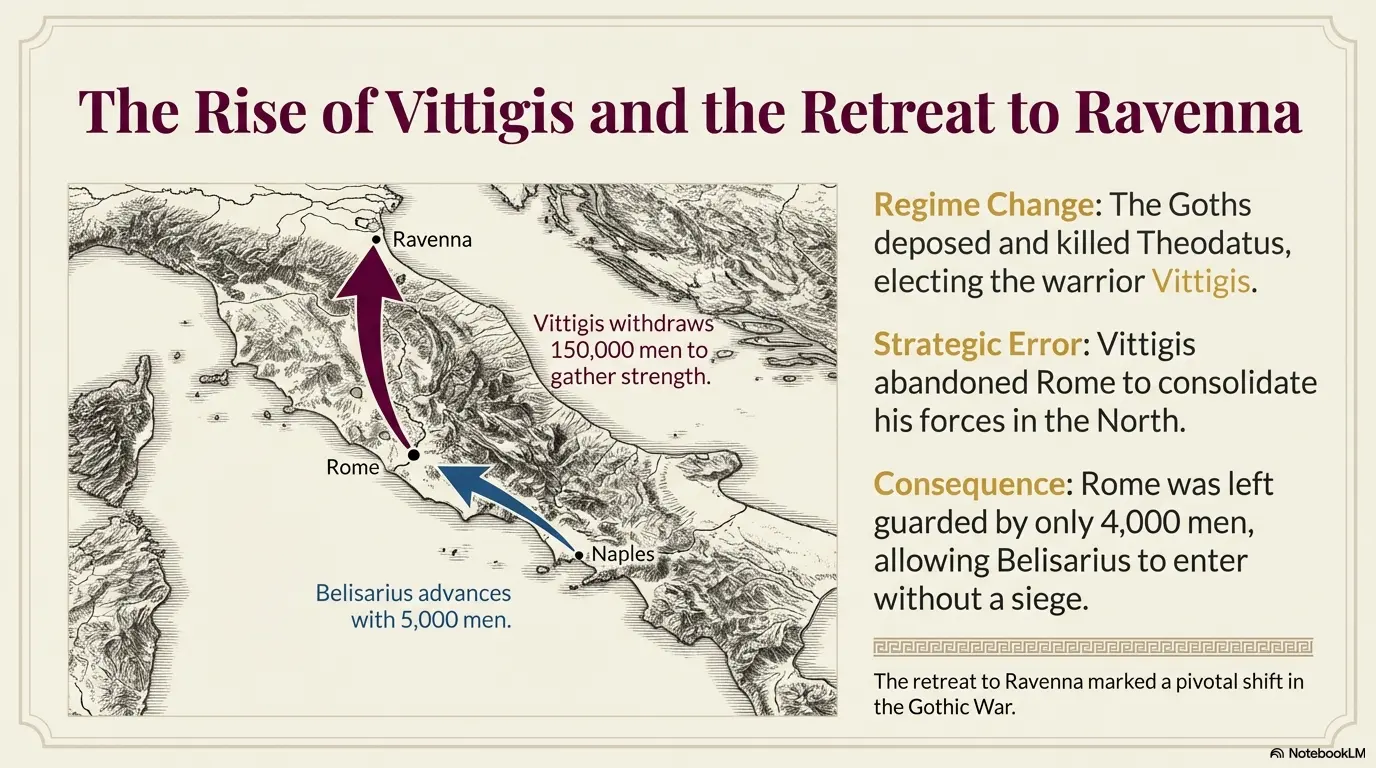
Justinian commander active against Persia and in Armenia, where he was killed suppressing a revolt.
See also Armenia, Iberian War
Read further Procopius Persian Wars Books I and II
Ostrogothic king who revived resistance to Justinian armies and recovered much of Italy before defeat and death at Taginae.
See also Taginae
Read further Procopius Wars VIII 29-32: Taginae
Restored with Roman aid, later conquered major eastern Roman provinces before Heraclius counteroffensive and his own overthrow.
See also Last Roman Persian War, Nineveh
Read further Khosrow II by James Howard-Johnston
Sasanian commander prominent in the conquest of Syria, Jerusalem and Egypt; briefly seized the Persian throne after Khosrow II fall.
See also Last Roman Persian War, Khosrow II Parviz
Read further Khosrow II by James Howard-Johnston
Roman general associated with Rome defense and the recovery of Petra; Procopius sharply criticizes his conduct during famine.
See also Lazic War
Read further Procopius Wars VIII 8-14: Lazica and Italian preparation
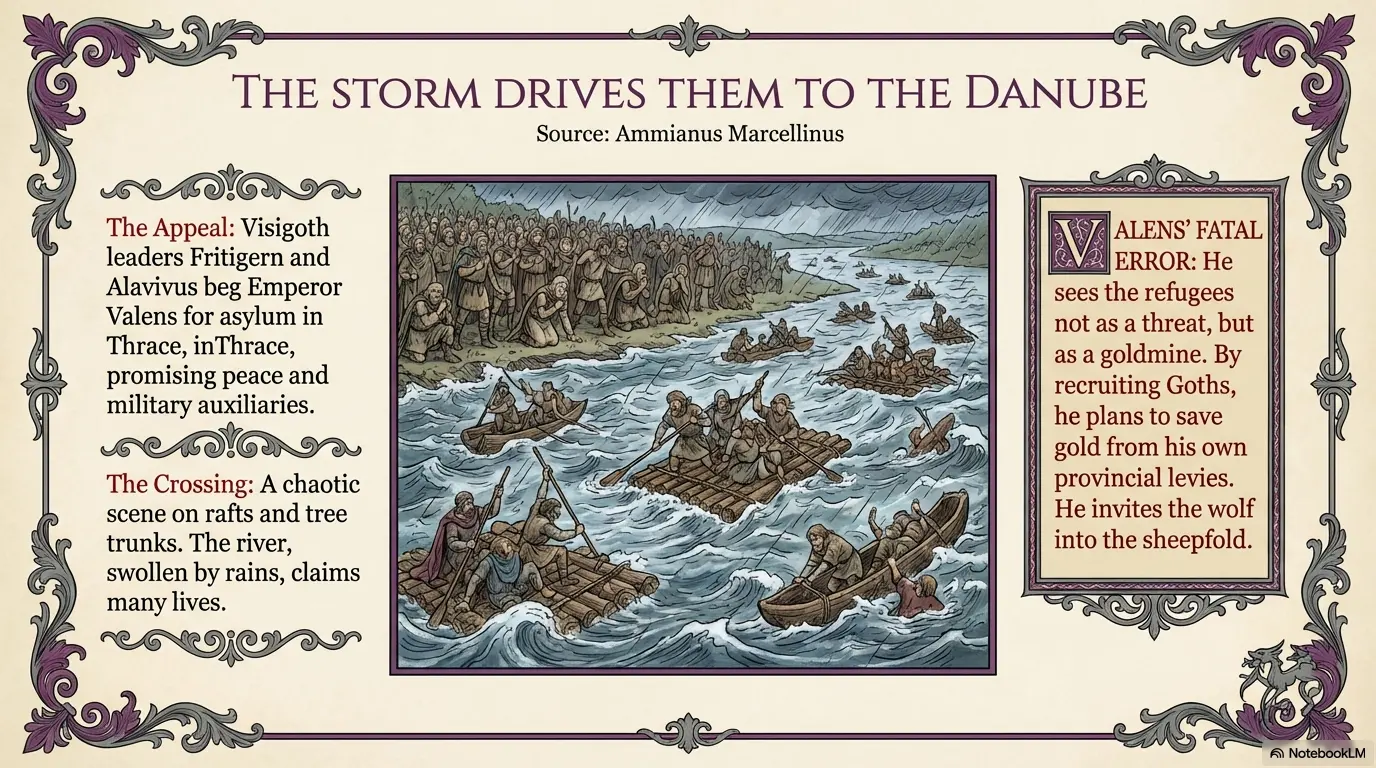
Gothic leader prominent in the revolt after the Danube crossing; commanded against Valens at Adrianople.
See also Gothic War 376-382 CE, Adrianople
Read further Ammianus Marcellinus Res Gestae Book 31
Farmer-dictator of Roman exemplary tradition, associated with victory over the Aequi and voluntary surrender of emergency power.
See also Dictator
Read further Livy History of Rome Book 3
Early republican consul remembered for laws protecting citizens against magistrates; much biographical detail belongs to later foundation tradition.
See also Lucius Junius Brutus
Read further Plutarch Life of Publicola
Flavian commander who suppressed the Batavian revolt and subsequently governed Britain; earlier defeated during Boudica rising.
See also Batavian revolt, Britannia
Read further Tacitus Histories IV 54-79 · Tacitus Annals Book 14B
Heraclian emperor confronting Arab expansion; ruled for a time from Syracuse and was assassinated there.
See also Syracuse, Constantinople
Constans II Constantine IV and Justinian II governed amid Arab expansion and institutional change; coups followed Justinian II's interrupted reigns.
See also Constans II, Constantinople
Faced Arab pressure and Balkan change; the sixth ecumenical council addressed monothelitism.
See also Constantinople, Bulgars
Deposed and mutilated, then restored with outside support; his violent second reign ended in another overthrow.
See also Bulgars
Leo III Constantine V Leo IV Constantine VI and Irene ruled during military recovery and disputes over sacred images.
See also Iconoclasm, Irene
Founded a durable dynasty and survived the Arab siege of Constantinople; later remembered for initiating iconoclastic policy.
See also Iconoclasm
Restored image veneration at Nicaea II and eventually ruled alone after deposing her son Constantine VI.
Nikephoros I Michael I Leo V Michael II Theophilos and Michael III preceded the Macedonian dynasty; icon controversy ended in 843.
See also Iconoclasm, Constantinople
From Basil I through Theodora, dynastic continuity coexisted with military co-emperors Romanos I Nikephoros II and John I.
See also Basil II, Constantinople
Expanded imperial authority, especially against Bulgaria; his long reign became a later benchmark of power.
See also Bulgars, Constantinople
Rapid changes of dynasty and military setbacks linked Michael VI Isaac I Constantine X Romanos IV Michael VII and Nikephoros III.
See also Manzikert, Seljuk Turks
Rebuilt imperial resources and managed the First Crusade's arrival; Komnenian rule renewed dynastic military government.
See also Constantinople
Pursued Balkan and Anatolian consolidation while maintaining Komnenian dynastic authority.
Pursued wide-ranging diplomacy and warfare in Europe and the eastern Mediterranean; defeat at Myriokephalon limited Anatolian ambitions.
Alexios II Andronikos I Isaac II Alexios III Alexios IV and Alexios V preceded the Fourth Crusade's conquest.
A Latin Empire at Constantinople coexisted with Greek successor centers in Nicaea Epirus and Trebizond; Nicaea recovered the city.
Recovered Constantinople and founded the restored Palaiologan dynasty, facing military and church-union disputes.
See also Constantinople
Andronikos II Andronikos III John V John VI Manuel II and John VIII ruled amid civil wars territorial loss and Ottoman expansion.
See also Ottomans
Last emperor at Constantinople, killed during the Ottoman conquest; surviving Roman successor territories lasted beyond the city's fall.
See also Ottomans