Wars · V. The early Principate: conquest and provincial war
W053 Corbulo, Armenia and the Parthian settlement
Battles and sieges
Rhandeia 62 ADArmenia's kingship stood between Roman and Parthian interests. Corbulo's campaigns captured Armenian centers and demonstrated Roman military leverage, but Rome's ability to dictate a lasting settlement was contested. The defeat and capitulation of Paetus at Rhandeia in AD 62 exposed the risks of divided commands and inadequate preparation.
Renewed Roman pressure led to agreement. Tiridates, an Arsacid, retained the Armenian throne while receiving recognition through the Roman emperor. His visit to Nero in AD 66 supplied a ceremonial statement of the arrangement, not proof that Armenia had become an ordinary Roman province.
Command, forces and military problem
| Field | Dossier |
|---|---|
| Roman leadership | Corbulo and Paetus in different commands |
| Opposing or rival parties | Arsacid rulers and commanders; Tiridates in Armenia |
| Forces and capabilities | Field armies, fortified centers and royal allied forces |
| Operational problem | Demonstrate leverage while avoiding the collapse of a divided command in Armenian country. |
Extended campaign study
The account below develops the operations and their interpretation. Reported numbers and reconstructed tactical details retain the uncertainties described in the dossier.
The Discipline of Corbulo
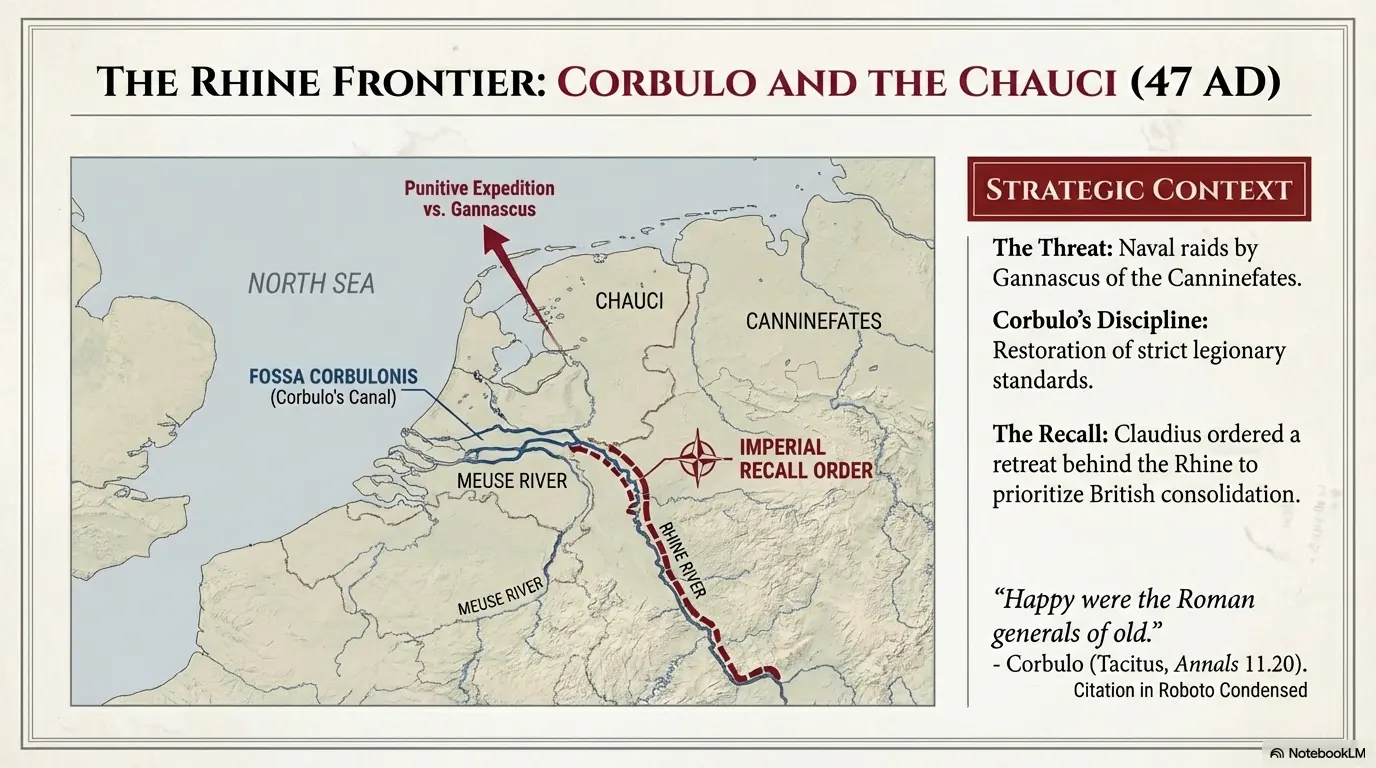
Gnaeus Domitius Corbulo — half-brother by marriage to Caligula's empress, consular, a giant in body with a gift for the theatrical severity the age called old-Roman — took the lower Rhine command in 47 and conducted, against the Chaucian sea-raids of the deserter Gannascus and the loosened Frisii, a campaign of textbook restoration: the raiders hunted down, the Frisii resettled and garrisoned, the legions retaught the entrenching-tool by a general who executed one soldier for digging unbelted of his sword and another for digging armed with dagger alone — the anecdote's point, as Tacitus frames it, being not the cruelty but the appetite of an army for a master. On the brink of finishing the Chauci, he received Claudius's order — the post-Varian standing policy asserting itself against the man most likely to test it — to withdraw every garrison west of the Rhine; and his reply, spoken as he obeyed, became the epigraph of the whole Principate's command-problem: beatos quondam duces Romanos — happy the Roman generals of old. Denied his war, he set the legions to peace-work on the scale of one: the twenty-three-mile canal between Meuse and Rhine that drained the flood-country and still runs — the fossa Corbulonis, traced by Dutch archaeology through the peat with its timber revetments dendro-dated to the very years — so that the chapter's protagonist enters the eastern crisis already complete: the empire's best soldier, trusted absolutely with armies and never quite with victory, digging canals to spend an aggression the system could employ but not afford.
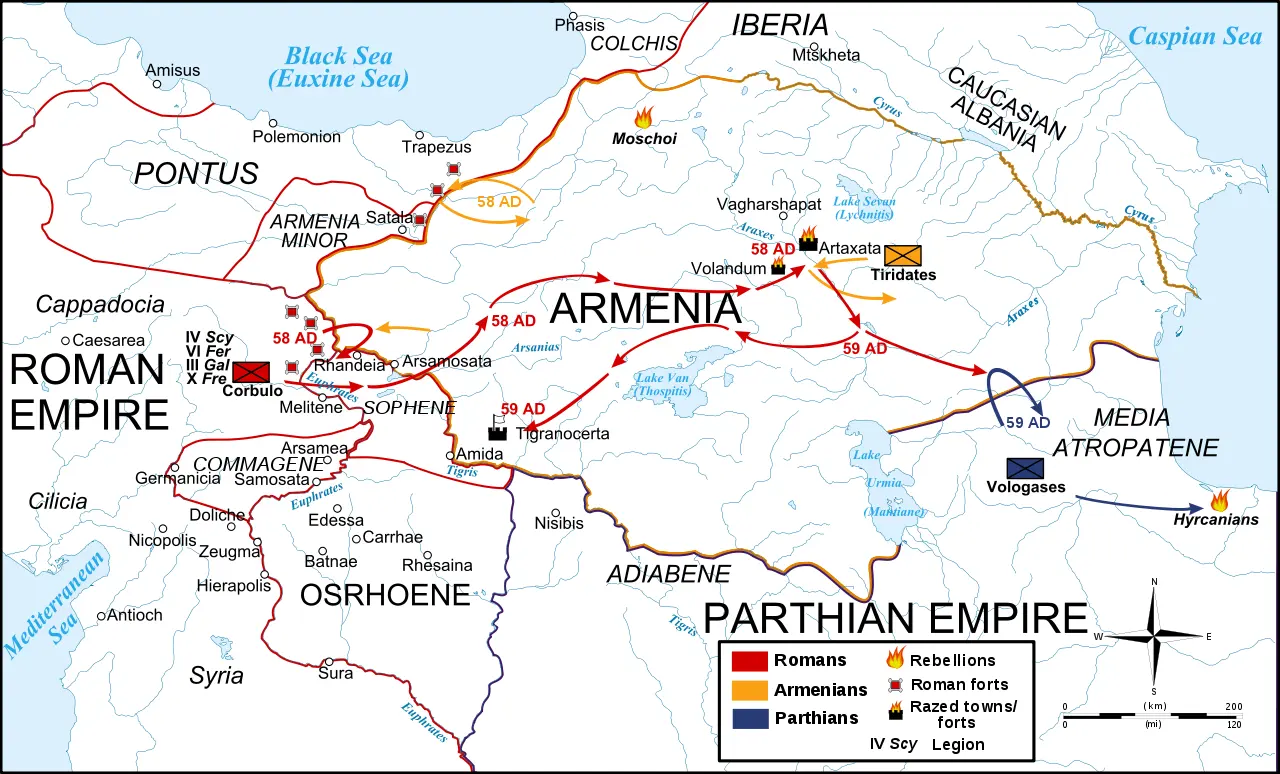
The crisis that summoned him east was the oldest file in Roman diplomacy. Rome's answer waited on a reign-change: among the first acts of Nero's new government in 54 — the government of Seneca and Burrus, advertising merit — was Corbulo's appointment to Cappadocia and the Armenian commission, and the East revealed to him what four decades of the standing peace had made of its garrison: legions, Tacitus reports from what must be Corbulo's own dispatches, containing veterans who had never stood a watch nor dug a rampart, without helmets or breastplates sold long since, soldiers of the towns and the trade-fairs. The reconstruction consumed three years and became the army's legend of itself: the winter training-camps pitched deliberately in the Armenian highland frost where sentries froze at their posts and the general, cloakless and bare-headed, walked the works praising and burying; discharges purged the unfit, Galatian and Cappadocian levies filled the files, desertion was answered by execution on the first offense rather than the third; and when the army moved at last in 58, it moved as the instrument the chapter's battles will assume without further comment.
Artaxata and Tigranocerta (58–60)
Against Tiridates's horse-archer strategy — raid the pro-Roman districts, refuse the legions' embrace — Corbulo divided into mutually supporting columns, fortified as he went, brought the Moschian hill-tribes and the client-kings of Commagene and Iberia in upon the kingdom's flanks, and struck not at the king but at his roofs: the storm of the fortress of Volandum in a morning, the systematic reduction of the strongholds, and in the campaign's crisis the running fight before Artaxata, where Tiridates's encircling archery broke against a marching-square that declined pursuit into the dusk — and the capital, watching, opened its gates next dawn. Artaxata was burned regardless — the city was ungarrisonable at that season and clemency, Corbulo judged, must not look like inability — and the omen-tradition supplied the thunderclap that divided the sky as the army entered. The next season delivered the strategic geometry's second point: the march on Tigranocerta across the waterless Taurus country, the army eating its baggage-animals, the punitive columns fanning through Tauraunitis after an assassination-attempt on the general by a captured noble's hired hand; and the second capital, weighing Artaxata's ashes against Volandum's, sent out its golden crown ahead of the siege — one recalcitrant fortress, Legerda, stormed to keep the arithmetic honest. By 60 the kingdom was swept, Tiridates's Median invasion-attempt was parried by the fortified passes, and Rome installed its nominee: Tigranes VI, a Cappadocian-Herodian princeling from the hostage-nursery at Rome — the client-system's pure product, set on the client-system's most breakable throne — while Corbulo, promoted to the vacant governorship of Syria, handed Armenia to the settlement's guarantee and the guarantee, within a year, to its test.
Rhandeia (62), and the Peace of the Diadem (63–66)
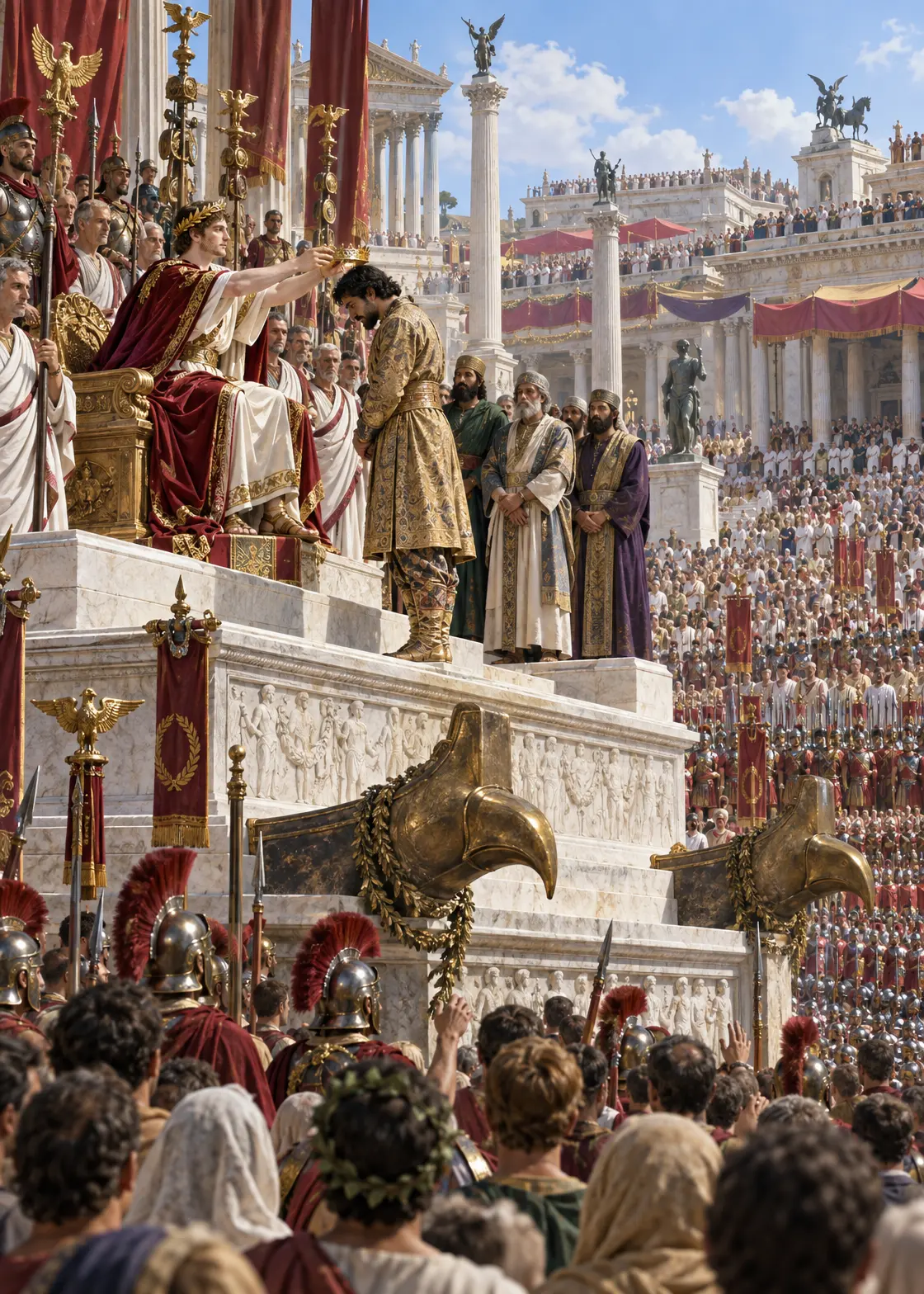
The test came from both directions at once. Tigranes, misreading investiture as license, raided Adiabene — a Parthian vassal — and gave Vologases the casus his nobility demanded; the Parthian king crowned Tiridates afresh before his court, sent his grand vizier Monaeses against Tigranocerta, and turned the Armenian question, for the first time since Antony, into the prospect of open war between the empires. Rome's response divided the command and doubled the risk: Corbulo, holding Syria and the Euphrates with his veteran legions, requested a separate general for the Armenian theater, and received Lucius Caesennius Paetus — consular, connected, and convinced, the sources agree, that Corbulo's methods were slow theater and Armenia a province waiting for its census. Paetus's dispatches had meanwhile announced a war proceeding favorably; Nero learned the truth from the Parthian embassy's terms; and the empire's answer restored the chapter's protagonist to the whole theater with imperium maius — the greatest delegated command since the civil wars, the system's post-Varian caution overridden by the system's need — and Corbulo, rebuilding Paetus's shaken legions with drafts and shame, crossed the Euphrates at Melitene in 63 in a strength no Parthian field-army would test. No battle followed, because none was required and neither professional wanted one: at Rhandeia itself — the site chosen by both sides for the symmetry, disgrace to be annulled where incurred — Tiridates met Corbulo in conference, and before the assembled legions and the images of Nero laid his diadem at the emperor's feet, to be resumed only from the emperor's hand at Rome. The coronation-journey of 66 sealed it as spectacle: Tiridates overland nine months with three thousand horse — the daily cost to the fiscus eight hundred thousand sesterces in Dio's figure, entered here as tradition's arithmetic — the magi in his train, the Naples preliminaries, and the golden day in the Forum: the king ascending the rostra to the seated emperor before the drawn-up Guard and the city on the rooftops, the diadem set on his head at the point of a century of contention, the Janus doors closed, the day named golden by decree.
Corbulo — the empire's most famous soldier, its eastern armies' oath-personified, his daughter married into the senatorial opposition's orbit, his name (the sources let us see the regime seeing it) canvassed by every conspirator sounding the East — was summoned in 67 to Greece, where the emperor was touring his other victories; at Cenchreae, disembarking to the arrest-order, he ran himself through with the one word the tradition preserves, the Greek acclamation of the games: Axios — Worthy. The Principate had solved the Republic's dilemma of the over-mighty commander not by abolishing him — the frontiers required him — but by owning him absolutely and terminating him at will; Corbulo, who had spent the Rhine command envying the generals of old and the eastern command proving he was one, obeyed the summons as he had obeyed the recall of 47, and his death, eighteen months before the eastern legions he had built began making emperors themselves, stands as the last demonstration of the loyalty whose withdrawal, in the chapter after next, ends the dynasty.
Tactical illustrations
Outcome and critical assessment
Result and caution: both imperial systems could claim elements of success. Distinguish battlefield performance, diplomatic compromise and ceremonial representation. The dossier's conventional AD 58 opening concerns the major campaigning phase; the Armenian succession dispute itself began earlier.
Historical record: IR-VI, chapter 5; Tacitus, Annals 13–15; Dio, Neronian narrative.