Wars · Guide
Historical sources and critical notes
The dossiers incorporate narrative history rather than substituting a bibliography for the account. The following register identifies the principal historical voices and their limits. Detailed compilation provenance, inspected files, image prompts and source fingerprints are preserved separately in the archive receipt.
Livy, History of Rome
The fundamental retrospective narrative for early and middle Republican wars. Surviving books must be distinguished from summaries of lost books; speeches, annual chronologies and exemplary episodes are not contemporary dispatches.
Polybius, Histories
Central for the Punic and Macedonian worlds, with direct access to important informants and places. Survival becomes fragmentary in later books. His explanatory judgments and numerical claims remain arguments to assess.
Appian, Roman History
Separate regional books and the Civil Wars connect conquest, provincial politics and internal conflict. A second-century author using earlier material; not an eyewitness to the Republican campaigns.
Caesar and the Caesarian corpus
The Gallic and Civil Wars combine a commander's account with political self-justification. Hirtius' eighth Gallic book and the Alexandrian, African and Spanish continuations require separate authorship treatment.
Plutarch, Parallel Lives
The biographies preserve valuable campaign narratives and lost traditions, organized to reveal character. Famous speeches, moral episodes and private motives require particular care.
Sallust, Jugurthine War
A sustained narrative of a war and of Roman politics. Its moral interpretation and political positioning belong to the evidence alongside its military detail.
Tacitus, Annals, Histories and Agricola
Major accounts of early imperial war, revolt and civil conflict. The Agricola is also a commemorative work; the surviving Histories end before the entire Flavian narrative is completed.
Cassius Dio, Roman History
A long retrospective imperial history whose survival changes from continuous text to excerpts and epitomes. Reading a late epitome requires attention to the loss and reshaping of the original.
Josephus, Jewish War
An indispensable participant's narrative, written after his change of allegiance under Flavian patronage. Its military detail, political defense and religious interpretation must be distinguished.
Ammianus Marcellinus, Res Gestae
The surviving books cover AD 353–378 with valuable military experience and some direct participation. Eyewitness access applies to particular episodes, not automatically to every council or distant battle.
Procopius, Wars
The central contemporary narrative for Justinianic campaigning, especially where the author accompanied Belisarius. The substantial translated selections retain their ancient loci and the distinction between testimony and modern assessment.
Velleius Paterculus, Roman History
A concise history with important participant knowledge of Tiberian campaigns and pronounced loyalty to the regime.
Eutropius, Breviarium
A useful abbreviated sequence of wars and rulers. Compression limits tactical and causal reconstruction.
Jordanes, Getica
A sixth-century Gothic historical tradition important to late Roman events. Retrospective speeches, ethnic origins and the battle arithmetic require especially careful handling.
Hydatius, Chronicle
An important regional witness to the fifth-century West. His perspective and chronological conventions are not an empire-wide operational picture.
Orosius, History Against the Pagans
A Christian universal history whose apologetic purpose shapes its selection and interpretation of war and disaster.
Claudian, political poetry
A central witness to the representation of Stilicho's government. Panegyric and invective are historical evidence without becoming neutral staff reports.
Sidonius Apollinaris, Letters and Poems
Elite and episcopal testimony to late western politics and the experience of changing rule. His political commitments matter to his judgments.
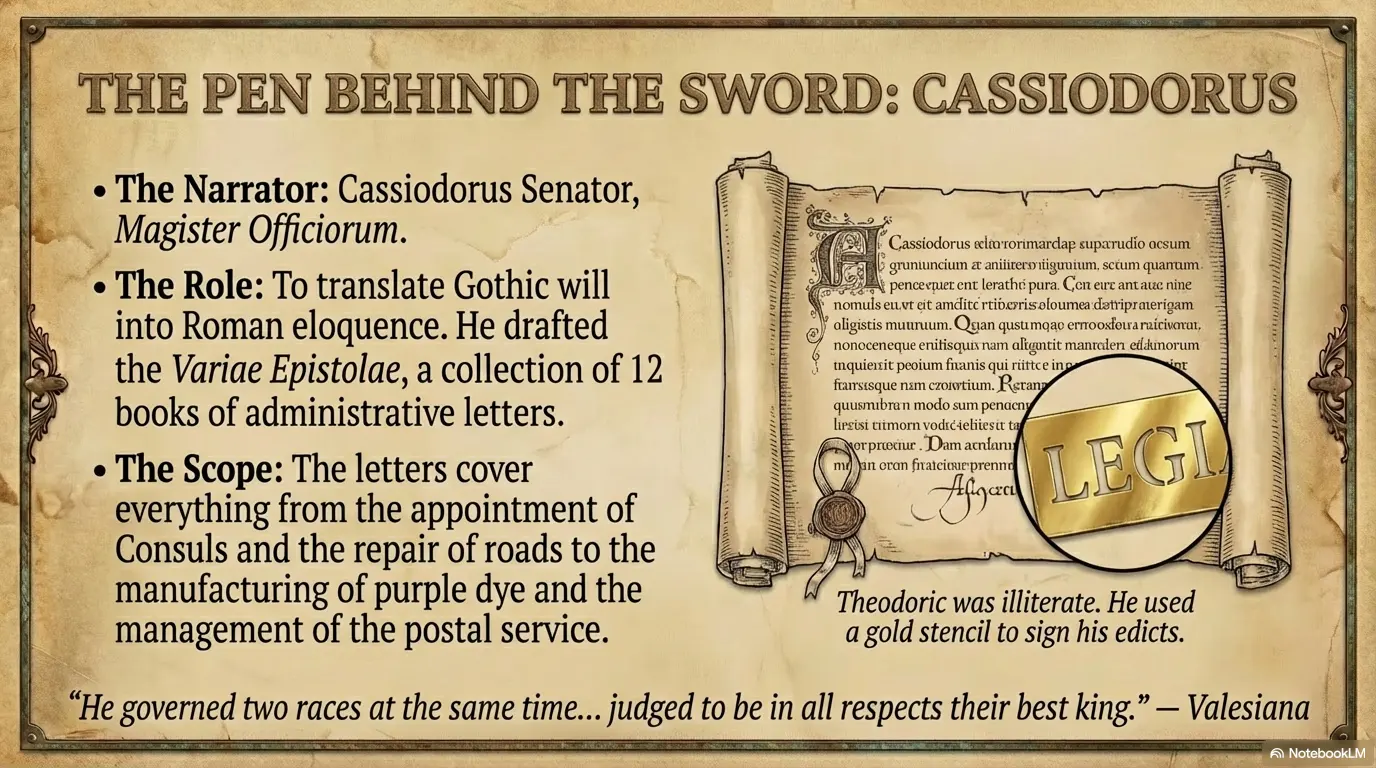
Cassiodorus, Variae
Administrative and political language from Ostrogothic Italy. Official representation does not by itself establish that every expressed ideal was realized.
Historia Augusta
A particularly problematic later biographical collection. It can preserve useful material but also invention, false attribution and distorted chronology; attractive detail requires independent control.
Diodorus Siculus, Library of History
The Sicilian servile wars depend on fragmentary later transmission. Narrative stereotypes and the survival of excerpts shape what can be recovered.
Strabo, Geography
Geographic and historical interpretation, including contemporary information about Augustan expeditions. Close relationships with officials can influence the assignment of blame.
Herodian, History of the Empire
A major literary witness to imperial politics and warfare in AD 180–238. The reading loci supplied in the dossiers are distinct from a claim of complete textual collation.
Eusebius, historical and Constantinian works
Important religious and political testimony, with documents, retrospective narrative and imperial representation requiring separate assessment.
J. B. Bury, History of the Later Roman Empire
Modern historical synthesis with close engagement in late antique evidence. The locally inspected volume is volume I; references to later chapters identify the separate continuation. Its judgments are scholarship, not ancient testimony.
Edward Gibbon, History of the Decline and Fall of the Roman Empire
An influential eighteenth-century synthesis, consulted selectively for later imperial narrative and its ancient references. Its rhetoric, chronology and judgments require comparison with the underlying evidence; extracting a complete digital text does not constitute a complete historical review.
Chronological and campaign registers
Editorial finding aids used to locate and compare events, commanders and places. Repeated rows or matching graph connections are not additional independent ancient witnesses.
Editorial narrative studies
Imperium Romanum, Book I (390–264 BC). Edited campaign narrative incorporated into the dossiers. These studies are editorial synthesis; their inherited interpretations and reported numbers are not treated as independently verified ancient testimony.
Imperium Romanum, Book II (264–216 BC). Edited campaign narrative incorporated into the dossiers. These studies are editorial synthesis; their inherited interpretations and reported numbers are not treated as independently verified ancient testimony.
Imperium Romanum, Book III (216–201 BC). Edited campaign narrative incorporated into the dossiers. These studies are editorial synthesis; their inherited interpretations and reported numbers are not treated as independently verified ancient testimony.
Imperium Romanum, Book IV (200–146 BC). Edited campaign narrative incorporated into the dossiers. These studies are editorial synthesis; their inherited interpretations and reported numbers are not treated as independently verified ancient testimony.
Imperium Romanum, Book V (133–30 BC). Edited campaign narrative incorporated into the dossiers. These studies are editorial synthesis; their inherited interpretations and reported numbers are not treated as independently verified ancient testimony.
Imperium Romanum, Book VI (30 BC–AD 96). Edited campaign narrative incorporated into the dossiers. These studies are editorial synthesis; their inherited interpretations and reported numbers are not treated as independently verified ancient testimony.
Imperium Romanum, Book VII (AD 96–284). Edited campaign narrative incorporated into the dossiers. These studies are editorial synthesis; their inherited interpretations and reported numbers are not treated as independently verified ancient testimony.
Imperium Romanum, Book VIII (AD 284–476). Edited campaign narrative incorporated into the dossiers. These studies are editorial synthesis; their inherited interpretations and reported numbers are not treated as independently verified ancient testimony.