Wars · Guide
The archivist's reading keys
Geography is a military condition
The most useful geographical questions recur across otherwise different wars. Where can a fleet land and unload? What does a river crossing require? Which routes remain usable after rain or snow? Can a fortified city be bypassed without exposing the army's communications? Is an enemy army defending territory, seeking supplies, supporting an ally or trying to force negotiations?
The Punic wars reward attention to ports and connected theaters. Iberia rewards attention to local coalitions and the distance between coastal possession and inland control. The Danube joins crossing points, army concentrations and access to the Balkans. The eastern wars repeatedly return to Armenia's routes and the fortified northern Mesopotamian zone. These are recurring problems, not evidence that a single unchanging "Roman doctrine" governed thirteen centuries.
Supplies, replacement and endurance
An army's presence does not prove its capacity to stay. Grain, fodder, water, money, shipping and replacement troops shape what a commander can attempt. Roman survival after Cannae, the persistence of resistance in Iberia, Julian's failed invasion and the long Gothic war all become clearer when operational endurance is considered beside battle results.
Unit strengths, ration scales, marching distances and the exact supply plan of a named campaign require period-specific evidence. An impressive map arrow should never conceal an unexamined supply problem.
Alliances are part of the battlefield
Samnite coalitions, Roman Italian allies, Numidian rulers, Greek leagues, Armenian kings, Gallic communities, Rhine auxiliaries and African allies all altered military possibilities. They had interests of their own. An atlas that colors every ally as a passive extension of a Roman or opposing state loses much of the actual political geography.
For each treaty, preserve who negotiated, who was expected to comply, what obligations are actually attested, and whether the terms survive directly or through a later paraphrase. A later rebellion may reveal a failed relationship rather than an intrinsically disloyal people.
Siege is both engineering and society
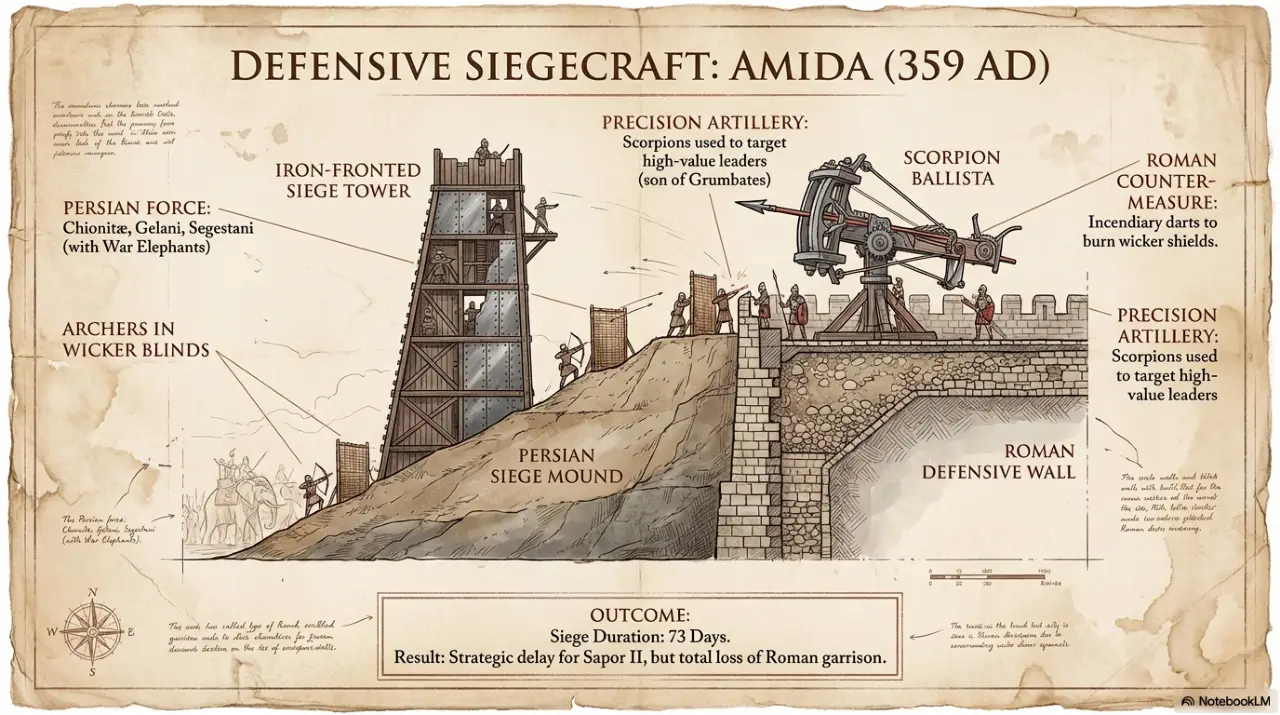
Veii, Lilybaeum, Numantia, Alesia, Jerusalem, Amida and Rome belonged to very different contexts. Walls, access to water, stored supplies, relief forces, internal factions and disease mattered alongside rams, mines and artillery. The phrase "the city fell" should open inquiry into capture, surrender, killing, enslavement, evacuation and resettlement rather than end it.
The same city can be attacked in different centuries with different defenses. Rome in 390 BC, 410, 455, 472 and 537–538 is not one permanent siege diagram. Amida in 359 and 502–503 is not one event with variant dates.
Military institutions change
Avoid anachronistic standardization. An early Republican levy, a late Republican army under a provincial commander, a Principate legionary establishment and a sixth-century expeditionary force are not interchangeable formations. A legion name or number found in a later source cannot simply be projected backward.
Similarly, auxilia, foederati, comitatenses and limitanei belong to particular administrative and historical contexts. A late unit list is evidence for its compilation and transmission, not automatically for every troop present in an earlier battle. Fleet establishments and garrison locations require dates as well as names.
Civil war is not an interruption to Roman military history
The Social War, Sulla, Caesar, AD 69, the Severan wars, Constantine's campaigns and the fourth-century succession conflicts determined who controlled the military resources of the state. Provincial armies became political constituencies. Loyalty, pay, veterans' expectations and commanders' claims to legitimacy could be as decisive as external pressure.
Do not silently classify all soldiers fighting the recognized emperor as non-Roman. The classification of a commander as emperor, usurper, king, ally or rebel is often one of the conflict's disputed outcomes.
Preserve the civilian record
Victories were experienced as requisition, debt, lost harvests, captivity, destroyed homes, displacement and changes in legal status. Ancient elite narratives rarely distribute attention according to the number of people affected. A compendium intended for archival work should retain room for letters, inscriptions, papyri, settlement archaeology and material losses beside narratives of command.
The stories of conquered Gauls, enslaved Sicilians, Judaean communities, African towns and Italian civilians should not be reduced to anonymous costs attached to a commander's achievement. Exact quantitative claims still require evidence; the lack of a secure number does not mean there was no harm.
Victory and ending need separate fields
At least five different endpoints recur: a battle won, an enemy ruler removed, a treaty made, a province organized and resistance reduced to a new level. They need not coincide. Zama in 202 BC and the treaty in 201, Ravenna in 540 and the continued Gothic war, or the removal of Augustulus in 476 and the survival of eastern Roman government are examples.
When expanding the atlas, record an outcome at the appropriate scale. "Rome won" is insufficient if the army won a battle but the settlement failed. "Rome fell" is insufficient if it refers only to the city, one imperial court or one office.
Working vocabulary
| Term | Use in this atlas |
|---|---|
| Campaign | A connected series of operations, usually within a theater and a defined period. |
| War | A broader conflict; conventional titles and dates may be later historical labels. |
| Theater | A geographic area in which related military and political operations occur. |
| Siege | Operations intended to capture, compel or isolate a defended place. |
| Blockade | Restriction of movement or supplies; not every blockade involves continuous assault. |
| Settlement | A political or administrative outcome, potentially distinct from the last fighting. |
| Province | An evolving Roman administrative and jurisdictional category, not merely territory visited by an army. |
| Client ruler | A useful shorthand for an asymmetric relationship; the actual obligations require case-by-case evidence. |
| Socii | Allies; in Republican Italy, communities whose relationships and obligations varied. |
| Auxilia | Supporting or auxiliary forces, with organization and status depending on period. |
| Foederati | Forces or groups connected through treaty arrangements; the meaning changed over time. |
| Comitatenses | Troops associated with late Roman field-army establishments; not a universal label for all mobile forces. |
| Limitanei | A late frontier troop category; it does not by itself mean an untrained peasant militia. |
| Usurpation | A seizure or assertion of imperial power treated as illegitimate by a rival or later tradition. |
| Annalistic tradition | A year-by-year historical tradition whose surviving form may incorporate later reconstruction. |
| Epitome | An abridgment; it can preserve lost material while removing context and detail. |
| Panegyric | Praise composed for a political or ceremonial purpose; useful evidence when that purpose is retained. |
| Eyewitness | A witness to specified events, not an automatic guarantee of neutrality or universal knowledge. |
| Attestation | Evidence that something is recorded; distinct from proof that the record is accurate in every detail. |
| Representative point | A gazetteer coordinate derived to locate a feature generally; not necessarily the feature's surveyed position. |