Wars · Guide
Armies, weapons and the conduct of campaigns
Reading the soldiers across thirteen centuries
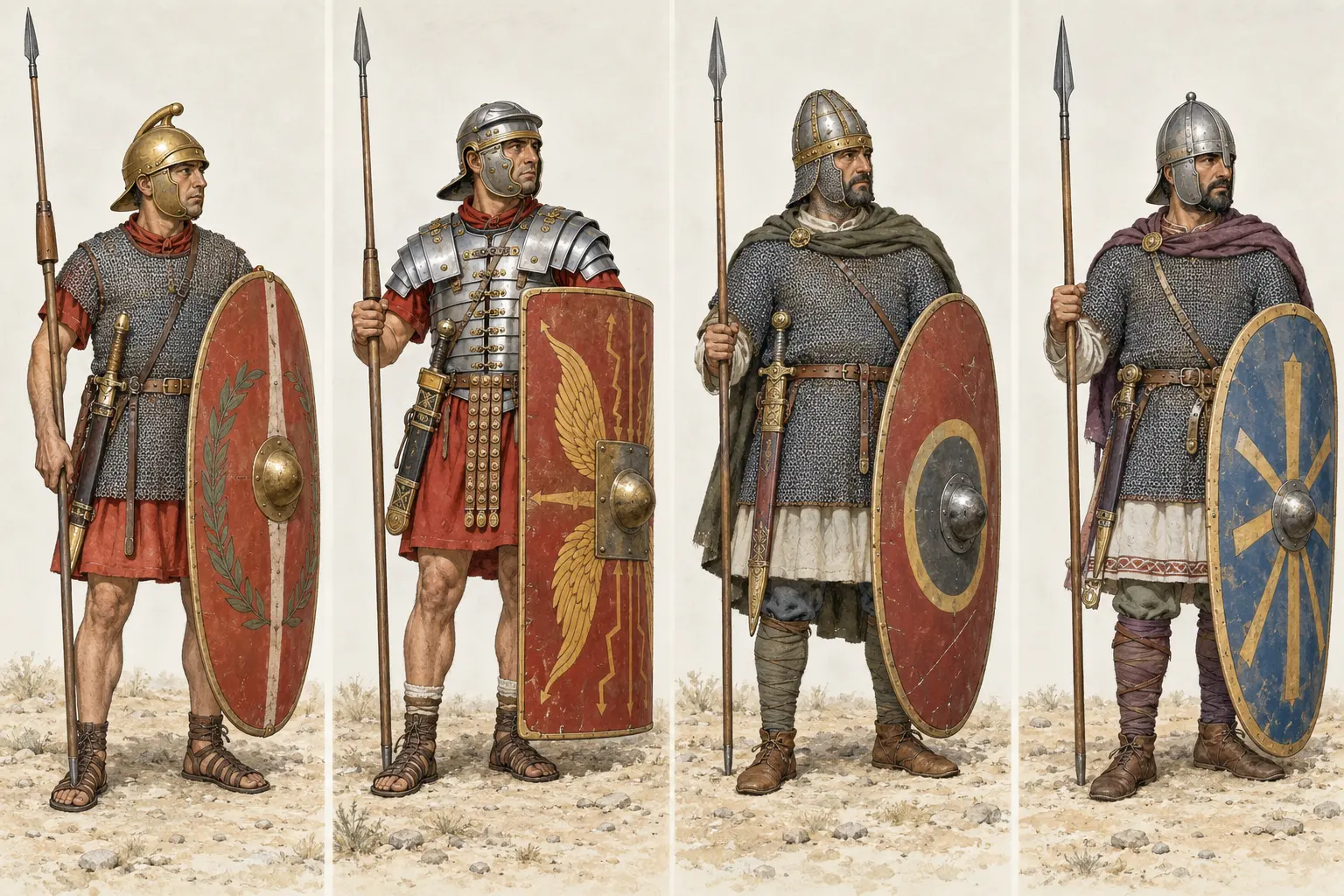
Roman armies changed with their recruitment, equipment, political organization and opponents. A soldier in the Samnite wars cannot be dressed as a legionary of Trajan; a soldier under Belisarius cannot be assigned Caesar's unit organization merely because both served Roman governments. Equipment also varied within a period. Private resources, supply, rank, unit role, local manufacture, repair and reuse prevented perfect visual uniformity.
| Military setting | Organization and equipment that matter | What the image of an army should preserve |
|---|---|---|
| Early civic and Italian warfare | Community levies, allied obligations, unequal resources, changing shield and armor traditions | No confident projection of imperial unit numbers or identical standardized equipment into the regal period |
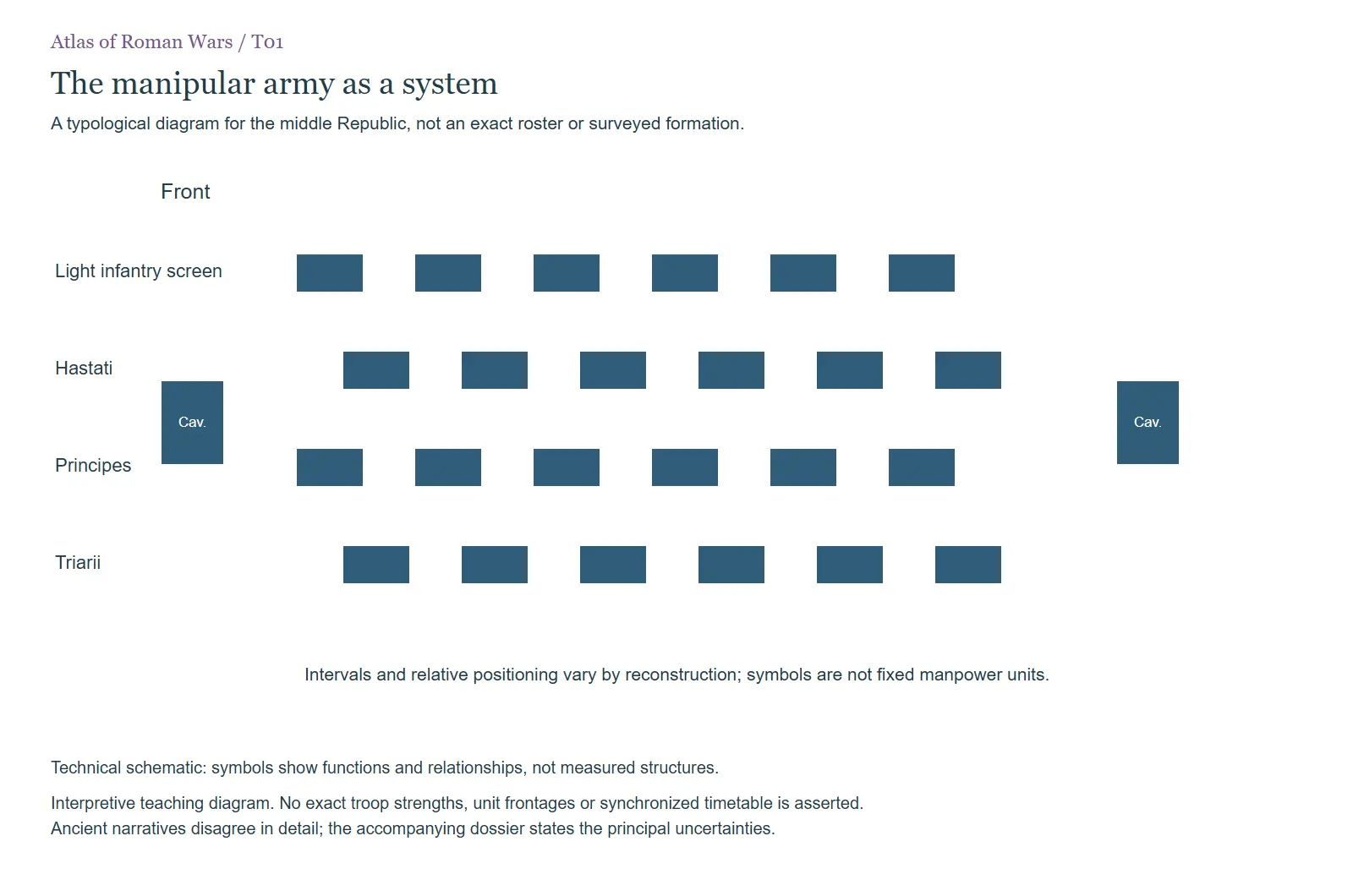
| Middle Republican campaigns | Roman and allied contingents; manipular infantry, light troops and cavalry; mail and other protection according to means | A flexible system whose formations and battlefield intervals cannot be reduced to one fixed graphic |
| Late Republican armies | Provincial commands, experienced soldiers, long service in campaigns, allied and recruited specialists | Political loyalty, recruitment and supply beside the familiar heavy infantry |
| Principate forces | Legions, auxiliary units, fleets, permanent bases and detachments; varied armor forms | The coexistence of mail, scale, segmented armor and different roles rather than a single universal costume |
| Late Roman warfare | Several field and frontier establishments, smaller units, allied contingents and changing command structures | Long swords, spears, missiles, oval or round shields and mixed protection without assuming every soldier was a cavalryman |
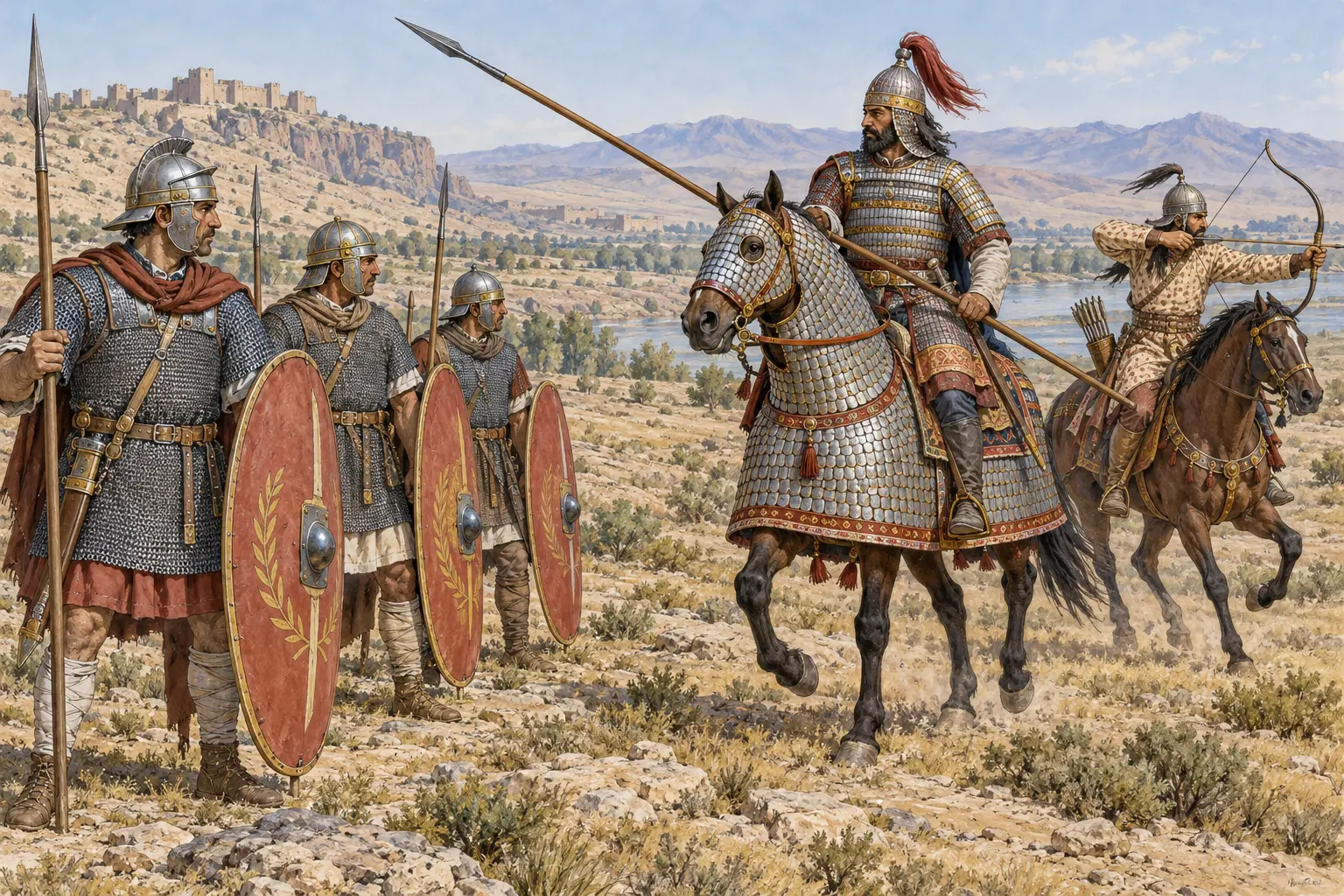
| Justinianic expeditions | Mixed infantry and cavalry, mounted archers, personal military followings, allies and shipborne supply | A composite army supported by pay, transport and local relationships, not an unchanging early imperial legion |
Opponents and allies
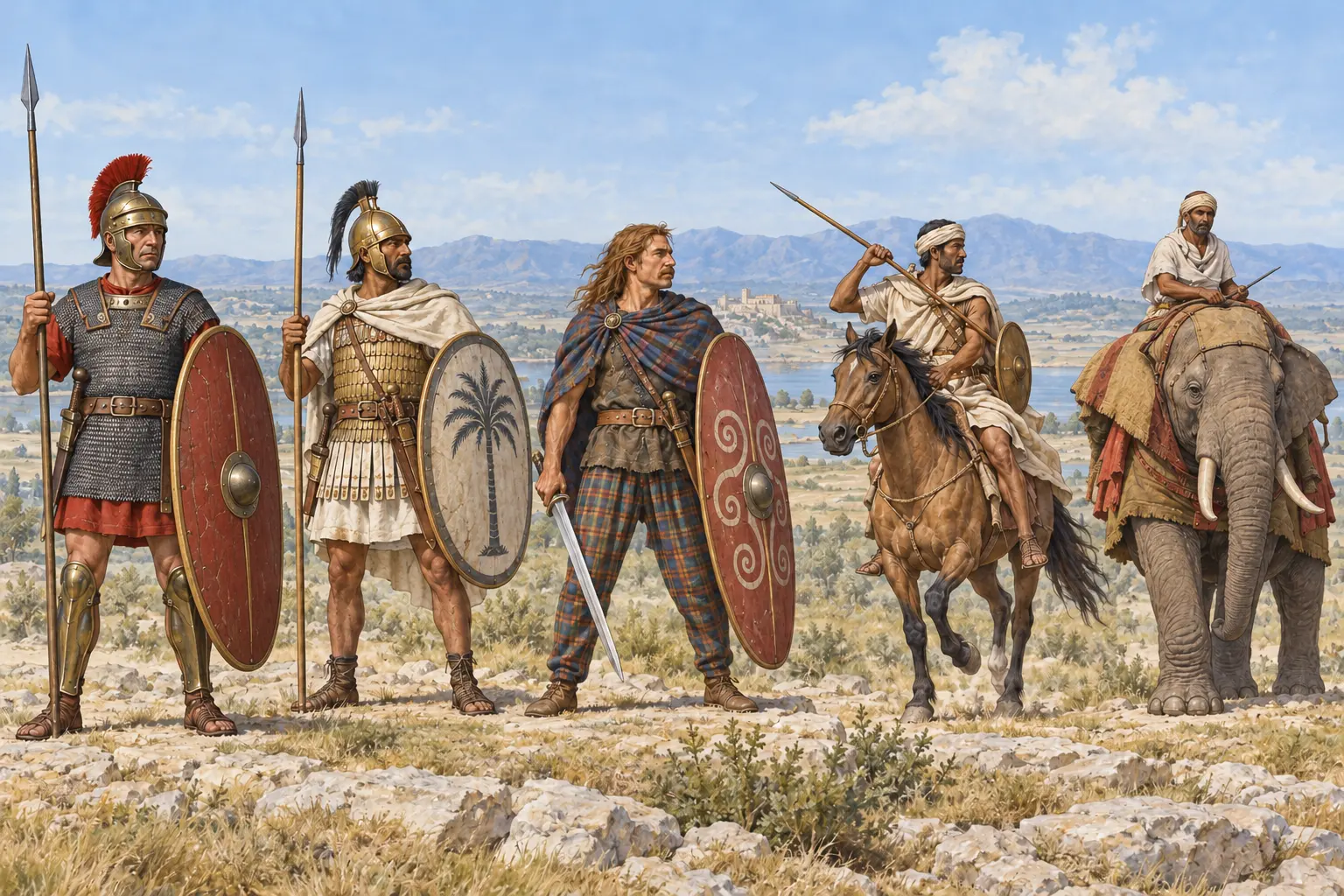
Rome's enemies were not a sequence of uniform national armies. A Carthaginian army could include African infantry, Iberian and Gallic contingents, cavalry from different political relationships and elephants in some campaigns. A Numidian ruler might oppose Rome in one phase and become an indispensable ally in another. The mixed army required the management of different fighting methods, languages, recruitment relationships and expectations of reward.
Macedonian and Seleucid forces also combined arms. The phalanx's strength depended on order, frontage and mutual support; cavalry, light troops and the broader command plan mattered to its employment. Cynoscephalae and Pydna do not establish that any Roman infantry formation defeated any phalanx in all terrain. They show what could happen when a long-weapon formation's cohesion and coordination were compromised.
Gallic and Germanic coalitions require the same care. Their forces could possess skilled leaders, cavalry, strongholds, weapons manufacture and sophisticated political relationships. Their failure to reproduce a Roman administrative system does not make every army an undisciplined crowd. Roman writers' classifications were shaped by their own purposes, and modern labels must not erase differences between communities or centuries.
| Fighting role | Principal military function | Constraint that a dossier must consider |
|---|---|---|
| Heavy infantry | Hold ground, close with opponents, protect a formation and support assaults | Cohesion, fatigue, frontage, missile exposure and contact with neighboring units |
| Light infantry and missile troops | Screen, skirmish, disrupt and exploit terrain | Ammunition, protection, room to withdraw and support from other forces |
| Shock cavalry | Strike exposed or disordered opponents, threaten a flank, pursue | Space, horse condition, cohesion, terrain and a target that can actually be reached |
| Mounted archers | Apply mobile missile pressure, screen and harass movement | Arrows, remounts or horse endurance, visibility and the risks of pursuing into prepared ground |
| Elephants | Disrupt, intimidate or create a tactical opportunity in suitable conditions | Handling, terrain, missiles, panic, supply and the danger posed to their own side |
| Engineers and labor parties | Build camps, bridges, siege approaches, artillery positions and counterworks | Tools, materials, time, protection, expertise and the command's ability to maintain workers |
| Naval forces | Move and protect troops and supplies, blockade, fight and threaten coasts | Trained crews, weather, ports, maintenance, water and communication with armies ashore |
Weapons in context
The pilum, spear, sword, bow and sling perform different tasks. A weapon name alone does not establish its dimensions or the way every soldier used it. Roman sword forms changed, and the long sword was not introduced to every unit in one administrative instant. Shield shape and construction likewise varied; later artistic stereotypes should not replace evidence for a particular date.
Mail, scale and segmented armor reflect different manufacturing and maintenance requirements. Their presence in the same broad period does not mean identical distribution. Protection of the head, torso and limbs must also be separated: a single armored officer in a relief is not a statistical sample of the army. The generated equipment plates make these differences visible while leaving exact unit attribution open.
For an army in the field, weapons depended on transport and repair. A broken shield, exhausted horse or shortage of arrows could make nominal equipment irrelevant. Detailed dossiers therefore treat weapons as part of a working military system rather than an isolated catalog of impressive objects.
Camps, supplies and the labor of war
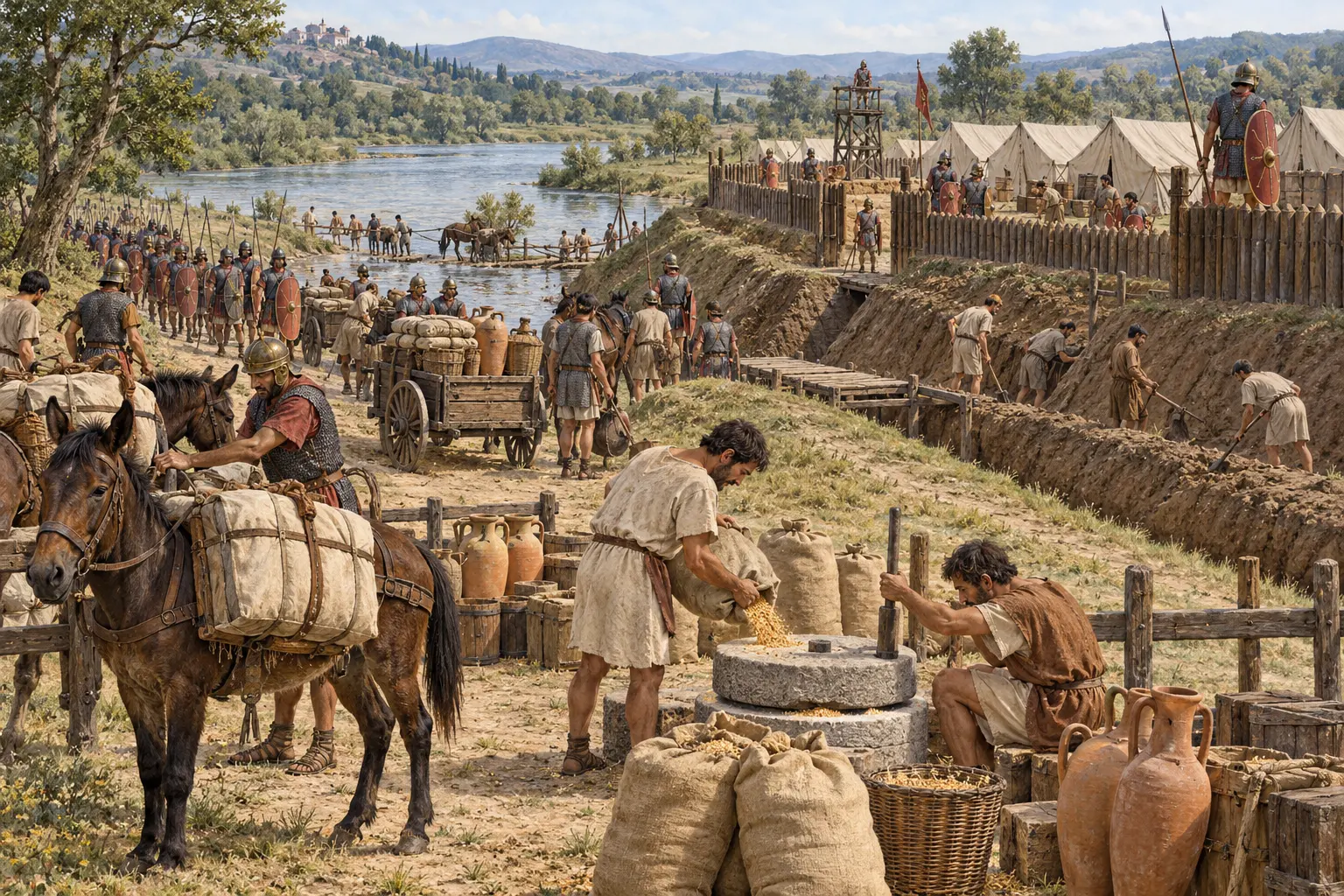
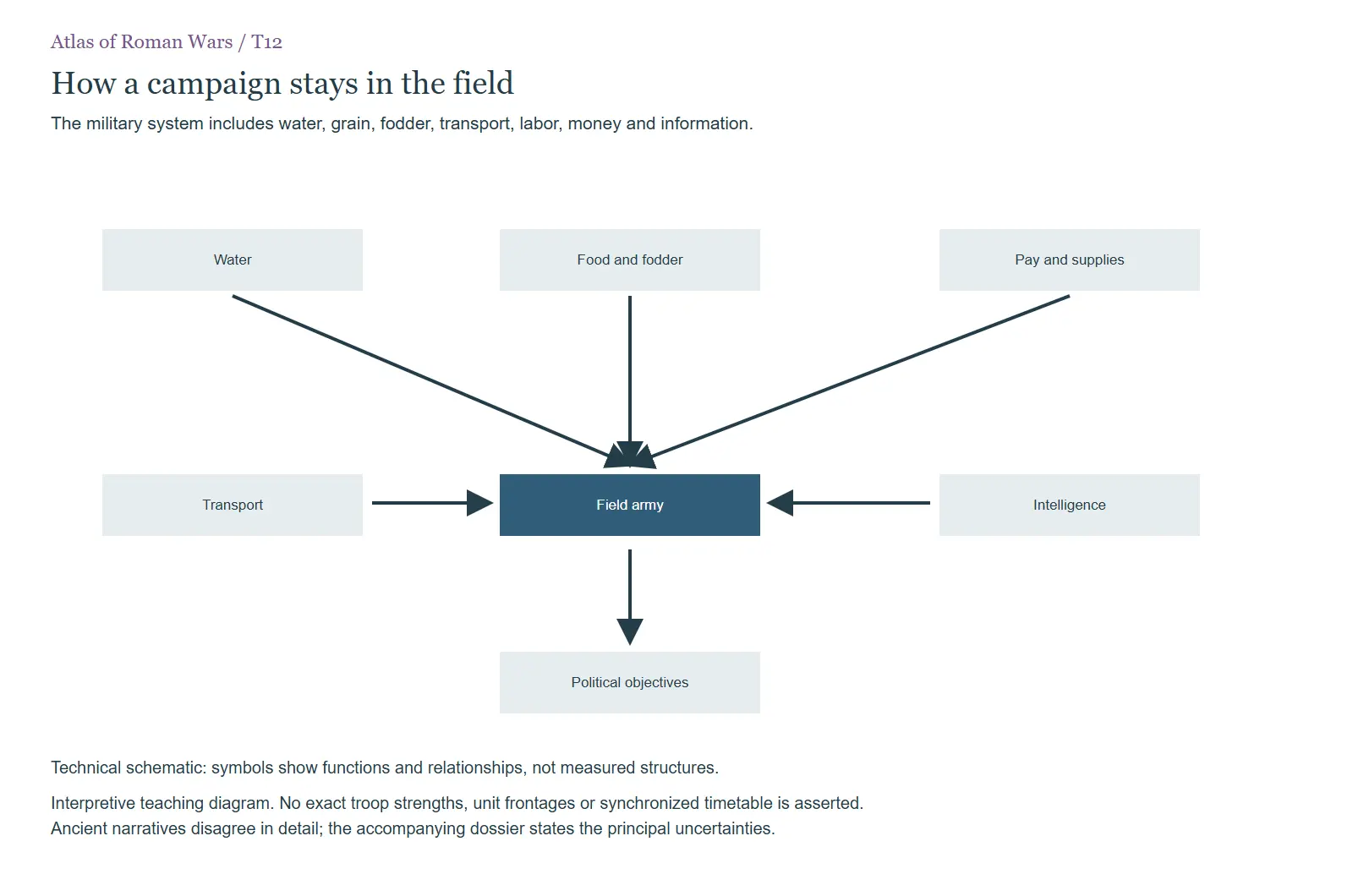
Food for men and fodder for animals impose different burdens. Water can determine the line of movement before an enemy army intervenes. Pack animals and carts increase carrying capacity while creating their own demands for forage, supervision, road space and protection. A fleet can transform an army's endurance, but only while harbors, weather, crews and the land force's access remain usable.
Pay is another form of supply. The allegiance of soldiers and allied forces depends partly on promises being credible. The late western recovery expeditions, mutinies in reconquered Africa and the long Gothic war show the consequences when a government can assemble an army but struggles to keep it paid and supported. Command decisions must be assessed against those constraints.
Siege and counterwork
Siege warfare changes the relationship between time and force. A defended place can compel an attacker to remain, expose workers and maintain supplies while a relief army gathers. A blockade can be strategically stronger than an assault while producing terrible civilian suffering. Defenders may counterattack, repair damage, detect mines, change water access or exploit disorder inside the besieging army.
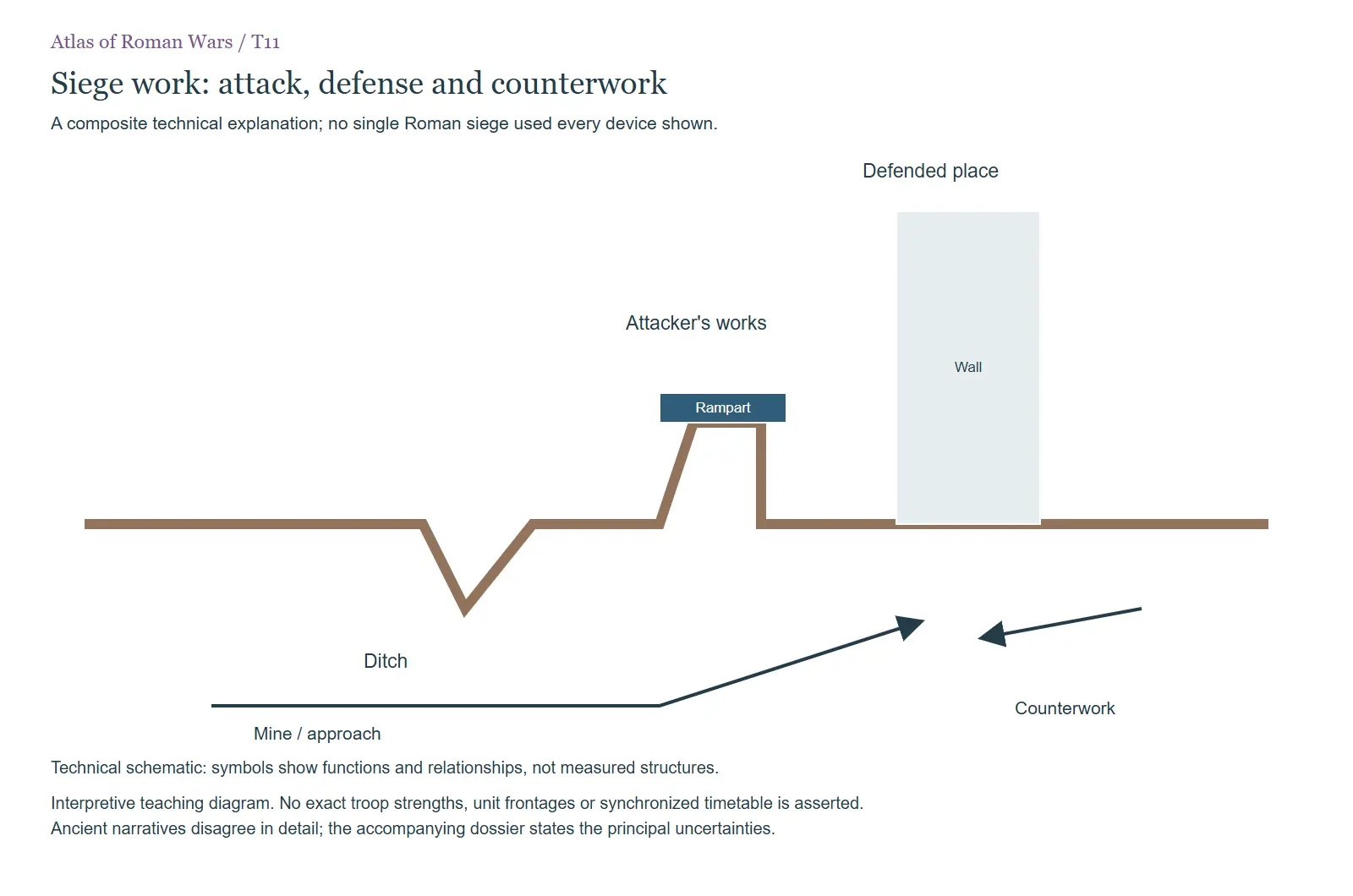
Torsion artillery, rams, towers and mining must be dated and contextualized. A machine that appears in a later illustration is not automatically appropriate to Alesia, Jerusalem or sixth-century Rome. Nor does a siege description provide every dimension needed to build an exact model. The dossiers retain the tactical purpose of a device and distinguish it from a completely verified reconstruction of its engineering.
Battlefield environments
| Environment | Campaign problem | Examples in the dossiers |
|---|---|---|
| Mountain passes and broken ground | Access, ambush risk, animals, supply and the separation of formations | Samnium, the Alps, Armenia, Isauria |
| Open plains | Observation, cavalry mobility, missile pressure, frontage and maneuver | Cannae, Carrhae, parts of the eastern wars |
| River crossings | Order of movement, wet or exhausted troops, bridge security and supply access | Trebia, Germanicus' campaigns, Julian's expedition |
| Marshes, lagoons and changing coasts | Unreliable modern shoreline analogies, disease and restricted movement | Carthago Nova, Ravenna, the African coast |
| Urban strongholds | Walls, gates, water, population, internal politics and relief | Carthage, Numantia, Jerusalem, Amida, Rome |
| Coastal and island theaters | Shipping, protected anchorages, weather and coordination ashore | Sicily, the Adriatic, Sextus Pompey's war, the Vandalic expedition |
| Steppe and broad frontier zones | Mobile opponents, dispersed resources, tribute and local alliances | The Danube, Hunnic wars, portions of the eastern frontier |
No environment determines the result automatically. Armies learn, opponents adapt, and the same ground can support different operations under different political and logistical conditions. The atlas uses the visuals to make these relationships legible, not to replace them with a promise that one diagram explains every war.