Wars · V. The early Principate: conquest and provincial war
W051 The conquest of Britain and Agricola's northern campaigns
Battles and sieges
Mons Graupius 83 ADThe Claudian invasion under Aulus Plautius established a Roman military foothold and culminated in the occupation of Camulodunum. The extension of control required decades of campaigning against different communities, particularly in Wales and the north. Commanders, armies and policies changed during that process.
Agricola's campaigns combined land operations with naval support and culminated in the victory called Mons Graupius, conventionally dated to AD 83 or 84. The conquest was therefore a sequence of advances, reverses and reorganizations rather than one army steadily crossing an island to a predetermined frontier.
Command, forces and military problem
| Field | Dossier |
|---|---|
| Roman leadership | Plautius, Ostorius Scapula, Agricola and other governors |
| Opposing or rival parties | Caratacus and many different British communities and coalitions |
| Forces and capabilities | Legions, auxiliaries, fleets, defended settlements and local allies |
| Operational problem | Establish a province and expand it while securing communications behind successive advances. |
Campaign geography and operational plates
Britain: conquest phases and military communications
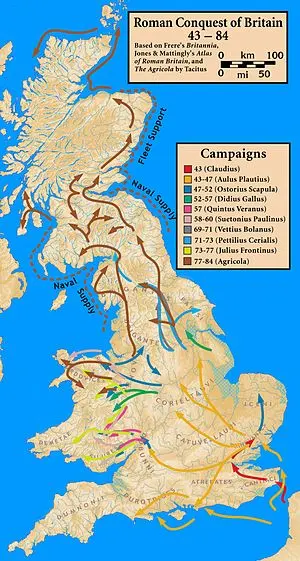
The southeast, western uplands and northern campaigning zones required different approaches. The key separates the initial advance from operations under later governors, rather than presenting the colored arrows as one simultaneous expedition. Broad arrows explain the expansion of the theater; precise landing places and the location of Mons Graupius remain separate historical problems.
Britain: the river and settlement network
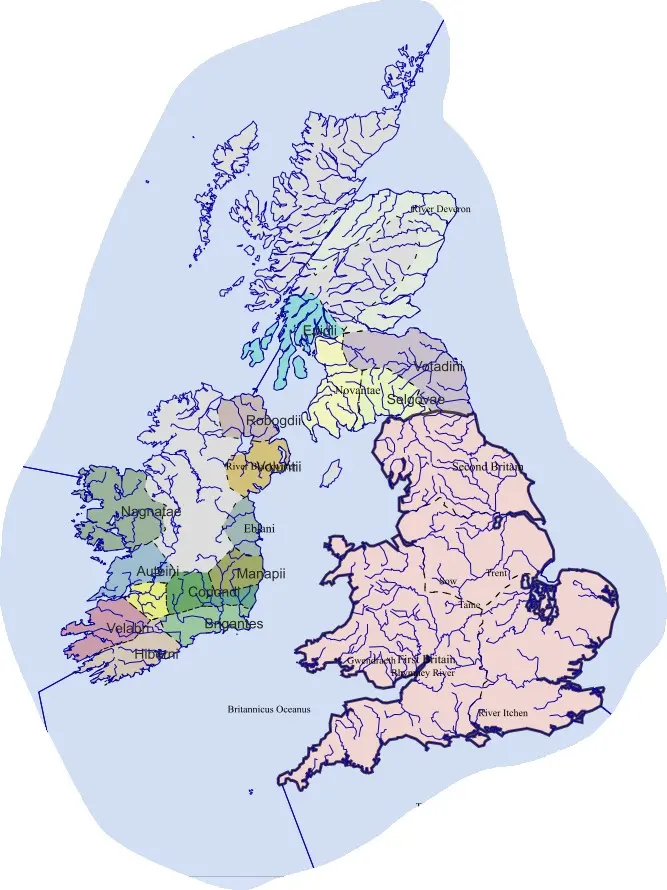
The southern lowlands and the narrower northern corridors place the fort and town network within a physical landscape. This is particularly helpful when comparing the initial conquest with the second-century choice of frontier. The combined network is not a snapshot in which every installation was occupied simultaneously.
Extended campaign study
The account below develops the operations and their interpretation. Reported numbers and reconstructed tactical details retain the uncertainties described in the dossier.
The Claudian Invasion (43–47)
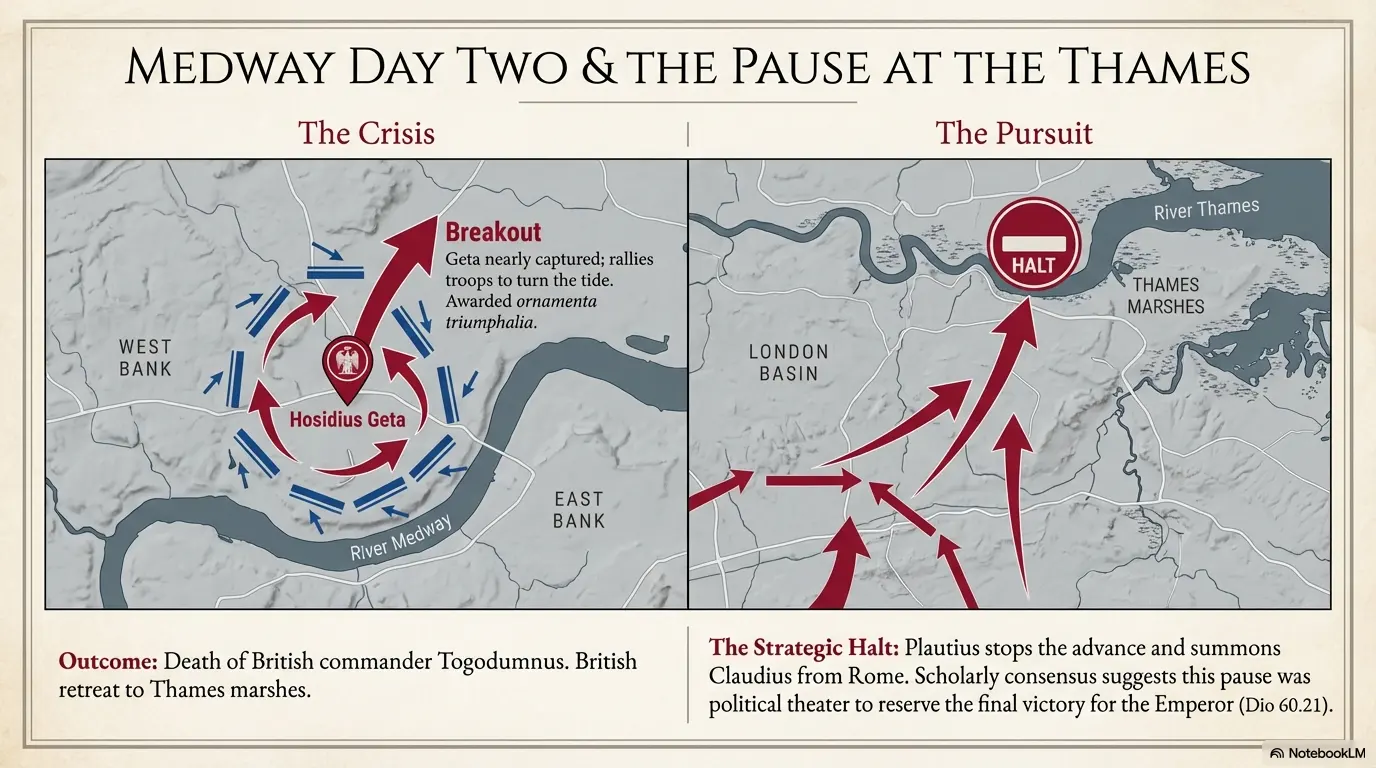
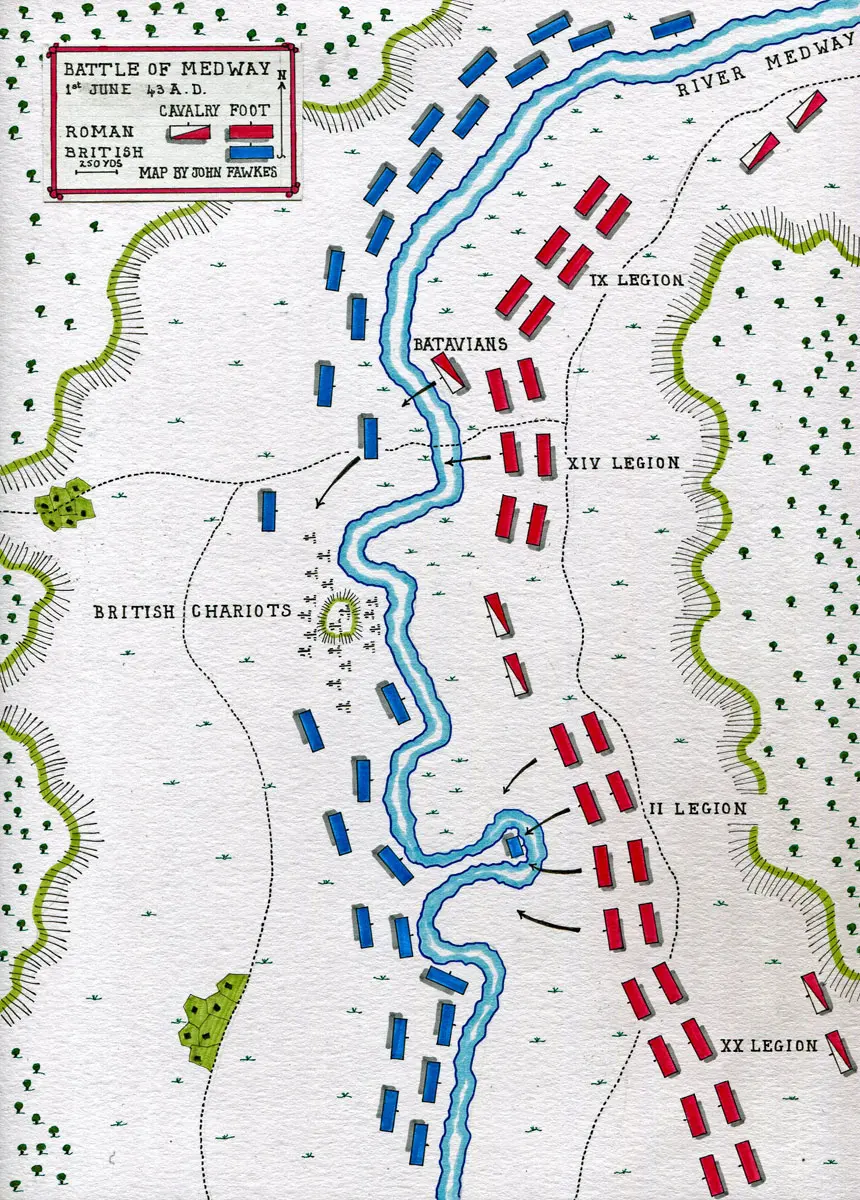
The invasion of 43 was assembled from the standard imperial kit: a dynastic need (Claudius, raised by the Praetorians over the Senate's protests after Gaius's murder, required a conquest as a coronation requires a crown), a legal pretext (the exiled king Verica of the Atrebates, suppliant at Rome against the expanding sons of Cunobelinus), and an economic brief the merchants had been writing for a century. Four legions were committed — II Augusta from Strasbourg under the future emperor Vespasian, IX Hispana from Pannonia, XIV Gemina and XX from the Rhine — with auxilia to match, some forty thousand men under Aulus Plautius; and the expedition began with the age's characteristic mutiny, the troops refusing the Ocean as a boundary of the human world until Claudius's freedman Narcissus, mounting the tribunal, was shouted down with the Saturnalian jeer Io Saturnalia — slaves playing master — and the army, having laughed itself out of its terror, embarked. The landing (Richborough by the consensus the archaeology of the Claudian base there sustains, against a minority case for the Solent) was unopposed, the Britons having stood down a coastal levy the delayed crossing outwaited; the campaign's decision came on the Medway, a two-day battle — a rarity in ancient warfare the sources mark as such — where the Batavian cohorts swam the river in armor to hamstring the chariot-teams, Hosidius Geta's division was cut off and nearly lost before winning the ornamenta triumphalia, and the brothers Togodumnus and Caratacus were broken westward. Plautius halted at the Thames per his instructions, and the emperor came out for the finale as the script required: Claudius crossed with the reinforcements and the elephant corps, presided sixteen days, received Camulodunum and the surrender or alliance of eleven kings — the arch at Rome would count them — and returned to celebrate the conquest of Ocean; the Senate gave him the name Britannicus for his son, and the reign its foundation myth.
Caratacus (47–51)
The son of Cunobelinus, twice beaten in the southeast, executed the strategic withdrawal that made him: westward, out of his own lost kingdom, into the hills of the Silures and Ordovices, where for eight years he ran the war Rome could least afford — the Sertorian war of ambush and weather, the legions' roads lengthening behind them, a governor (Ostorius Scapula) dying in harness of the strain. Brought to bay at last in 51 on a prepared position in the Ordovician hills — river in front, slopes stone-walled, the sources' description generic enough that no modern candidate site commands assent — he lost the set-piece battle to the escalade he could not prevent, lost wife and daughter to the camp's capture, and, fleeing north to the Brigantes, was delivered in chains by their queen Cartimandua, Rome's client, whose reward and whose consequent domestic history — the consort Venutius twice raised the north against her, the second time, in the year of the four emperors, for keeps — the chapter will meet again. The captive's Roman finale Tacitus stages as the dynasty's best theater and the tradition's best speech: the parade of the Claudian guard, the trophies, the kneeling family — and Caratacus upright, asking the emperor from the tribunal why a possessor of such marble should covet British tents, and closing on the hinge the historian built for him: kill me, and both the war and your glory die with me; spare me, and I am forever the proof of your clemency. The captor-queen's reward, and the Silurian war grinding on regardless — a legionary camp stormed, a governor's ashes, the Senate hearing the war-word deleri, extermination, entered into policy against the Silures — carried the province to the reign of Nero, the appointment of Suetonius Paulinus, the Atlas veteran, and the operation with which the next section opens: the reduction of the druids' island, Mona, in 60 — the shore-line of black-robed women with torches among the warriors, the soldiers frozen until shame moved them, the sacred groves cut — at the precise moment when, at the province's other end, a client-king's will came due.
Agricola and the Far North (77–84)
Through the Agricola — biography, ethnography, and opposition pamphlet in one — the narrative presents the northern conquest whole: Mona finished in the first season; the Brigantian and lowland consolidations; the Forth–Clyde line garrisoned and judged, for one paragraph of the historian's regret, a sufficient terminus; then the estuary-hopping advance beyond it, the fleet feeling ahead of the army, the ninth legion's camp surprised by night and saved by the general's own column striking the attackers' rear at dawn; and in the seventh summer, at the mountain the sources call Graupius — unlocated; the northeast's candidates from Bennachie northward each keep their partisans — the massed Caledonian confederacy under Calgacus, thirty thousand by the account, standing at last. The battle beneath the speeches Agricola won without committing a legion: the auxilia — eight thousand foot, Batavian and Tungrian cohorts leading — carried the slope sword-to-buckler, the cavalry broke the flanking masses, and the pursuit ran to nightfall with the tradition's arithmetic at ten thousand Caledonians against three hundred and sixty auxiliaries; the fleet was then sent north about, took the surrender of Orkney, sighted Thule, and proved Britain an island — the campaign's real strategic yield, the Ocean's circumnavigation, worth more at Rome than the moor it garlanded.
Tactical illustrations
Outcome and critical assessment
Result and caution: Rome established a durable province but never permanently conquered all Britain. Tacitus' Agricola is also a tribute to his father-in-law. The precise site of Mons Graupius is unconfirmed, and the famous speech of Calgacus is literary composition, not a transcribed indigenous testimony. The Medway identification also requires more care than its familiar modern label suggests.
Historical record: IR-VI, chapter 4; Dio, book 60; Tacitus, Agricola, especially 18–38.