Wars · V. The early Principate: conquest and provincial war
W050 Tacfarinas and the Mauretanian annexation wars
Tacfarinas led resistance that repeatedly challenged Roman control beyond the settled provincial core. Roman responses had to address mobility, local alliances, military posts and access to resources. The conflict's persistence shows the limits of treating an African province as a uniformly pacified colored area.
The annexation of Mauretania after the death of Ptolemy under Caligula produced a separate conflict, including resistance associated with Aedemon. Roman campaigns preceded the organization of Mauretania into provinces. The two wars share a regional setting but neither the same leaders nor a single continuous political cause.
Command, forces and military problem
| Field | Dossier |
|---|---|
| Roman leadership | Several African governors; later Paulinus and Geta in Mauretania |
| Opposing or rival parties | Tacfarinas and his allies; Aedemon and other Mauretanian resistance |
| Forces and capabilities | Mobile regional forces, Roman posts, field armies and locally negotiated support |
| Operational problem | Secure movement and authority without assuming that a leader's defeat completes annexation. |
Tacfarinas: the struggle over control and mobility
Tacfarinas' earlier Roman military experience is significant because the revolt cannot be explained as an encounter between a wholly Roman military culture and people entirely unfamiliar with it. His following and alliances changed. Raiding, attacks on posts and the possibility of concentrating larger forces allowed the movement to survive reverses.
Roman commanders faced the choice between concentrating enough troops to defeat a gathered enemy and dispersing them enough to protect places, communications and access to supplies. Blaesus' operations and Dolabella's final campaign belong to that changing response. The capture or death of a leader could matter greatly, but a victory announcement alone did not demonstrate that the underlying regional relationships had been permanently settled.
The control of grazing, cultivation and movement is a useful interpretation of the theater's importance. It should not become an unsupported claim that every group fought for one identical economic program. Tacitus provides the principal political and military narrative, with particular hostility toward officials and claims of triumph that he considered inadequate.
Mauretania: the violence of annexation
The killing of Ptolemy ended a royal relationship that had mediated Roman interests in Mauretania. Annexation required the replacement of that relationship by direct imperial structures. Resistance associated with Aedemon made the transition a military problem, followed by campaigns under commanders including Suetonius Paulinus and Hosidius Geta.
The mountain and interior setting differed from the ports and urban centers from which Roman administration could be organized. Marching farther inland demonstrated reach but did not create a continuous surveyed frontier. Provincial organization into Tingitana and Caesariensis helped define Roman responsibilities without eliminating the need for continuing diplomacy and force.
Shared consequences, separate wars
Both conflicts changed the relationship between imperial government and African populations. Both also show the limits of the word "pacification," which can disguise recurrent coercion, negotiated accommodations and uneven control. They remain separate wars because their timing, leadership and political causes differ. The later revolt of Firmus and the sixth-century wars with the Mauri belong to the same broad region's military history, but should not be represented as the automatic continuation of a single people fighting one thirteen-generation war.
Campaign geography and operational plates
North Africa: cities, roads and military districts
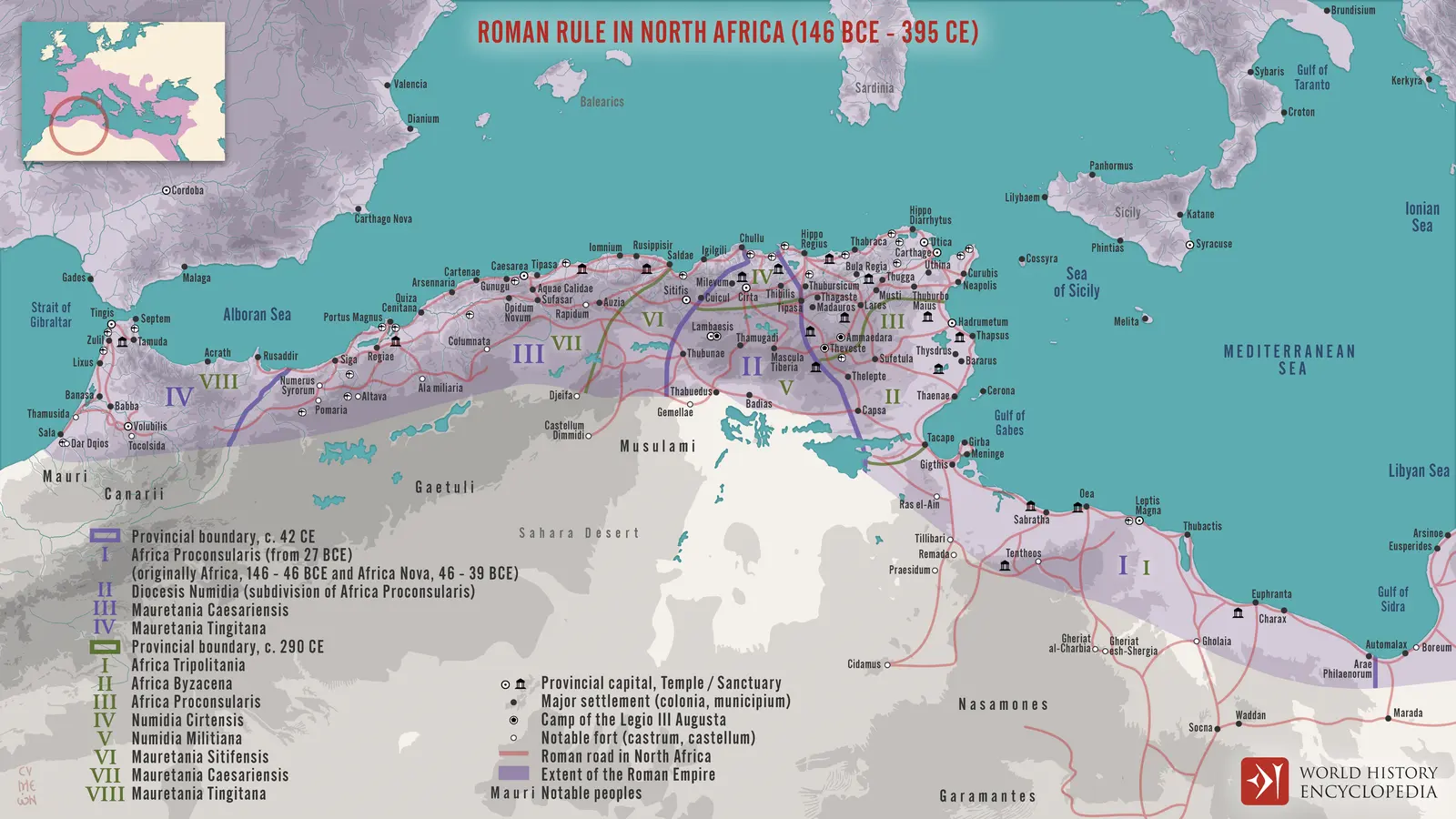
A narrow, connected coastal and upland world contrasts with the much larger interior. The towns, road systems and legionary references help explain the relationship between settled resources and operations beyond them. For Jugurtha or early annexation, treat the later roads and administrative units as a subsequent layer, not as contemporary campaign infrastructure.
The Mauretanian war and the Atlas crossing
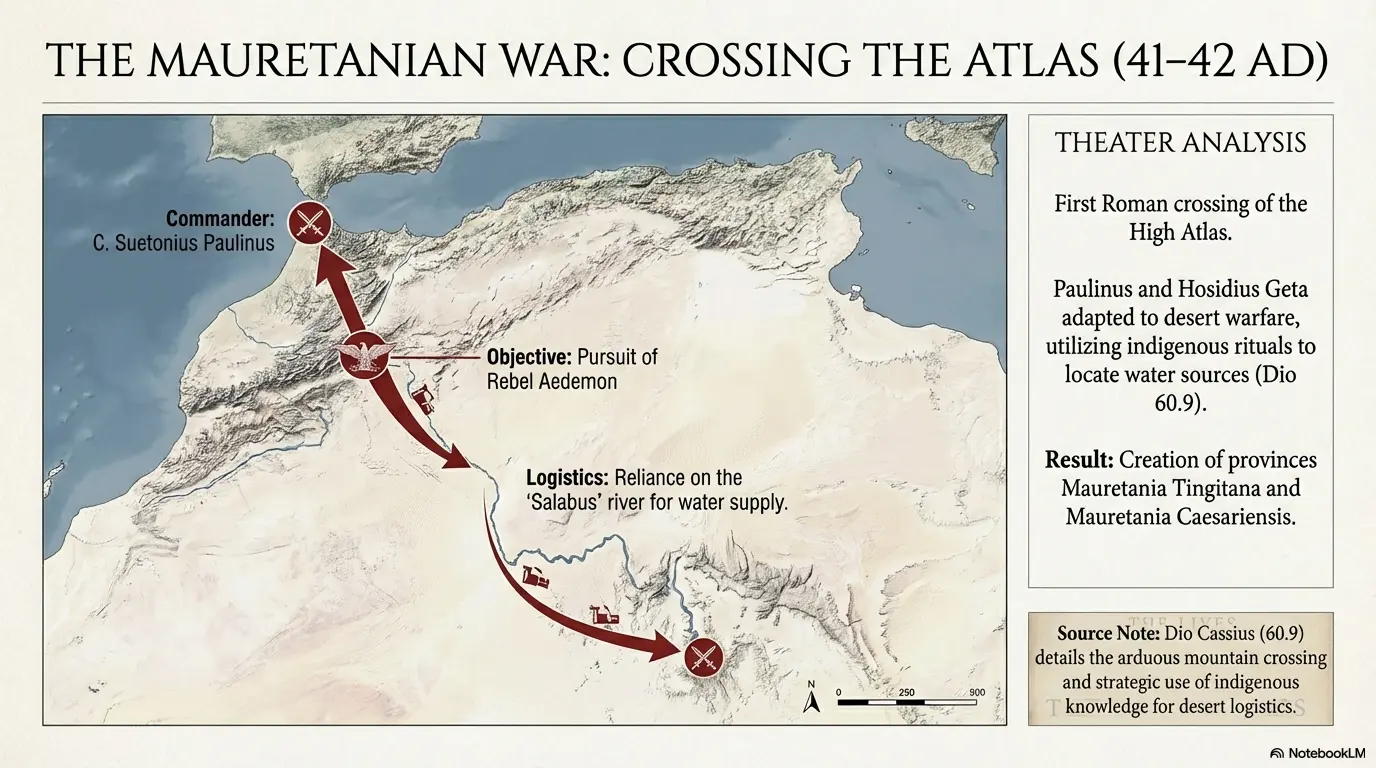
The contrast between coast, mountain barrier and interior helps explain why the Atlas crossing became memorable in the narrative tradition. Water, indigenous knowledge and the ability to pursue beyond familiar zones mattered. The path drawn over the relief is an explanation of the operational problem, not independent proof of an exact pass or every stop.
Outcome and critical assessment
Result and caution: Roman authority expanded or was restored, while frontier management continued. "Bandit" is an elite literary description, not a sufficient classification of the movements. The broad regional locator plate does not supply a surveyed boundary between cultivated land, pastoral movement and Roman military control.
Historical record: Tacitus, Annals 2–4 for Tacfarinas; Dio, Claudian context for Mauretania; IR-VI, provincial-war background.