Wars · V. The early Principate: conquest and provincial war
W049 Varus' defeat and Germanicus' campaigns
Battles and sieges
Varus disaster 9 ADIdistaviso and the Angrivarian Wall 16 ADArminius' coalition destroyed the army of Varus in AD 9. The loss of three legions and associated forces had a lasting political impact. The character of Roman control east of the Rhine before the defeat remains a question of developing administration, military presence and relationships, not a border drawn securely across a map.
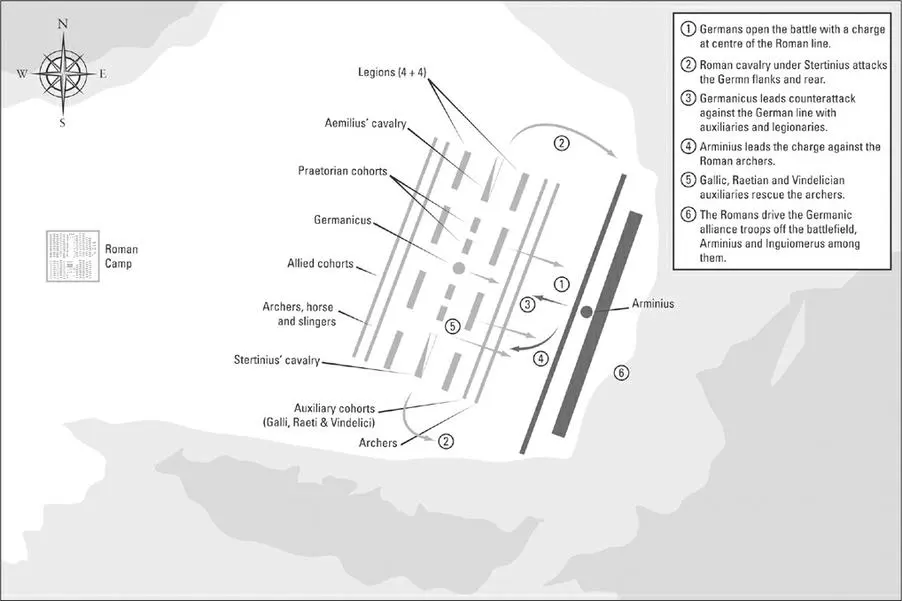
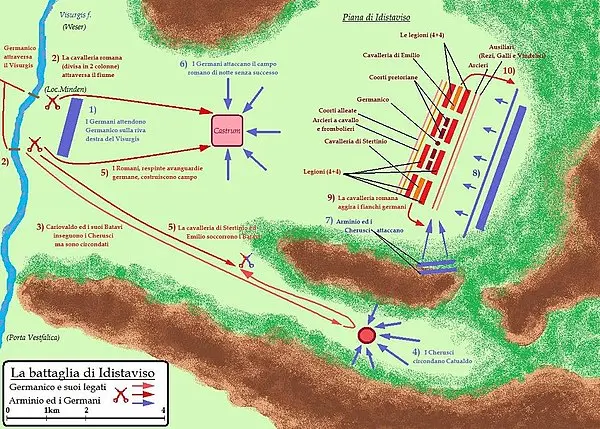
Germanicus later campaigned beyond the Rhine, recovered some standards and fought engagements reported as Idistaviso and the Angrivarian Wall. Fleet movement, river crossings and weather were important. Tiberius ended the command without turning those campaigns into permanent occupation of the whole region.
Command, forces and military problem
| Field | Dossier |
|---|---|
| Roman leadership | Varus in AD 9; Germanicus in later expeditions |
| Opposing or rival parties | Arminius and changing Germanic coalitions |
| Forces and capabilities | Legions, auxiliaries, local intelligence networks, river transport and fleets |
| Operational problem | Prevent or recover from loss of cohesion and decide whether expeditions justify lasting occupation. |
Campaign geography and operational plates
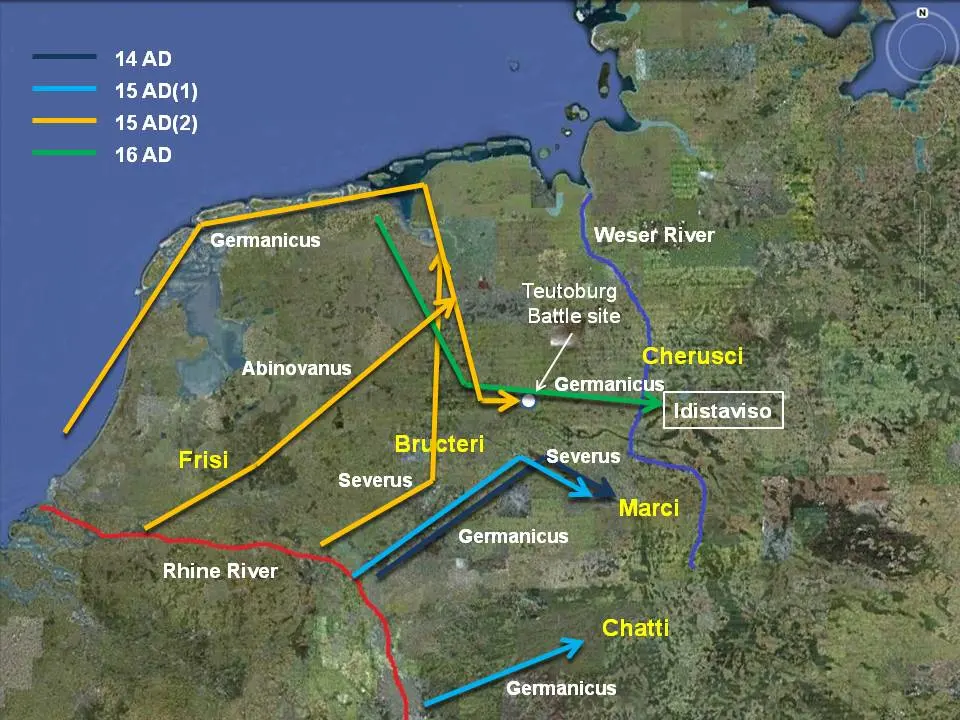
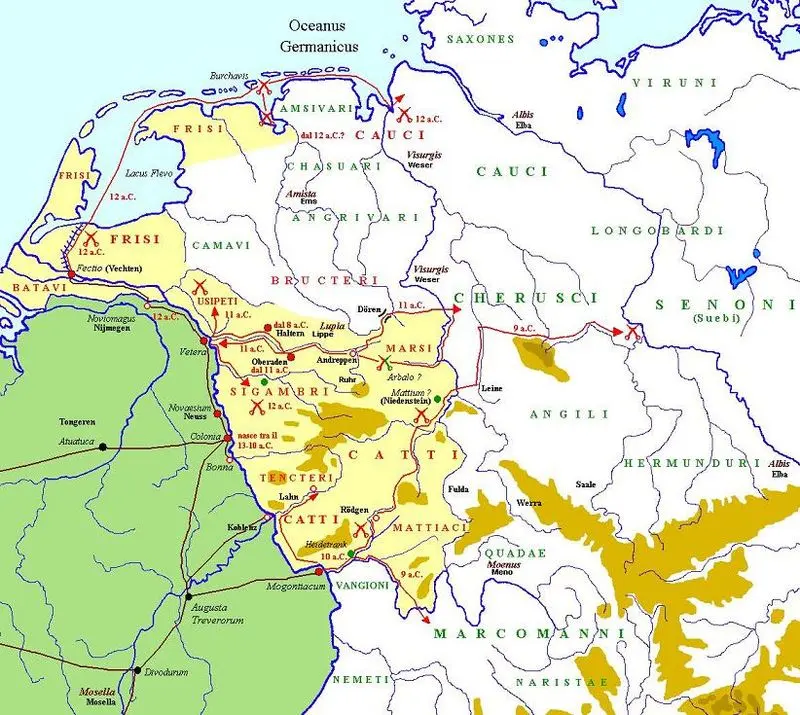
Germanicus: river access and repeated expeditions
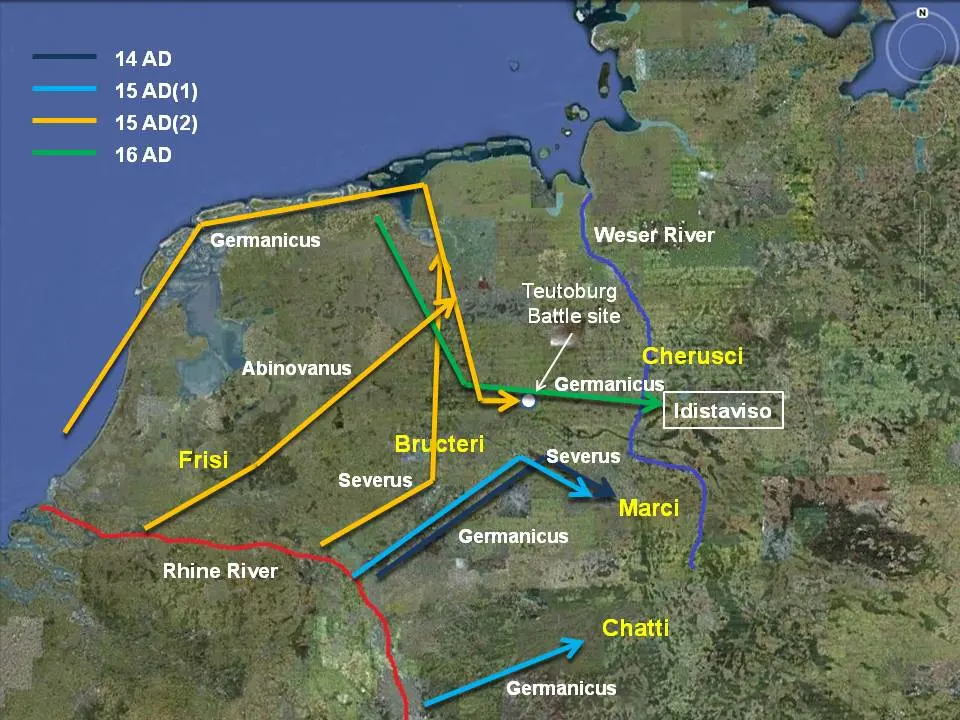
The map brings the Rhine, North Sea approaches and inland river corridors into the same frame. Moving an army into Germania was a transport problem as well as a fighting problem. The smooth colored lines compress difficult movements and should not be taken to locate every camp or the still-disputed details of each battlefield.
Corbulo, the Chauci and the Rhine frontier
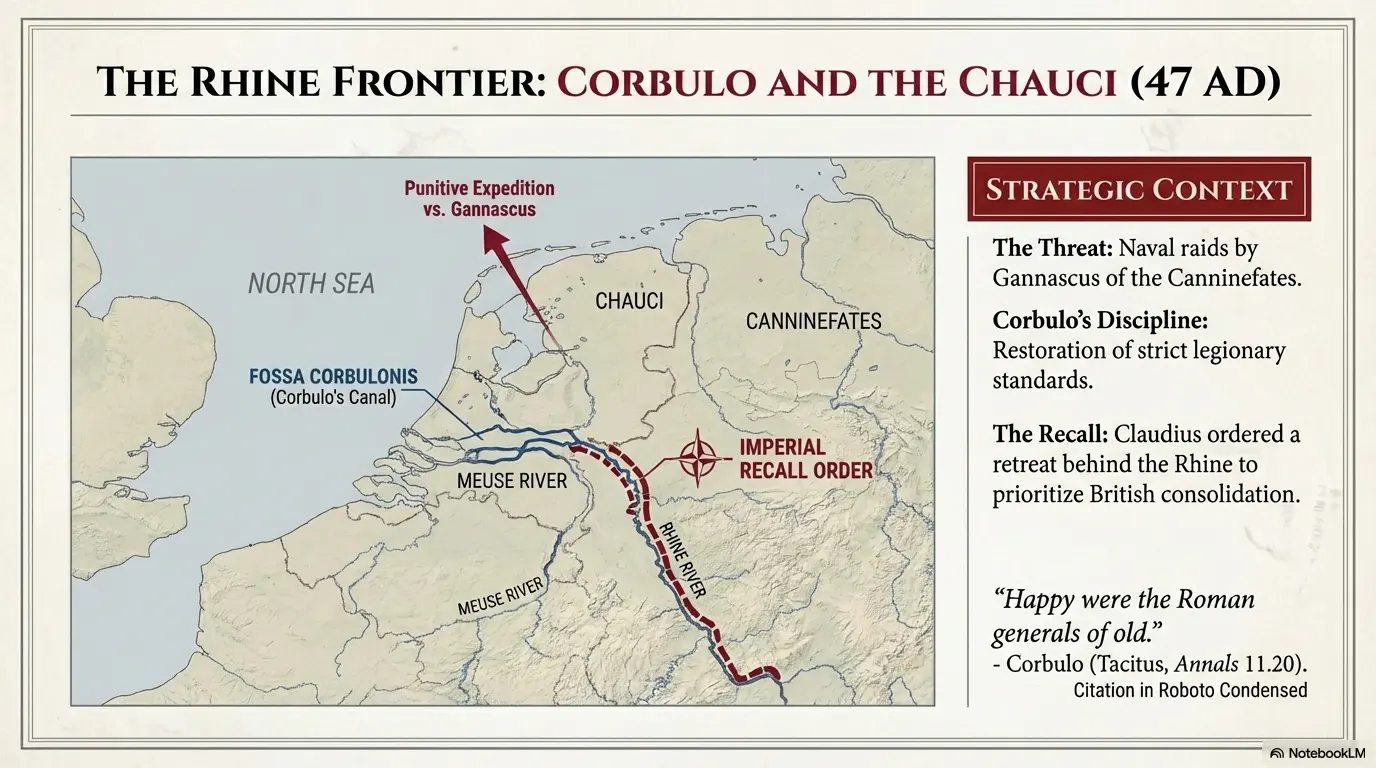
This later episode extends the dossier beyond the Varus disaster and Germanicus' campaigns. Naval raiding, river access, discipline and orders from the emperor all shaped what a frontier commander could attempt. The canal belongs to the management of movement and communications; the map is not a technical survey of its ancient alignment.
Extended campaign study
The account below develops the operations and their interpretation. Reported numbers and reconstructed tactical details retain the uncertainties described in the dossier.
The Teutoburg (September, AD 9)
Publius Quinctilius Varus was not the fool the tradition required. Consular, husband of the emperor's grand-niece, former governor of Africa and of Syria — where he had marched on Jerusalem to crucify two thousand rebels after Herod's death, efficiently — he was appointed to the Rhine command about AD 7 as precisely what the German project now seemed to need: an administrator, to convert Drusus's and Tiberius's conquest into a tax-paying province. Velleius, who knew him, fixed his epitaph in an epigram — that he entered rich Syria poor and left poor Syria rich — and fixed the deeper failure in a sentence: he imagined the Germans could be tamed by law. Through the summer of 9 he held assizes east of the Weser as though in Umbria, his three legions dispersed on requisition and escort duties, while around him the conspiracy assembled itself inside his own headquarters.
Its architect, Arminius of the Cherusci, was twenty-five or six: a chief's son raised as a hostage-soldier in the Roman auxilia, decorated in the Illyrian war, enrolled in the equestrian order, commander of the Cheruscan contingent at Varus's own table — the client-army system's finished product, turning the entire apparatus of his formation against its makers. The warnings were delivered and declined: Segestes, a rival Cheruscan loyal to Rome and Arminius's unwilling father-in-law, denounced the plot at dinner and urged Varus to arrest the conspirators on the spot; Varus, weighing a family feud against his own judgment of men, declined. In late September the army — the Seventeenth, Eighteenth, and Nineteenth legions, six auxiliary cohorts, three cavalry alae, with the baggage, the families, and the law-courts of a governor's progress — broke camp for the Rhine by the northern route, and turned aside, on Arminius's intelligence, to suppress a rising that Arminius had arranged; his auxiliaries rode ahead, he said, to gather the loyal tribes, and gathered them.
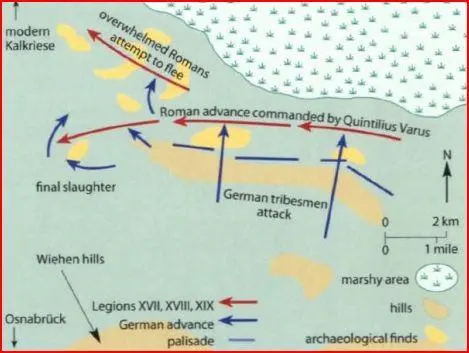
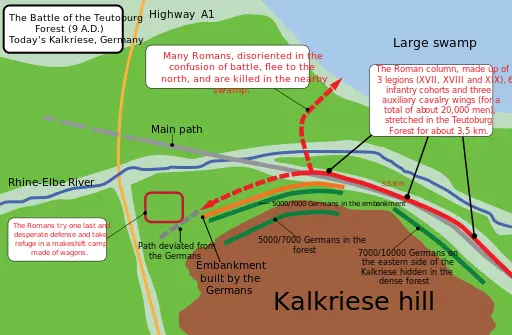
What followed, across four days of the Kalkriese corridor where the great bog comes down to meet the Wiehen hills, one reconstruction describes from Dio's narrative and the ground's own testimony, which since 1987 has been excavated into an extensively investigated battlefield associated with the Varus disaster. The column, ten miles of soldiers, wagons, and civilians on a forest track in breaking autumn weather, was bled first at range — the trees felled ahead, the javelins from the slopes, the rain that soaked the shields heavy and the bowstrings slack; the first night's camp was entrenched in full order, the second, after a day of running fight and the baggage burned by its own escort, barely at all. On the third or fourth day the survivors entered the killing ground the archaeology has mapped: the narrow passage between hill and bog at Kalkriese, where the Germans had built along the slope's foot a turf-and-sand rampart, sod-faced, with sally gaps — a Roman field-fortification, built by men Rome trained, to murder a Roman army in — and the column, assaulting it under the storm, broke against it.
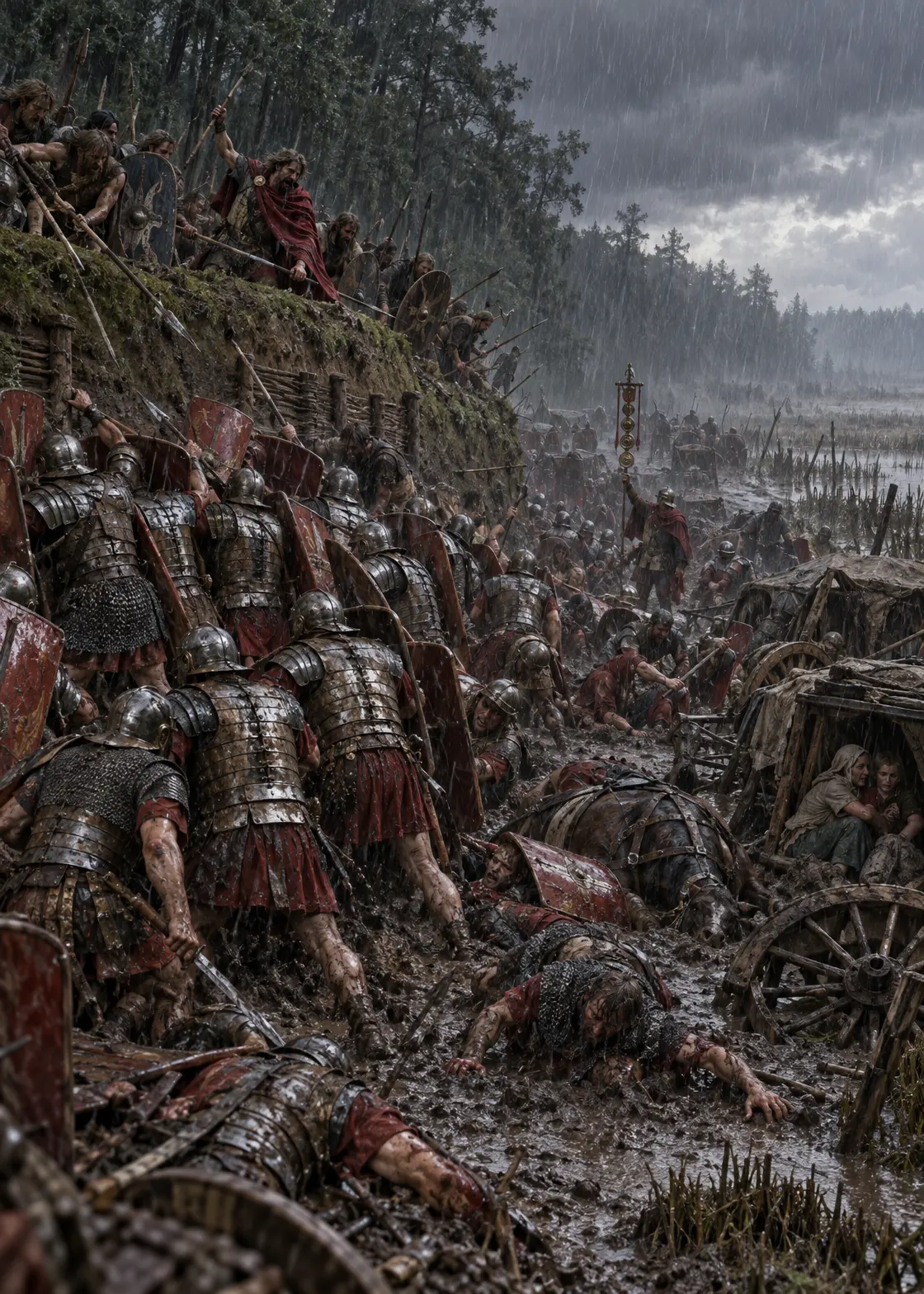
The finds speak with terrible particularity: the rampart's collapsed face lying over Roman ordnance where the countercharges failed; the coin-horizon sealed at 9, the legionary mint-marks of the lost numbers; the iron catapult bolts, the officer's silvered parade-mask torn from its helmet, the surgeon's instruments, the women's hairpins among the military bronze; the mule-skeletons still harnessed, one with its neck-bell stuffed with straw — the column's last night-move, muffling the animals in the dark, preserved in a handful of oat-stems and forever. Varus, wounded, fell on his sword with his senior officers in the tradition of Cannae's consul rather than Carrhae's proconsul; one camp prefect died fighting, the other negotiated a surrender that delivered the remnant to the altars — the groves where, when Germanicus's men came six years later, the skulls were still nailed to the trees and the survivors could point out the pits, and the gibbets, and where each tribune had been butchered. Perhaps fifteen to twenty thousand soldiers died with the uncounted civilians; a few prisoners were ransomed decades later, forbidden by their own families' settlements to enter Italy; the three eagles went to the tribes, and the legionary numbers XVII, XVIII, and XIX were never borne by any Roman unit again .
The strategic sequel was decided in a fortnight and ratified for four hundred years. Lucius Asprenas brought the two Mainz legions down the river and held the crossings; the fort of Aliso on the Lippe, besieged, broke out by night behind its archers and reached the Rhine — the one clean feat of arms the disaster's tradition preserved; Arminius, who understood everything about Roman armies except their depth, sent Varus's head to Maroboduus, soliciting the alliance of the two Germanies against the wounded empire, and Maroboduus, who had watched twelve legions turn back from his mountains three years before, sent the head on to Augustus for burial and stayed neutral. At Rome the emperor, seventy-one years old, dismissed his German bodyguard, posted watches against a rising that never came, and was seen for months, Suetonius records, unbarbered and beating his head against the doors with the cry the tradition made the epitaph of the entire project: Quinctili Vare, legiones redde — Quinctilius Varus, give back the legions. The army establishment absorbed the amputation — twenty-five legions now, the Rhine command rebuilt to eight — and the policy conclusion, drafted in the state-paper already cited and executed by Tiberius against every provocation of the following decade, renounced the Elbe: Germany would be punished, demonstratively and repeatedly, and never again governed.
The Mutinies of AD 14
The first succession of the Principate was ratified not in the Senate but in the camps, and nearly refused there. Within days of Augustus's death in August 14, the two great army groups of the north — three legions in summer camp in Pannonia, eight on the Rhine — rose in the mutiny that stands as the professional army's first collective bargaining and the reign's first lesson to its new master. The grievances, which Tacitus reconstructs through the camp-orator Percennius with a sympathy his politics elsewhere forbids, were the terms of service themselves: men held to the standards twenty, thirty, forty years by recall and stoppages, flogged by centurions whose nicknames — one was called Cedo Alteram, "Fetch-Another," for the vine-staves he broke on soldiers' backs — the mutineers now repaid with interest, discharged when at all to bounty-land that was marsh or mountainside. Pannonia was settled by Tiberius's son Drusus with an eclipse of the moon, judicious executions, and concessions later withdrawn; the Rhine was graver, because the Rhine had a candidate.
The pacified legions then demanded, and their general granted, the therapy the mutiny's psychology required: an immediate crossing of the Rhine against the enemy, and the autumn massacre of the Marsi — a tribe surprised at a festival, cut down drunken and sleeping through a fifty-mile radius of systematic killing, the grove-sanctuary of Tanfana razed — opened the campaigns that the next section must weigh as war, expiation, and dynastic argument at once.
The German Campaigns of Germanicus (15–16)
The three campaigning seasons that followed were the empire's revenge upon the Teutoburg and the empire's last argument with itself about Germany. In 15 Germanicus struck the Chatti and burned their capital; answered the appeal of the loyalist Segestes, besieged by his own tribe, and carried off in the rescue the war's great trophy and its great wound — Arminius's wife Thusnelda, Segestes's daughter, pregnant, marching into captivity with her eyes, Tacitus says, not on her father's Roman protectors but her own clasped hands; her husband, raptor of her and now raging at the theft in return, raised free Germany with the cry that Rome now warred on wombs. The season closed with the disaster deferred: the retreat of Caecina Severus's four legions by the causeway of the pontes longi, Arminius closing on the drowning track through the bogs, the camp half-flooded and the night alive with German fires — and the old general (forty years' service, the detail is the point) holding his shaking legions through a dawn breakout that turned ambush into counter-ambush; behind them, at the Rhine, the panic proposal to demolish the bridge was faced down by Agrippina herself, who stood at the bridgehead with praise and clothing and dressings as the survivors came over — a femina ingens animi doing a general's office, in words Tacitus lifts toward her and lets fall, with their shadow, toward the emperor reading of it.
The campaign of 16 was the maximum effort: a purpose-built fleet of a thousand hulls down Drusus's canal and along the ocean to the Ems, the army landed dry and deep, and the war Arminius could not refuse brought to the Weser plain at Idistaviso. The ocean then delivered its verdict on the year: the fleet, standing home late in the season, was scattered by the equinoctial storm down the whole amber coast, hulls swallowed, cohorts drowned, survivors trickling back for months from the islands and the amber-marts — some ransomed out of inner Germany — with tales of monsters that Tacitus records as the sea's own propaganda. Two of the lost eagles had been recovered in the campaigns — the Nineteenth's from the Bructeri, a second from the Marsi; the third would come home a generation later, in 41, taken from the Chauci by Gabinius under Claudius, closing the account at last — and on that arithmetic the emperor closed the war. The recall of 16, wrapped in a second triumph and a second consulship, was justified in the sentence of Tiberian statecraft Tacitus preserves and the whole subsequent frontier history ratified: enough had been achieved, and more would be, by leaving the Germans to their own quarrels.
The quarrels obliged. Within two years Arminius and Maroboduus — liberator and king, the two Germanies the Roman advance had called into being — fought their own great war on the Weser, indecisive in the field and decided by desertion; Maroboduus, abandoned, begged asylum and got Ravenna, eighteen years of comfortable exhibition, Tiberius pointing him out to the Senate as once more dangerous than Pyrrhus and now more instructive; his kingdom passed to adventurers Rome licensed and taxed.
The Long Frontier (17–43)
The quarter-century between the German recall and the invasion of Britain a summary connects to its wars, which were the new system's maintenance schedule. In Africa, the deserter Tacfarinas — another auxiliary graduate — ran a raiding war through Numidia for seven years (17–24), outlasting three proconsuls and the temporary transfer of the Ninth legion from Pannonia, until Dolabella's converging columns caught and killed him at Auzea; the war's texture, small war of razzia and waterhole, was the African frontier's permanent grammar learning itself. In Gaul in 21, the debt-revolt of Florus and Sacrovir — Romanized nobles, one commanding his own trained gladiators — flared and died at Augustodunum in a single charge, notable chiefly for Tiberius's refusal to interrupt his routine for it. In Thrace, the client-kingdom's levies mutinied rather than serve abroad; in 26 the mountain tribes stood a siege of their crag and broke; the kingdom itself would be a province by 46. On the lower Rhine in 28, the Frisii — Drusus's model allies — rose against a requisition of ox-hides assessed, with the immortal stupidity of middle management, by the standard of the aurochs rather than their own small cattle; they hanged the tax-soldiers, mauled the punitive expedition at the wood of Baduhenna with nine hundred Roman dead, and were — the sequel is the policy — written off: Tiberius suppressed the reverse and declined the war, and Frisia stayed loose until Corbulo's day.
Tactical illustrations
Outcome and critical assessment
Result and caution: the Rhine became a lasting central axis of Roman frontier deployment, but Rome continued to operate beyond it. Kalkriese is central to archaeological discussion of the Varus disaster; the exact relationship between excavated ground and the whole multiday campaign needs separate study. Several later battlefield locations remain disputed.
Historical record: IR-VI, chapters 2–3; Velleius, 2.117–120; Tacitus, Annals 1–2; Dio, book 56.