Wars · V. The early Principate: conquest and provincial war
W048 The great Illyrian revolt
The revolt disrupted Roman preparations for campaigning farther north. Leaders known as Bato headed different insurgent groups in a complex regional struggle. Roman forces under Tiberius, with other commanders, had to restore control across difficult terrain while maintaining supply and preventing the revolt from spreading or threatening Italy.
The operation required concentration of substantial forces, repeated campaigns and the reduction of defended positions. Pannonian and Dalmatian phases should not be imagined as one army moving along one recoverable route. Local recruitment obligations and the experience of Roman rule belong to the explanation of the rising.
Command, forces and military problem
| Field | Dossier |
|---|---|
| Roman leadership | Tiberius and several subordinate commanders |
| Opposing or rival parties | Different insurgent leaders including the two men named Bato |
| Forces and capabilities | Concentrated imperial forces against widespread regional resistance |
| Operational problem | Restore control across difficult country while preventing danger to Italy and adjoining provinces. |
Campaign geography and operational plates
The Balkans: Adriatic approaches and interior corridors
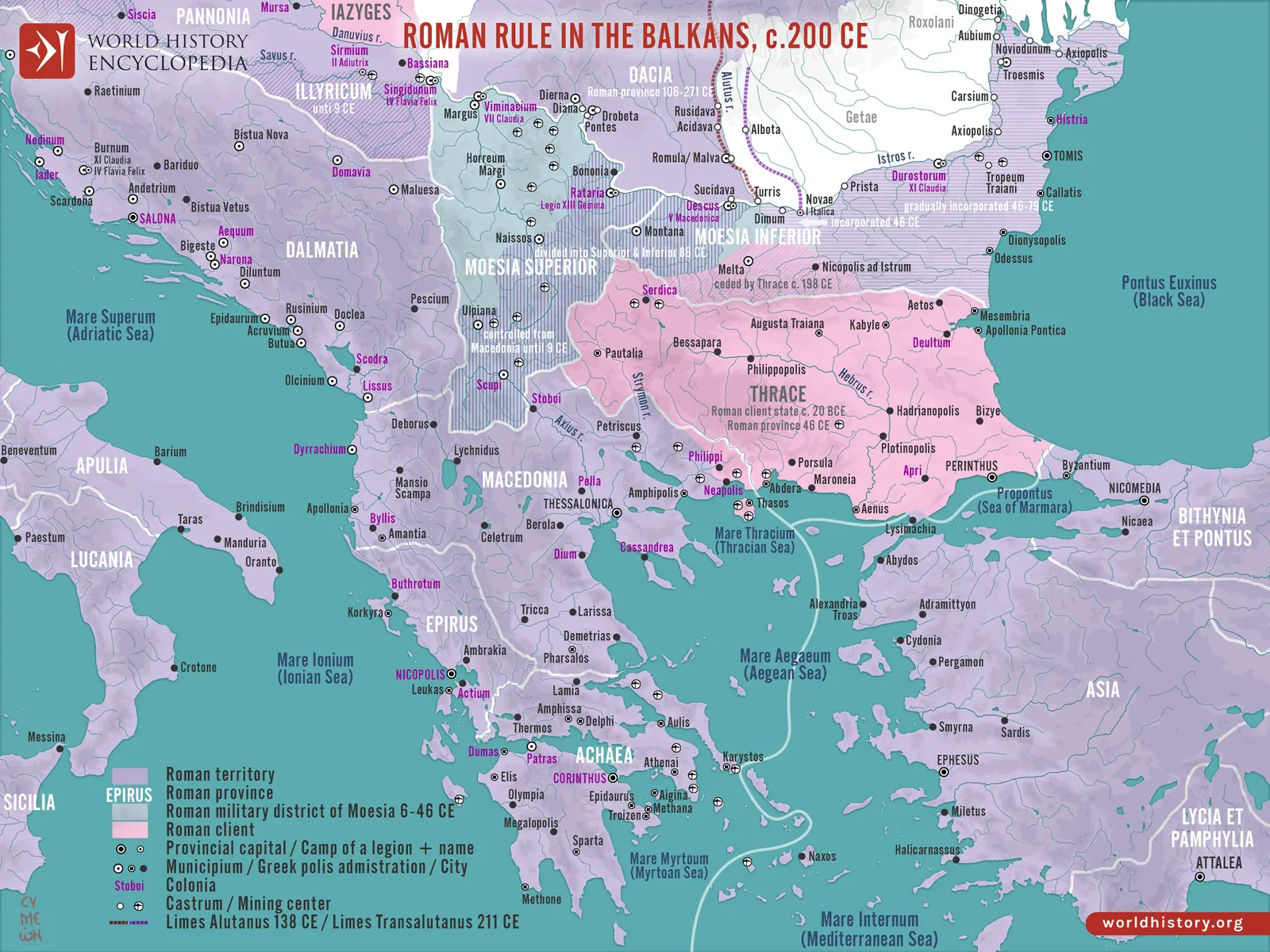
The Adriatic coast, Macedonian approaches and Danubian interior were connected but operationally distinct. Coastal access did not remove the difficulties of reaching defended inland communities. Later roads and military stations help explain the mature imperial network; they should not be read backward as infrastructure available to the first Republican expeditions.
Extended campaign study
The account below develops the operations and their interpretation. Reported numbers and reconstructed tactical details retain the uncertainties described in the dossier.
The Bellum Batonianum (AD 6–9)
The rising that saved Maroboduus began, with the bitterest of the period's ironies, in a levy: Illyrian auxiliaries mustering for Tiberius's Bohemian war looked at their own assembled strength, weighed the taxes and the recruiting officers and the publicani against it, and concluded — their leader's words were remembered and are given below — that Rome had taught them her language of war too well to go on speaking her language of obedience. The revolt of the two Batos — Bato the Daesitiate in the Bosnian mountains, Bato the Breucian in the Save valley, with the Pannonian Pinnes beside them — ran through the whole tract between Italy and Macedonia within weeks: garrisons and citizen traders massacred, the coast raided, Macedonia invaded, and Italy itself, as the panic in the capital measured it, ten days' march from an enemy who was said to put two hundred thousand foot and nine thousand horse under arms. Augustus told the Senate the war was the gravest since Carthage — Suetonius preserves the estimate, and the mobilization certifies it as more than rhetoric: the Bohemian operation cancelled and a face-saving treaty thrown to Maroboduus; ten legions concentrated with above seventy auxiliary cohorts and ten thousand recalled veterans; freedmen conscripted into cohorts for the first time since the Hannibalic emergencies; and the emergency taxes and slave-levies at Rome accompanied by grain rationing and the muttering, which Dio records, that the city itself was one bad harvest from joining the provinces in revolt.
The war Tiberius then conducted for three years is the least narrated great war of the ancient world — its only continuous account is Dio's compressed annalistic, with Velleius riding in it and gilding it — and the most instructive, because it is the Principate's military system operating exactly as designed against the worst case: no battles of annals, but a strangulation. The armies converged and declined combat except on their own terms; the country was eaten systematically, valley by valley, the population driven from the lowlands, the fortified refuges reduced one by one; Germanicus, the dead Drusus's son, was blooded here in independent command; and the coalition was disassembled politically as it was starved militarily — the Breucian Bato bought in AD 8 with recognition as client-prince, then seized and executed by his Daesitiate namesake when the Save valley's surrender exposed the mountains; the Pannonians beaten at the Bathinus river on the third of August 8; the last campaign of 9 a mountain man-hunt through the karst, ending at the siege of Andetrium above Salona, where the final assault up the cliff-terraces was delivered under the eyes of Tiberius enthroned before the camp, and the war's end was transacted in the exchange the compendium has carried from Dio as one of its permanent texts. The surrendered Bato, brought before the tribunal and asked why his people had rebelled, answered: You are to blame for this; for you send as guardians of your flocks neither dogs nor shepherds, but wolves. Tiberius — the detail completes the exchange — kept him honorably interned at Ravenna for life: the one commander of the age who never pretended the answer was false. Three days after the news of the Illyrian peace reached Rome, the couriers from the Rhine arrived.
Outcome and critical assessment
Result and caution: the revolt was suppressed, but at considerable Roman effort and alongside the disaster in Germany in AD 9. Velleius was a participant and admirer of Tiberius; his testimony is valuable without being politically disinterested. The two men called Bato must not be collapsed into one person by a name-matching index.
Historical record: IR-VI, chapter 2; Velleius, 2.110–116; Dio, book 55–56 narrative.