Wars · V. The early Principate: conquest and provincial war
W047 The Arabian expedition and the Nubian wars
From Roman Egypt, Aelius Gallus led an expedition into Arabia. Distance, water, disease, intelligence and dependence on guides undermined the effort. The ancient explanation places considerable blame on the guide Syllaeus, but that assignment of responsibility requires scrutiny.
At the southern Egyptian frontier, Kushite forces attacked Roman-held positions, and Petronius counterattacked into Nubia. The conflict ended with a negotiated frontier arrangement. This was a distinct campaign system from the Arabian expedition, although both depended on the resources and command structure of Roman Egypt.
Command, forces and military problem
| Field | Dossier |
|---|---|
| Roman leadership | Aelius Gallus in Arabia; Petronius on the Nile |
| Opposing or rival parties | Arabian rulers and communities; the Kushite monarchy in the separate Nile war |
| Forces and capabilities | Expeditionary land forces dependent on water, guides, shipping or the river corridor |
| Operational problem | Match distant ambitions to supplies and information and define a sustainable frontier. |
Arabia: ambition, preparation and the problem of access
The Arabian expedition was an attempt to project Roman power from the newly acquired Egyptian base into a region associated with valuable aromatics and long-distance trade. Its aims combined exploration, diplomacy and the possibility of conquest. Cooperation with Nabataean interests was important to the plan, which means that local political relationships were part of the expedition's military infrastructure.
Strabo describes difficulties in the movement from Egypt, the force's health and the inland march. His explanation strongly blames Syllaeus, the Nabataean intermediary. That testimony is valuable, but Strabo's proximity to Gallus also makes the distribution of blame a historical question. The expedition revealed the danger of committing an army to a theater whose water, routes, food and political geography were poorly understood by its senior command. Strabo, Geography 16.4.22–24.
Reaching settlements or defeating local forces did not solve the problem of remaining there. The army's withdrawal was a strategic failure of the attempt to impose durable Roman power, even where the narrative preserves successful encounters. The result should not be expressed as an annexation of Arabia Felix.
Nubia: a different frontier problem
The fighting with the Kushite kingdom concerned the Nile corridor south of Egypt. Attacks on Roman-held places challenged the provincial frontier and imperial prestige. Petronius' counteroffensive penetrated southward, but an army's ability to advance along the river was different from the government's willingness and ability to hold every position indefinitely.
Fortified bases, river movement and the political authority of the Kushite monarchy shaped the negotiations. The settlement associated with the embassy to Augustus at Samos helped establish a more durable relationship. It was not simply an admission that one side had ceased to possess military power.
Comparative result
The Arabian and Nubian operations share an Egyptian base but demonstrate different uses and limits of expeditionary force. In Arabia the difficulty of sustaining the invasion defeated the larger ambition. On the Nile, campaigning and negotiation helped establish a workable frontier. Neither outcome supports a universal rule that desert armies were unbeatable or that Rome lacked the technical means to operate outside Mediterranean farmland. The relevant question is the relationship between military means, information and political objectives in each theater.
Campaign geography and operational plates
Egypt, Syria and the Nile corridor
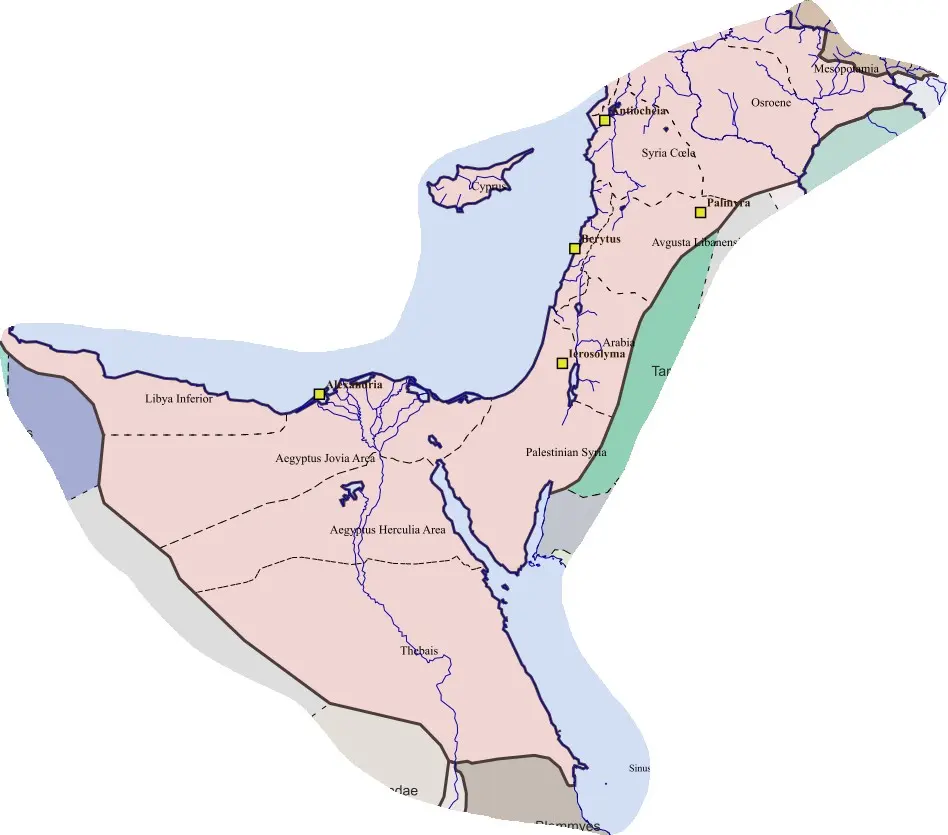
The narrow Nile valley is a transport and settlement axis beside a much wider arid region. That contrast helps distinguish the Nubian operations from the Arabian expedition launched through Red Sea connections. The picture orients the theater; it does not establish an ancient coastline, desert water itinerary or exact treaty boundary.
Outcome and critical assessment
Result and caution: neither operation made Rome master of all Arabia or the middle Nile. A treaty and a limited frontier could be strategically preferable to indefinite occupation. The theater cannot be explained through desert hardship alone: local states, their diplomacy and Roman administrative priorities were active factors.
Historical record: IR-VI, Augustan campaigns; Dio, book 53–54 context; Strabo, books 16–17. The atlas does not supply a verified itinerary of Gallus' march.