Provinces · Gaul and the Rhine
RP-14 The Augustan Germania beyond the Rhine
The attempt to carry the frontier to the Elbe
Augustan campaigns beyond the Rhine sought to reshape the strategic geography of northern Europe. Moving the frontier eastward might reduce the exposed Rhine-Danube angle and bring additional peoples under Roman power. Yet the project required more than victories: reliable supply, roads, winter quarters, agreements, courts, tribute, and repeated access through difficult terrain were all necessary.
Drusus’s campaigns opened routes through river valleys and inland districts, while Tiberius combined operations with diplomacy. Roman forces encountered communities with different political structures and interests. The Cherusci, Chatti, Sugambri, and other names describe neither one united German state nor populations without internal divisions. Roman alliances could strengthen particular leaders while creating rivals and resentment within their communities.
An unfinished administrative landscape
Military bases, roads, and settlements demonstrate that Roman ambitions extended beyond temporary raiding. Waldgirmes, with its planned civil character, indicates the possibility of a more enduring provincial society. Haltern and other installations show the military infrastructure needed to sustain that project. Neither kind of site proves that every part of the territory between Rhine and Elbe had acquired a regular, uniform administration.
Varus’s exercise of judicial authority suggests an effort to govern rather than simply campaign. What remains uncertain is how far those practices extended, how they were understood by allied leaders, and whether a fully constituted territorial province existed in a sense comparable to established provinces elsewhere. The transition was incomplete and uneven.
The disaster of 9 CE
Arminius’s position within Roman military and diplomatic networks enabled him to organize a coalition using knowledge of Roman practices. The destruction of Varus’s army was therefore an internal failure of frontier relationships as well as a military defeat. Difficult terrain, disrupted movement, surprise, and the coalition’s coordination contributed to the disaster. Its exact tactical sequence cannot be reconstructed in every detail.
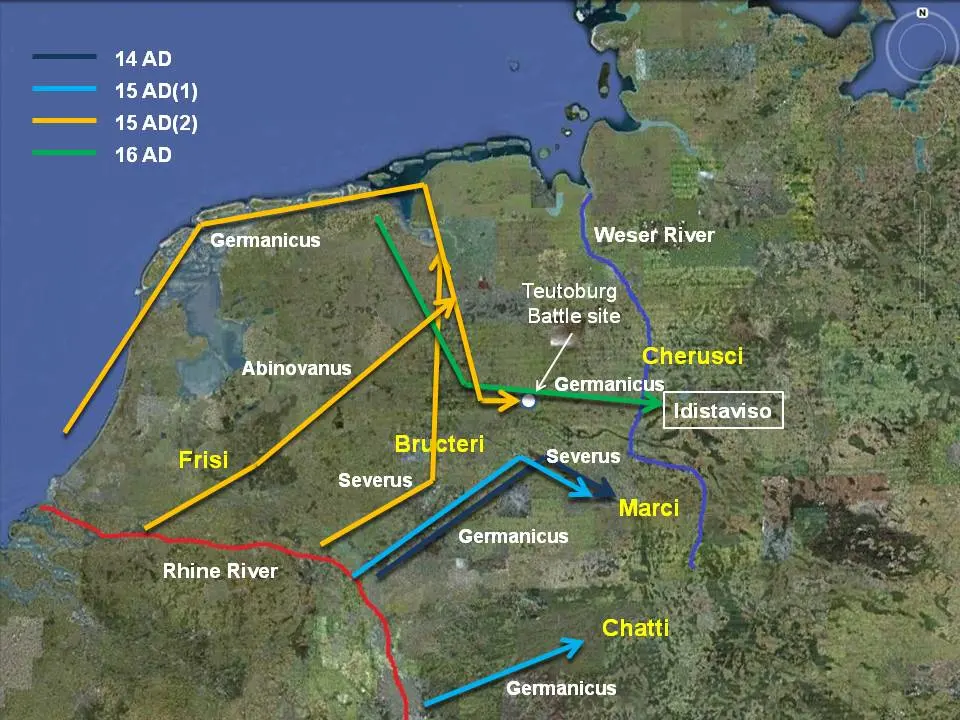
The loss of three legions had strategic and psychological consequences. Rome nevertheless retained forces on the Rhine and continued operations beyond it. Campaigns by Germanicus demonstrated military reach and recovered some lost standards, but could not by themselves establish a durable provincial system throughout the earlier target area.
A frontier abandoned, relationships retained
Tiberius’s decision to end Germanicus’s major campaigns accepted the Rhine as the principal northern boundary of direct rule in this sector. It did not end diplomacy, trade, recruiting, or intervention east of the river. Roman governments continued to cultivate rulers, reward allies, punish opponents, and influence frontier politics.
The abandoned provincial project had a long afterlife in Roman memory, but it should not be described as the simple failure of “civilization” against an unchanged wilderness. Communities beyond the frontier were transformed by contact, warfare, trade, and the movement of people. Rome’s later German provinces emerged along the Rhine through a different institutional development from this Augustan attempt to govern farther east.