RP-15 Britannia
The island encountered by Rome
Britain contained numerous political communities, regional exchange systems, farming landscapes, and elite centres before conquest. Southern and eastern connections with Gaul were particularly important, but the island was not culturally uniform. Coinage, imported goods, fortified settlements, and changing rulership show active participation in wider networks. Rome entered a world already experiencing political competition and cross-Channel movement.
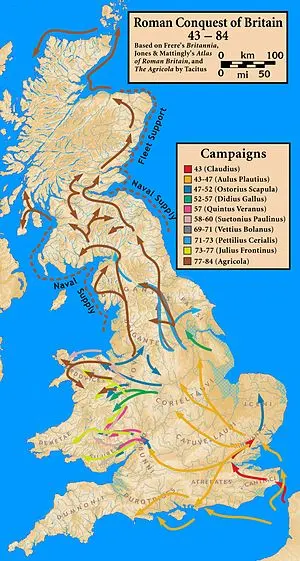
The invasion of 43 CE advanced through southeastern footholds and river crossings. Client rulers helped sustain Roman influence in some districts while direct military operations continued elsewhere. Camulodunum symbolized conquest through colonial settlement and the cult of Claudius. London grew through its transport and commercial position rather than as an old preconquest royal capital.
Rebellion and the limits of early rule
Boudica’s revolt emerged from the treatment of the Iceni and wider hostility to Roman power, debt, settlement, and coercion. The destruction of Camulodunum, London, and Verulamium exposed the fragility of the new provincial network. The subsequent Roman victory re-established control through military force, but provincial government required additional accommodation with local elites and communities.
Wales and northern Britain demanded sustained campaigning. The capture of leaders, destruction of strongholds, creation of forts, and negotiation of submissions proceeded at different rates. Cartimandua’s relationship with Rome and the conflict involving Venutius illustrate how local succession and Roman intervention could become inseparable. Agricola’s northern campaigns represented a further expansion, not the first arrival of Roman authority in all northern districts.
A province shaped by its garrison
Britain maintained a substantial army relative to its population and fiscal resources. Legionary bases and auxiliary forts supported conquest and frontier control, while roads connected the garrison to ports and supply districts. Hadrian’s Wall combined a monumental frontier with gates, forts, roads, and communities. It regulated movement and projected authority; it was never a complete barrier against every person or raid.
The Antonine advance moved the frontier into the central Scottish belt for a limited period. Withdrawal restored a more southerly military organization, but campaigning beyond the wall continued. Septimius Severus’s northern expedition again mobilized the province on a large scale. His death at York in 211 linked Britain directly to imperial succession.
Towns and countryside
Colonies such as Colchester, Lincoln, Gloucester, and York possessed different foundations and later roles. Civitas capitals such as Silchester, Cirencester, Wroxeter, and Caerwent organized local government and markets. Bath’s sacred spring gave it a distinct religious and therapeutic identity. Ports connected these settlements to continental trade and imperial communication.
The countryside ranged from wealthy villa districts to small farms, enclosed settlements, upland pastoral communities, and landscapes under military influence. Large villas and mosaics reveal concentrated wealth, especially in selected southern and eastern districts, without showing that most inhabitants lived in Roman-style country houses. Grain, livestock, wool, metals, pottery, salt, and other products sustained regional economies. Lead and silver mining, iron-working, and gold extraction drew official and commercial interest to particular locations.
Religion and the provincial household
Local deities continued within new architectural and ritual settings. Sulis at Bath, regional gods at rural shrines, imperial cult, Mithraic groups near military settlements, and imported cults belonged to a diverse religious environment. Women, children, freedpeople, enslaved people, and mobile families participated in provincial life alongside soldiers and civic elites.
Christianity is securely visible by the fourth century, with British bishops participating in church affairs beyond the island. Its extent was uneven, and later stories about individual martyrs cannot all be treated as contemporary descriptions. Christian identity did not instantly replace older customs or ensure political unity.
Usurpation, subdivision, and the fifth-century rupture
Britain became a base for competing imperial claimants. Albinus’s challenge, the regime of Carausius and Allectus, Magnus Maximus’s expedition, and Constantine III’s rise all connected the island to wider civil wars. Each episode could draw troops and resources away from local defence. Constantius’s recovery of the island in 296 brought another reorganization of imperial authority.
The late provincial divisions distributed civil government more widely, while frontier military commands followed a different pattern. Coastal forts, the northern army, and field forces had related but distinct responsibilities. The crisis associated with raids and military breakdown in 367 was followed by recovery under Count Theodosius, demonstrating that disruption did not always produce immediate abandonment.
In the early fifth century, the breakdown of central military and fiscal support changed the provincial order fundamentally. Local authorities assumed responsibilities previously attached to imperial institutions. Coin supply, urban public life, taxation, and long-distance administrative relationships changed sharply, but inhabitants did not vanish. Regional rulers, communities, and later kingdoms emerged from a society carrying Roman, British, and incoming continental inheritances. The end of Britannia was therefore both a serious institutional rupture and the beginning of several distinct post-Roman histories.
Settlement geography
| Ancient place | Modern location |
|---|---|
| Londinium | London |
| Camulodunum | Colchester |
| Lindum | Lincoln |
| Glevum | Gloucester |
| Verulamium | St Albans |
| Eboracum | York |
| Deva | Chester |
| Isca Augusta | Caerleon, Wales |
| Corinium Dobunnorum | Cirencester |
| Aquae Sulis | Bath |
| Calleva Atrebatum | Silchester |
| Venta Belgarum | Winchester |
| Noviomagus Reginorum | Chichester |
| Durovernum Cantiacorum | Canterbury |
| Viroconium Cornoviorum | Wroxeter |
| Ratae Corieltauvorum | Leicester |
| Isca Dumnoniorum | Exeter |
| Durnovaria | Dorchester |
| Venta Icenorum | Caistor St Edmund |
| Venta Silurum | Caerwent, Wales |
| Isurium Brigantum | Aldborough |
| Rutupiae | Richborough |
| Dubris | Dover |
| Luguvalium | Carlisle |
| Vindolanda | Near Bardon Mill |
| Coria | Corbridge |