Aesculapius
Healing god adapted from Greek Asklepios; Rome’s Tiber-island sanctuary joined religious care with a wider Mediterranean therapeutic tradition.
See also Apollo
The gods, the cults and the faiths, and how they changed.
Healing god adapted from Greek Asklepios; Rome’s Tiber-island sanctuary joined religious care with a wider Mediterranean therapeutic tradition.
See also Apollo
Hadrian’s deceased companion received divine honors and distinctive cults, especially in the Greek East; forms and reception varied locally.
See also Hadrian, Antinoopolis, Imperial cult
Read further Gwynaeth McIntyre Imperial Cult 2019
Greek-origin god of prophecy, music and healing; Augustus’ Palatine sanctuary made his cult prominent in imperial self-presentation.
See also Augustus, Aesculapius
In the volumes Book V · Chapter 4: The Social War and the Civil Wars of Marius and Sulla
Mythic and cultic companion of the Great Mother; evidence varies by period, and later narratives should not be projected unchanged into Republican Rome.
See also Magna Mater Cybele, Galli
Read further Metropolitan Museum Eastern Religions in the Roman World
Goddess associated with women’s ritual and well-being; the elite December ceremony became politically notorious through the Clodius scandal of 62 BCE.
See also Household cult
Prophetic and childbirth-associated goddess honored in January; antiquarian traditions connected her with Evander and the transmission of cultural knowledge.
Read further Ovid Fasti Book 1 translated by J G Frazer
Goddess of grain and cultivated fertility; her Aventine cult with Liber and Libera also intersected plebeian civic life.
See also Cerialia, Liber, Libera
Read further Ovid Fasti Book 4 translated by J G Frazer
Divine concord representing desired agreement within the political community; dedication and imagery often responded to conflict rather than proving harmony existed.
See also Senate
God linked to stored grain and underground rites near the Circus Maximus; his festivals also involved horses and communal celebration.
See also Ops
Goddess honored at a spring sanctuary by dedications and offerings; claims about a wider universal identity exceed the strong local evidence.
See also Hadrian's Wall, Votive offerings, Military religion
Read further RIB 1523 Coventina dedication
Goddess honored by the Arval Brothers in ceremonies concerned with the fields and the community; inscriptions preserve detailed imperial-era rites.
See also Arval Brothers, Agriculture, Vota
Read further Robert Whiston Arvales Fratres in Smith Dictionary 1875
Personified Rome received cult in Greek cities before Augustus; provincial worship later paired Roma with the ruler in varied civic institutions.
See also Imperial cult, Asia
Read further Gwynaeth McIntyre Imperial Cult 2019
Collective divine dead invoked on epitaphs; the dedication formula records funerary practice without establishing one uniform doctrine of the afterlife.
Goddess linked to hunting, childbirth and woodland sanctuaries; Aricia and the Aventine offered distinct Italian cult contexts.
See also Apollo
In the volumes Book V · Chapter 5: Wars in the Shadow of the Settlement: Mithridates, Sertorius, Spartacus
Underworld deity connected with wealth below the earth and Roman ritual; identification with Greek Pluto belongs to particular textual and cult contexts.
See also Proserpina, Secular Games
Horse-associated goddess whose cult traveled beyond Gaul; military and transport contexts help explain her broad imperial distribution.
See also Gaul, Interpretatio Romana
Read further RIB 2177 Epona dedication
Italian god associated with rural places and prophetic traditions; literary connections with Pan do not demonstrate one uniform pastoral religion.
See also Lupercalia
Read further Ovid Fasti Book 2 translated by J G Frazer
Divine trust and fidelity, linked to oaths and dependable relationships; political use made reliability a public and religious claim.
See also Pietas
In the volumes Book V · Chapter 1: The Gracchan Crisis: The Return of Political Violence
Goddess associated with flowering and fertility; the Floralia belonged to Rome’s festival calendar and public entertainment.
See also Floralia, Public games, Agriculture
Read further Ovid Fasti Book 5 translated by J G Frazer
Fortune worshipped under many civic and personal titles; Praeneste’s Fortuna Primigenia was a major Italian sanctuary rather than a generic luck shrine.
Protective or generative divine identity attached to persons and groups; worship of the emperor’s genius differed conceptually from posthumous deification.
See also Imperial cult, Household cult, Vota
Read further Gwynaeth McIntyre Imperial Cult 2019
Hero-god with Greek and Italian cult histories; Roman worship linked him with strength, travel, trade and the Ara Maxima.
See also Commodus, Interpretatio Romana
In the volumes Book V · Chapter 2: The Jugurthine War and the Rise of Marius · Book VII · Chapter 6: The Auction and the Severan Reconstruction
Read further Ovid Fasti Book 1 translated by J G Frazer
Egyptian goddess whose Mediterranean cult acquired varied local forms; sanctuaries, processions and initiation linked divine care with communities beyond civic origin.
See also Serapis, Isiac cults, Alexandria
Read further Metropolitan Museum Eastern Religions in the Roman World
God of beginnings, passage and doorways; his cult was linked to the calendar and the public symbolism of war and peace.
See also Augustus
In the volumes Book V · Epilogue: Rome in 31/30 BC · Book VI · Chapter 1: The Augustan Conquests · Book I · Chapter 2: The Latin Twilight and the Samnite Dawn · Book V · Chapter 8: The Civil Wars and the End of the Republic · Book VI · Chapter 5: The Eastern Question: Corbulo, Armenia, and Parthia
Read further Ovid Fasti Book 1 translated by J G Frazer
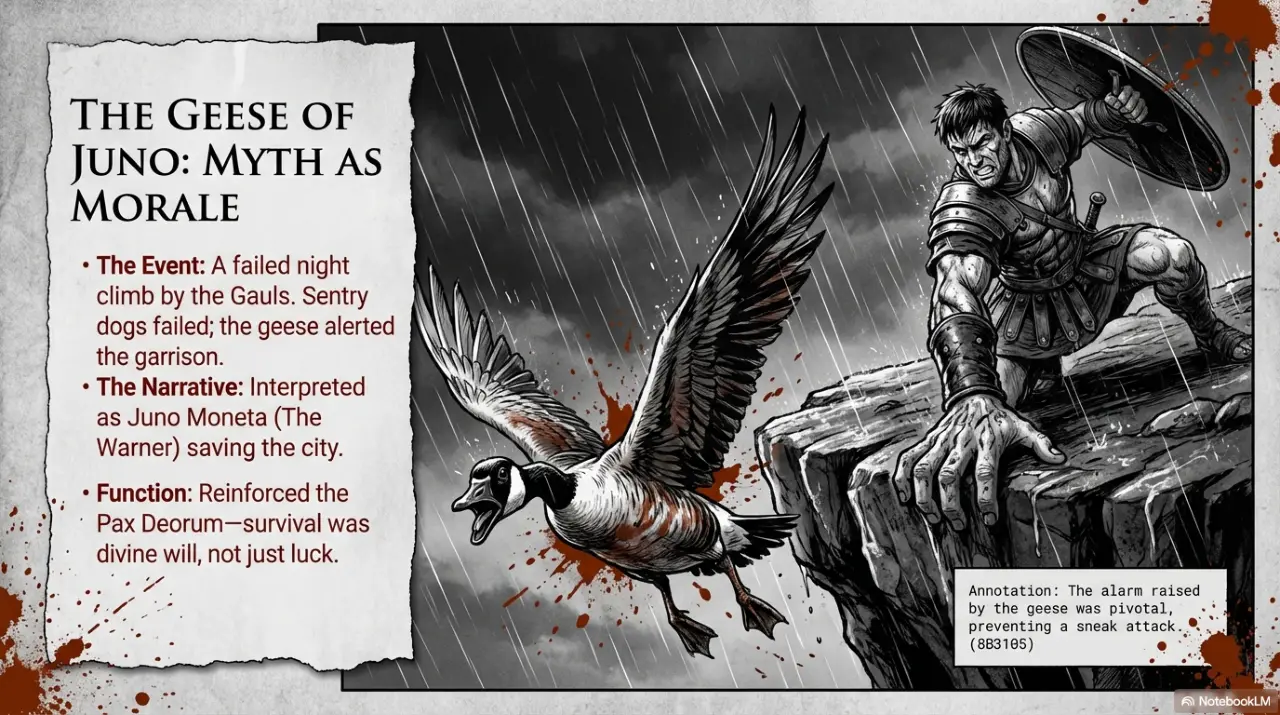
Goddess with civic, marital and childbirth roles; Regina, Moneta, Lucina and Sospita designate particular functions and cult settings.
See also Jupiter, Matronalia, Capitoline triad
In the volumes Book I · Chapter 1: The Gallic Catastrophe · Book I · Epilogue: Rome in 264 BC · Book II · Chapter 4: The Coming of Hannibal: From Saguntum to the Alps
Read further Ovid Fasti Book 6 translated by J G Frazer
Chief Roman public god of sky, sovereignty and oaths; Jupiter Optimus Maximus anchored Capitoline state worship, with many distinct local epithets.
See also Capitoline triad, Juno, Minerva
In the volumes Book I · Chapter 2: The Latin Twilight and the Samnite Dawn · Book II · Chapter 3: The Interwar Years: Mercenary War, Sardinia, Gauls, and Illyrians · Book V · Chapter 1: The Gracchan Crisis: The Return of Political Violence · Book V · Chapter 8: The Civil Wars and the End of the Republic · Book VI · Chapter 6: The Jewish War · Book VI · Chapter 7: The Year of the Four Emperors and the Batavian Revolt · Book VI · Chapter 8: The Flavian Consolidation and the Wars of Domitian · Book VII · Chapter 3: Hadrian: The Wall, the Army in Being, and the Last Jewish War and 1 more
Read further Ovid Fasti Book 1 translated by J G Frazer
A cult centered on a deity associated with Doliche spread through military and mobile communities; the Jupiter title signals a particular Roman combination.
See also Commagene, Military religion, Interpretatio Romana
Read further Kunsthistorisches Museum Jupiter Dolichenus Mauer an der Url
Protective divinities honored in domestic and neighborhood settings; the Lares Compitales joined local associations and public urban organization.
See also Lararium, Compitalia, Household cult
In the volumes Book I · Chapter 2: The Latin Twilight and the Samnite Dawn
Restless or troubling dead in Roman descriptions; the Lemuria addressed them through household ritual rather than a centralized theological system.
See also Lemuria, Di Manes, Household cult
Read further Ovid Fasti Book 5 translated by J G Frazer
God associated with growth, freedom and wine; Roman practice connected him with Dionysus, while local cult and literary mythology remained varied.
Read further Ovid Fasti Book 3 translated by J G Frazer · Livy 39 1–19 Bacchanalia in Sage translation
Goddess paired with Ceres and Liber in the Aventine triad; later identifications with Proserpina do not erase the cult’s particular history.
See also Ceres, Liber, Proserpina
Moon divinity with Roman sanctuaries and Greek associations; she should not be confused with Lua Mater, a distinct name in Roman ritual.
See also Diana
The Great Mother’s cult entered Roman public religion in 204 BCE; Roman civic rites and the practices of her specialist devotees had distinct regulations.
See also Attis, Megalesia, Galli
Read further Metropolitan Museum Eastern Religions in the Roman World · Ovid Fasti Book 4 translated by J G Frazer
God of warfare and Roman communal protection, also present in agrarian ritual; the father of Romulus in Rome’s foundation tradition.
See also Salii, Arval Brothers
In the volumes Book I · Chapter 2: The Latin Twilight and the Samnite Dawn · Book I · Chapter 5: The Pyrrhic War · Book I · Chapter 6: The Consolidation of Italy
Read further Ovid Fasti Book 3 translated by J G Frazer
Mother-goddess groups with numerous local epithets and votive communities; a shared iconographic pattern does not make every group the same cult.
See also Votive offerings
Read further Roman Inscriptions of Britain Matres attestation index
God associated with exchange, travelers and communication; provincial worship connected him with local identities and votive communities.
See also Interpretatio Romana
Read further Ovid Fasti Book 5 translated by J G Frazer
Goddess associated with skilled activity, arts and wisdom; a Capitoline member whose provincial identifications require local evidence.
See also Capitoline triad, Quinquatrus, Sulis Minerva
Read further Ovid Fasti Book 3 translated by J G Frazer
God of a Roman initiatory cult prominent from the late first century CE; archaeology is abundant but a continuous ancient sacred narrative does not survive.
Read further London Museum Roman London Temple of Mithras · Roman Religion in the Classroom The Mysteries of Mithras
God associated especially with water and the sea; Roman uses also drew on Poseidon’s equestrian and mythological attributes.
Divinity of agricultural plenty and stored abundance, associated with Saturn; her distinct festivals resist reduction to a generic fertility label.
Pastoral divinity whose festival purified shepherds and flocks; Ovid also connected the Parilia with Rome’s traditional foundation day.
Read further Ovid Fasti Book 4 translated by J G Frazer
Personified peace honored in Augustan and imperial settings; peace imagery expressed a ruler’s settlement and could coexist with expansion and coercion.
See also Augustus
Read further Ovid Fasti Book 1 translated by J G Frazer
Divinities protecting household provision and continuity; Roman public Penates were also woven into Trojan ancestry and the state’s sacred identity.
See also Vesta, Household cult
Personification of dutiful regard toward gods, family and community; imperial imagery used the virtue to present legitimate conduct and succession.
See also Household cult
Goddess of orchard fruit and cultivated abundance; known through literary tradition and a specialized priesthood rather than a universal agrarian pantheon.
Read further Smith Dictionary Flamen
God associated with harbors and entrances; the Portunalia linked urban ritual with access, movement and the waterfront.
Underworld goddess often related to Greek Persephone; her cult and myth intertwined with Ceres and the movement between death and fertility.
See also Ceres, Dis Pater, Eleusinian mysteries
Read further Ovid Fasti Book 4 translated by J G Frazer
Ancient civic god with a major flamen; later Roman tradition identified him with the divinized Romulus, without making every early cult feature recoverable.
In the volumes Book I · Chapter 2: The Latin Twilight and the Samnite Dawn
Read further Dionysius Roman Antiquities II 57–76
God represented in distinctive cult hands and other objects; Roman evidence links him with several divine traditions, while ritual interpretation remains partly uncertain.
See also Jupiter, Mystery cults
Read further British Museum Sabazios cult hand 1824 0441 1
Divine health and public welfare; imperial coinage and dedications could apply her protection to the ruler, army or commonwealth.
See also Votive offerings
God associated with sowing and a remembered golden age; his temple housed the treasury and his December festival licensed festive reversals.
See also Saturnalia, Ops, Aerarium
Read further Ovid Fasti Book 1 translated by J G Frazer
Deity developed in Ptolemaic Egypt and worshipped across the Roman world, often alongside Isis; his imagery combined several divine and royal traditions.
See also Isis, Alexandria
Read further Metropolitan Museum Eastern Religions in the Roman World
Woodland and boundary-associated god often honored in private and rural dedications, including those of workers and soldiers.
See also Votive offerings
Roman solar worship had several forms; Aurelian’s major solar patronage in 274 CE did not make all solar cults or Mithras identical.
Named divine combination attested by dedications at Bath; healing waters, vows and curse tablets reveal a local sanctuary rather than simple replacement of Sulis.
See also Minerva
Read further RIB 150 Sulis Minerva dedication
Divinity of boundaries and boundary stones; his festival connected neighborhood relationships, property and religious obligation.
See also Terminalia, Jupiter
Read further Ovid Fasti Book 2 translated by J G Frazer
Divine personification of the Tiber, honored within a landscape where river transport, flooding and Rome’s foundation traditions intersected.
See also Rome
Goddess of desire and generative power; Venus Genetrix and Venus Victrix connected divine favor with rival late-Republican political claims.
See also Julius Caesar, Pompey
Read further Ovid Fasti Book 4 translated by J G Frazer
God of change, seasons and produce; Roman literature and antiquarian accounts linked his cult with Etruscan connections.
Divinity of the hearth and civic fire; Rome’s Vestals maintained rites whose continuity symbolized the community’s security.
See also Vestal Virgins, Penates, Vestalia
In the volumes Book V · Chapter 4: The Social War and the Civil Wars of Marius and Sulla · Book VI · Chapter 7: The Year of the Four Emperors and the Batavian Revolt
Read further Ovid Fasti Book 6 translated by J G Frazer
Personified victory, prominent in temples, official imagery and imperial representation; her cult’s political visibility persisted into late-antique controversy.
God of destructive and productive fire; his cult addressed risks to crops and communities as well as the mythology of divine craftsmanship.
Labels cover different non-Nicene positions and coalitions; Homoian Christianity among Goths and other rulers should not be collapsed into every teaching attributed to Arius.
See also Goths, Constantius II
Read further First Council of Nicaea creed and canons · First Council of Constantinople creed and synodal letter
Priestly brotherhood honoring Dea Dia and performing public vows; surviving inscriptions provide unusually detailed ritual records.
See also Dea Dia, Agriculture, Imperial cult
Read further Robert Whiston Arvales Fratres in Smith Dictionary 1875
Members of the public priestly college preserving augural expertise; magistrates’ auspices and augurs’ interpretation were related but not interchangeable functions.
See also Augury and auspices, Cicero
In the volumes Book II · Chapter 2: The First Punic War: Africa, Sicily, and the Long Resolution
Read further Dionysius Roman Antiquities II 57–76
Specialist interpretation of authorized signs helped establish whether public action had divine approval; disputes over auspices also shaped political legitimacy.
See also Augurs
Read further Dionysius Roman Antiquities II 57–76
Episcopal leadership, assemblies and networks developed unevenly; imperial patronage enlarged their authority but did not make ecclesiastical institutions identical with state offices.
See also Council of Nicaea, Rome, Constantinople
Read further First Council of Nicaea creed and canons · First Council of Constantinople creed and synodal letter
Jupiter, Juno and Minerva shared Rome’s great Capitoline temple; provincial capitolia expressed civic affiliation without making every community’s worship identical.
Festival and games honoring Ceres; the rites joined agricultural concern with urban collective celebration.
See also Ceres, Grain supply, Public games
Read further Ovid Fasti Book 4 translated by J G Frazer
A movement emerging within Jewish settings developed varied congregations, texts and institutions; its later imperial dominance should not be projected onto its beginnings.
See also Persecution of Christians
Read further Tertullian Apology · Metropolitan Museum Jewish Art in Late Antiquity and Early Byzantium
Doctrine of Father, Son and Holy Spirit defined through creeds and sustained dispute; Nicene language should not be projected as uniform among all earlier Christians.
See also Council of Nicaea, Council of Constantinople, Christian communities
Read further First Council of Nicaea creed and canons · First Council of Constantinople creed and synodal letter
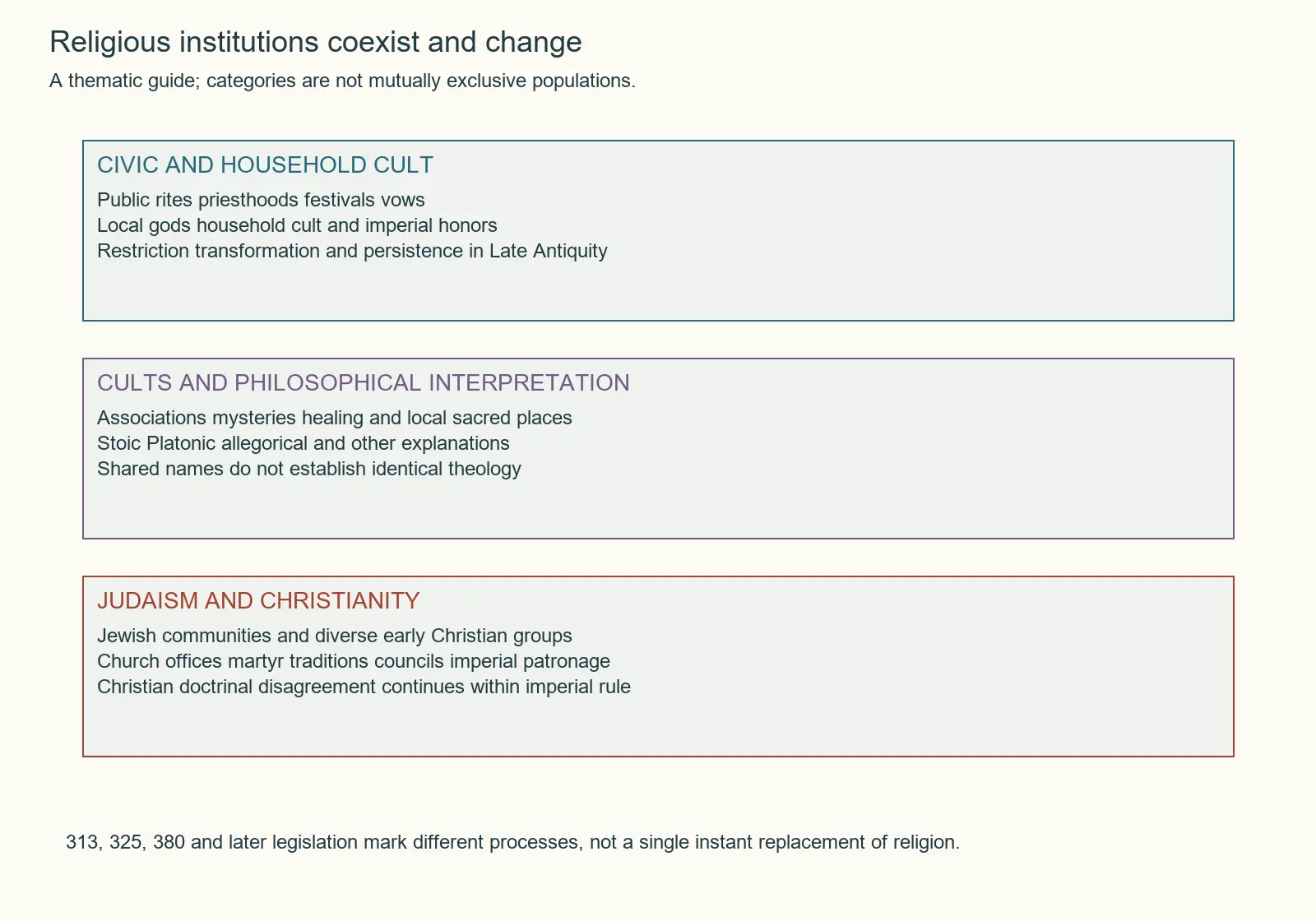
Imperial laws, patronage, local conflict and changing practices transformed religious landscapes unevenly; legal prohibition does not establish immediate disappearance of traditional rites.
See also Theodosius I, Justinian I
Read further Metropolitan Museum Eastern Religions in the Roman World · Lactantius On the Deaths of the Persecutors
Crossroads festival of the Lares, involving neighborhood communities and dependents; Augustan reorganization linked local cult with imperial imagery.
See also Lares, Household cult, Augustus
Council formulated Christ as acknowledged in two natures and regulated church affairs; rejection by substantial communities shaped enduring divisions.
See also Marcian, Miaphysite Christianity, Constantinople
Read further Council of Chalcedon acts and definition
Imperial council reaffirming Nicene alignment and regulating ecclesiastical affairs; its reception and later creed tradition belong to continuing institutional history.
See also Theodosius I
Read further First Council of Constantinople creed and synodal letter
Council associated with condemnation of Nestorius and affirmation of Theotokos language; rival sessions and jurisdictions exposed intense political and theological conflict.
Read further Council of Ephesus acts and canons
Written requests to bind or punish targets addressed gods or underworld powers; Bath tablets connect theft complaints with a specific sanctuary.
See also Sulis Minerva
Read further RIB 150 Sulis Minerva dedication
A commander’s ritual dedication of himself and the enemy to divine powers, associated above all with the Decii; the surviving accounts are exemplary narratives.
See also Sentinum
In the volumes Book I · Chapter 2: The Latin Twilight and the Samnite Dawn · Book I · Chapter 4: The Coalition War: Sentinum and Its Antecedents · Book I · Chapter 3: The Long Samnite War · Book I · Epilogue: Rome in 264 BC
Posthumous divine status granted to selected rulers and relatives; consecration differed from the worship of a living ruler’s genius or an ordinary honorific title.
See also Julius Caesar, Augustus, Imperial cult
Read further Gwynaeth McIntyre Imperial Cult 2019
Rival church networks emerged from disputes over persecution-era conduct and episcopal legitimacy; opponents’ claims of purity and universal communion require recognition as arguments.
See also Carthage, Christian communities
Read further Donatus and Donatism Oxford Classical Dictionary
Initiatory cult of Demeter and Persephone linked public procession with restricted rites; surviving myth and archaeology do not reveal every secret ritual.
See also Ceres, Proserpina, Mystery cults
Read further Metropolitan Museum Mystery Cults in the Greek and Roman World
Atomist philosophy pursuing freedom from distress; its gods did not govern human affairs, and it rejected fear of posthumous punishment without simply advocating indulgence.
See also Cicero
Read further Stanford Encyclopedia of Philosophy Epicurus
Priestly college established to manage public sacred banquets; changing numbers and honors followed the development of Roman elite institutions.
See also Jupiter
Ritual invitation for an enemy city’s protective deity to transfer allegiance; famous accounts concern Veii and Carthage, with details mediated by later literary sources.
Calendars distinguished festival, judicial and other day classifications; Ovid’s poem supplies literary etiologies, not a neutral transcript of every calendar tradition.
See also Ovid Fasti, Pontifices
Read further Ovid Fasti Book 1 translated by J G Frazer
Priests concerned with ritualized demands, treaties and declarations of war; accounts of their archaic foundations are later reconstructions.
Read further William Ramsay Fetiales in Smith Dictionary 1875
Priests assigned to particular gods; the three major flamines served Jupiter, Mars and Quirinus, while imperial cult created additional priestly titles.
See also Jupiter, Mars, Quirinus
Read further Smith Dictionary Flamen
Games and festival of Flora associated with flowering, fertility and conspicuously festive performance; moralizing accounts reflect authorial judgments.
See also Flora, Public games
Read further Ovid Fasti Book 5 translated by J G Frazer
Specialist devotees and priests of the Great Mother, associated in Roman descriptions with castration and distinctive dress; restrictions and roles changed over time.
See also Magna Mater Cybele, Attis, Megalesia
Read further Metropolitan Museum Eastern Religions in the Roman World
Specialists interpreted entrails, lightning and prodigies through traditions associated with Etruria; they were distinct from the Roman augural college.
Families and dependents maintained rites for protective powers and the dead; surviving lararia show practices shaped by household status and local circumstances.
See also Lares, Penates, Genius and Juno of persons
Imperial conflicts over sacred images culminated in reversals and restoration; 787 distinguished veneration of images from worship due to God.
See also Constantinople, Irene, Eastern Roman Empire
Read further Second Council of Nicaea
Honors and worship involving rulers, deified predecessors, their households and Roma; civic initiative and regional tradition shaped institutions as well as imperial power.
See also Dea Roma, Divus and consecratio
In the volumes Book VI · Chapter 1: The Augustan Conquests
Read further Gwynaeth McIntyre Imperial Cult 2019
Roman naming or comparison of other peoples’ gods could produce translations and combinations; it does not prove universal divine identity or uniform local acceptance.
See also Sulis Minerva, Mercury, Epona
Read further RIB 150 Sulis Minerva dedication · RIB 2177 Epona dedication
Worship of Isis and associated deities combined public processions, sanctuary service and some initiatory experiences; communities and civic acceptance varied.
See also Isis, Serapis, Alexandria
Read further Metropolitan Museum Eastern Religions in the Roman World
Central figure of Christian worship; councils debated the relation of divine and human in Christ, leaving distinct enduring traditions rather than one uncontested imperial theology.
See also Christian Trinity, Council of Chalcedon, Miaphysite Christianity
Read further First Council of Nicaea creed and canons · Council of Chalcedon acts and definition
Diverse Jewish communities maintained scriptures, law, festivals and communal institutions; diaspora synagogues demonstrate continuing urban life beyond the Temple’s destruction in 70 CE.
See also Jerusalem
Read further Metropolitan Museum Jewish Art in Late Antiquity and Early Byzantium
Fixed monthly reference points used for dating; their religious associations and inclusive counting require conversion before comparison with modern dates.
Read further Ovid Fasti Book 1 translated by J G Frazer
Household shrine or shrine setting for protective images and offerings; its modern archaeological label covers varied domestic arrangements.
See also Household cult, Lares, Pompeii
Plotinus and later Platonists developed differing accounts of reality and return to the divine; Iamblichan theurgy gave ritual a particular philosophical role.
See also Julian
Read further Stanford Encyclopedia of Philosophy Neoplatonism
Public ritual banquet for divine guests represented on couches; Roman tradition associated its introduction with crisis management and consultation of the Sibylline Books.
See also Sibylline Books, Sacrifice
Household rites addressing threatening dead; Ovid’s account preserves a particular ritual narration rather than a universal Roman afterlife doctrine.
See also Lemures, Household cult, Di Manes
Read further Ovid Fasti Book 5 translated by J G Frazer
Festival of Liber associated in Roman descriptions with offerings and boys’ assumption of the adult toga; practice and explanation should be dated to their evidence.
See also Liber
Read further Ovid Fasti Book 3 translated by J G Frazer
Ritual involving sacrifice and running Luperci; ancient explanations of purification, fertility and origins disagree, so no single origin should be treated as settled.
See also Faunus, Julius Caesar
In the volumes Book V · Chapter 8: The Civil Wars and the End of the Republic
Read further Ovid Fasti Book 2 translated by J G Frazer
Ritual purification could mark censuses, fields or military groups; it was a specific religious action, not evidence of modern sanitation theory.
See also Census, Suovetaurilia
Read further Ovid Fasti Book 2 translated by J G Frazer
Religion founded by Mani, explaining salvation through a struggle of light and darkness; missionary translation and the distinct roles of Elect and Hearers organized diverse communities.
See also Sasanian Empire
Read further Desmond Durkin-Meisterernst and Philip G Kreyenbroek Manicheism in Encyclopaedia Iranica
Mary as mother of Jesus received growing devotional attention; Theotokos affirmed the identity of the incarnate Christ and did not mean that Mary originated the divine nature.
See also Council of Ephesus, Jesus Christ and Christology, Saints martyrs and relics
Read further Council of Ephesus acts and canons
Festival associated with Juno Lucina and women’s relationships within households; its literary explanations intertwine marriage, childbirth and Roman foundational stories.
Read further Ovid Fasti Book 3 translated by J G Frazer
Games and rites honoring the Great Mother, integrating an introduced deity into Roman public religion while marking distinctive ritual practices.
See also Magna Mater Cybele, Galli, Public games
Read further Ovid Fasti Book 4 translated by J G Frazer
Traditions affirming one incarnate nature of the divine Word; they rejected Chalcedon without simply denying Christ’s humanity, despite hostile shorthand.
See also Council of Chalcedon, Alexandria
Read further Council of Chalcedon acts and definition
Official rites for standards and rulers coexisted with soldiers’ diverse personal dedications; the army did not share a single exclusive soldiers’ religion.
See also Mithras, Jupiter Dolichenus
Read further RIB 1523 Coventina dedication · London Museum Roman London Temple of Mithras
Initiatory worship centered on Mithras, small groups and distinctive sanctuaries; grades, imagery and meals survive more clearly than a full liturgy or doctrine.
See also Mithras, Military religion
Read further London Museum Roman London Temple of Mithras · Roman Religion in the Classroom The Mysteries of Mithras
Ascetic communities and solitary practices developed diverse rules and relationships with cities, bishops and rulers; Antony and Pachomius represent different influential models.
Modern collective label for different initiatory cults with restricted rites; Eleusinian, Isiac and Mithraic traditions were not one organized religion.
See also Isiac cults, Eleusinian mysteries
Read further Roman Religion in the Classroom The Mysteries of Mithras
Constantine convened the council; its creed rejected propositions associated with Arius, but subsequent decades brought competing settlements rather than immediate doctrinal unanimity.
See also Constantine I, Arian and Homoian Christianity, Council of Constantinople
Read further First Council of Nicaea creed and canons
Annual observances for family dead, ending with the Feralia; they linked graves, kinship and offerings within Roman social memory.
See also Di Manes
Read further Ovid Fasti Book 2 translated by J G Frazer
Purification festival of Pales and flocks; its association with Rome’s foundation made pastoral ritual part of urban civic memory.
Read further Ovid Fasti Book 4 translated by J G Frazer
Policies varied sharply by ruler, place and period; Decian sacrifice requirements and the Great Persecution require distinction from ordinary local hostility.
See also Decius, Diocletian
Read further Lactantius On the Deaths of the Persecutors
Leading office of the pontifical college, politically important in the Republic and held by emperors; the title’s later history differs from its Roman civic role.
See also Julius Caesar, Augustus, Pontifices
In the volumes Book V · Chapter 1: The Gracchan Crisis: The Return of Political Violence · Book V · Chapter 4: The Social War and the Civil Wars of Marius and Sulla · Book V · Chapter 8: The Civil Wars and the End of the Republic
Read further Dionysius Roman Antiquities II 57–76 · Gwynaeth McIntyre Imperial Cult 2019
Priestly college concerned with sacred law and ritual regulation; its members were public elites, not a separate church hierarchy.
See also Pontifex maximus, Flamines, Vestal Virgins
Read further Dionysius Roman Antiquities II 57–76
Reported exceptional events could prompt investigation, consultation and corrective rites; narrative portents remain an author’s transmitted reports rather than independently verified miracles.
See also Sibylline Books
Local and provincial offices organized ruler-related worship and festivals; holding a priesthood could express elite civic standing and competitive generosity.
Read further Gwynaeth McIntyre Imperial Cult 2019
College charged with the Sibylline Books and related rites; changes in membership size reflect institutional development rather than a timeless fifteen-man body.
See also Sibylline Books, Secular Games, Apollo
Festival strongly associated with Minerva and skilled communities; Roman calendrical traditions preserve more than one explanation of its name.
See also Minerva
Read further Ovid Fasti Book 3 translated by J G Frazer
Priest performing rites traditionally associated with kingship; separation from ordinary political power preserved royal ritual within a republic.
See also Numa Pompilius, Pontifices
Ritual obligations sought a workable relationship between community and gods; modern religion is a convenient umbrella, not an exact Roman institutional category.
See also Sacrifice, Vota, Pietas
Read further Dionysius Roman Antiquities II 57–76
Offerings included animals, incense, food and wine; correct procedure and distribution mattered, and different cults imposed different rules.
See also Pontifices
Read further Dionysius Roman Antiquities II 57–76
Commemoration of holy dead developed around tombs, anniversaries, bodily remains and associated objects; evidence for veneration differs from verification of every martyr legend.
See also Christian communities, Iconoclasm and Second Council of Nicaea
Read further Fitzwilliam Museum Relics and Reliquaries
Priestly groups associated with sacred shields, ritual movement and song; literary accounts connected their ceremonies with Rome’s military and calendrical identity.
See also Mars
Read further Ovid Fasti Book 3 translated by J G Frazer
Festival honoring Saturn, associated with gifts, feasting and temporary social reversals; festive inversion did not abolish slavery or ordinary hierarchy.
In the volumes Book VI · Chapter 4: Britain: Conquest and Revolt
Read further Smith Dictionary Saturnalia 1875
Exceptional games claiming renewal across a saeculum; different rulers’ chronological reckonings made the interval and political meaning variable.
See also Augustus, Sibylline Books, Apollo
In the volumes Book VII · Chapter 7: The Breaking, 235–260
State-controlled oracular collection consulted in selected crises; successive losses and replacement complicate any claim to an unchanged archaic text.
See also Quindecimviri sacris faciundis, Lectisternium, Apollo
Philosophical school joining ethics, logic and materialist physics, with providential reason organizing the cosmos; it was neither a state cult nor mere emotional restraint.
See also Marcus Aurelius
Read further Stanford Encyclopedia of Philosophy Stoicism
Sacrificial grouping of pig, sheep and bull used in purification contexts, including rites associated with land and the civic body.
See also Mars, Lustration, Census
Festival honoring boundary markers and Terminus; neighborhood ritual tied landholding and mutual recognition to divine protection.
See also Terminus, Votive offerings
Read further Ovid Fasti Book 2 translated by J G Frazer
Galerius’ edict and Constantine–Licinius correspondence altered Christian legal conditions; the so-called Edict of Milan was not an instant conversion of the Empire.
See also Galerius, Constantine I, Licinius
Read further Lactantius On the Deaths of the Persecutors
Mythic, civic and natural theology distinguished poetic stories, public cult and philosophical accounts; Augustine preserves the scheme while arguing against Roman worship.
Read further Georgetown introduction and outline Augustine City of God
Prestigious female priesthood guarding Vesta’s fire and sacred duties; exceptional legal status coexisted with strict discipline and severe penalties.
See also Vesta
In the volumes Book I · Chapter 1: The Gallic Catastrophe
Read further Dionysius Roman Antiquities II 57–76
Observances honoring Vesta, including access and cleansing connected to her sanctuary; restrictions differentiated sacred space from ordinary civic access.
See also Vesta, Vestal Virgins
Read further Ovid Fasti Book 6 translated by J G Frazer
A vow promised an offering in return for divine aid; inscriptions recording fulfillment reveal individual circumstances as well as public religion.
See also Vota, Sulis Minerva, Coventina
Read further RIB 150 Sulis Minerva dedication · RIB 1523 Coventina dedication