Wars · IV. The Republic at war with itself
W034 The First Mithridatic War
Mithridates VI of Pontus exploited disputes in Anatolia and hostility toward Roman domination. The killings of Romans and Italians in Asia and the extension of Pontic power into Greece transformed the crisis. Sulla campaigned while the Roman political order itself was in civil war.
The sieges of Athens and Piraeus and the battles at Chaeronea and Orchomenus in 86 BC broke the Pontic position in Greece. Other Roman forces operated in Asia under rival political authority. The settlement at Dardanus in 85 BC allowed Sulla to leave the East and confront his opponents in Italy.
Command, forces and military problem
| Field | Dossier |
|---|---|
| Roman leadership | Sulla; other Roman forces operating under rival political authority |
| Opposing or rival parties | Mithridates VI and his commanders in Asia and Greece |
| Forces and capabilities | Siege forces, Roman infantry, Pontic field armies and naval resources |
| Operational problem | Defeat the Pontic position in Greece while Rome's own command legitimacy is divided. |
Campaign geography and operational plates
Bithynia and Pontus: the northern Anatolian corridor
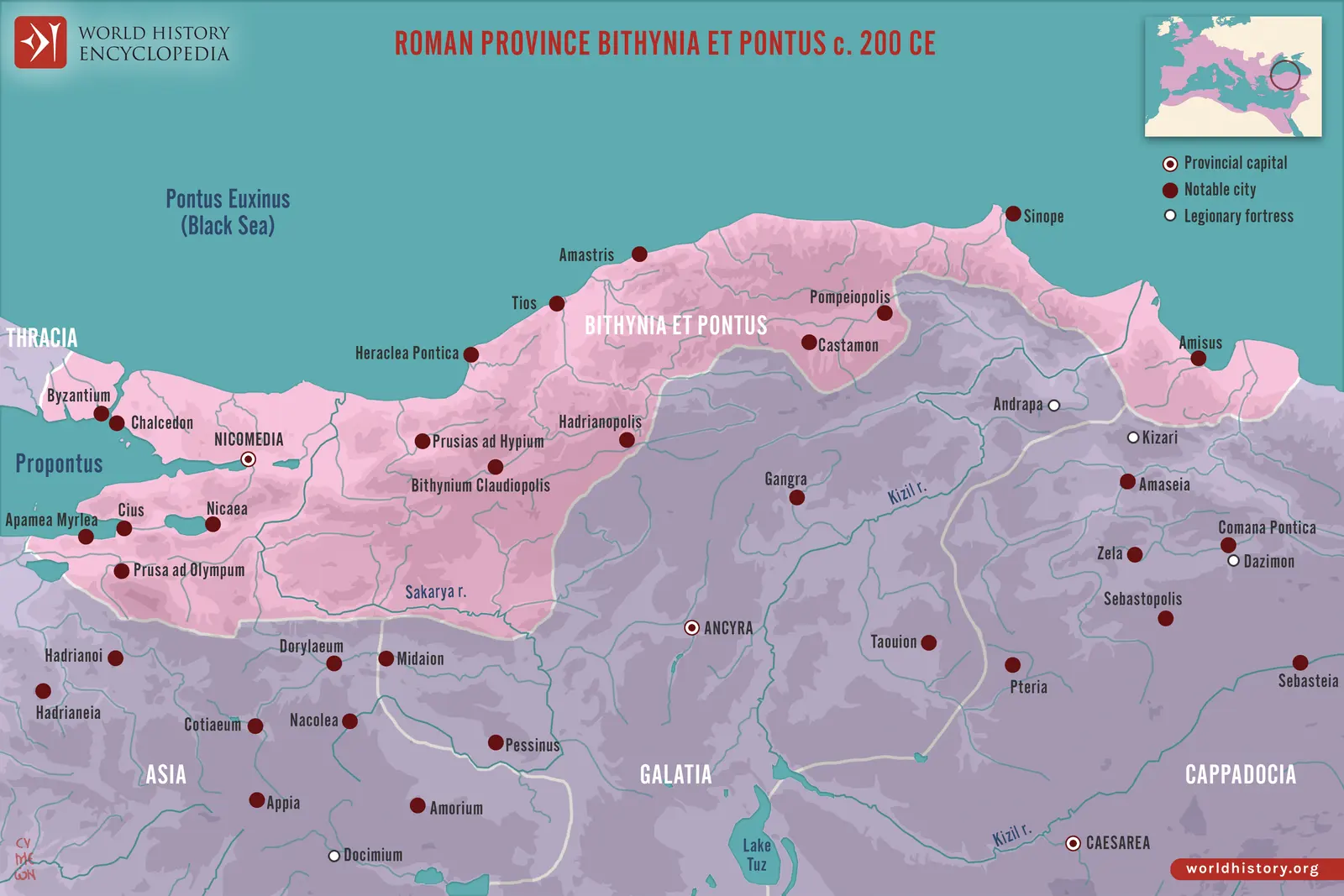
The southern Black Sea coast and inland connections give the Mithridatic wars a more specific geography than a single outline of Asia Minor. The cities shown survived in changing political frameworks. Provincial boundaries and Roman administrative details on this later map are not the borders that Mithridates inherited or controlled.
Chaeronea: works, approach and tactical disruption
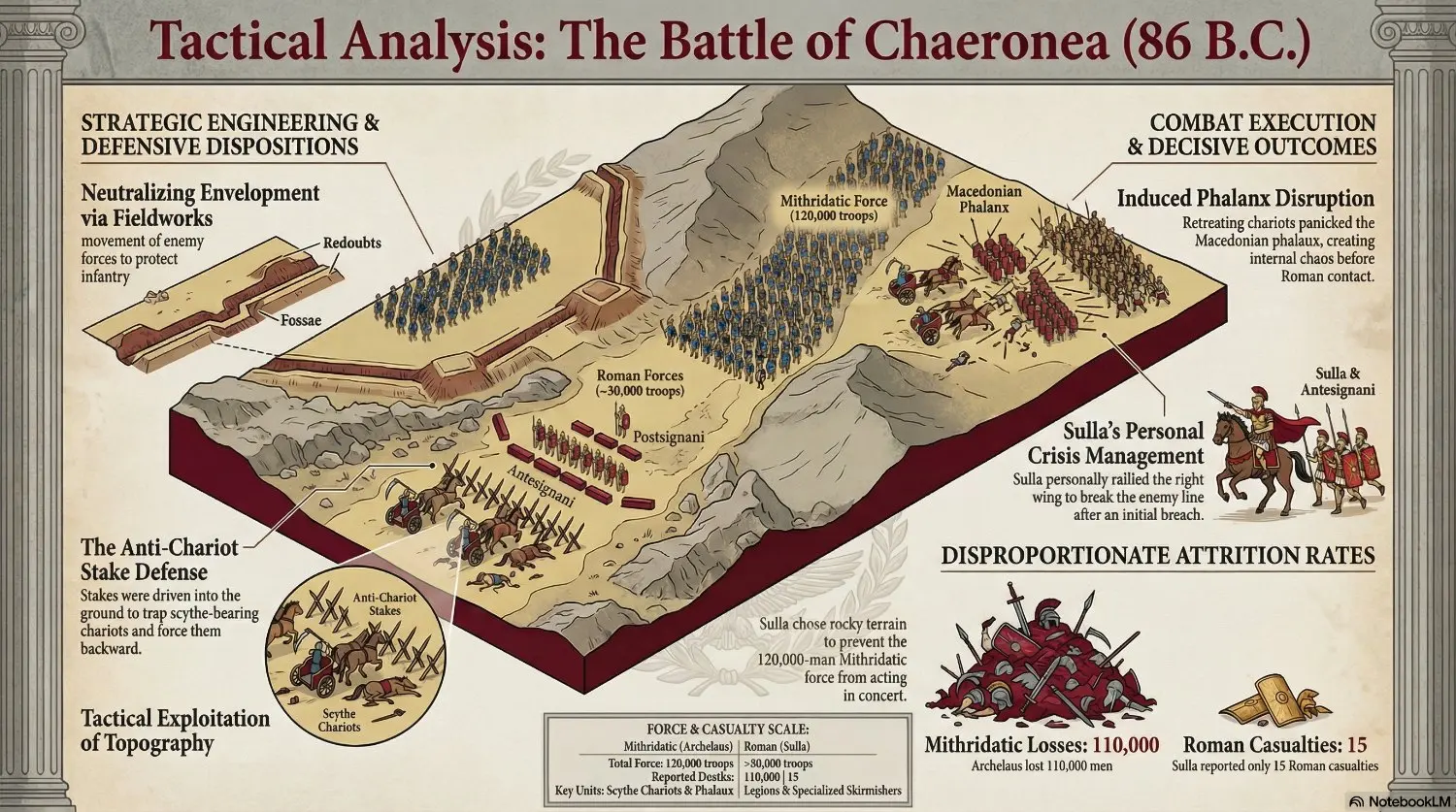
The useful content is the relationship between prepared positions, the opponent's approach and the disruption of particular attacks. The extremely small Roman losses and enormous hostile totals associated with Sulla's victory require skepticism. The plate is retained for its explanation of tactical possibilities, not as certification of its force bars or casualty ratio.
Extended campaign study
The account below develops the operations and their interpretation. Reported numbers and reconstructed tactical details retain the uncertainties described in the dossier.
The First War Against Mithridates (88–85 BC)
The eastern war whose command had broken the constitution in 88 deserves the fuller treatment deferred from the preceding chapter, for its antagonist was the most formidable foreign enemy Rome faced between Hannibal and the Parthian ascendancy. Mithridates VI Eupator, king of Pontus — the Hellenized Iranian realm along the Black Sea's southern shore — had come to his throne as a boy amid court murder, survived (the tradition says) by years of self-imposed exile in the wild and by the systematic self-administration of graduated poisons that made his immunity proverbial, and built across four decades a Black Sea empire embracing the Crimea, Colchis, and the Anatolian interior. He was a figure calculated to seize the Greek imagination and the Roman nightmare alike: speaking, the tradition claimed, the languages of all twenty-two nations he ruled; a giant in body; a collector of antidotes, concubines, and grievances; and the first eastern monarch since Hannibal to understand that Rome's empire was most vulnerable in the hatred of its own subjects. When the collision came in 89–88 — provoked by Roman commissioners goading Bithynia into raiding Pontic territory, with the province of Asia stripped of troops for the Social War — Mithridates swept the peninsula in a single campaign, and then transformed invasion into revolution with the order already noticed: the coordinated massacre, on a single day of 88, of the Roman and Italian residents of Asia — merchants, tax-farmers, families; the ancient figures run from eighty to one hundred fifty thousand — carried out by the Greek cities with an enthusiasm that measured, better than any speech, what a generation of the publicani had made of Roman rule. Greece itself then rose to him; Athens, under the philosopher-tyrant Aristion, declared for the king; and it was against this position — the Aegean world in arms, Italy barely out of the Social War, Rome descending into the Marian terror behind him — that Sulla crossed with five legions in 87.
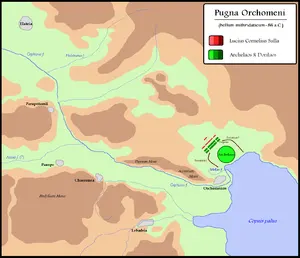
The campaign that followed made the army that would conquer Rome. Sulla besieged Athens and the Piraeus through the winter of 87–86 with a thoroughness that consumed the sacred groves of the Academy and the Lyceum, felled for siege timber, and the treasuries of Olympia and Delphi, borrowed against with a soldier's piety; the city starved until men boiled hides in the Ceramicus, and fell by night assault on the first of March 86, the breach carried at the Heptachalcum, the slaughter running until — the phrase is preserved as his — Sulla declared that he spared the living for the sake of the dead, forgiving the few Athenians for the sake of their ancestors. Aristion, taken later on the Acropolis, was poisoned; the Piraeus, Themistocles's harbor-fortress, was burnt to its foundations and never in antiquity recovered its rank. In Boeotia that summer the king's grand army under Archelaus — the sources give it one hundred twenty thousand, against Sulla's perhaps forty — met the legions at Chaeronea, where Greece's battles went to die; the scythed chariots that opened the Pontic attack were received by the veterans with opened lanes and derisive applause, as at a circus, and the phalanx of freed slaves behind them, pinned by pila and the entrenchments Sulla had dug across the plain, was enveloped and destroyed — the Roman casualty return, as Sulla's memoirs preserved it with a straight face, being twelve men missing, of whom two returned by evening. The following year at Orchomenus, on the drained lakebed of the Copais, Archelaus's rebuilt army caught the Romans entrenching and broke the line — the day retrieved by Sulla himself on foot among the fugitives with a standard, shouting that when men asked where they had abandoned their imperator, they should answer: at Orchomenus; the line turned, the trenches were carried, and the marsh finished what the sword began. With Asia in revolt against the king's increasingly Oriental severities, with a rival Roman army — the Marian government's, its commander Flaccus murdered by his own legate Fimbria, who then campaigned with cheerful savagery across the straits — burning Ilium itself, Mithridates treated. At Dardanus in 85, king and proconsul met: the terms — evacuation of all conquests, seventy warships, two thousand talents, the status of Roman ally restored — were of a mildness that scandalized the army until Sulla explained it with his usual candor: he could not fight Mithridates and Rome at once, and Rome came first.
Tactical illustrations
Outcome and critical assessment
Result and caution: Mithridates lost his conquests but retained Pontus. The Roman settlement imposed severe costs on affected communities. Accounts of the massacres and battlefield losses contain inflated or politically charged figures; the strategic reversal is firmer than their arithmetic.
Historical record: IR-V, chapter 5; Appian, Mithridatic Wars; Plutarch, Sulla.