Wars · IV. The Republic at war with itself
W032 The Social War
Italian allies bore major military obligations while lacking equal access to Roman citizenship and political power. After the murder of Marcus Livius Drusus, revolt developed into a war involving an insurgent confederation whose center at Corfinium was styled Italica. The Roman consuls and commanders faced serious opposition in separate northern and southern theaters.
Roman citizenship legislation changed the conflict while armies were still fighting. Measures associated with the lex Julia and lex Plautia Papiria offered paths to incorporation, weakening the insurgent coalition. Military operations and political concession worked together; neither alone explains the outcome.
Command, forces and military problem
| Field | Dossier |
|---|---|
| Roman leadership | The consuls of 90–89 BC and commanders including Sulla and Pompeius Strabo |
| Opposing or rival parties | Marsic, Samnite and other allied leaders |
| Forces and capabilities | Closely related Italian military systems; insurgent administration and separate theaters |
| Operational problem | Combine military pressure with citizenship concessions that divide the opposing coalition. |
Campaign geography and operational plates
Italy and the Roman world on the eve of the Social War
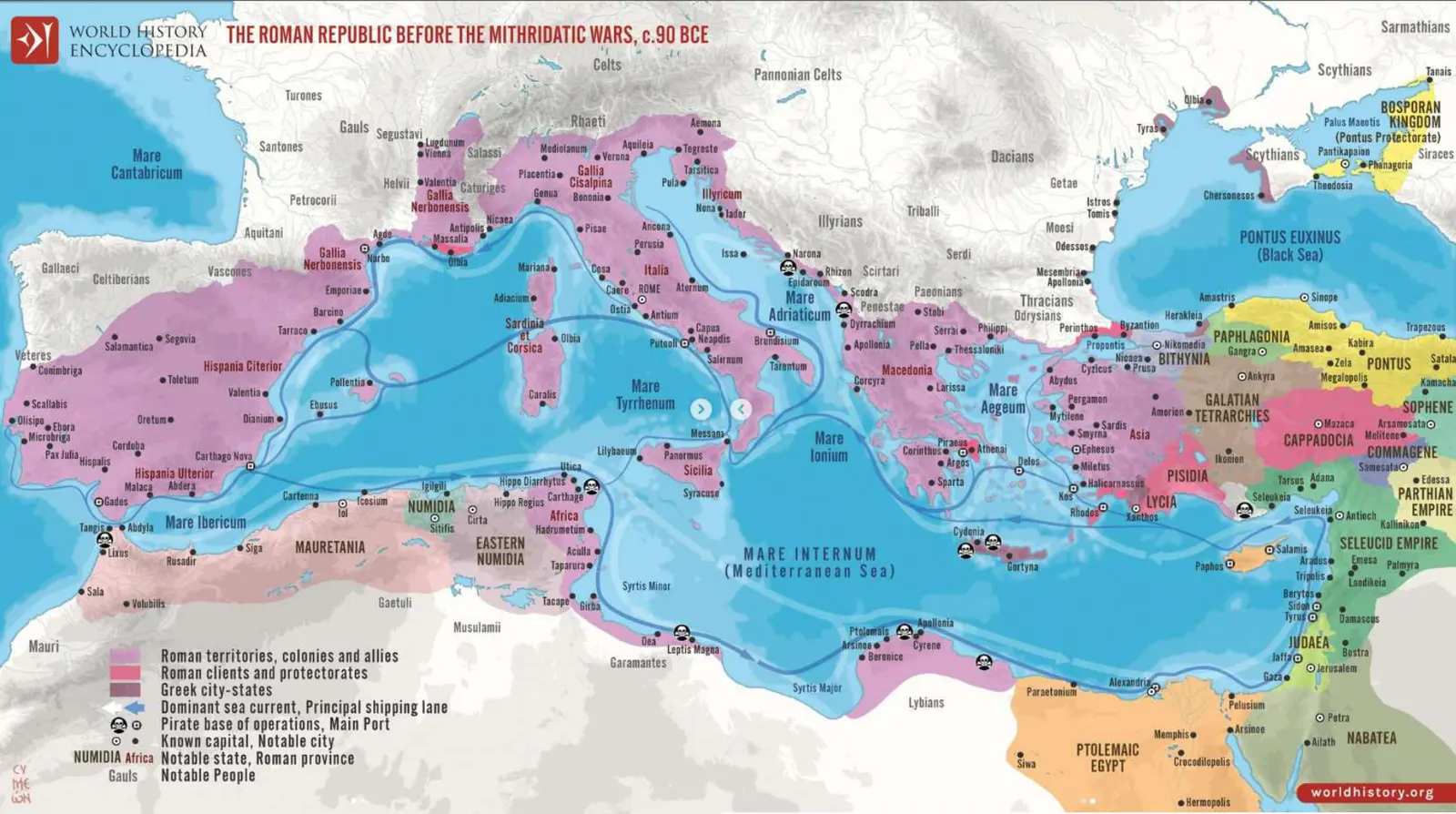
The Italian allies' place inside an expanding Mediterranean system gave citizenship claims an imperial significance. A broad political map cannot show the division of loyalties within every community. It can, however, show why an internal Italian struggle mobilized resources and relationships that reached far beyond the peninsula.
Extended campaign study
The account below develops the operations and their interpretation. Reported numbers and reconstructed tactical details retain the uncertainties described in the dossier.
The Italian Question and the Social War (91–88 BC)
The question that detonated the first general war on Italian soil since Hannibal was the one Gaius Gracchus had raised and Rome had refused for thirty years: the citizenship of the allies. The tribune Marcus Livius Drusus — son of the Drusus who had outbid Gaius Gracchus, and a reforming conservative of the paradoxical kind the late Republic occasionally produced — made the last constitutional attempt in 91 BC: a grand compromise of land and grain laws for the plebs, jury reform splitting the courts between Senate and equestrians, and enfranchisement for the Italians. Every interest he balanced turned against the balancer; his laws were annulled on a religious technicality; and in the autumn of 91 he was struck down in the evening crowd at his own doorway by an assassin's knife that was never officially traced — dying, Velleius reports, with the question whether the Republic would ever have a citizen like himself again. The Italians, who had bound themselves to Drusus by secret oath and whose hopes died with him, went to war within weeks; the spark was struck at Asculum in Picenum, where the town rose and massacred every Roman resident within its walls.
The war that followed — the bellum sociale, the war of the allies — was the strangest and among the deadliest Rome ever fought: a war against her own army, in effect, for the enemy was organized, equipped, drilled, and officered on the Roman model by men who had learned war in Roman service. The insurgent confederacy — its core the Marsi of the central Apennines under Quintus Poppaedius Silo and the Samnites under Gaius Papius Mutilus, with the Paeligni, Vestini, Marrucini, Frentani, Picentes, Lucanians, and Apulians in association — established a capital at Corfinium, renamed Italica, with a senate of five hundred, consuls, praetors, and a coinage whose types declared the program: the Italian bull goring the Roman wolf. The fighting of 90 BC went heavily against Rome on both fronts — the consul Rutilius Lupus killed in a river ambush in the Marsic north, his colleague repeatedly mauled in Campania, where Mutilus's Samnites took Nola and the coastal cities; the state put out its full strength, recalling every commander of capacity including the aging Marius, who handled the northern front with a steadiness his enemies called sluggishness, and the legate Sulla, whose service in the south began his ascent to independent fame. But the war was decided as much by statute as by steel. The lex Julia of late 90, carried by the consul Lucius Julius Caesar, granted citizenship to every allied community that had not revolted or would lay down arms; the lex Plautia Papiria of 89 extended it to individuals of the insurgent peoples presenting themselves within sixty days; and the confederacy, its grievance conceded in principle, fought on only where hatred outran calculation. In 89 the northern front collapsed after Asculum fell to Gnaeus Pompeius Strabo — father of Pompey the Great, a commander of glacial cruelty who triumphed over the ruins — while Sulla in the south retook Campania and broke the Samnites in the field, winning the consulship for 88 on the credit. Silo died in a last battle in 88; the Samnites and Lucanians smoldered unreconciled, awaiting the occasion they would find four years later; and Italy south of the Po emerged from three years of war and perhaps three hundred thousand dead as, in law, a single citizen state — the new citizens carefully registered, in a final Roman meanness that would furnish the next decade's politics, into a minority of the voting tribes so that their numbers could never control an assembly.
Outcome and critical assessment
Result and caution: Rome defeated the rebellion militarily while accepting much of its citizenship demand. Integration and the allocation of new citizens remained contentious. Dates such as 91–87 in inherited tables may include later resistance, but should not be allowed to erase the transition into the Sullan conflicts.
Historical record: IR-V, chapter 4; Appian, Civil Wars 1; Velleius, book 2.