Wars · IV. The Republic at war with itself
W030 The Jugurthine War
Jugurtha's struggle for power and the crisis at Cirta drew Rome into Numidian affairs. Early Roman operations were compromised by political conflict, allegations of corruption and military failure. Metellus improved the Roman position; Marius then took over the command and continued operations across difficult country.
Capturing towns did not automatically capture a mobile ruler. Water, distance, intelligence and local support shaped the campaign. The war ended through diplomacy as well as force: Bocchus of Mauretania surrendered Jugurtha in negotiations in which Sulla played an important role.
Command, forces and military problem
| Field | Dossier |
|---|---|
| Roman leadership | Bestia, Albinus, Metellus, Marius and Sulla in successive roles |
| Opposing or rival parties | Jugurtha; Bocchus as an initially opposing and later negotiating ruler |
| Forces and capabilities | Roman and allied infantry and cavalry against mobile royal forces |
| Operational problem | Capture or isolate a mobile king rather than mistake occupation of towns for victory. |
Campaign geography and operational plates
North Africa: cities, roads and military districts
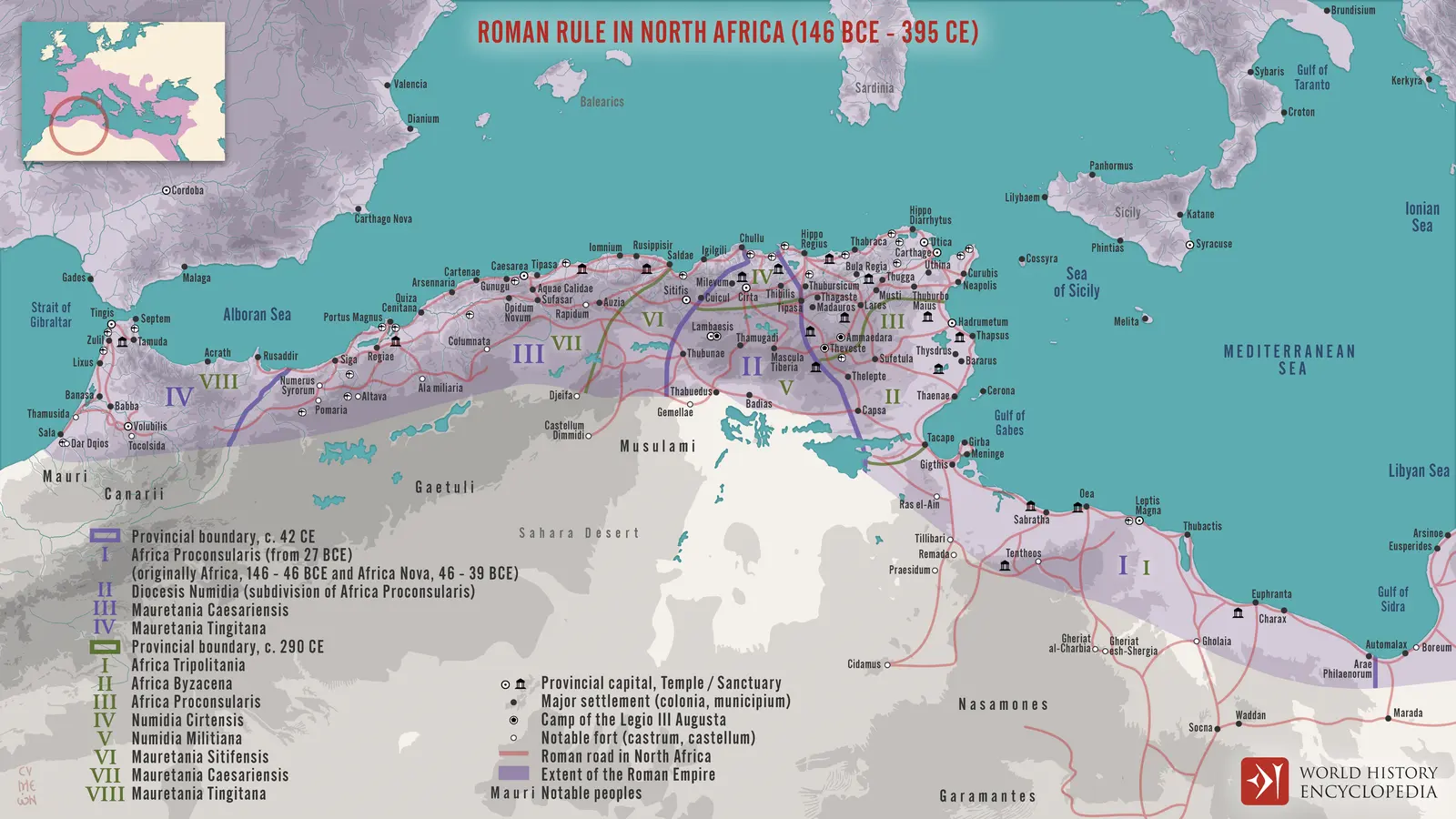
A narrow, connected coastal and upland world contrasts with the much larger interior. The towns, road systems and legionary references help explain the relationship between settled resources and operations beyond them. For Jugurtha or early annexation, treat the later roads and administrative units as a subsequent layer, not as contemporary campaign infrastructure.
Extended campaign study
The account below develops the operations and their interpretation. Reported numbers and reconstructed tactical details retain the uncertainties described in the dossier.
The Numidian Succession
The war that carried Gaius Marius to the consulship and the Roman army to its professional transformation began, like the Third Punic War before it, in the dynastic politics of the Numidian kingdom that Masinissa had built and Rome had guaranteed. Micipsa, Masinissa's son and successor, died in 118 BC leaving the kingdom jointly to his two sons, Adherbal and Hiempsal, and to his nephew Jugurtha — the illegitimate grandson of Masinissa whom Micipsa had adopted late and reluctantly, precisely because the young man's capacities made him dangerous to exclude. Those capacities were genuine and Roman-certified: Jugurtha had commanded the Numidian contingent under Scipio Aemilianus at Numantia in 134–133, where he had distinguished himself in the fighting and, more consequentially, had received an education in the purchasability of the Roman aristocracy from the ambitious young nobles of Scipio's staff — several of whom, Sallust reports, privately assured him that a bold man could buy at Rome whatever a king might need. Scipio himself, with characteristic penetration, had warned him formally against exactly this course. The warning was remembered; the private assurances were acted upon.
The joint kingship dissolved in the manner such arrangements do. Hiempsal, the more assertive of the legitimate heirs, was murdered by Jugurtha's agents within the year — surprised in a house at Thirmida and his head brought to his cousin. Adherbal, defeated in the open war that followed, fled to Rome and laid the cause before the Senate; Jugurtha's envoys arrived with heavier purses; and the senatorial commission of 116, headed by the same Lucius Opimius who had killed Gaius Gracchus, partitioned Numidia in a settlement that assigned the western — and, as events proved, militarily stronger — portion to the usurper. When Jugurtha resumed the war regardless and penned Adherbal in his capital of Cirta, two successive Roman embassies were received with courtesies and dismissed with nothing; and in 112, when Cirta capitulated on terms, Jugurtha executed Adherbal under torture and put to the sword the town's defenders indiscriminately — including a substantial community of resident Italian merchants who had manned the walls. The massacre of the Italians made the war. The Senate might still have temporized — substantial portions of it, in Sallust's unsparing account, having been retained in Jugurtha's interest — but the equestrian order whose kinsmen and correspondents had died at Cirta could not be faced down, and the tribune Gaius Memmius made the scandal of senatorial venality the theme of a sustained popular agitation. Rome declared war in 111 BC.
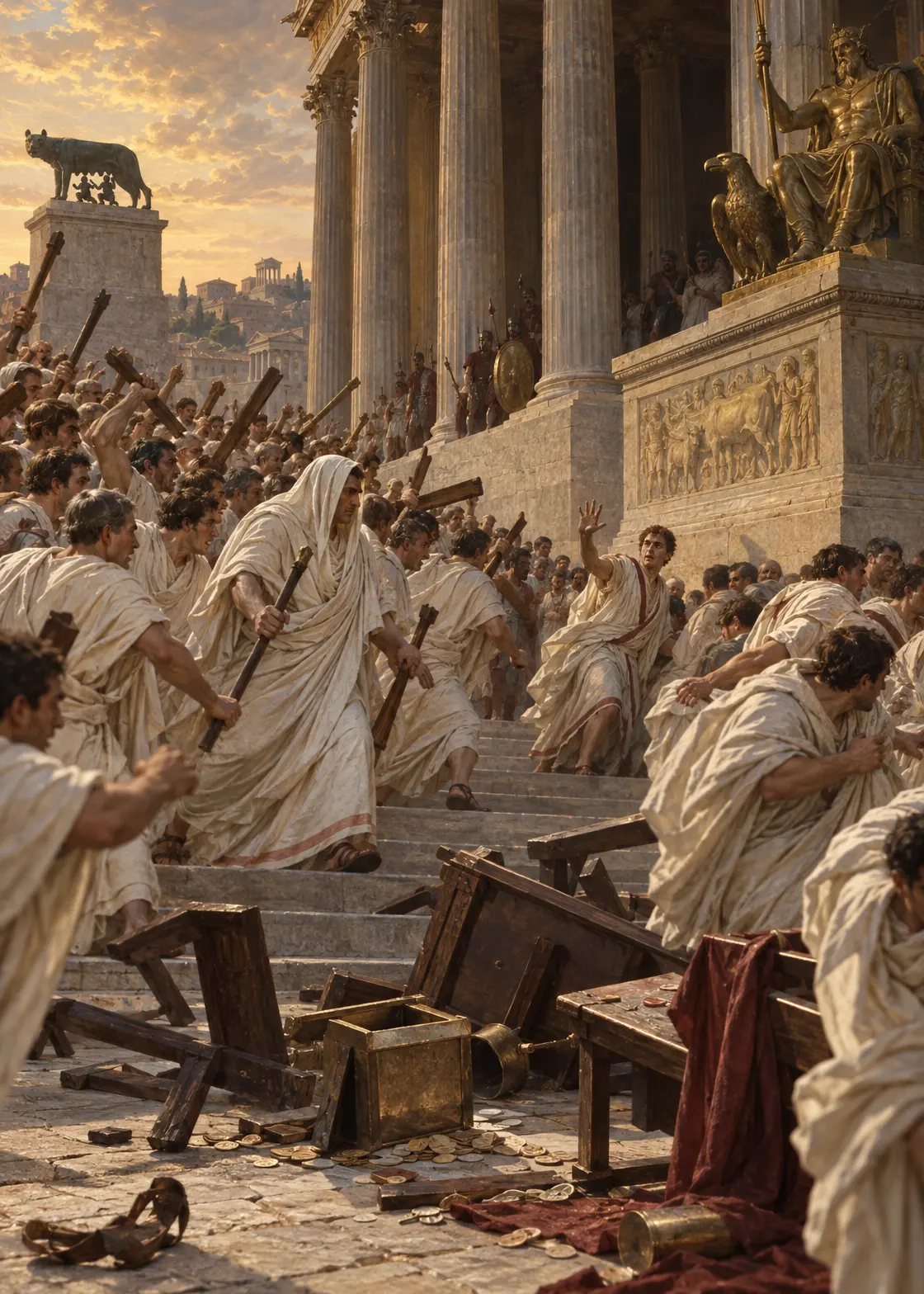
The war's opening years compounded the scandal. The consul Lucius Calpurnius Bestia campaigned briefly and then sold Jugurtha a peace of derisory mildness for what everyone understood to be a personal consideration; the tribunes forced the treaty's repudiation and summoned Jugurtha to Rome itself under safe-conduct to give evidence on the corruption — an extraordinary scene, the African king lodged in the city naming the senators he had purchased, until a tribune's veto (itself purchased) silenced the inquiry, and Jugurtha, having meanwhile procured the murder in Rome of a rival Numidian pretender, was expelled from Italy. His verdict on departure became the most quoted sentence of the war, and Sallust set it at the head of the whole moral architecture of his monograph: urbem venalem et mature perituram, si emptorem invenerit — "a city for sale, and doomed to perish quickly, if it finds a buyer." The campaign of 110 under Spurius Postumius Albinus achieved nothing; and in January 109 the consul's brother Aulus, left in command through the winter, was lured into a night assault on the treasury-town of Suthul, ambushed in the retreat, and compelled to surrender his surrounded army — which was sent under the yoke, the archaic humiliation Rome had not suffered since the Caudine Forks, and bound by a treaty of evacuation that the Senate, once again, repudiated as unauthorized. At Rome the Mamilian commission, established by tribunician law over senatorial resistance, tried and exiled the venal commanders and negotiators of the preceding decade, Bestia and Opimius among them: the killer of Gaius Gracchus died an exile at Dyrrachium, hated, as Cicero later noted, by the very order he had bloodied his hands to defend.
Metellus and Marius
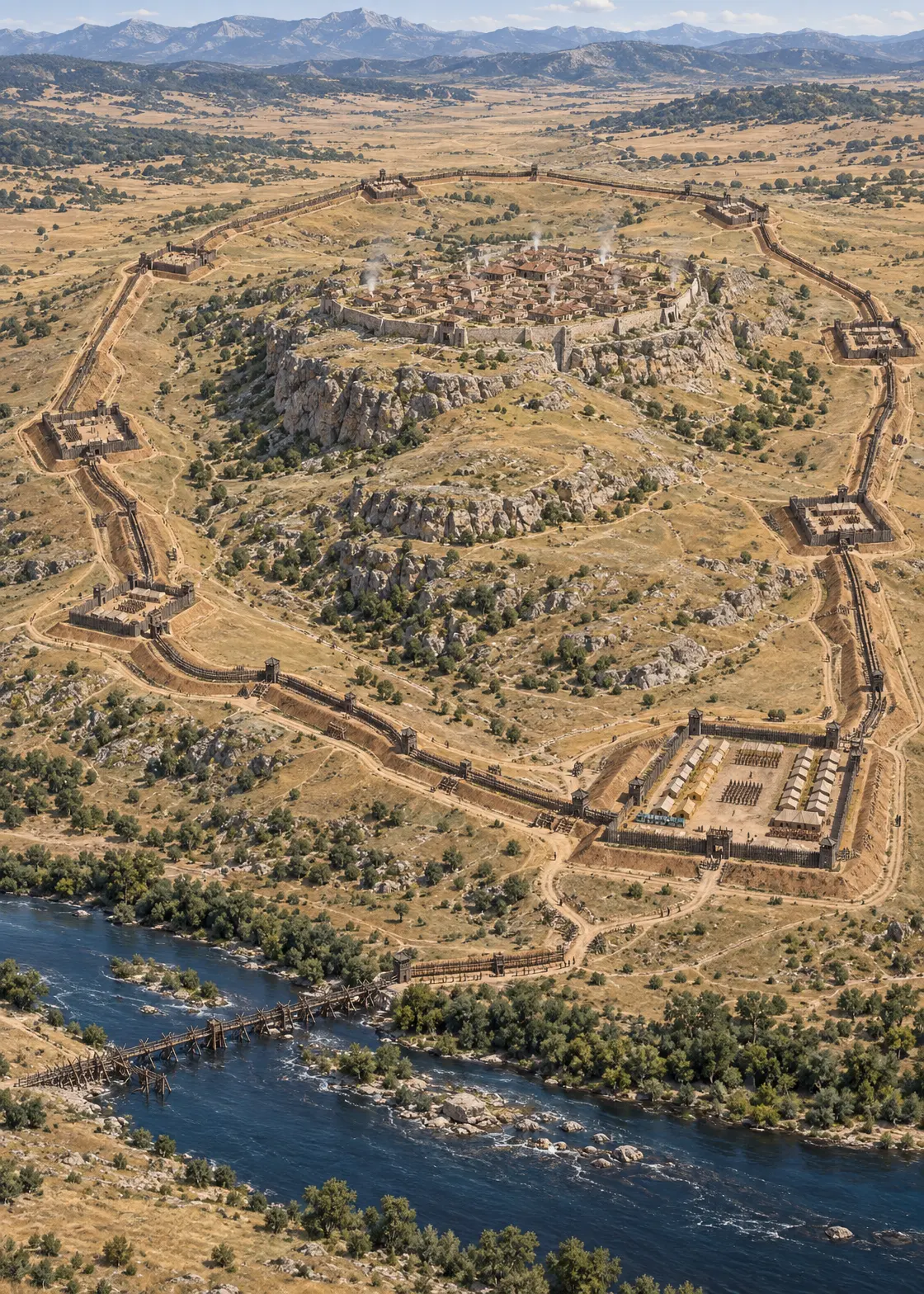
Quintus Caecilius Metellus took over the Numidian command in 109 BC and restored discipline before renewing the offensive. Jugurtha combined negotiation with attempts to catch the Roman army at a disadvantage. At the Muthul, conventionally dated to 109 BC, the Roman column faced a dispersed and difficult engagement after descending into the river country. Sallust's account gives important roles to Metellus, Marius, Rutilius and separate bodies of troops; the fighting should not be reduced to one legate single-handedly saving a unified battle line. The army retained the field, but Jugurtha remained at large. Operations around Zama and the continuing difficulty of forcing a final decision sharpened the political dispute over the command. Marius' later capture of Capsa belongs to his own subsequent command, rather than to Metellus' first campaign.
Marius was at this point in his middle fifties, a novus homo from Arpinum in the Volscian hills — the first man of his family to enter the Senate, risen through equestrian military service (he had been commended at Numantia by Scipio Aemilianus himself, in an anecdote the tradition polished until it became prophecy), tribune, praetor, marriage into the patrician but faded house of the Julii Caesares — his wife's nephew, born a decade before the Muthul, would be Gaius Julius Caesar.
When Marius sought leave from Metellus to return to Rome and stand for the consulship of 107, the proconsul's reply — that Marius should not hurry, that it would be time enough for him to stand alongside Metellus's own son, then a boy of twenty — was the aristocratic insolence around which the novus homo built his campaign. Released at last, contemptuously late, Marius reached Rome with the army's letters and the equestrian traders' testimony proclaiming him the man who would end the war, and was elected consul for 107 in a landslide that the popular assembly then compounded with a second unprecedented step: overriding the Senate's routine assignment of provinces, it voted the African command directly to Marius by plebiscite. The Metellan establishment answered with the honors of its own — a triumph for Metellus and the cognomen Numidicus — but the constitutional fact stood: for the second time in a generation the assembly had taken a fundamental senatorial prerogative into its own hands, and this time the beneficiary was a general.
What Marius did next is the institutional hinge of the entire volume. Authorized to raise supplementary forces and finding the propertied recruitment classes depleted and unwilling, he enrolled volunteers from the capite censi — the "head count," the propertyless citizens below the census minimum, whom the Servian constitution had never armed because men without property were held to have no stake worth defending. Sallust presents the step as expedience seasoned with demagogy, and at the time it was scarcely remarked as revolutionary; the census minimum had already been lowered repeatedly across the second century, and emergency enrollments of the poor had ancient precedent. But the volunteers of 107 were not an emergency measure to be disbanded at the crisis's end; they were the first cohorts of a new kind of army — men for whom the legion was not an interruption of livelihood but the livelihood itself, whose service had no natural terminus, and whose hopes of a farm at discharge rested not on any institution of the state, which provided none, but on the personal capacity of their commander to wring land laws out of the political system. The client army was born in the recruiting of 107; every civil war of the following seventy-six years was implicit in it. Marius completed the transformation in the field across the following years with the reorganizational package that tradition, simplifying, calls the Marian reforms: the cohort of six hundred confirmed as the standard tactical unit in place of the maniple, the legion's ten cohorts giving a flexibility of articulation the manipular checkerboard had lacked; the soldier's kit consolidated onto his own back — the muli Mariani, "Marius's mules," the army's own name for itself — cutting the baggage train that had made Roman columns slow and vulnerable; equipment standardized and state-supplied, as it had to be once the recruits owned nothing; the pilum's shank redesigned to bend on impact; and above all the eagle — the aquila, made the sole standard of the legion, the cult-object of the new professional loyalty.
The Capture of Jugurtha (107–105 BC)
The African war itself ended not in a decisive field engagement — Jugurtha, after the Muthul, never again offered one — but in the slow strangulation of the king's resources and the final treachery of his last ally. Marius campaigned across 107 and 106 with the new army in the deep interior, storming Capsa and the desert fortresses, wintering where Numidian armies had always assumed Romans could not, and progressively driving Jugurtha westward into dependence on his father-in-law Bocchus, king of Mauretania, whose enormous and untested kingdom stretched to the Atlantic. Twice the combined kings attacked the Roman army on the march near Cirta in late 106, in sprawling engagements of ambush and counterattack from which the legions extricated themselves with heavy Numidian slaughter; and Bocchus, weighing the account, opened the secret correspondence with the Roman command that occupied the war's final year. The Roman negotiator was the quaestor of 107, retained since as legate: Lucius Cornelius Sulla, a patrician of ruined family and dazzling gifts, whose descent into Bocchus's camp — where the king was simultaneously entertaining Jugurtha's envoys and weighing, Sallust makes clear, which guest to betray to the other — is one of the great sustained nerve-pieces of ancient narrative.
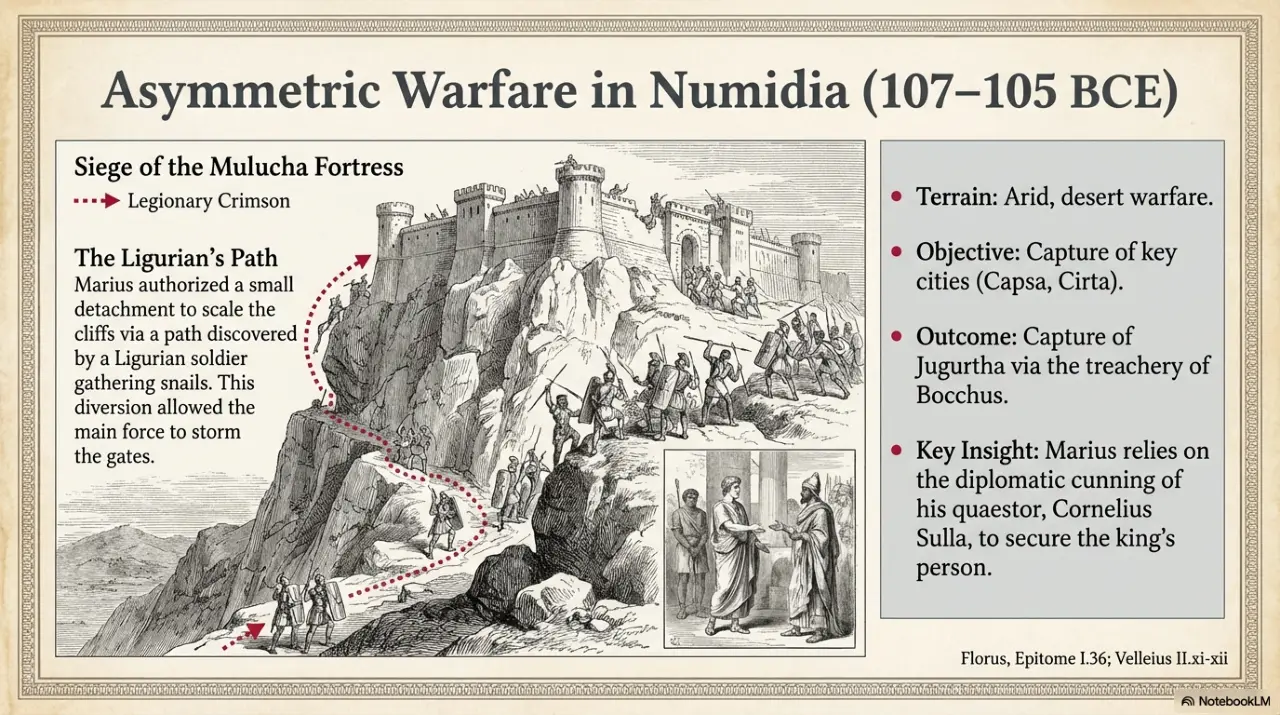
The Moorish council was held; the dice fell Roman; and at a parley staged for the purpose in 105, Jugurtha was seized by his father-in-law's men, his companions cut down around him, and the king delivered in chains to Sulla, who conveyed him to Marius. Sulla commemorated the scene on his personal seal-ring — Bocchus delivering, Sulla receiving, the kneeling king between — and wore it for the rest of his life: a small object over which, Plutarch records, the enmity of the two greatest soldiers of the age first crystallized, Marius holding the war to be his and the capture a subordinate's errand, Sulla wearing the errand on his hand.
The king was then stripped, his earrings torn away with the flesh, and lowered into the Tullianum, the ancient carcer beneath the Capitol; the tradition preserves his last words as he went down naked into the cold — "Hercules, how cold your bath is, Romans" — and he died there of starvation on the sixth day. Numidia was not annexed: the western portion went to Bocchus as the wage of treachery, the remainder to a compliant grandson of Masinissa, and Rome withdrew, having fought the whole war, as she had fought it under the Scipiones, to demonstrate that no African client might defy her — and having acquired in the process, almost inadvertently, the general, the army, and the grievances out of which the Republic's destruction would be assembled.
Outcome and critical assessment
Result and caution: Jugurtha was captured and the regional settlement changed, but Numidia was not simply annexed in its entirety. Sallust's history is indispensable and also an argument about Roman moral and political decay. Marius' recruitment should not be turned into one instantaneous, fully documented "Marian reform" that permanently redesigned every aspect of the army.
Historical record: Sallust, Jugurthine War; IR-V, chapter 2. Sallust's detailed narrative deserves more weight than generic campaign-table descriptions.