Provinces · Anatolia and the Aegean
RP-31 Bithynia et Pontus
Two acquired territories and a composite province
Bithynia had a royal history distinct from the Pontic kingdom of Mithridates VI. Nicomedes IV’s bequest brought the former kingdom into Roman hands, while the Mithridatic wars determined the fate of neighbouring territories. Pompey’s settlement joined Bithynia with western Pontic districts and reorganized communities within the new provincial system. Other Pontic lands remained under rulers or entered different commands later.
This composite origin mattered geographically. Northwestern cities faced the Propontis and Bosporus; coastal Pontic cities participated in Black Sea networks; inland districts depended on roads, valleys, and agricultural production. Provincial unity was administrative, not evidence that all these areas had identical political or cultural histories.
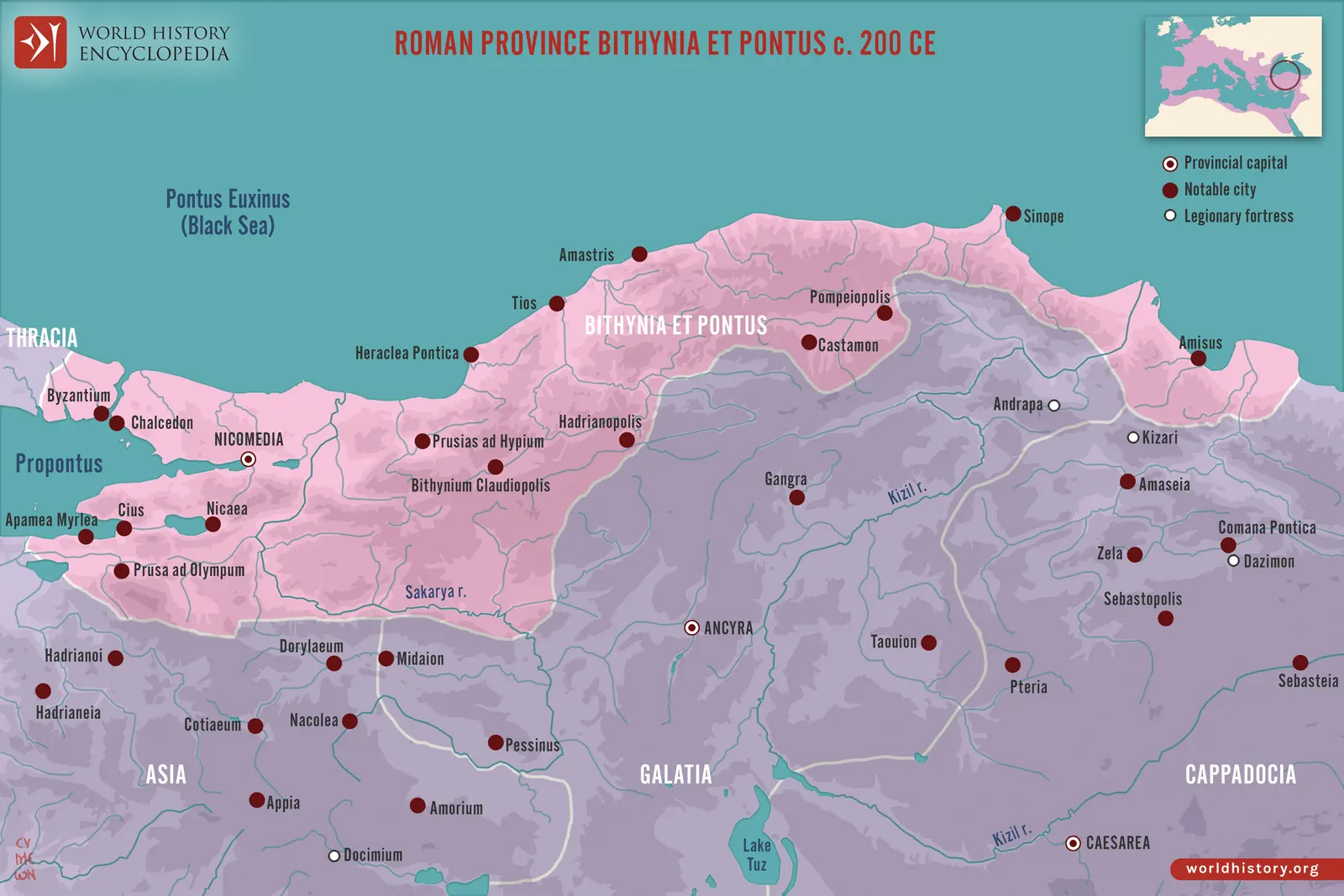
Cities and local competition
Nicomedia possessed a strong royal inheritance, a fine harbour position, and close access to the routes between Europe and Anatolia. Nicaea’s location and civic ambition made it a major rival. Prusa, Chalcedon, Apamea Myrlea, Heraclea Pontica, Sinope, and Amisus occupied different places within the province’s urban network.
City governments sought buildings, honours, festivals, and recognition. Councils, assemblies, wealthy patrons, and local factions shaped public decisions. Competition could support impressive development but also lead to financial strain and unfinished projects. Roman officials intervened in accounting, construction, and disputes without abolishing local civic institutions.
The exceptional imperial commission
Pliny’s governorship under Trajan involved unusually close supervision of provincial affairs. His responsibilities included investigating city finances and dealing with practical questions of public building, law, associations, and civic obligation. Aqueducts, baths, theatres, and other projects were matters of government because expenditure, contracts, corruption, and public utility were inseparable.
The concern that voluntary associations might become political factions illustrates the imperial preference for order over some forms of local initiative. The handling of Christian accusations similarly shows government trying to manage unfamiliar religious identity through legal procedure and political expectations. Such cases belong to the actual workings of provincial rule, not merely to the biography of an individual governor.
Economy and movement
Timber, farming, livestock, fishing, ports, shipping, and urban manufacture supported the region. The Black Sea offered connections with Pontic, Crimean, and Caucasian communities, while western routes linked the province to Europe and the Aegean. Coastal transport could connect cities separated by difficult inland terrain.
The province’s roads became increasingly important as imperial activity shifted towards the eastern frontiers and later Constantinople. Movement through Bithynia brought soldiers, officials, supplies, and travellers, creating demand and imposing obligations on communities along the routes.
Nicomedia, Nicaea, and the Christian empire
Nicomedia’s role as an imperial residence under Diocletian brought the court, public construction, officials, and military support into the city. It also placed the region near the centre of the Great Persecution beginning in 303. The later prominence of Constantinople changed the balance of nearby cities without making Nicomedia insignificant.
Nicaea hosted the council of 325, placing the city at the centre of a major attempt to define Christian doctrine and imperial religious unity. That event added to its prestige but did not mark the first existence of Christian communities in the province.
Late subdivision separated Bithynia and neighbouring jurisdictions such as Honorias, while Pontic districts entered a more complex provincial system. The older combined province ceased to exist as one jurisdiction, but its cities and routes remained central to eastern imperial life. Their subsequent histories were shaped by proximity to Constantinople, the Anatolian road network, and the enduring importance of the Black Sea.
Settlement geography
| Ancient place | Modern location |
|---|---|
| Nicomedia | İzmit, Turkey |
| Nicaea | İznik, Turkey |
| Prusa | Bursa, Turkey |
| Chalcedon | Kadıköy, Istanbul |
| Apamea Myrlea | Mudanya, Turkey |
| Heraclea Pontica | Karadeniz Ereğli, Turkey |
| Amastris | Amasra, Turkey |
| Sinope | Sinop, Turkey |
| Amisus | Samsun, Turkey |