Provinces · Anatolia and the Aegean
RP-30 Asia
The inheritance of the Attalids
Asia was a Roman province built upon a dense Hellenistic urban world. Its cities possessed councils, assemblies, sanctuaries, festivals, local law, and traditions of diplomacy long before annexation. The Attalid kingdom had combined royal power with civic autonomy and regional patronage. Rome inherited that complicated structure rather than an administratively empty territory.
Attalus III’s bequest in 133 BCE gave Rome a legal-political claim, but Aristonicus’s resistance showed that inheritance on paper did not guarantee obedience. Warfare, suppression, and settlement produced the province’s effective organization. Some lands and communities received different treatments, while provincial borders changed with later decisions and annexations.
Taxation, debt, and the Mithridatic catastrophe
Roman revenue collection brought public contractors, financiers, officials, and merchants into close contact with provincial communities. Tax demands, debt, legal inequality, and abuses could generate intense resentment. Local elites also participated in the system, sometimes benefiting through connections with Roman patrons and commercial interests.
Mithridates VI’s challenge in 88 BCE transformed these tensions into a devastating political and military crisis. The mass killing of Romans and Italians in Asian cities marked a profound rupture. Different communities acted under varying combinations of coercion, local hostility, opportunism, and royal pressure. Roman reconquest brought punishment, indemnities, financial obligations, and further disruption. The province’s later prosperity therefore followed a period of severe violence rather than uninterrupted stability.
Ephesus, Pergamum, and Smyrna
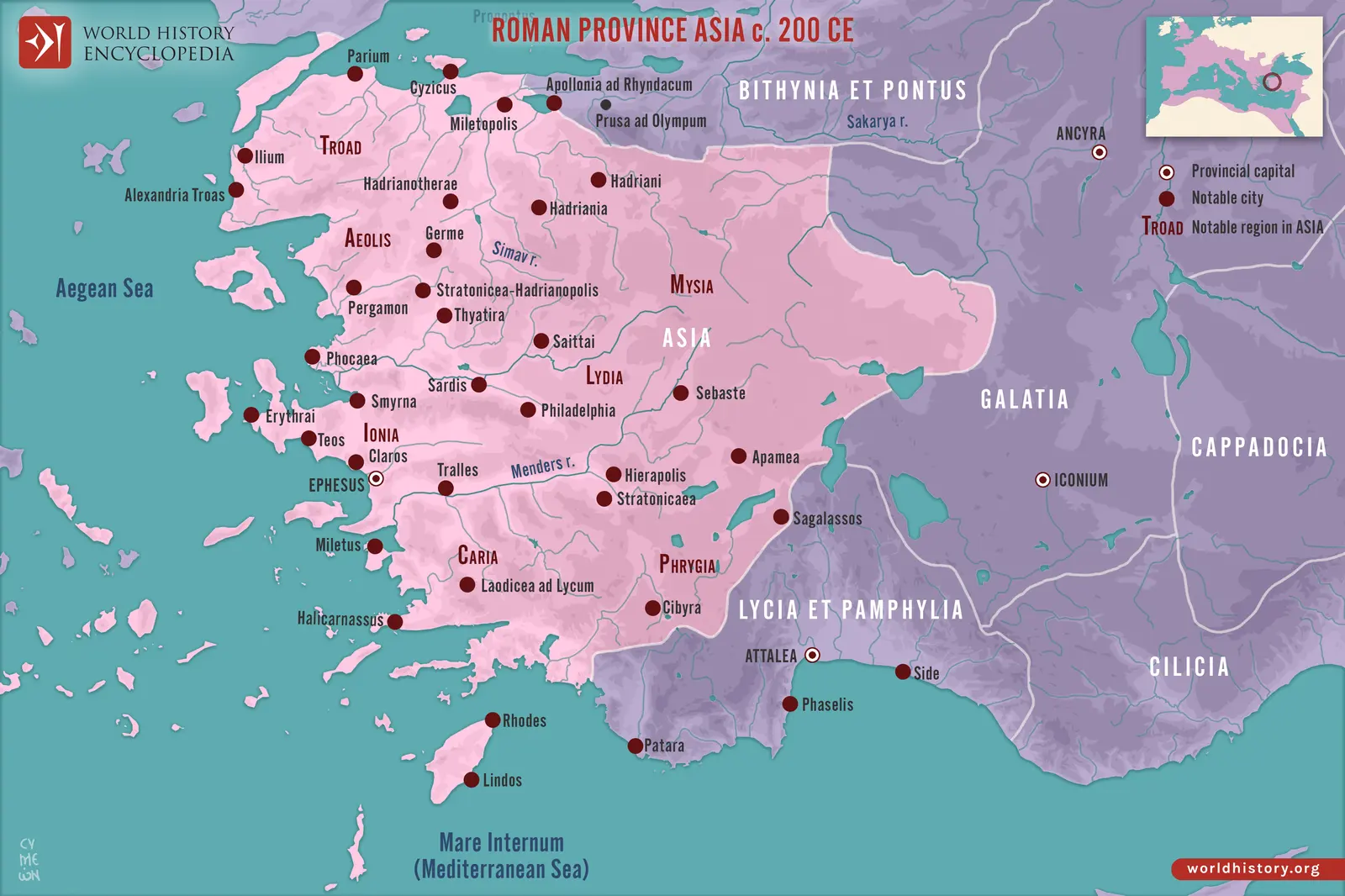
Ephesus’s harbour, regional routes, sanctuary of Artemis, and role as the governor’s principal centre made it a leading city. Pergamum retained royal memory, intellectual prestige, and important cult institutions, including the healing sanctuary of Asclepius. Smyrna combined maritime exchange with civic ambition and later imperial patronage. Their rivalry for honours, titles, temples, and precedence was part of provincial political life.
Many smaller cities were equally important within their territories. Sardis, Miletus, Aphrodisias, Laodicea, Hierapolis, and inland market centres organized productive districts and cultural networks. A proconsul’s judicial circuit connected such places to Roman authority, while local councils and magistrates conducted much everyday administration.
Production and exchange
River valleys and plateaus supported cereals, vines, olives, livestock, textiles, and regional specializations. Marble quarrying and sculpture, especially in particular centres, linked workshops to distant patrons. Ports carried goods, officials, students, pilgrims, and migrants between Anatolia and the wider Mediterranean. The province’s urban density depended upon agricultural hinterlands and labour as well as elite generosity.
Associations of craftsmen, merchants, and religious groups organized parts of social and economic life. Public benefaction supported baths, theatres, fountains, and festivals, while civic competition could encourage spending beyond a community’s means. Imperial intervention in financial affairs was therefore compatible with the survival of strong local institutions.
Religion and the provincial identity
Great sanctuaries existed alongside household cults, civic temples, healing centres, and imperial worship. The imperial cult became an important arena for provincial representation. Cities competed for the honour of hosting temples and festivals connected to the emperors, while wealthy officeholders turned service into public distinction.
Jewish communities and Christianity added further layers to an already diverse religious world. Christian congregations developed in several cities during the early imperial period, later becoming part of a powerful episcopal network. Their growth involved disputes over authority, doctrine, civic obligations, and participation in traditional public life. Christianization transformed cities gradually and unevenly.
The smaller late Asia
The large province’s subdivision produced several jurisdictions bearing older regional names. Lydia, Caria, the Phrygias, Hellespontus, and the islands acquired separate governors or distinct relationships within the late system. The remaining Asia retained Ephesus and a smaller western Anatolian core, while the proconsul’s special rank preserved part of the older province’s prestige.
The seventh-century wars placed new pressures on coastal and inland communities, but western Anatolia remained within the eastern empire long after the Levant and Egypt were lost. Its subsequent provincial and military reorganization belongs to a later institutional world. Asia’s long history combines a Hellenistic civic inheritance, Roman fiscal and political authority, extraordinary urban competition, and a durable transformation into Christian imperial society.
Settlement geography
| Ancient place | Modern location |
|---|---|
| Ephesus | Near Selçuk, Turkey |
| Pergamum | Bergama, Turkey |
| Smyrna | İzmir, Turkey |
| Sardis | Near Salihli, Turkey |
| Miletus | Near Didim, Turkey |
| Aphrodisias | Near Geyre, Turkey |
| Hierapolis | Pamukkale, Turkey |
| Laodicea on the Lycus | Near Denizli, Turkey |
| Magnesia on the Maeander | Near Germencik, Turkey |
| Tralles | Aydın, Turkey |
| Philadelphia | Alaşehir, Turkey |
| Thyatira | Akhisar, Turkey |
| Halicarnassus | Bodrum, Turkey |
| Cnidus | Near Datça, Turkey |
| Priene | Near Güllübahçe, Turkey |
| Alexandria Troas | Near Dalyan, Turkey |
| Ilium | Troy, Turkey |
| Cyzicus | Near Erdek, Turkey |
| Apamea Celaenae | Dinar, Turkey |
| Rhodus | Rhodes, Greece |
| Cos | Kos, Greece |
| Mytilene | Lesbos, Greece |