Provinces · Macedonia, Greece, Epirus, and Thrace
RP-29 Thracia
Kingdom, plain, and mountain
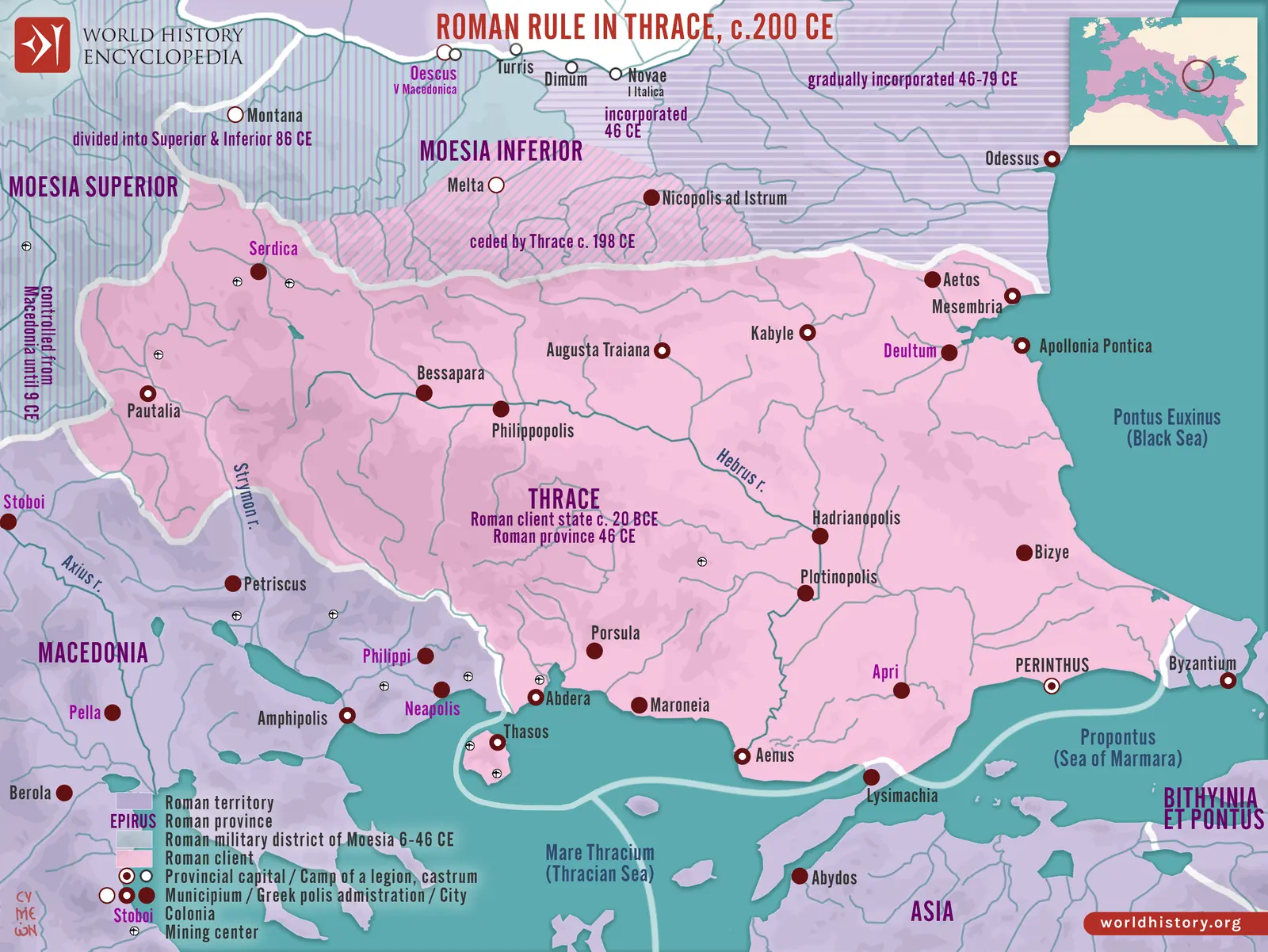
Thracia’s pre-annexation history included several royal arrangements, local communities, and relationships with Rome. Its plains and river valleys supported agriculture and movement, while the Rhodope and Balkan mountain districts presented different conditions. Greek cities along the coasts and straits had long connected the region to maritime trade and civic culture.
The annexation of 46 CE replaced dependent kingship with direct provincial government. Roman officials inherited a region whose internal differences required flexible administration. Urban foundations and the promotion of existing settlements helped organize authority, taxation, and communications through a network of cities and territories.
Roads and urban growth
Philippopolis occupied an important position in the interior, while Perinthus and Byzantium faced the straits and maritime routes. Hadrianopolis developed at a major communications junction. Serdica’s earlier association with Thracian geography and its later placement in a different province illustrate the changing boundaries of the administrative landscape.
Roads through the Hebrus/Maritsa valley connected the central Balkans to the straits. The Via Egnatia and coastal routes added further links. Towns, posting stations, bridges, and surrounding agricultural districts sustained this movement. Thrace’s strategic value lay partly in feeding and carrying armies moving through it rather than in maintaining only its own provincial garrison.
Agriculture, recruitment, and cultural mixture
Cereals, vines, livestock, timber, mining in selected areas, and local crafts supported the region. Rural communities supplied the towns and military routes. Recruitment linked Thracian populations to service across the empire, creating personal and religious connections far beyond the province.
Greek civic culture expanded while Latin remained important in military and official contexts. Local religious traditions, including the widespread imagery of the Thracian Rider, persisted within a Roman provincial environment. Sanctuaries, dedications, and funerary practices reveal both regional continuities and participation in imperial forms.
Constantinople changes the balance
The establishment of Constantinople in 330 placed a new imperial capital beside the Thracian world. Roads, food supply, estates, military protection, and religious politics acquired new significance in relation to the city. The capital possessed its own urban government, but its needs transformed neighbouring provinces and routes.
Late Thracia, Europa, Haemimontus, and Rhodope divided much of the old province’s territory. The Diocese of Thrace also included lower Danubian provinces of a different origin. This larger grouping linked the defence of the capital with the security of the Balkan approaches.
War and late antique resilience
Third-century invasions inflicted serious damage, including the sack of Philippopolis. Later imperial efforts rebuilt cities and military capacity. The arrival of Gothic groups across the Danube in 376, failures of provisioning and control, and the ensuing war culminated in Valens’s defeat at Adrianople in 378. The battle was a major disaster, but Roman government and army organization continued afterward.
Thrace remained central to fifth- and sixth-century politics, warfare, and supply. Its proximity to the capital made it both vulnerable to invaders and a priority for defence. Avar and Slavic pressures and seventh-century changes reduced imperial control in many districts, while Constantinople and selected coastal and fortified centres remained. The old province’s later history therefore cannot be separated from the survival of the eastern imperial capital at its edge.
Settlement geography
| Ancient place | Modern location |
|---|---|
| Perinthus | Marmara Ereğlisi, Turkey |
| Byzantium | Istanbul, Turkey |
| Philippopolis | Plovdiv, Bulgaria |
| Serdica | Sofia, Bulgaria |
| Augusta Traiana | Stara Zagora, Bulgaria |
| Deultum | Near Burgas, Bulgaria |
| Apri | Near Keşan, Turkey |
| Mesembria | Nesebar, Bulgaria |
| Anchialus | Pomorie, Bulgaria |