Wars · V. The early Principate: conquest and provincial war
W052 Boudica's revolt
Battles and sieges
Boudica's final battle 60 ADThe treatment of the Iceni royal household and wider provincial grievances preceded the revolt led by Boudica. While Suetonius Paulinus was campaigning in Mona, rebel forces attacked Camulodunum and subsequently Londinium and Verulamium. The destruction of these centers exposed a provincial system whose army was deployed across several tasks.
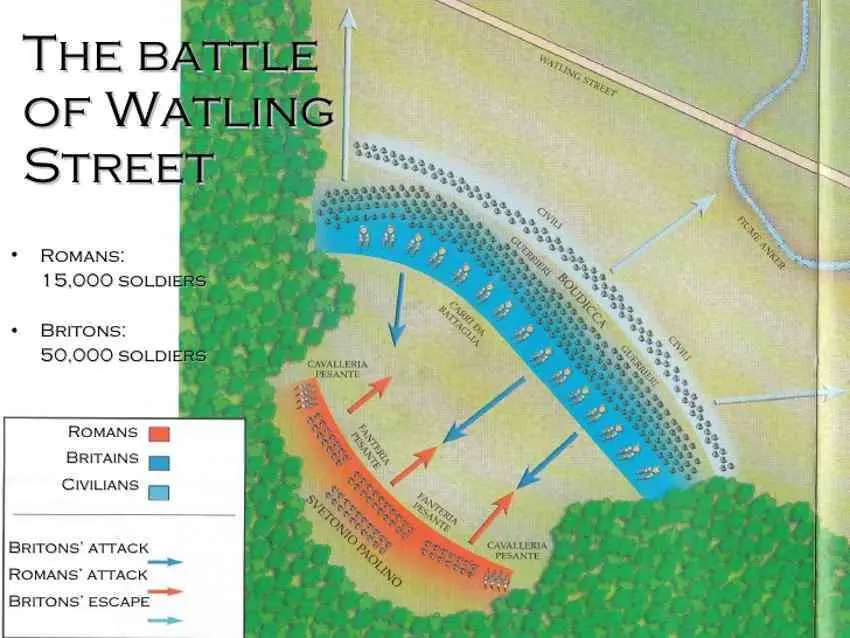
Paulinus concentrated forces and won a decisive battle. The surviving accounts emphasize his choice of ground and the rebels' difficulties in a constrained engagement, but neither account establishes a securely identified modern battlefield.
Command, forces and military problem
| Field | Dossier |
|---|---|
| Roman leadership | Suetonius Paulinus; provincial officials whose conduct and policies differed |
| Opposing or rival parties | Boudica and the Iceni and other participating communities |
| Forces and capabilities | A concentrated Roman force against a large, unevenly equipped revolt |
| Operational problem | Recover concentration after urban destruction and defeat the main force without a securely located field. |
Extended campaign study
The account below develops the operations and their interpretation. Reported numbers and reconstructed tactical details retain the uncertainties described in the dossier.
Boudica (60–61)
Prasutagus of the Iceni had died leaving half to his daughters and half to the emperor, the standard actuarial flattery of a client court; the procurator Catus Decianus foreclosed on the whole as on a defaulted estate. What followed at the royal seat — the widow Boudica flogged, the daughters raped, the nobility's lands called in, the Claudian temple at Camulodunum meanwhile taxing the province to deify its conqueror — assembled in one season every grievance the narrative's provincial wars have catalogued, and the rising, Iceni and Trinovantes together with the harvest left standing, fell first on the colony itself: Camulodunum, unwalled, its veterans' appeals answered by the procurator with two hundred men, held the temple podium two days and was erased — the archaeological signature, the burnt destruction horizon of 60/61, red between the Claudian and Flavian layers under three modern cities like a page of the annals fired into the ground. Paulinus, with XIV Gemina, detachments of XX, and auxilia — perhaps ten thousand — accepted battle where the ground was his: a defile fronting open plain, forest at the back, the site unlocated to this day though the search parties of scholarship have never disbanded. Boudica ended by poison in Tacitus's account, by illness in Dio's — the divergence itself the measure of how quickly the queen passed from intelligence into legend; Poenius Postumus, camp prefect of II Augusta, who had refused Paulinus's summons and kept his legion in the west, fell on his sword when the news came. The sequel was the more consequential battle: Paulinus's reprisals — fire and sword through the rebel cantons, the famine of the unsown year — against the new procurator Julius Classicianus, whose report to Rome argued that vengeance was not a fiscal policy; the freedman Polyclitus's commission of inquiry; and Paulinus's supersession under cover of a lost fleet detachment.
Tactical illustrations
Outcome and critical assessment
Result and caution: the revolt was suppressed, followed by debate over punishment and provincial management. Boudica's final battlefield remains unlocated; the Wroxeter identification used in some modern illustrations is not established. The enormous death totals and speeches in the literary accounts require separate treatment from the destruction evidence at affected towns.
Historical record: IR-VI, chapter 4; Tacitus, Annals 14.29–39; Dio, book 62 in later transmission.