Wars · V. The early Principate: conquest and provincial war
W054 The first Jewish revolt
Provincial tensions, local violence and conflict over Roman authority developed into a major revolt. The failure of Cestius Gallus' intervention gave the insurgency time and prestige. Vespasian's campaigns in Galilee and elsewhere reduced organized resistance; the Roman succession crisis then affected the timing and command of operations.
Titus besieged Jerusalem in AD 70. Factional conflict within the city, hunger, fortifications and Roman siege labor shaped the catastrophe, including the destruction of the Temple. Resistance continued at other sites; the date conventionally assigned to Masada varies between AD 73 and 74.
Command, forces and military problem
| Field | Dossier |
|---|---|
| Roman leadership | Vespasian, Titus and subsequent provincial commanders |
| Opposing or rival parties | Several Jewish factions, regional leaders and stronghold defenders |
| Forces and capabilities | Legions, auxiliaries, allied forces, siege equipment and urban resistance |
| Operational problem | Reduce successive centers of resistance and sustain siege operations amid factional and civilian catastrophe. |
Campaign geography and operational plates
The Levant: coast, inland cities and desert approaches
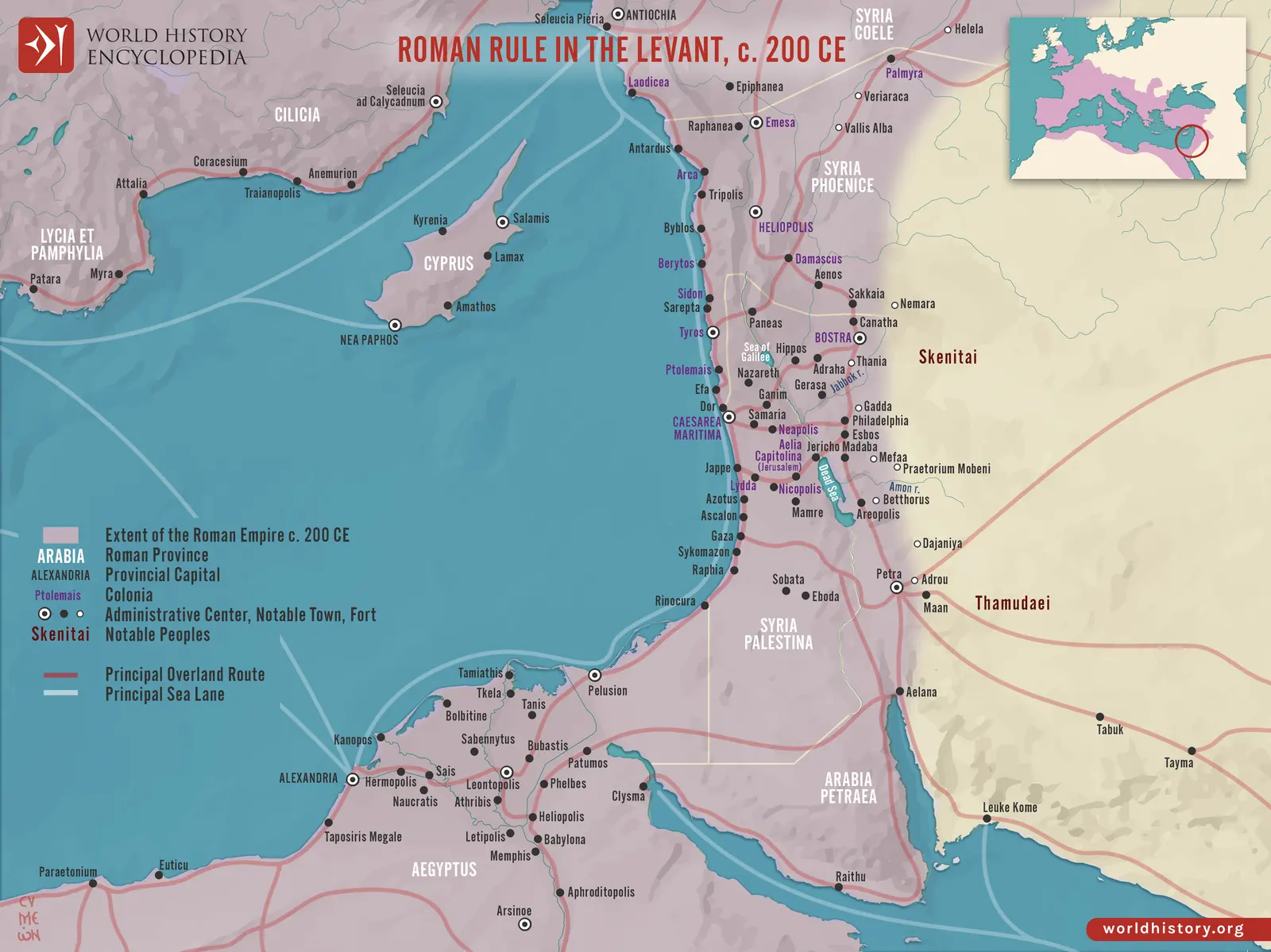
The coast and the inland routes through Syria, Judaea and Arabia connect theaters often discussed separately. Defended cities, ports and approaches to the Euphrates formed part of the military landscape. The map's later provincial organization is distinct from the political settings of the first Jewish revolt, the Bar Kokhba war and third-century eastern invasions.
The imperial army as a collection of military roles
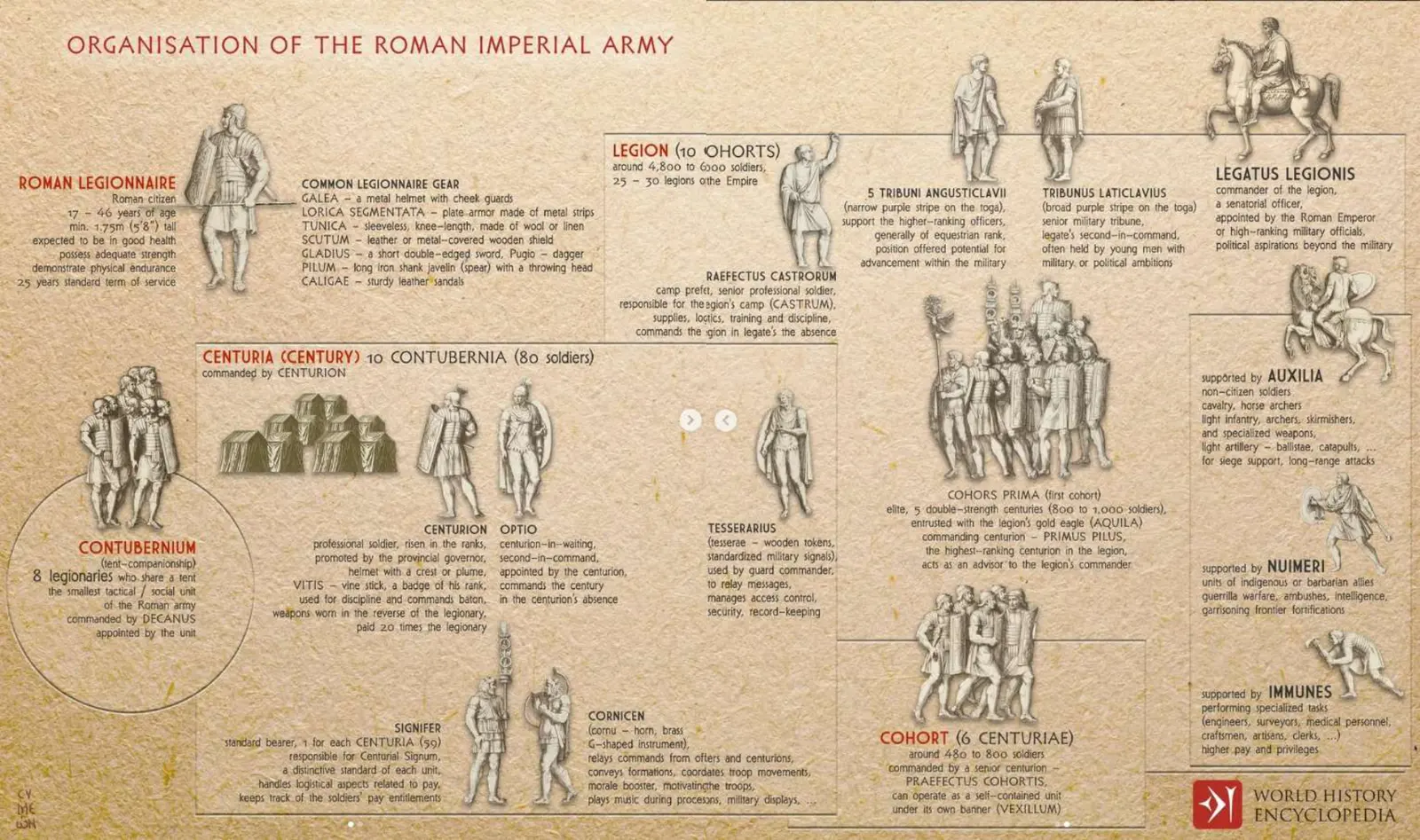
Legionary infantry was only one part of an army that also required auxiliary infantry, cavalry, specialists and command structures. The diagram helps interpret the range of capabilities involved in a provincial war and siege. Its institutional outline is not a roster of the army at Jerusalem, and actual unit strengths could differ substantially from a paper establishment. The figure combines institutional details that should not be assumed to belong to one uniform system throughout the empire; its height and service annotations are not universal recruitment rules.
Extended campaign study
The account below develops the operations and their interpretation. Reported numbers and reconstructed tactical details retain the uncertainties described in the dossier.
The Road to Revolt
The war that destroyed Jerusalem was the narrative's most heavily foretold catastrophe, a generation of warnings filed and ignored. Judaea after the client-kings was governed by procurators of the second administrative rank, from a coastal capital, with auxiliaries recruited from the province's own Greek cities — Samaritans and Caesareans policing Jews, an arrangement with the stability of a lit fuse; the province's grievances ran from the fiscal (the census that had raised Judas the Galilean's rising at the annexation itself) through the calendrical (Gaius's order, deflected only by his murder, to install his statue in the Temple) to the daily frictions of garrison and festival — a soldier's obscene gesture from the Antonia's roof at Passover had cost, under Cumanus, a stampede's worth of dead measured in tens of thousands by Josephus's arithmetic. The last procurator, Gessius Florus, converted friction to policy: when Caesarea's synagogue dispute was settled for cash and then betrayed, he took seventeen talents from the Temple treasury "for Caesar's needs," answered the mockery of Jerusalem's alms-baskets ("for poor Florus") with a punitive market-sack and the crucifixion of Jews of Roman equestrian rank, and departed leaving the city to choose, in the summer of 66, between submission proved by greeting his cohorts and the refusal the priests' faction then made irreversible: the captain of the Temple, Eleazar son of Ananias, ceased the daily sacrifice offered for Rome and the emperor. That liturgical act was the declaration of war. The Roman garrison of the upper city, surrendering on terms, was massacred to a man save its commander, who promised circumcision; the same hour, Josephus notes with his historian's ear for the age's symmetries, the Greeks of Caesarea slaughtered their Jewish neighbors — twenty thousand in a day — and the whole Levant followed, city by city, into reciprocal pogrom; and in the autumn Cestius Gallus, legate of Syria, came south with the Twelfth legion reinforced, took the suburbs, assaulted the Temple wall's approaches — and then, for reasons no source makes intelligible and his death the following year left forever unexplained, broke off and retreated. The withdrawal through the Beth-Horon defiles — the road where Judas Maccabaeus had destroyed Seleucid columns two centuries before, a resonance no one in either army missed — became a running massacre: five thousand three hundred infantry and near five hundred horse lost, the artillery train captured entire and mounted thereafter on Jerusalem's walls, and the column's eagle, by the tradition Suetonius transmits, taken — the Twelfth Fulminata's disgrace, which Titus would let the legion redeem at the same walls four years later.
Vespasian in Galilee (67–68), and the Historian at Jotapata
Nero, receiving the news in Greece between festival victories, appointed to the war the empire's available specialist in difficult terrain: Titus Flavius Vespasianus, the Britain veteran, out of favor for sleeping at the imperial recitals and therefore safely employable — with his son Titus as legate, three legions (V Macedonica, X Fretensis, XV Apollinaris), and the client-kings' auxiliaries: some sixty thousand men mustered at Ptolemais in the spring of 67 against a Galilee whose commander had spent the winter fortifying towns and drilling levies in the Roman manner he admired and describes.
The campaign was methodical erasure: Gabara stormed and burned; then Jotapata, the crag-fortress where Josephus himself took command of the defense, and where for forty-seven days the war's whole texture was rehearsed — the ramp raised and the wall raised faster atop it, ox-hides against the rams, boiling oil and the boiled-fenugreek stratagem greasing the assault-planks, the water rationed and the defenders' wrung garments hung dripping from the battlements in ostentatious waste, until a deserter sold the sentries' exhaustion and the dawn escalade took the town asleep; forty thousand dead across the siege by the account, the survivors enslaved. The commander's own survival became antiquity's most examined self-exculpation, because he wrote it: the cave with forty notables sworn to mutual death, Josephus's argued theology of surrender voted down, the lots drawn for the order of killing — by chance or by God's providence, his own phrasing, he drew last but one, and persuaded his final companion to live; then the surrender, and before Vespasian the prophecy that converted a prisoner into a client: that the general and his son would wear the purple, Nero's fall being at hand. Galilee was finished by winter — Taricheae's lake-battle staining Gennesaret red, the Gamala escarpment stormed twice with the town's population ending in the ravines, Gischala abandoned by night by the faction-chief John, who reached Jerusalem to become half its ruin; and through 68 Vespasian methodically shaved the country — Peraea, Idumaea, the coast, Jericho, Qumran's settlement destroyed in the passing (the community's library going into the cliff-caves against a return that never came: the Dead Sea Scrolls are, among all else, this campaign's archaeological shadow) — until Jerusalem stood alone; whereupon Nero died, and the war stopped for the empire's own, treated in the chapter following. Vespasian, proclaimed in 69, sailed for the grain-lever of Alexandria and left the city, now a three-cornered civil war of its own — John of Gischala against the priestly establishment he had destroyed with Zealot help and Idumaean knives, against Simon bar Giora let in from the countryside as a counter-tyrant — to consume its stores and its leadership for two full years while Rome consumed its own.
The Siege of Jerusalem (70)
Titus came up from the coast in the spring of 70, days before Passover, with four legions — the Twelfth brought back for its honor, the Fifth, Fifteenth, and Tenth, the last encamped on the Mount of Olives — against a city whose festival crowds the siege now sealed in: Josephus's figures, graded below, put the trapped multitude beyond a million; Tacitus's independent notice says six hundred thousand of every age and both sexes. The defense mounted perhaps twenty-five thousand fighters under commands that fused only when the rams touched stone: Simon on the walls of the upper and outer city, John holding the Temple mount and Antonia. The Antonia fell at the end of July; the daily sacrifice — maintained through everything — ceased on the seventeenth of Panemus for want of men and lambs; and on the eighth of the month Ab the assault on the Temple platform began. Titus's council on the sanctuary's fate is the war's great source-crux: Josephus stages a deliberate debate and a commander voting to spare; the rival tradition, preserved through Sulpicius Severus and argued by many to descend from Tacitus's lost books, has Titus ordering the destruction to cut Judaism and its Christian offshoot at the root. The upper city stood a month more behind Herod's towers until ramps broke it in September; the order then was raze — the tradition's tenth-legion plough passing over the Temple courts — save the three towers kept as a scale-marker for what the army had taken, and the western wall-stretch kept to shelter the garrison: the Tenth Fretensis, encamped in the ruin it had made, the city's population dead by the siege's own arithmetic or marching for the mines, the arenas, and the triumph.
Triumph and Masada (71–74)
The spoils endowed the dynasty's monuments — the Temple of Peace received the lampstand; the amphitheater the world calls the Colosseum rose, its rededicated inscription's ghost-letters read by modern scholarship as ex manubiis, from the spoils of war, this war; and the province received the settlement's fiscal signature: the two-drachma tax every Jew in the empire had paid to the Temple now assessed for Jupiter Capitolinus — the fiscus Judaicus, defeat renewed annually at the tax-office. Three fortresses held out past the fall; the last was Masada, Herod's table-mountain over the Dead Sea, held since 66 by the Sicarii under Eleazar ben Yair.
Outcome and critical assessment
Result and caution: Roman control was restored through killing, enslavement, displacement and a transformed political and religious landscape. Josephus participated, changed sides and wrote under Flavian patronage. His narrative is indispensable but cannot be treated as a neutral census of deaths or an unmediated record of every defender's motives.
Historical record: IR-VI, chapter 6; Josephus, Jewish War 2–7, especially books 5–6 for Jerusalem and book 7 for the remaining strongholds.