Wars · VII. The fourth-century empire
W077 The Gothic war and Adrianople
Battles and sieges
Adrianople 378 ADGothic groups crossing into the empire under pressure from events beyond the Danube encountered failed provisioning, exploitation and violence by Roman authorities. Revolt followed. Roman operations failed to contain the conflict, and Valens advanced before joining fully with the western forces expected from Gratian.
At Adrianople, the Roman army was defeated and Valens killed. The war continued: the defeat did not itself deliver Constantinople or every Balkan city to the victors. Subsequent operations and negotiation culminated in the settlement conventionally dated to AD 382 under Theodosius I.
Command, forces and military problem
| Field | Dossier |
|---|---|
| Roman leadership | Valens, Gratian and then Theodosius I with subordinate commanders |
| Opposing or rival parties | Fritigern and other Gothic and associated forces |
| Forces and capabilities | Imperial field armies, mobile opponents, cavalry and defended towns |
| Operational problem | Manage settlement and supply failure, then contain a revolt before seeking a durable accommodation. |
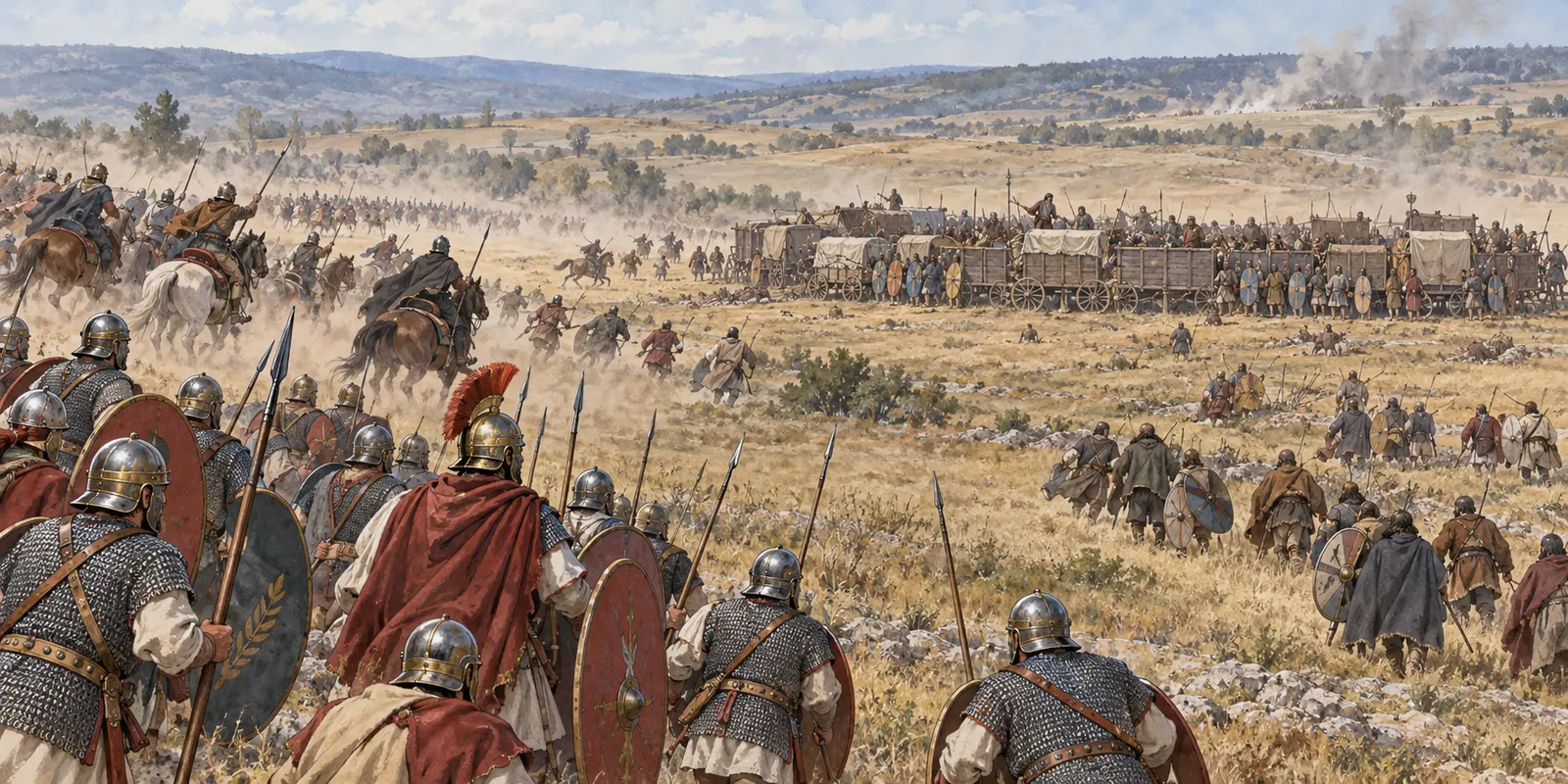
Campaign geography and operational plates
Thrace: the approaches to the capital
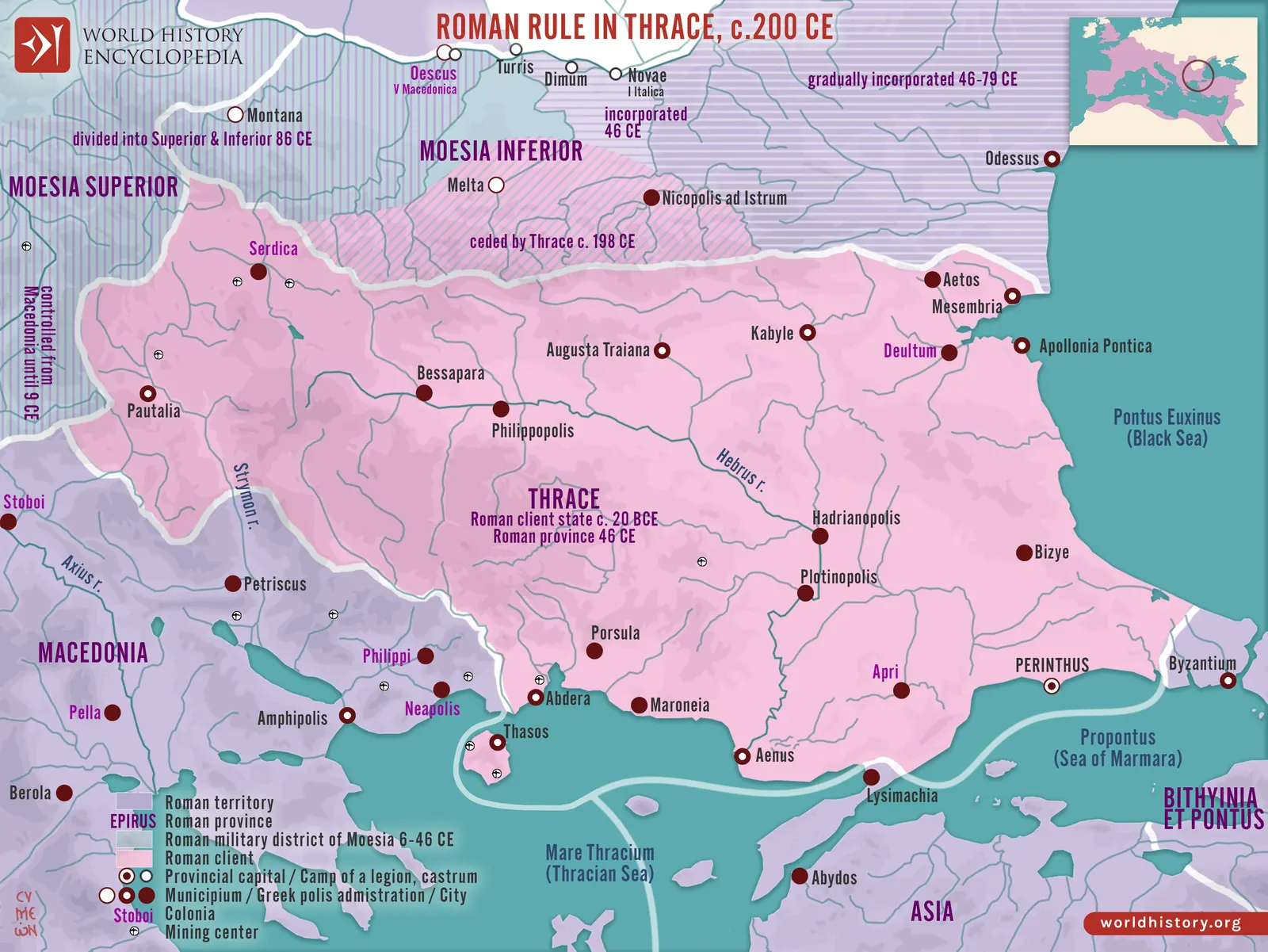
Adrianople and the road systems toward the Bosporus explain why invasions in Thrace posed a different problem from fighting on the far side of the Danube. The settlement network remained historically important, but the map does not reconstruct the defenses or exact administrative organization of AD 378, Attila's campaigns or the invasion of AD 559.
Adrianople: heat, delayed contact and the wagon enclosure
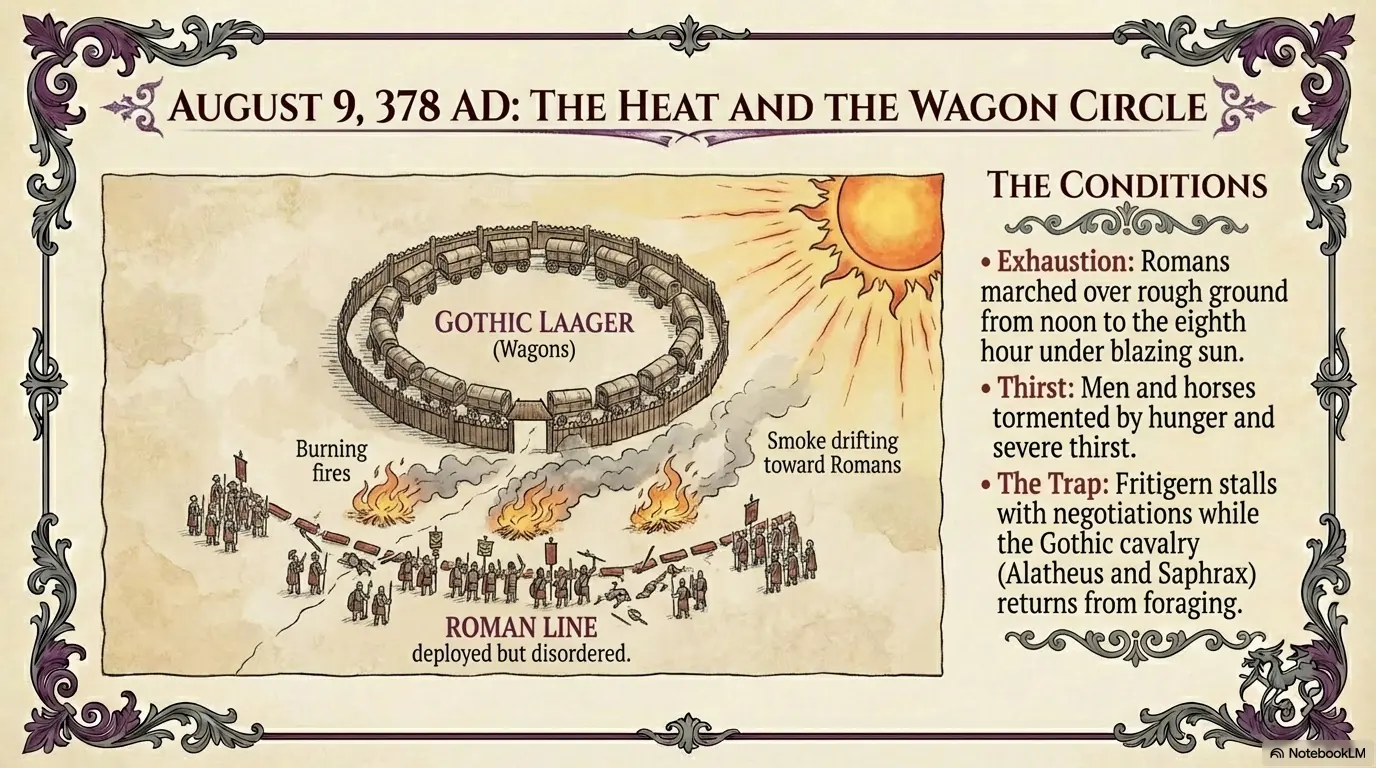
The diagram combines fatigue, smoke, negotiation and separated troops, showing why the encounter was not simply two intact lines advancing on command. Its spatial arrangement is explanatory. The dossier's uncertainty about the field and sequence remains in force, and the wagon enclosure should not be mistaken for a fully surveyed archaeological plan.
The Danube crossing: admission, transport and administrative failure
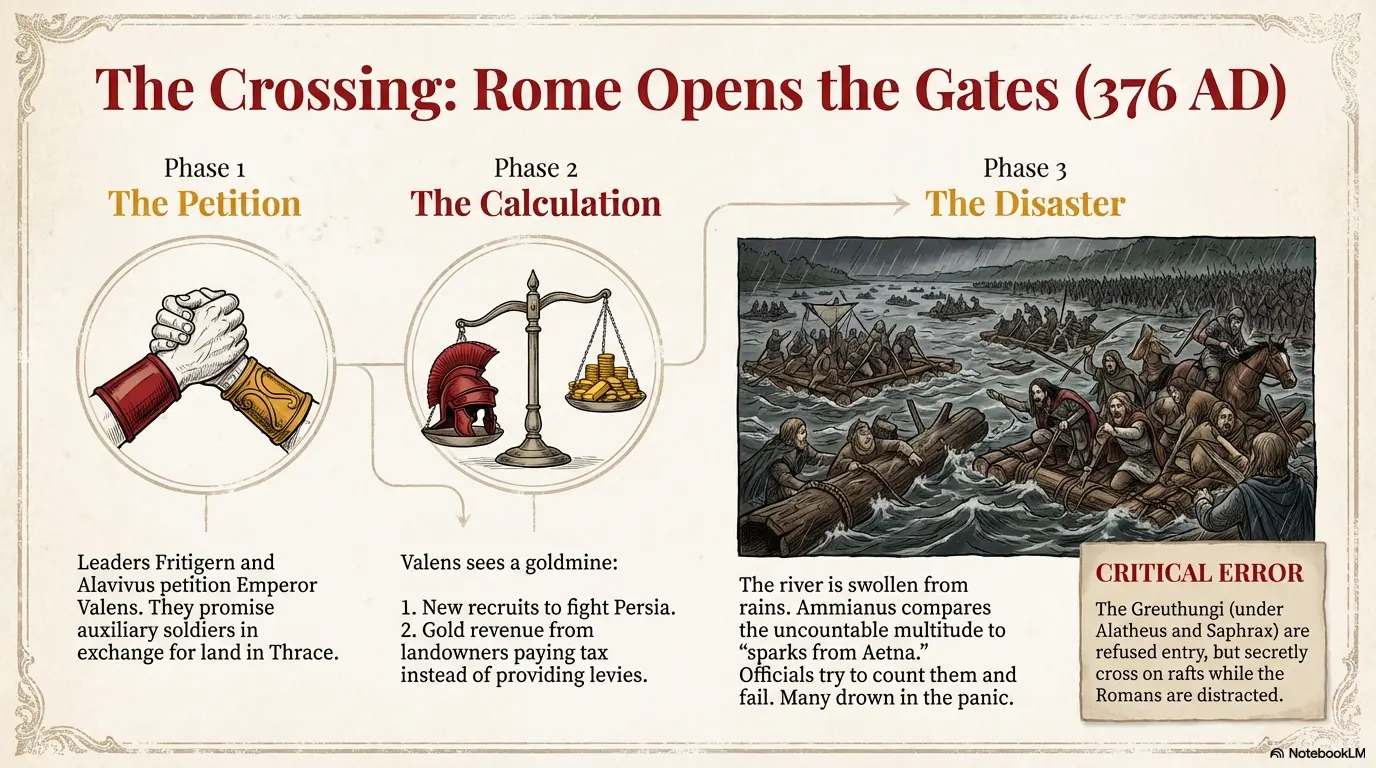
Transporting and feeding large groups was already an administrative and military operation before open revolt began. The figure connects admission policy to practical control on the river and the provision of necessities. It does not provide a reliable population count or demonstrate that every official acted from one shared purpose.
Adrianople: the arrival of Gothic and allied cavalry
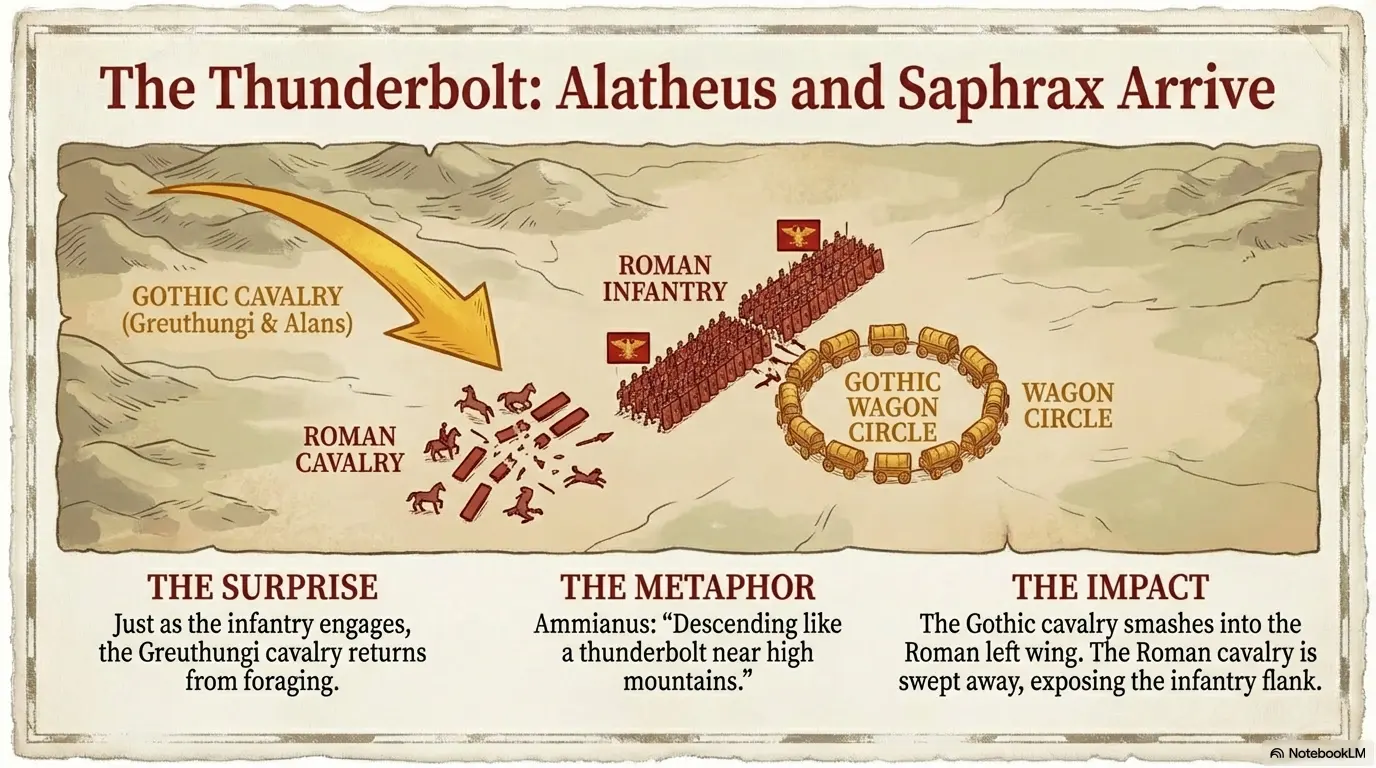
The return or arrival of a mobile force could change an encounter whose infantry were already committed. The figure helps separate that intervention from the initial approach to the wagon position. It does not identify an exact flank geometry, marching distance or minute of arrival, all of which remain less certain than the graphic's clean layout suggests.
Extended campaign study
The account below develops the operations and their interpretation. Reported numbers and reconstructed tactical details retain the uncertainties described in the dossier.
The Pannonian Brothers and the Fortified Peace (364–375)
The election that followed Jovian's brief reign (he died in his sleep on the road home, of charcoal fumes or surfeit, eight months after signing the peace) produced the last effective military dynasty of the undivided empire: Valentinian I, a Pannonian officer of harsh competence, who took the West and gave the East to his brother Valens — the division of 364 at Naissus, the field armies and their commanders partitioned by list, was meant as administrative and proved, in retrospect, the empire's permanent parting. Valentinian's eleven years were the frontier's last great maintenance overhaul, and Ammianus, who admired the work and feared the man, records both: the Alamannic war fought to a decision at Solicinium (368) and settled by fortification and assassination alike; the Rhine-Danube line rebuilt in the reign's signature program — the burgi, watchtowers, and bridgehead-forts whose building inscriptions cluster in the 360s-370s more densely than any period since Hadrian, the emperor himself dying of apoplexy in 375 while berating Quadic envoys who had complained of a fort built on their bank; Britain restored by the elder Theodosius after the "barbarian conspiracy" of 367 — Picts, Scots, and Saxons in concert with mutinied frontier-scouts, the diocese overrun and re-secured in two campaigning seasons; Africa's Firmus revolt broken by the same general, whose reward, in the age's grammar, was execution in a court intrigue at Carthage in 375/6.
The Crossing and the Catastrophe (376–378)
The crisis began as a humanitarian appeal. Valens, at Antioch with his army committed against Persia, granted it — a controlled crossing of the Tervingi under Fritigern, the Greuthungi refused — and the operation's execution converted policy into catastrophe: the crossing barely controlled (Ammianus's image is Vergil's leaves and sands), the disarmament corrupted away, and the provisioning plundered by the very commanders responsible — the count Lupicinus selling the refugees dog-flesh at the price of a child per dog, the detail the historian records as the war's true cause; when Lupicinus then bungled an assassination of the Gothic leadership at a banquet in Marcianople (377), the people he had starved became the army he had armed, and Thrace burned for two years — the refused Greuthungi crossing unopposed, Gothic slaves and miners guiding the columns to the hidden granaries, Roman field forces fighting the drawn nightmare at Ad Salices, the passes lost, Hun and Alan horse hired into the Gothic mass. The reckoning came on 9 August 378 outside ADRIANOPLE. The battle Ammianus reconstructs is Cannae's shape reassembled by accident: the Roman cavalry of the left committed piecemeal and shattered by the sudden return of the Gothic horse — Alatheus and Saphrax's Greuthungian and Alan cavalry, absent foraging, arriving onto the field's flank "like a thunderbolt" at the precise fatal minute — the infantry mass compressed by its own numbers against the laager until, in the historian's terrible phrase, the field was so packed the dead could not fall; the rout at dusk; two-thirds of the eastern field army destroyed, thirty-five tribunes, the magistri Traianus and Sebastianus, and the emperor — dead in the press by one account, burned alive by another in a farmhouse his guards defended too well, his body never found.
Outcome and critical assessment
Result and caution: a major Roman military disaster followed by an accommodation. The treaty's precise provisions are not preserved in a complete document. Describing it as a fully sovereign "state within a state" converts a modern interpretation into an unverified treaty clause. "Visigoth" is also a retrospective label when applied indiscriminately to all participants in AD 378.
Historical record: Ammianus, book 31; IR-VIII, chapter 3; later sources for the settlement require separate evaluation because Ammianus ends in AD 378.