Figures · Reform rivalry and the Republic in civil war
RF-034 Vercingetorix
Life and career
His position among the Arverni provided social standing but did not give him automatic authority over all the communities that joined the revolt. Leadership required persuasion, coercion, hostages, and repeated negotiation among peoples with different interests. The argument over whether to destroy Avaricum reveals the tension between an overarching supply strategy and local attachment to a major settlement.
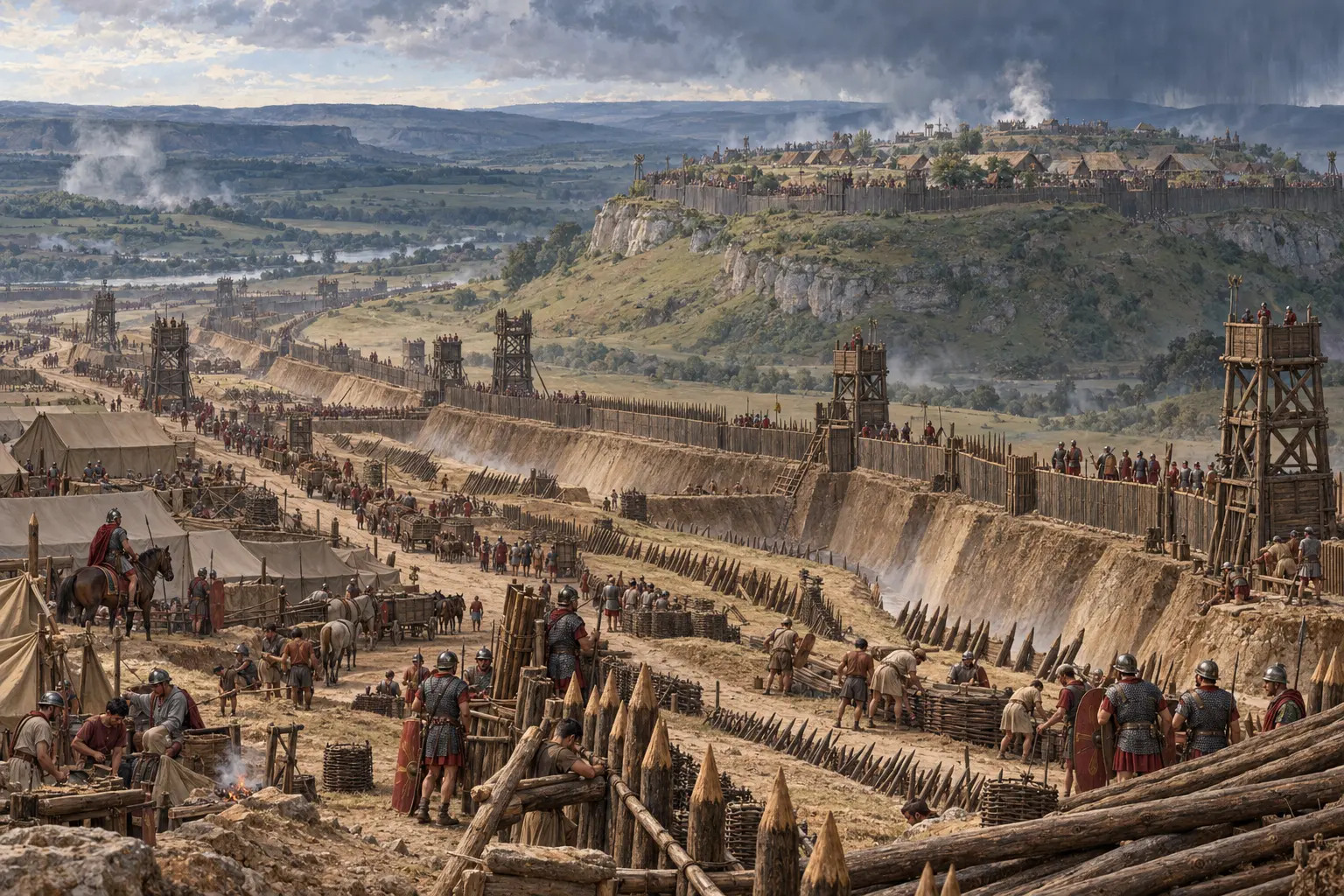
Vercingetorix coordinated a major uprising against Caesar and pursued a strategy involving supply denial, destruction of settlements, and coalition warfare. His success at Gergovia was followed by confinement at Alesia, where Roman siege works faced both the defenders and a relief army. His surrender made him a captive symbol of Caesar's conquest; he was later killed after Caesar's triumph. His archive should preserve the difficulty of coalition leadership rather than reduce the war to a duel between two men.
Leadership and historical significance
He forced Caesar to respond to coordinated resistance rather than a sequence of isolated enemies. Gergovia demonstrated that Roman discipline and leadership did not guarantee success against a defended position. At Alesia, the problem became the timing and coordination of relief under extreme pressure. His legacy as a national figure developed much later; the historical dossier should preserve the coalition's particular institutions and fractures rather than project a modern unified France into the first century BCE.
Landmarks
- 52 BCE — revolt, Gergovia, and Alesia.
- 46 BCE — display in triumph and execution.
Historical uncertainty
Caesar is the principal surviving narrative witness. His speeches for Gallic leaders, intentions attributed to them, and numerical claims require critical reading.
Connected dossiers: Gaius Julius Caesar, Titus Labienus.