Figures · Reform rivalry and the Republic in civil war
RF-032 Gaius Julius Caesar
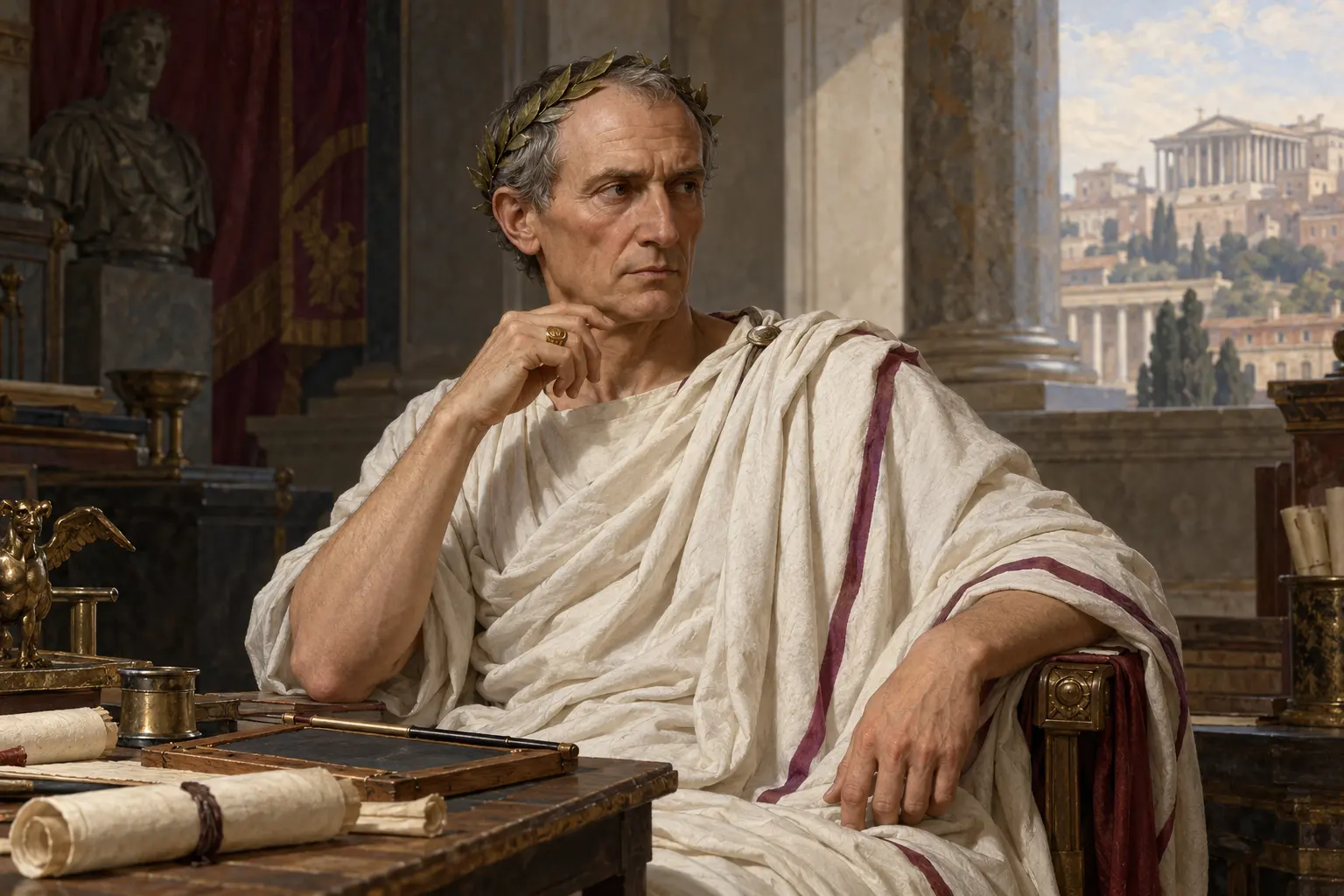
Life and career
Caesar's patrician ancestry supplied prestige without guaranteeing the resources needed for advancement. Marriage connections, priesthood, debt, popular legislation, and alliance with Pompey and Crassus formed the political basis for his major command. Gaul then supplied wealth, captives, military reputation, and an experienced force personally associated with his leadership.
Caesar turned a provincial command into conquest in Gaul and a military base for civil war. Victory over Pompey and successive opponents allowed him to concentrate offices, honors, patronage, and legislative initiative in his own hands. Reforms to the calendar and political administration coexisted with the erosion of competition for supreme power. His assassination on the Ides of March removed the dictator without restoring a stable Republican settlement.
Leadership and historical significance
His operations combined speed, engineering, intimidation, siege work, diplomacy, and opportunistic concentration. These methods had devastating consequences for communities subjected to massacre, enslavement, tribute, and repeated mobilization. In civil war he cultivated clemency as a political resource while retaining overwhelming coercive power. His reforms changed administration and civic life, but no durable agreement settled the status of a perpetual dictator. His importance lies in both effective command and the failure to reconcile concentrated personal power with the ambitions and expectations of the governing elite.
Landmarks
- 52 BCE — Alesia.
- 49 BCE — invasion of Italy.
- 48 BCE — Pharsalus.
- 44 BCE — perpetual dictatorship and assassination.
Historical uncertainty
He was not an emperor in the later Augustan constitutional sense. His commentaries are a participant's defense of command; the Alexandrian, African, and Spanish wars are not automatically his own compositions.
Connected dossiers: Gnaeus Pompeius Magnus, Titus Labienus, Vercingetorix, Marcus Junius Brutus, Augustus.