Figures · Conquest and transformation of the Republic
RF-010 Hannibal Barca
Life and career
Hannibal inherited a military and political position built by Hamilcar and Hasdrubal in Iberia. His army drew on different languages, fighting traditions, and relationships of service. Maintaining its cohesion over years in Italy required rewards, leadership, and continuing access to supplies. The Alpine crossing transferred this coalition into a theater where Roman allies, rather than the city alone, were the central political target.
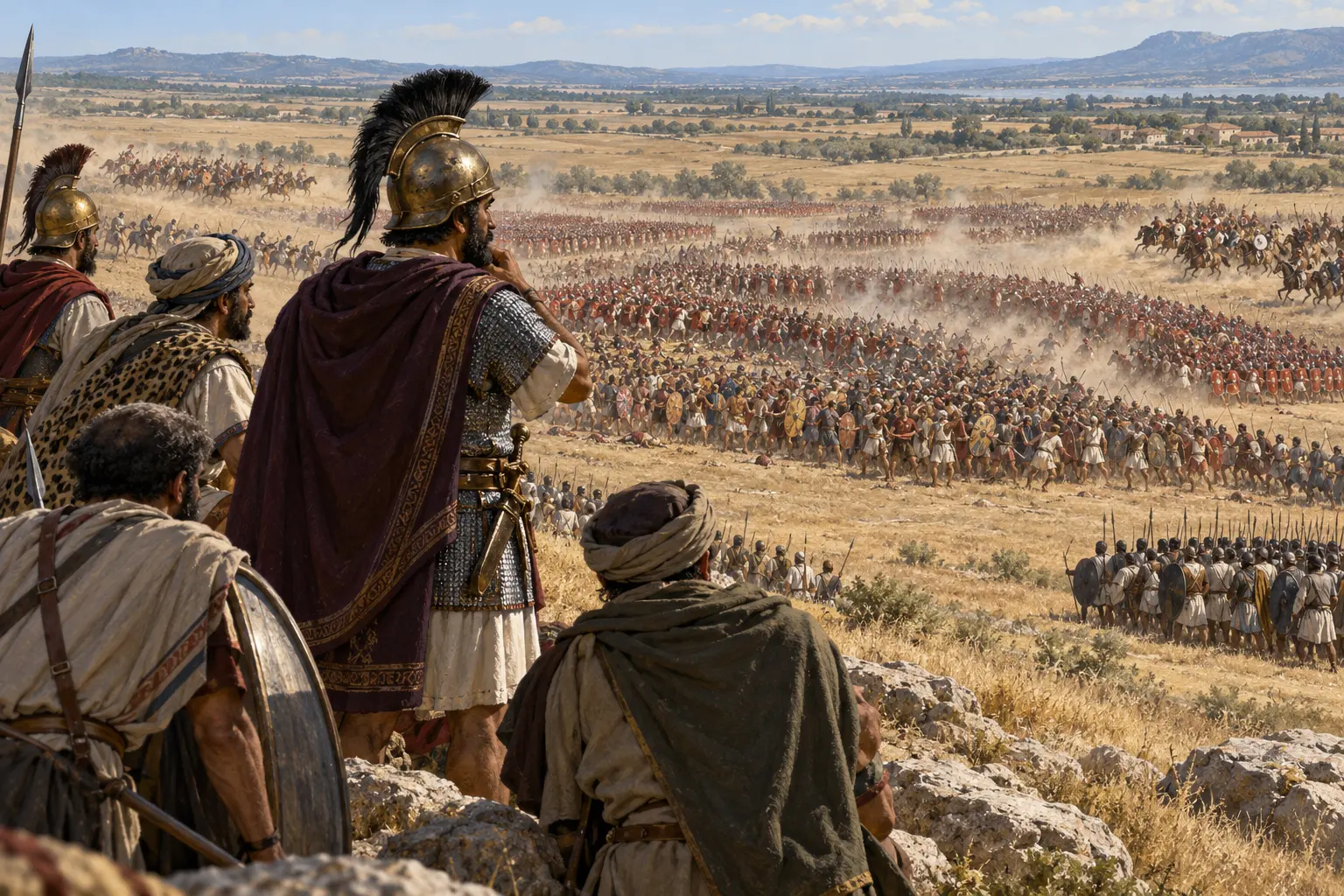
Hannibal carried the Second Punic War into Italy and repeatedly defeated Roman armies. His greatest successes combined reconnaissance, terrain, deception, and coordination of varied forces. Yet his victories did not dismantle the entire Roman alliance system or deliver a durable political settlement. Recalled to Africa, he lost to Scipio at Zama. His later civic career and exile show that his significance extended beyond battlefield command into Carthaginian reform and Mediterranean diplomacy.
Leadership and historical significance
His battlefield method varied: river crossings and concealment at Trebia, constricted movement at Trasimene, and coordinated envelopment at Cannae. Treating all three as one fixed trick obscures his ability to read conditions. His central limitation was the conversion of destruction into a settlement that severed enough of Rome's alliance network. The later African campaign confronted a different balance of cavalry, allies, and strategic initiative. Zama should therefore be understood as the culmination of a changed war, not the sudden exposure of an otherwise overrated commander.
Landmarks
- 218 BCE — Alpine crossing and Trebia.
- 217 BCE — Trasimene.
- 216 BCE — Cannae.
- 202 BCE — Zama.
Historical uncertainty
Polybius and Livy transmit a largely Greek and Roman literary record. Precise troop and casualty figures, and the exact Alpine route, remain matters for separate source comparison.
Connected dossiers: Publius Cornelius Scipio Africanus, Quintus Fabius Maximus, Marcus Claudius Marcellus.