Provinces · Egypt and Roman Africa
RP-46 Africa Vetus, Africa Nova, and Africa Proconsularis
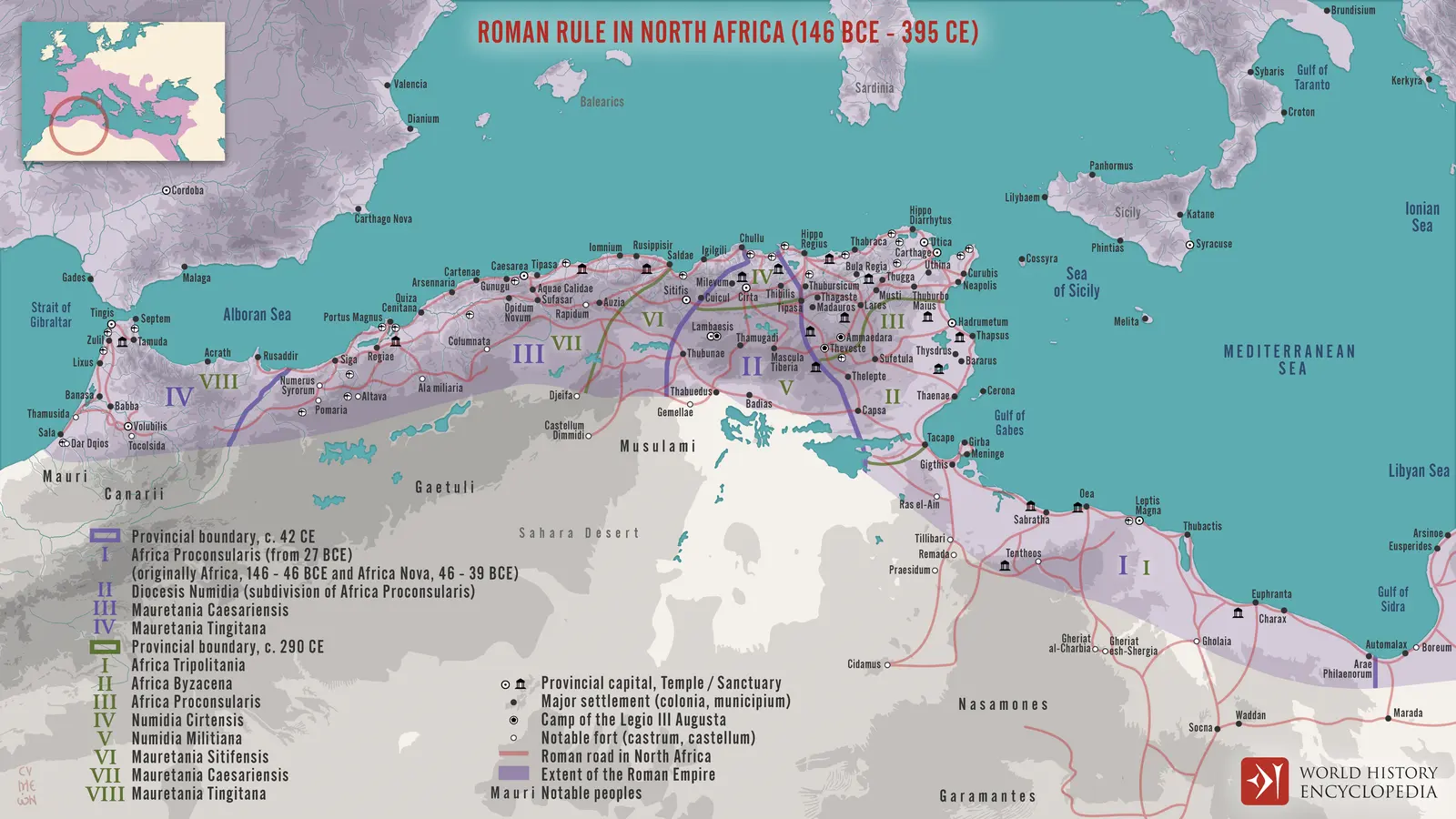
The Carthaginian inheritance and the first province
Roman Africa began in the destruction of a major rival. Carthage’s fall in 146 BCE brought devastation and a new provincial claim over part of its former territory. The region’s Punic towns, agricultural knowledge, commercial relationships, and rural communities did not all disappear with the city. Utica’s early administrative role reflected the postwar political settlement and its relationship with Rome.
The province initially occupied only part of the wider North African world. Numidian kingdoms remained important neighbours and allies, and Roman intervention beyond the provincial boundary did not automatically annex every territory involved. Africa’s later expansion must therefore be separated from the original Carthaginian acquisition.
Africa Vetus and Africa Nova
The old province acquired the distinguishing name Vetus as Caesar’s victory in 46 BCE added much of Juba I’s kingdom as Africa Nova. The new jurisdiction emerged from Roman civil war and the defeat of a regional monarchy. Its territory, official arrangements, and relationships with surviving local powers differed from those of the older province.
Subsequent combinations and reorganizations created the large Augustan public province. These changes brought together districts with different conquest histories and different degrees of urban development. The later title Africa Proconsularis expressed the governor’s rank and imperial arrangement, not one single moment at which all Roman Africa was acquired.
Carthage reborn
The refoundation of Carthage created a major Roman colony and, eventually, one of the largest cities of the Latin-speaking empire. Its harbour connections, administrative role, productive hinterland, workshops, and public institutions supported exceptional prominence. Baths, theatres, civic buildings, and later churches gave monumental form to a society sustained by regional production and maritime exchange.
Other cities retained strong identities. Hadrumetum, Thugga, Thysdrus, Bulla Regia, Sufetula, and many smaller centres possessed different civic statuses and histories. Urban density depended on the countryside, where estates, villages, tenants, workers, and local elites produced the resources that supported public life.
Grain, oil, and the agricultural landscape
African agriculture supplied local consumers and distant markets. Cereals and olive oil were especially important, but livestock, vines, pottery, fish products, and other activities broadened the economy. Production changed over time with investment, landholding, demand, transport, and environmental conditions.
Large estates could belong to imperial, senatorial, or other wealthy owners. Tenants and smaller cultivators operated within systems of rent, labour, and fiscal obligation. Imperial estate regulations and local agreements could define rights to cultivate neglected land or plant new crops, but actual bargaining power remained unequal. Agricultural prosperity cannot be separated from the organization and burden of labour.
African ceramics and amphorae connected workshops and farms to a wide Mediterranean market. Ports, roads, storage, merchants, and shipping contractors made the exchange possible. The province’s role in supplying Rome gave it direct political significance during civil war and later imperial crisis.
Society, language, and religion
Latin public culture flourished alongside Punic language and other regional traditions. Municipal advancement gave local elites routes into imperial society without erasing their African origins. Writers, officials, soldiers, landowners, and religious leaders connected provincial communities to Rome and other regions.
Traditional cults included Saturn and Caelestis in forms shaped by both local and Roman histories. Christianity developed strongly, producing influential thinkers, martyrs’ cults, bishops, and churches. Persecution, disputes over ecclesiastical authority, and the Donatist controversy became major features of late African life. Religious division intersected with local rivalries and social tensions without being reducible to one simple class conflict.
Byzacena and Tripolitania
Late subdivision separated the productive central-southern Tunisian zone of Byzacena and the coastal-hinterland system of Tripolitania. The remaining proconsular province retained Carthage and its northern core. Each descendant had different cities, frontier concerns, and economic relationships, while all continued to participate in Mediterranean exchange.
Tripolitania’s Oea, Sabratha, and Leptis Magna linked ports to agricultural and desert-edge hinterlands. Byzacena’s towns and estates supported a dense productive landscape. Their separation made administrative distinctions within regions that had long been connected by the larger African province.
Vandals and Eastern Roman recovery
The Vandal crossing into Africa in 429 began a conquest that culminated in Carthage’s capture in 439. Losing the city and its revenues profoundly weakened the western imperial state. Vandal government used much of the existing urban, agricultural, and administrative framework, while conflicts over property, religion, and royal power altered provincial society.
Justinian’s expedition recovered Carthage in 533 and destroyed the Vandal kingdom by 534. The new imperial government faced military resistance, local powers, fiscal demands, and continuing religious disagreements. Recovery restored an important Mediterranean base but did not recreate all earlier Roman frontiers. Africa’s provincial history continued through the prefecture and later exarchate until seventh-century conquest ended imperial rule at Carthage in 698.
Settlement geography
| Ancient place | Modern location |
|---|---|
| Carthago | Carthage, near Tunis, Tunisia |
| Utica | Near Bizerte, Tunisia |
| Hadrumetum | Sousse, Tunisia |
| Thapsus | Ras Dimass, Tunisia |
| Leptis Minor | Lamta, Tunisia |
| Thysdrus | El Djem, Tunisia |
| Thugga | Dougga, Tunisia |
| Bulla Regia | Near Jendouba, Tunisia |
| Thuburbo Maius | Near El Fahs, Tunisia |
| Sicca Veneria | El Kef, Tunisia |
| Mactaris | Maktar, Tunisia |
| Sufetula | Sbeitla, Tunisia |
| Hippo Diarrhytus | Bizerte, Tunisia |
| Gigthis | Near Boughrara, Tunisia |
| Hippo Regius | Annaba, Algeria |
| Theveste | Tébessa, Algeria |
| Ammaedara | Haïdra, Tunisia |
| Leptis Magna | Near Khoms, Libya |
| Oea | Tripoli, Libya |
| Sabratha | Sabratha, Libya |