Provinces · Egypt and Roman Africa
RP-45 Aegyptus
The Nile country Rome inherited
Egypt’s Roman history began with the conquest of an exceptionally old and organized society. The Nile flood, canals, embankments, fields, villages, temples, estates, and cities formed an interdependent landscape. Greek royal government had added new institutions and communities to older Egyptian structures, creating the Ptolemaic kingdom that Octavian conquered in 30 BCE.
Alexandria’s position connected the Nile economy to Mediterranean shipping. The city contained royal and intellectual traditions, Greek civic institutions, Jewish communities, harbours, workshops, and a politically active population. It was not simply a warehouse through which anonymous Egyptian grain passed to Rome. Inland towns and villages possessed their own complex social, fiscal, and religious lives.
Prefect, nomes, and local government
The equestrian prefect represented the emperor and combined major civil and military responsibilities. Restrictions on senatorial entry reflected Egypt’s political sensitivity and its importance to imperial security. Exceptional arrangements did not make every farm and house the private property of the emperor.
Government operated through regional districts, officials, local elites, tax collectors, record-keeping, and village institutions. The nome system and inherited administrative practices continued in adapted forms. Greek was prominent in administration, while Egyptian language and traditions remained important in society and religion. Later Coptic developed within this long multilingual history.
Taxes could be assessed in grain or money, and obligations extended beyond one simple levy. Transport, public service, labour requirements, customs, and local charges affected different groups. The success of government depended on measuring production, maintaining records, and extracting resources without wholly undermining cultivation. In practice, corruption, arrears, inequality, and environmental variation made that balance difficult.
Agriculture, water, and labour
The annual flood shaped the agricultural cycle, but productive land depended upon human work in channels, banks, irrigation devices, and local water management. Cereals were central, alongside vines, olives in suitable districts, vegetables, fibres, livestock, and other crops. The Fayum illustrates both intensive cultivation and the long-term vulnerability of local systems to water and settlement change.
Farmers, tenants, estate managers, wage labourers, enslaved people, officials, and landowners occupied different positions within this economy. Contracts, leases, disputes, and household arrangements show lives far more varied than a single model of peasants compelled to feed Rome. Women could own property and participate in legal-economic transactions within the constraints of their social setting.
Mediterranean grain and Red Sea trade
Grain shipments connected Nile cultivation, collection, river transport, storage, Alexandrian ports, sea passage, and public consumption. Each stage involved labour, risk, accounting, ships, and institutional arrangements. Rome’s dependence on Egyptian supply gave the province strategic importance, though other provinces also contributed to food systems.
The desert roads from Coptos to Red Sea ports connected the Nile to Indian Ocean exchange. Berenice and Myos Hormos supported merchants, sailors, workers, officials, and military protection. Water stations and knowledge of the desert were essential. Goods arriving from Arabia, eastern Africa, and India passed through networks of intermediaries and varied political environments; this commerce did not imply Roman territorial rule over its distant trading partners.
Quarries and mines in the eastern desert supplied stone and minerals under demanding labour conditions. Their roads and stations linked extraction to the Nile and imperial construction. Egypt’s economy thus combined fertile river agriculture with costly operations in arid landscapes.
Cities, communities, and conflict
Alexandria’s population experienced recurring tensions involving civic privilege, imperial authority, and relations among communities. Violent conflict could arise from local disputes and wider political crises. Inland metropolitan centres, Greek cities, and villages stood within different legal and social frameworks; Egypt’s hierarchy of status changed over time rather than remaining fixed from the conquest onward.
Roman military installations protected key positions and supported government. Revolts and imperial civil wars could turn the province’s resources into political weapons. The uprising associated with the Boukoloi in the second century, third-century upheaval, and Palmyrene control in the 270s reveal episodes of serious disruption within the longer history of Roman rule.
Temples and Christian transformation
Egyptian temples continued as religious, economic, and cultural institutions under Roman emperors. Imperial names and imagery entered traditional monumental forms, while local priests maintained rituals and learning. Greek religious traditions, Serapis, Isis, Jewish communities, and other cults coexisted within the province’s varied society.
Christianity developed through towns, villages, monasteries, and intellectual centres. Alexandria became a major theological and episcopal seat, while Egyptian monasticism acquired influence across the Christian world. Religious change involved competing authorities, doctrinal conflicts, imperial intervention, and the reassignment of sacred spaces. The closure or transformation of temples did not occur everywhere at once.
Disputes over Christological doctrine and the authority of Alexandrian bishops shaped late political relationships. They cannot be reduced to a simple division between all Egyptians and all imperial officials. Local, social, linguistic, and theological differences crossed that imagined line.
The smaller provinces and the loss of Roman Egypt
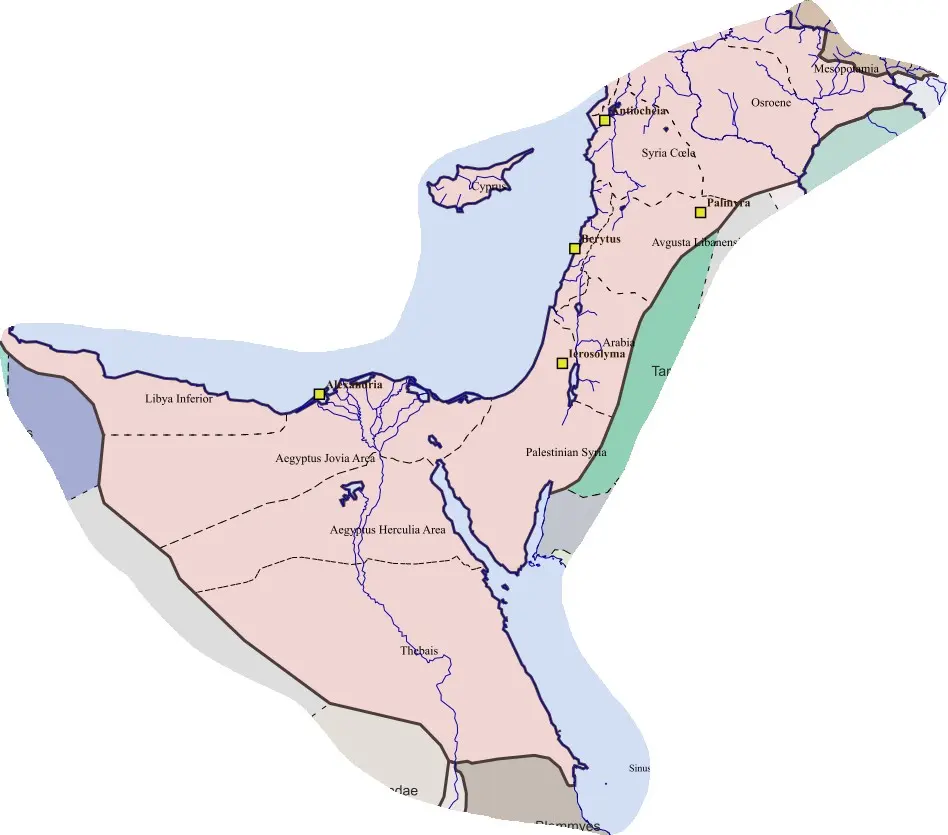
Late reorganization separated Aegyptus, Augustamnica, Arcadia, and Thebais, followed by further subdivisions. The larger Egyptian diocese included Libyan territories, demonstrating that the Nile country and its administrative grouping were not identical. Civil, fiscal, military, and ecclesiastical hierarchies overlapped in increasingly complex ways.
Persian conquest in 619 interrupted Roman government and the established supply relationships. Recovery under Heraclius was followed quickly by Arab invasion and the conquest of 639–642. The old imperial provincial system ended, but villages, farming, languages, churches, monasteries, and much everyday social life continued. Egypt’s Roman centuries left an enduring administrative, religious, and economic inheritance within a society far older than Rome itself.
Settlement geography
| Ancient place | Modern location |
|---|---|
| Alexandria | Alexandria, Egypt |
| Nicopolis | Eastern Alexandria, Egypt |
| Canopus | Abu Qir, Egypt |
| Pelusium | Tell el-Farama, Egypt |
| Naucratis | Near Kom Gieif, Egypt |
| Babylon | Old Cairo, Egypt |
| Memphis | Mit Rahina, Egypt |
| Arsinoe | Faiyum, Egypt |
| Karanis | Kom Aushim, Egypt |
| Oxyrhynchus | El-Bahnasa, Egypt |
| Hermopolis Magna | El-Ashmunein, Egypt |
| Lycopolis | Asyut, Egypt |
| Ptolemais Hermiou | El-Mansha, Egypt |
| Tentyris | Dendera, Egypt |
| Coptos | Qift, Egypt |
| Thebae | Luxor, Egypt |
| Syene | Aswan, Egypt |
| Philae | Near Aswan, Egypt |
| Myos Hormos | Quseir al-Qadim, Egypt |
| Berenice | Near Ras Banas, Egypt |