Provinces · Egypt and Roman Africa
RP-49 Mauretania Tingitana
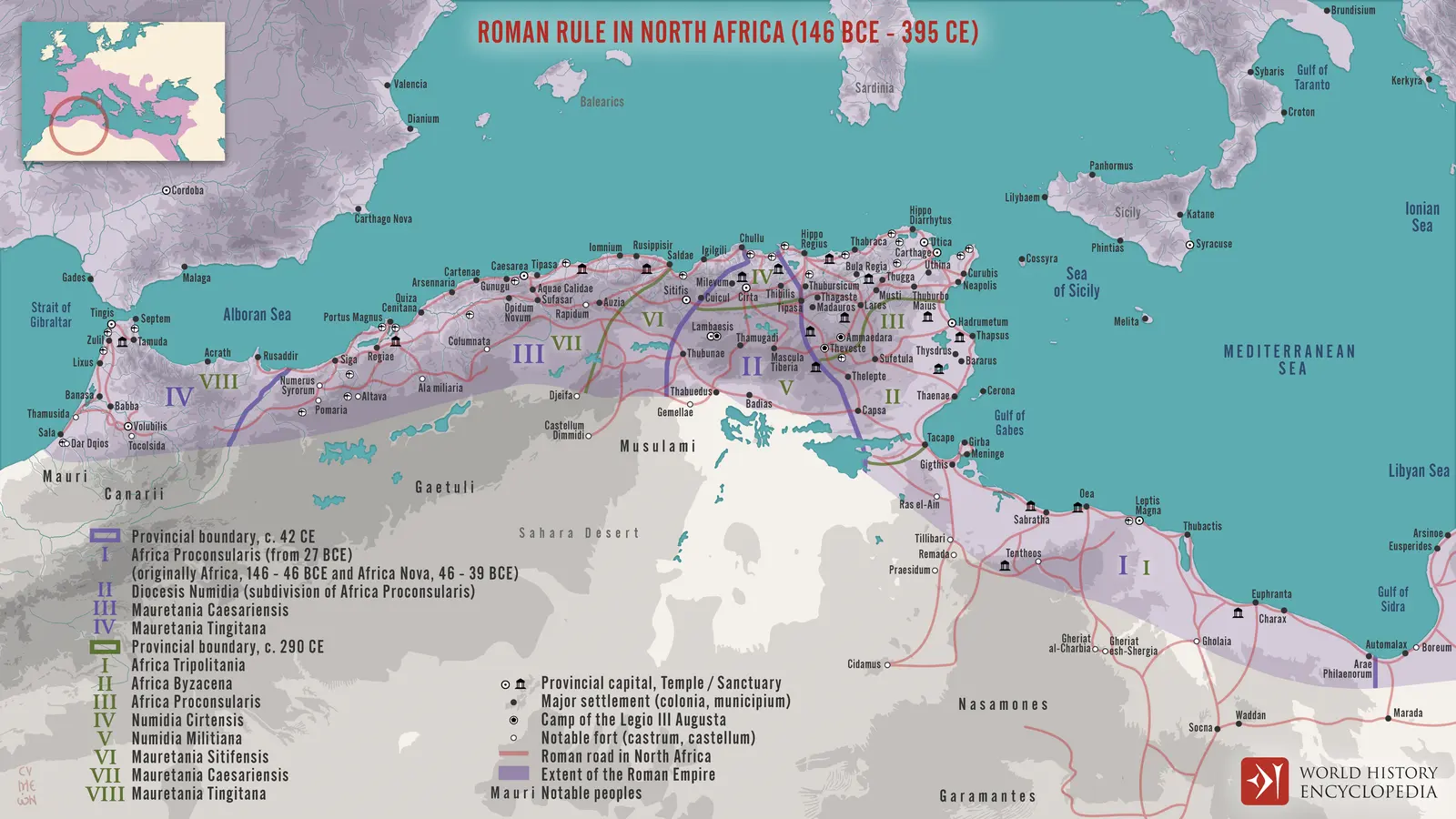
The Atlantic-facing Mauretania
Tingitana faced the Atlantic and the Strait of Gibraltar, with mountain and inland districts connected to coastal towns through routes of varying difficulty. Tingis anchored crossings to Hispania. Volubilis occupied a productive inland setting, while Lixus, Banasa, and Sala belonged to different coastal, estuarine, and agricultural environments.
The province inherited royal relationships and earlier Roman colonies. Direct annexation did not introduce the first Roman settlers or the first Mediterranean exchange. It changed the sovereign and institutional framework through which established towns and neighbouring communities dealt with imperial power.
Government, military service, and local elites
An equestrian governor managed a province whose security depended heavily on auxiliaries, roads, fortified positions, and relationships with local leaders. Communities beyond the most consistently administered territory were not all permanent enemies. Negotiation, citizenship grants, service, and patronage formed part of the political landscape.
Volubilis’s public life illustrates the advancement of local elites within Roman institutions. Civic honours, benefaction, family networks, and imperial grants connected the town to wider political structures. Such advancement could coexist with the survival of regional languages and traditions and with unequal power in the countryside.
Fields, presses, and maritime exchange
Olive cultivation and processing were important in productive inland districts. Farming, livestock, fish-salting, local crafts, and trade contributed elsewhere. Roads and short maritime crossings connected these activities to southern Spain and wider Mediterranean markets. The province’s economy was therefore oriented across the strait as well as along the African shore.
The towns’ public buildings reveal prosperity among selected groups and periods. They do not establish that every rural household benefited equally or that agricultural production was stable across all centuries. Water, security, landholding, labour, and access to markets shaped local fortunes.
Religious traditions and cultural identity
Roman civic gods, imperial cult, local divine traditions, and religious practices carried by migrants existed within the province. Christianity became established in the late imperial period, although the surviving evidence is uneven across towns and rural districts. Cultural integration operated through several institutions and did not require all inhabitants to adopt one language or identity.
The distinction between Romans and Mauri could express political perspective rather than a simple division between two biologically or culturally separate populations. Individuals and communities moved between military, civic, and regional networks. Provincial identity was layered and historically changeable.
Contraction and the late Hispanic connection
Withdrawal from parts of the southern and inland provincial zone around the end of the third century reduced the territory under continuous imperial administration. Volubilis’s later occupation continued after the withdrawal of the earlier official establishment, demonstrating that urban life and provincial government need not end simultaneously.
Tingitana’s assignment to the Diocese of Hispania recognized the practical importance of the strait. Its African location did not prevent administrative grouping with Iberian provinces. Later control differed between northern enclaves, coastal centres, inland communities, and the regions influenced by local rulers.
Eastern Roman authority at sites such as Septem represented specific strategic holdings, not the full restoration of the early imperial province. Tingitana’s history therefore ends neither with one universal Vandal conquest nor with a uniform Justinianic reconquest. It continues through a varied western North African landscape in which Roman institutions, local authority, and maritime power intersected under changing rulers.
Settlement geography
| Ancient place | Modern location |
|---|---|
| Tingis | Tangier, Morocco |
| Volubilis | Near Meknes, Morocco |
| Lixus | Near Larache, Morocco |
| Sala | Chellah, Rabat, Morocco |
| Banasa | Near Sidi Ali Ben Ahmed, Morocco |
| Zilil | Near Asilah, Morocco |