Provinces · The Levant and eastern borderlands
RP-39 Judaea and Syria Palaestina
Kingdoms and communities before direct rule
Judaea’s provincial history emerged from the world of Hasmonean kingship, Roman intervention, and Herodian monarchy. Pompey’s capture of Jerusalem in 63 BCE altered sovereignty without creating the later prefecture immediately. Herod’s rule from 37 to 4 BCE combined dependence on Rome with major building, dynastic politics, territorial adjustments, and coercive control.
The kingdom’s division after Herod’s death created different jurisdictions. Archelaus’s territories entered direct Roman administration in 6 CE, while neighbouring Herodian rulers continued elsewhere. The geography of Jewish settlement, religious authority, and political rule consequently did not coincide with one fixed Roman provincial outline.
Caesarea, Jerusalem, and prefectural government
Caesarea Maritima’s harbour and political position made it the principal Roman administrative seat. Jerusalem retained exceptional religious importance through the Temple and its institutions. A prefect governing from Caesarea could nevertheless intervene in Jerusalem, particularly during festivals when large gatherings created concerns about order.
Taxation, local elite authority, religious practice, judicial power, and Roman military intervention were deeply entangled. The census associated with the new administration in 6 CE generated resistance. Pontius Pilate’s prefecture belongs to this earlier institutional phase; Jesus’s crucifixion occurred within a society in which Roman coercive authority operated alongside local religious and political institutions.
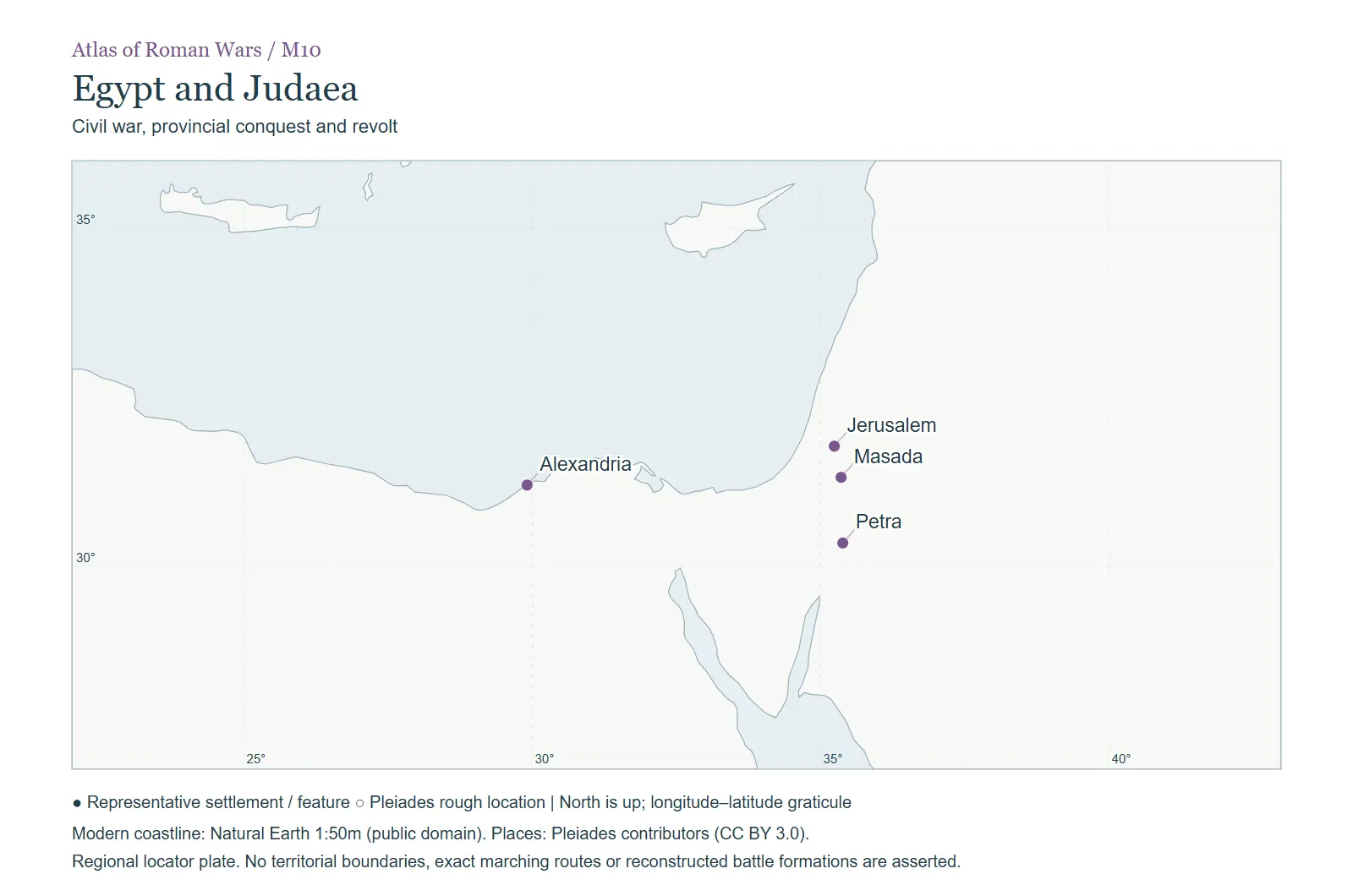
Provincial society and economic geography
The region included coastal cities, highland farming districts, the Jordan valley, Galilean settlements, and routes towards Arabia and Syria. Cereals, olives, vines, pastoral activity, fishing, crafts, and trade sustained communities under different ecological conditions. Estates, towns, villages, tenants, smallholders, labourers, and enslaved people experienced taxation and political change differently.
Jewish society itself was diverse in practice, outlook, wealth, and relation to authority. Greek-speaking cities and non-Jewish populations formed part of the wider provincial environment. Conflict cannot be explained through an assumption that every inhabitant belonged to one unified religious or political bloc.
Agrippa, direct rule, and the great revolt
Agrippa I’s short-lived kingdom in 41–44 temporarily changed the administrative arrangement. The resumption of direct rule after his death was followed by intensifying disputes involving officials, local elites, religious claims, city populations, and armed groups. The revolt beginning in 66 became a major war, including severe internal conflict within the rebel side.
Jerusalem’s destruction and the burning of the Temple in 70 transformed Jewish religious and communal life. The war continued beyond the city’s fall, with later operations against remaining strongholds. Roman victory brought killing, enslavement, confiscation, and a stronger military provincial establishment. The Jewish tax imposed afterward expressed a continuing fiscal consequence across the empire.
Hadrian and the second great catastrophe
Hadrian’s plans for Jerusalem and the wider religious-political situation formed the setting for the Bar Kokhba revolt of 132–135. The fighting inflicted severe devastation on parts of Judaea. Aelia Capitolina emerged as a Roman colonial city, while the province became known as Syria Palaestina in the Hadrianic period. The precise administrative act and timing of the provincial renaming remain less certain than the broad transformation.
The consequences differed across regions. Jewish life continued and developed strongly in Galilee and other areas; the destruction of one political centre did not end the history of an entire people. Rabbinic institutions, synagogues, scholarship, agriculture, and local communities formed part of the later provincial world.
The Christian Holy Land
Christian imperial patronage from the fourth century made Jerusalem and other sacred places major destinations. Churches, pilgrimage, monasteries, lodging, trade, and charitable institutions reshaped urban and rural economies. Christian prominence coexisted with Jewish and Samaritan communities and with conflicts over authority, land, and religious practice.
Samaritan uprisings and imperial repression in late antiquity reveal tensions that a simple story of peaceful Christianization would conceal. Jerusalem’s elevated ecclesiastical standing also differed from Caesarea’s earlier civil precedence. Religious and provincial hierarchies were related but not identical.
The three Palestines and conquest
Palaestina Prima centred on Caesarea and central-southern districts; Secunda on Scythopolis and northern territories; Tertia or Salutaris on southern districts including Petra. These boundaries combined areas with different earlier provincial histories. Each retained its own civil framework within the larger eastern system.
Persian conquest in 614 brought violence and a temporary break in Roman sovereignty. Roman recovery was brief before the Arab conquest of the 630s. Communities and religious institutions continued under a new political order, while the Roman provincial divisions lost their earlier governmental function. The region’s history therefore extends through several profound transformations without becoming one unchanging province from Pompey to the seventh century.
Settlement geography
| Ancient place | Modern location |
|---|---|
| Caesarea Maritima | Near Or Akiva, Israel |
| Hierosolyma | Jerusalem |
| Sebaste | Sebastia, West Bank |
| Flavia Neapolis | Nablus, West Bank |
| Scythopolis | Beit She'an, Israel |
| Tiberias | Tiberias, Israel |
| Sepphoris | Tzippori, Israel |
| Ioppe | Jaffa, Israel |