Provinces · The Levant and eastern borderlands
RP-38 Syria, Syria Coele, and Syria Phoenice
The Seleucid inheritance and Roman annexation
Syria was a landscape of coastal cities, river valleys, cultivated plains, mountain zones, oases, and desert approaches. Greek-speaking civic institutions coexisted with Aramaic-speaking communities, Phoenician traditions, local dynasties, temple authorities, and pastoral populations. The weakening Seleucid monarchy had left a fragmented political order in which several powers and local rulers competed.
Pompey’s annexation removed the remaining monarchy and established a major Roman command. It did not instantly annex every neighbouring client territory or eliminate all local forms of authority. Provincial expansion and consolidation continued through the absorption of dynastic holdings, adjustments to cities, and repeated relations with Judaea, Arabia, Commagene, and other regions.
Antioch and the eastern command
Antioch’s position on the Orontes, access to Seleucia Pieria, urban scale, and political importance made it one of the great cities of the empire. Governors and emperors used it as a base for eastern affairs. Its public buildings, festivals, religious communities, commercial activity, and social tensions gave it a provincial history far broader than its role as a military headquarters.
The Syrian governor’s army made the command politically powerful. Eastern wars and imperial succession could turn the province into a centre of rebellion or imperial formation. Recruitment, provisioning, and military movement affected cities and rural communities well away from the frontier itself.
Roads, agriculture, and long-distance exchange
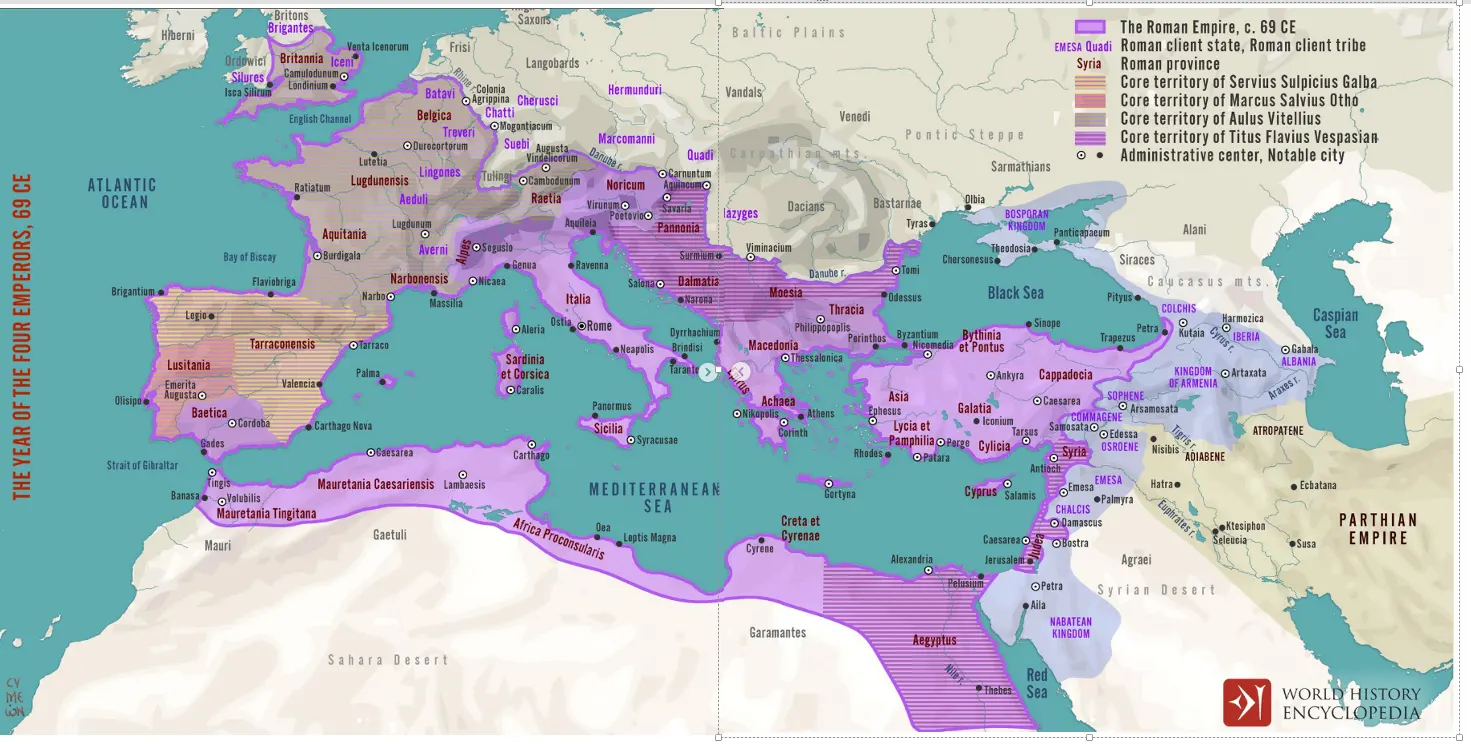
The Orontes valley and other cultivated districts supported substantial agricultural production. Coastal cities participated in Mediterranean shipping, while inland routes connected Damascus, Emesa, Palmyra, the Euphrates, and northern Mesopotamia. Long-distance trade involved many intermediaries and political boundaries; Syria was not simply one direct road from Rome to China.
Textiles, glass, wine, agricultural products, crafts, and transport services contributed to provincial wealth. Palmyra’s caravan activity rested on specialized knowledge, protection, finance, and relationships across the desert and eastern kingdoms. The city’s commercial importance should not obscure its agricultural and local social setting.
Cities and religious diversity
Berytus developed a strong Roman colonial identity and later a celebrated legal educational tradition. Tyre, Sidon, Byblos, Damascus, Apamea, and Hierapolis maintained distinctive civic and religious histories. Urban competition could involve titles, imperial favour, temples, festivals, and claims to antiquity.
Atargatis at Hierapolis, local solar cults, the temples of Heliopolis, Phoenician religious traditions, imperial observance, Jewish communities, and Christianity formed a complex religious landscape. Greek and Aramaic operated in different social and institutional settings, while Latin remained significant in colonies, the army, and official contexts. The province’s diversity was a durable feature of Roman rule.
Syria Coele
After the Severan division, the northern province retained Antioch and a major military-strategic role. Its relation to the Euphrates and northern routes made it central to campaigns against eastern powers. The name Coele Syria had older geographical uses, so its meaning must be tied to the Severan administrative setting when describing this province.
The division reduced the concentration of forces and authority under one governor after the civil war involving Pescennius Niger. It was therefore a response to internal imperial danger as well as the practical scale of the jurisdiction. Antioch’s prestige survived, but the old Syrian command no longer existed intact.
Syria Phoenice
The southern province joined coastal Phoenician cities with inland districts including important Syrian centres. Tyre acquired the leading administrative role, while other cities retained substantial standing. The province’s mixed coast-and-interior geography makes the modern word “Phoenician” too narrow if used as a purely coastal ethnic description.
Maritime exchange, agricultural production, crafts, urban culture, and inland movement sustained its economy. Emesa’s solar priestly tradition and the later imperial connections of the Severan dynasty added another political-religious dimension. The province’s identity emerged from Roman administrative division without erasing its cities’ much older histories.
Third-century catastrophe and recovery
Sasanian campaigns inflicted severe damage on Syria. Valerian’s capture in 260 exposed the failure of a Roman eastern campaign and destabilized the region. Odaenathus of Palmyra helped restore Roman positions, while the later regime of Zenobia and Vaballathus extended control across major eastern provinces before Aurelian’s reconquest.
These events did not create a permanent new province called Palmyra. They represented a changing concentration of regional and imperial power over existing jurisdictions. Later Roman recovery rebuilt military and administrative capacity, though the costs of warfare and destruction varied sharply between communities.
The Christian provinces and seventh-century rupture
Late subdivisions separated Syria Prima, Syria Secunda or Salutaris, Euphratensis, Phoenice, and Phoenice Libani. Bishops, monasteries, saints’ cults, schools, and doctrinal conflicts became central to provincial life. Antioch’s ecclesiastical importance connected local religious politics to imperial attempts at unity.
Earthquakes, plague, and war affected the sixth-century cities, while imperial recovery and rebuilding continued. Persian occupation in the early seventh century interrupted Roman government; Heraclius’s victory restored it briefly. Arab conquest in the 630s ended the ancient Roman provincial system across the region, but local populations, languages, cities, and religious communities continued under new rulers.
Settlement geography
| Ancient place | Modern location |
|---|---|
| Antiochia | Antakya, Turkey |
| Seleucia Pieria | Near Samandağ, Turkey |
| Apamea | Qalaat al-Madiq, Syria |
| Laodicea ad Mare | Latakia, Syria |
| Beroea | Aleppo, Syria |
| Hierapolis Bambyce | Manbij, Syria |
| Zeugma | Near Nizip, Turkey |
| Emesa | Homs, Syria |
| Palmyra | Tadmur, Syria |
| Damascus | Damascus, Syria |
| Heliopolis | Baalbek, Lebanon |
| Berytus | Beirut, Lebanon |
| Tyrus | Tyre, Lebanon |
| Sidon | Saida, Lebanon |
| Byblos | Jbeil, Lebanon |
| Ptolemais | Acre, Israel |
| Gaza | Gaza |
| Ascalon | Ashkelon, Israel |
| Samosata | Under the Atatürk Dam lake, Turkey |