Provinces · Gaul and the Rhine
RP-08 Gallia Narbonensis
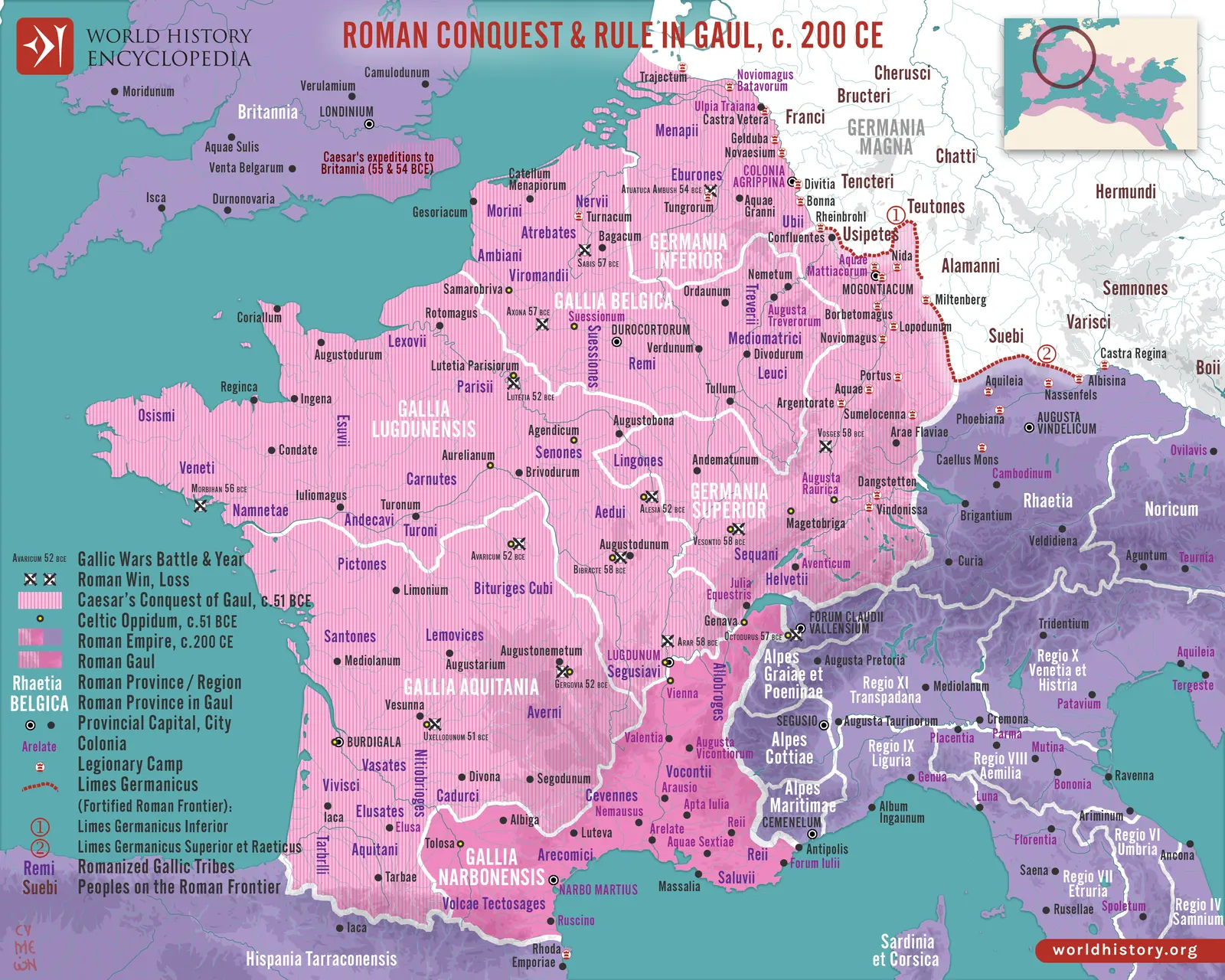
A Mediterranean province before Caesar’s conquest
Narbonensis was the original Roman bridge across southern Gaul. Its Mediterranean coast, lower Rhône valley, and routes towards the Pyrenees made it essential to communication between Italy and Spain. Greek Massilia already possessed a powerful commercial and cultural presence. Rome’s interventions developed through alliances, campaigns, colonial settlement, and the need to protect movement across the region.
The defeat of the Allobroges and Arverni established a new balance of power, but local peoples were not erased from the landscape. Colonial foundations and land distribution introduced Roman communities into an area already containing substantial towns, sanctuaries, and rural networks. The province’s later reputation for closeness to Italy arose from this long interaction rather than from an absence of indigenous history.
Cities and the Rhône corridor
Narbo Martius stood at the meeting of land routes and Mediterranean connections. Nemausus developed a monumental urban character tied to regional elites and imperial patronage. Arelate benefited from the Rhône and access to the sea, while Vienna commanded a major position farther inland. Massilia’s ancient privileges and Greek identity were altered by its defeat during Caesar’s civil war, yet its commercial and educational importance continued.
The Via Domitia crossed the province towards Spain. The Rhône carried bulk goods between coast and interior, with overland routes connecting to river ports and Alpine approaches. Warehouses, merchants, boatmen, transport associations, and local officials made these systems function. The province’s importance lay in linking regions as well as producing goods of its own.
Economy and provincial society
Vineyards, olive cultivation, cereals, livestock, quarrying, and craft production supported a diverse economy. Wine circulated locally and across longer distances, while imported goods and transport services connected the province to imperial markets. Rural estates and small settlements occupied landscapes whose productivity varied with water, soil, and access to routes.
Local elites pursued office, patronage, and monumental benefaction. Latin civic culture was conspicuous, but Greek remained significant in particular centres, and local religious traditions continued. Public architecture expressed urban competition as well as loyalty to emperors. Prosperous towns did not eliminate inequality, dependence, or the vulnerability of rural producers to political and fiscal pressures.
Religion and the Christian city
Imperial cult, municipal temples, regional sanctuaries, and household practices created several levels of religious life. Gods could retain local identities while being represented through Roman names and imagery. Christianity spread along the same communications routes that carried goods and officials. By late antiquity, episcopal cities became important actors in civic conflict, imperial politics, and regional administration.
Arles rose particularly high in the later western imperial system. Its position made it useful to emperors, prefectural administration, and military movement, while bishops and church councils added another form of authority. This later prominence should not be projected unchanged onto every earlier century of Narbonensis.
The divided province and successor powers
Late subdivision produced Narbonensis Prima, Narbonensis Secunda, and Viennensis. These districts separated coastal, inland, and Rhône-centred functions that had once belonged to the larger jurisdiction. Fifth-century competition among imperial armies, Visigoths, Burgundians, and later Franks changed political control in stages. Southern Gaul retained Roman law, Latin urban culture, episcopal institutions, and aristocratic networks under new rulers, making the province’s disappearance an institutional transformation rather than a simple end to Roman society.
Settlement geography
| Ancient place | Modern location |
|---|---|
| Narbo Martius | Narbonne |
| Nemausus | Nîmes |
| Arelate | Arles |
| Massilia | Marseille |
| Forum Julii | Fréjus |
| Arausio | Orange |
| Vienna | Vienne |
| Tolosa | Toulouse |
| Baeterrae | Béziers |
| Aquae Sextiae | Aix-en-Provence |
| Vasio | Vaison-la-Romaine |
| Glanum | Saint-Rémy-de-Provence |