RP-07 Hispania Citerior Tarraconensis
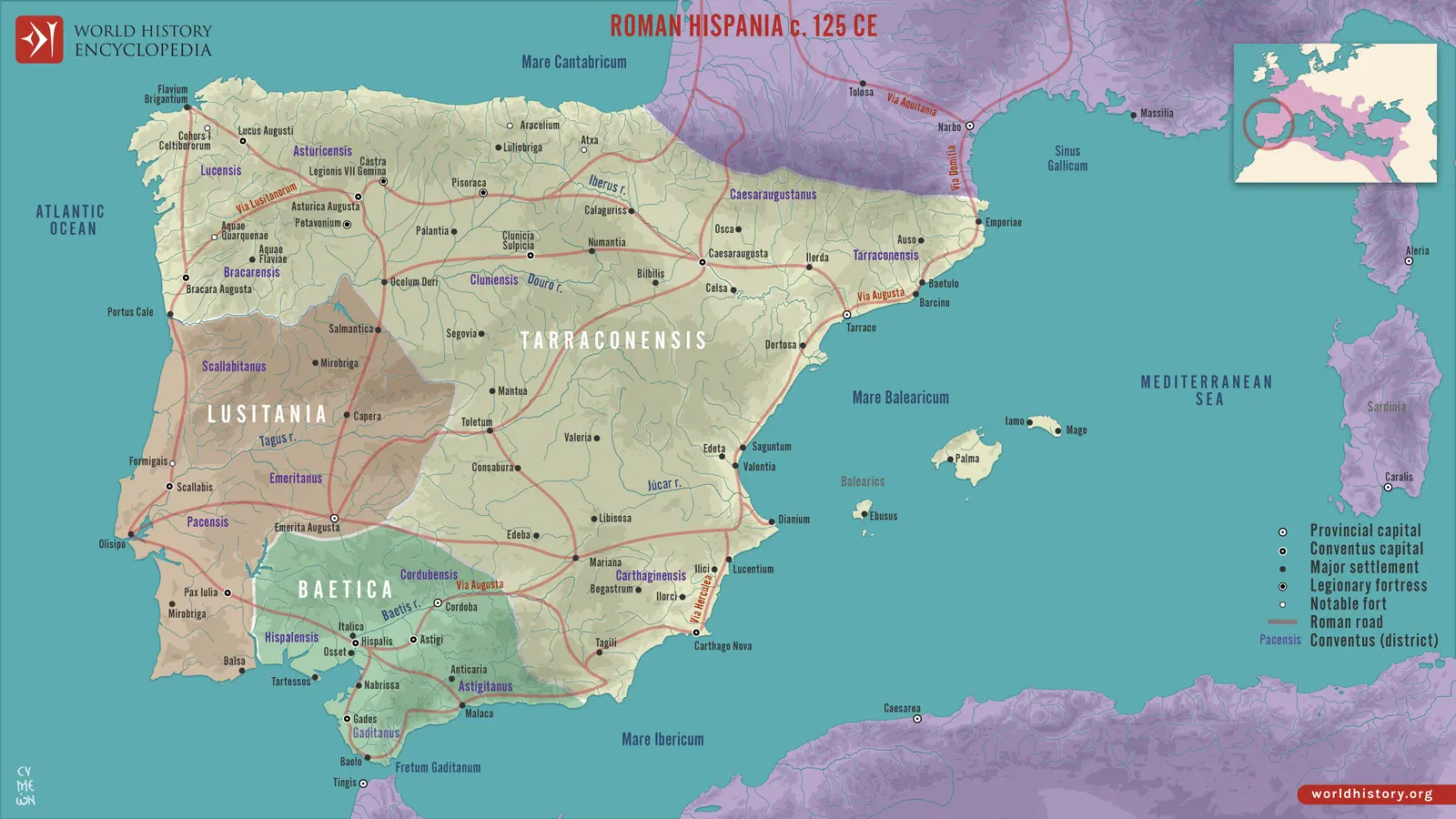
The enormous northern and eastern province
Tarraconensis joined regions with very different relationships to Rome. Its Mediterranean cities had long participated in maritime exchange; the Ebro basin supported established settlement and communication; the central plateau contained communities shaped by the Celtiberian wars; and the Atlantic northwest entered full imperial control only after prolonged conquest. Governing this province required a network of cities and judicial districts rather than constant direct intervention from Tarraco.
Tarraco’s coastal position connected the governor to Mediterranean shipping and imperial communications. Carthago Nova possessed a strong Punic and Roman inheritance and access to southeastern resources. Caesaraugusta organized an important Ebro crossing and regional network. Clunia served the northern interior, while Asturica Augusta and the northwestern centres became closely associated with military and mining administration.
Conquest and the army’s changing role
The Cantabrian and Asturian wars were a major undertaking of the Augustan settlement. Mountain terrain, mobile opponents, supply difficulties, and repeated resistance made them more than a ceremonial completion of an already conquered peninsula. Campaigning was followed by garrisons, roads, settlement changes, and the integration of productive districts into imperial systems.
As the military establishment contracted, a smaller number of major bases retained importance. Legio VII Gemina became central to the later provincial army and gave its name to the settlement that became León. Soldiers could supervise routes, provide specialist skills, support official operations, and participate in mining-related administration as well as prepare for warfare. Their presence affected neighbouring markets and communities.
Mining, agriculture, and regional exchange
Northwestern gold extraction included large-scale manipulation of water and terrain at sites such as Las Médulas. Aqueducts, channels, reservoirs, labour organization, and administrative oversight were essential to these operations. Mining’s dramatic physical remains must nevertheless be placed within a wider society of agricultural communities and towns, not treated as the province’s sole economic activity.
Elsewhere, cereals, livestock, vineyards, ceramics, salt, and local industries sustained economic life. Mediterranean ports exchanged goods with Italy, Africa, and Gaul. The Ebro corridor and roads across the interior connected these maritime networks with inland markets. The scale and diversity of Tarraconensis explain why later governments found subdivision attractive.
Peoples, language, and public life
Roman institutions developed across communities with Iberian, Celtiberian, and other linguistic and cultural inheritances. Local languages did not vanish at the instant of conquest, while Latin gained authority through law, service, civic office, and commerce. Municipal government gave regional elites a framework for public distinction. Provincial cult activity at Tarraco provided a further arena for representation and competition.
Religious life combined Roman civic observance with local traditions, sanctuaries, and cults transmitted through movement. Christianity spread through urban networks and eventually formed an influential episcopal geography. The province’s cultural history was therefore as differentiated as its physical geography.
Subdivision and late political change
The creation of Carthaginiensis and Gallaecia divided the old jurisdiction into more manageable units. The Balearic Islands later acquired a separate provincial identity. These arrangements did not remove the older importance of Tarraco, but they narrowed the territory associated with its governor.
The fifth century brought repeated changes in imperial, military, and Visigothic power. Tarraconensis remained relevant to Roman efforts in Spain after other districts had fallen beyond effective central control. Its eventual transformation into part of a successor kingdom was a sequence of campaigns, accommodations, and institutional adaptations. Roads, cities, and bishops preserved connections across the broken framework of the old large province.
Settlement geography
| Ancient place | Modern location |
|---|---|
| Tarraco | Tarragona |
| Carthago Nova | Cartagena |
| Caesaraugusta | Zaragoza |
| Barcino | Barcelona |
| Emporiae | Empúries |
| Valentia | Valencia |
| Saguntum | Sagunto |
| Clunia | Peñalba de Castro |
| Asturica Augusta | Astorga |
| Legio | León |
| Lucus Augusti | Lugo |
| Bracara Augusta | Braga, Portugal |
| Segovia | Segovia |
| Toletum | Toledo |
| Complutum | Alcalá de Henares |
| Bilbilis | Near Calatayud |
| Calagurris | Calahorra |
| Pompaelo | Pamplona |
| Ilerda | Lleida |
| Lucentum | Alicante |