RP-06 Lusitania
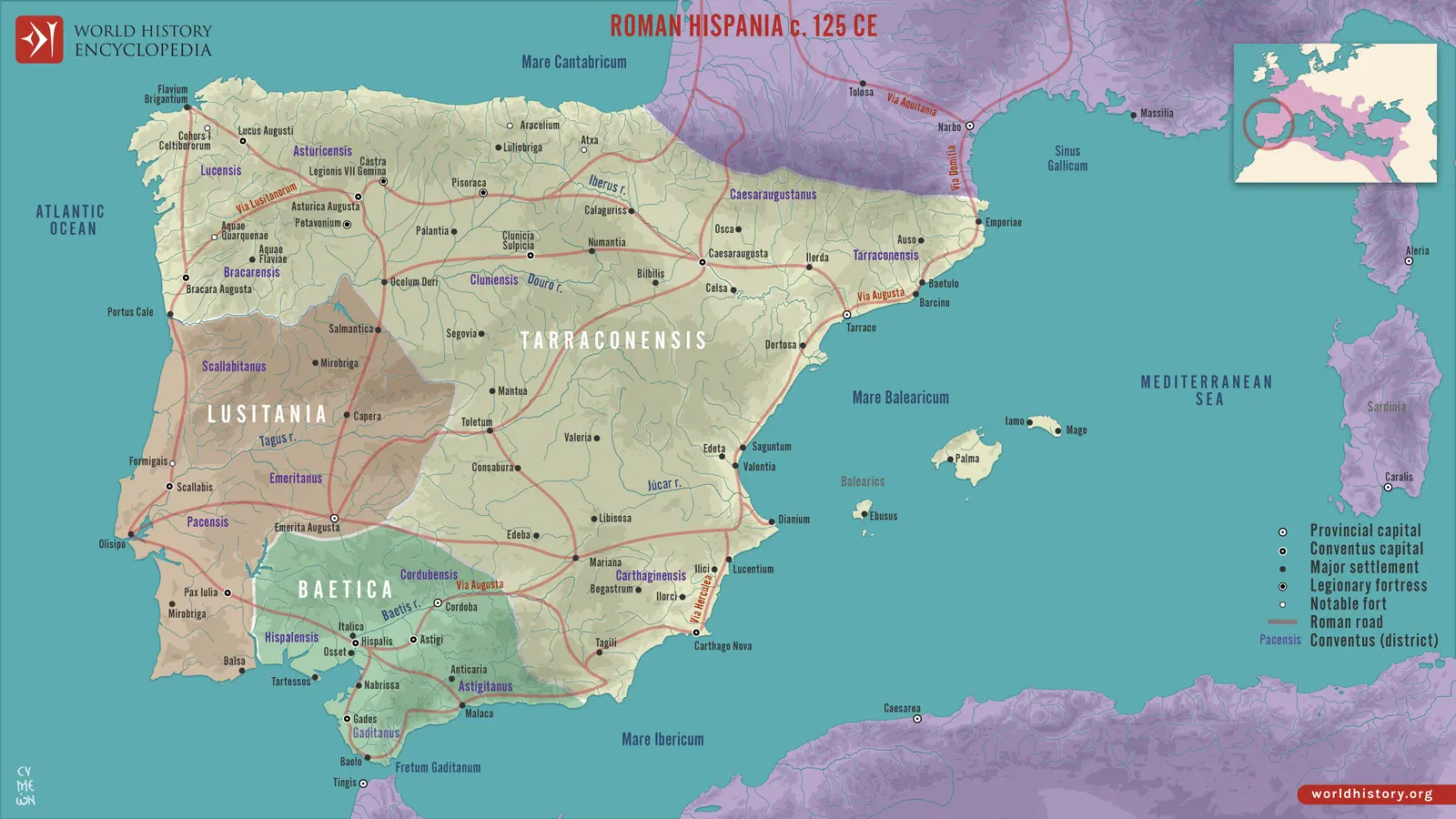
Between the Atlantic and the interior
Lusitania crossed landscapes that modern political borders divide differently. Its Atlantic coast opened towards maritime exchange, while the Tagus, Guadiana, and their tributaries linked productive valleys with inland settlements. Uplands supported pastoral activity and more dispersed communities. The province included major areas east of modern Portugal and did not include the whole Portuguese territory north of the Douro.
The Roman name drew upon a regional people whose earlier history included prolonged conflict with Republican commanders. Provincial organization, however, created a larger and more varied jurisdiction. The memory of Viriathus belongs to conquest and resistance, while the imperial province belonged to a subsequent political order with municipalities, veterans, roads, and new patterns of landholding.
Emerita and the architecture of government
Emerita Augusta became the administrative centre and a powerful statement of Augustan settlement. Its foundation for veterans linked the end of major campaigns to the distribution of land and the creation of a Roman civic community. Bridges, aqueducts, public buildings, and roads connected the city to its hinterland and to other provincial centres. Its importance extended beyond monumental display: courts, commerce, imperial representation, and local administration concentrated there.
The province’s judicial geography included important centres such as Pax Iulia and Scallabis, while Olisipo anchored Atlantic and estuarine connections. Local communities acquired different statuses over time. Municipal advancement could integrate regional elites without abolishing all older relationships to land, cult, and community.
Economy and movement
Farming, livestock, mining, and maritime production all contributed to Lusitanian life. Fish-salting and sauce production developed around favourable coastal and estuarine sites. Rivers and roads connected these activities with towns, ports, and inland markets. Mineral extraction brought specialized labour and official interests into selected districts; it should not be assumed to have dominated every part of the province.
The north-south routes through western Iberia connected Emerita with the northern territories, but their modern collective label should not be mistaken for the official name of one single Roman road. Bridges and milestones show sustained investment in communications. They also reveal that administration was concerned with moving people, messages, troops, and resources through a challenging landscape.
Provincial society and religion
Latin spread in inscriptions, civic administration, and elite self-presentation. Indigenous divine names remained important, sometimes appearing alongside Roman gods or within religious forms shaped by Roman institutions. Sanctuaries, funerary customs, and local patterns of naming show cultural change that was neither complete replacement nor static survival.
Veterans, merchants, officials, urban elites, farmers, tenants, and enslaved people experienced provincial integration differently. The imperial cult gave communities opportunities for public loyalty and social advancement. Christianity later developed through the same networks of towns and travel, with Emerita becoming an especially important episcopal centre.
Late antique continuity
Lusitania retained a recognizable provincial name as the western imperial structure weakened. Suevic and Visigothic expansion, Roman military efforts, and local political negotiations altered control during the fifth century. Emerita’s later Christian prominence shows that a city’s regional authority could survive major changes in sovereignty. Provincial institutions, royal government, and ecclesiastical geography overlapped without remaining identical. Lusitania’s long historical coherence came from its connected urban and river systems as much as from the endurance of its administrative title.
Settlement geography
| Ancient place | Modern location |
|---|---|
| Augusta Emerita | Mérida |
| Olisipo | Lisbon, Portugal |
| Pax Julia | Beja, Portugal |
| Ebora | Évora, Portugal |
| Conimbriga | Near Coimbra, Portugal |
| Scallabis | Santarém, Portugal |
| Norba Caesarina | Cáceres |
| Salmantica | Salamanca |
| Ossonoba | Faro, Portugal |