Provinces · Macedonia, Greece, Epirus, and Thrace
RP-26 Macedonia
The conquered royal heartland
Macedonia’s provincial history began with the dismantling of a monarchy whose military and political traditions had shaped the eastern Mediterranean. The defeats of Philip V and Perseus reduced Roman rivals without immediately producing the final provincial arrangement. The four republics created after Pydna limited Macedonian unity, while restrictions and Roman supervision changed economic and political relationships.
Andriscus’s challenge demonstrated that royal legitimacy remained capable of mobilizing support. His defeat and the subsequent settlement brought permanent provincial government. Macedonia then became a base for Roman affairs in the Balkans, with responsibilities extending beyond the older royal heartland. Its boundaries changed as new provinces were established around it.
The Via Egnatia and the coastal cities
The Via Egnatia connected Adriatic gateways with the Macedonian interior, Thessalonica, and eastern routes. Its strategic importance rested on a chain of ports, towns, stations, bridges, and maintained road sections. It made Macedonia a corridor between Italy and the eastern Mediterranean, but its benefits and burdens were distributed unevenly among communities along and away from the route.
Thessalonica combined a favourable harbour, inland access, and political importance. Philippi acquired a Roman colonial character following the civil wars. Beroea, Pella, Dion, and other centres retained different civic, cultural, and religious identities. The end of monarchy did not make Macedonian cities into interchangeable provincial settlements.
Civil war and the Roman settlement
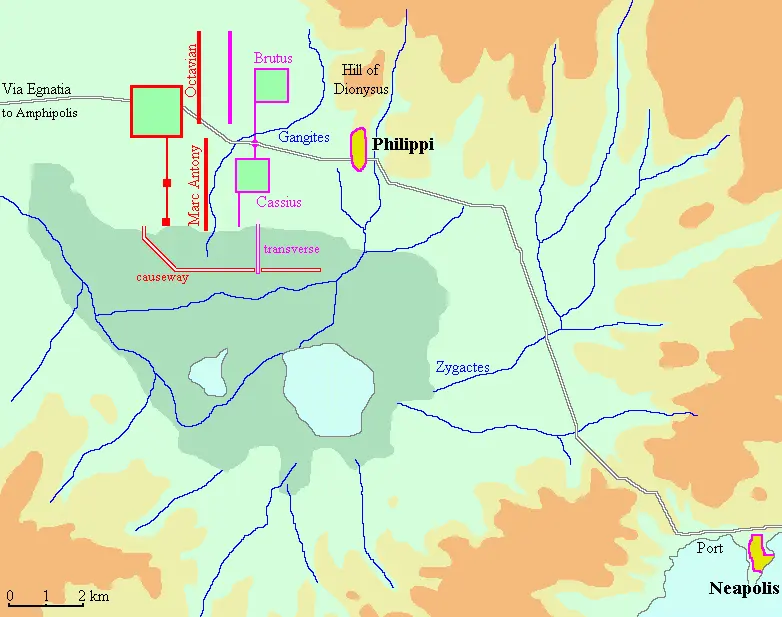
The eastern Balkans became a decisive theatre of Roman civil conflict. The battle of Philippi in 42 BCE brought the struggle after Caesar’s assassination into the region. Armies demanded food, money, transport, and cooperation from local communities, while victory produced colonial foundations, veteran settlement, and new political patronage.
During the Principate, provincial government relied on established city institutions as well as Roman colonies. Public allocation and periods of combined imperial administration show that constitutional status could change without creating a new population or geographical region. The governor’s duties included justice, order, and relations with local authorities within this layered institutional world.
Economy, culture, and religion
Agriculture, livestock, timber, mining in selected districts, crafts, and regional trade supported the province. The coast linked it to Aegean exchange, while interior valleys and roads connected it with Balkan markets. Greek remained central to civic culture, alongside the Latin institutions and public identities of Roman colonies and officials.
Traditional Macedonian and Greek cults coexisted with imperial observance and religious practices carried through mobility. Christianity developed early in several urban centres and later became embedded in the province’s institutional geography. Thessalonica’s bishops and religious communities acquired importance within the wider politics of the eastern empire.
The late Macedonian provinces
Thessaly’s separate organization and other subdivisions reduced the older province’s geographical reach. The Diocese of Macedonia included Achaia, Crete, the Epirote provinces, Thessaly, and Macedonia itself, a much larger administrative world than the province bearing the name. Macedonia Salutaris or Secunda reflects further experimentation in the northern districts.
Late invasions and settlement disrupted the interior, while Thessalonica retained exceptional resilience and strategic value. Its survival connected the region to Eastern Roman naval, military, and ecclesiastical power even when surrounding districts changed politically. Macedonia’s late history therefore combines contraction of effective control, continuity in major centres, and the emergence of new regional communities.
Thessaly’s earlier provincial relationships require separate attention. Its incorporation into Achaia under Augustus was followed by transfer to Macedonian jurisdiction at a date that remains disputed. Its eventual separate province therefore emerged from a history involving both larger jurisdictions. Larissa and the Thessalian communities retained regional institutions and identities across those changes.
Settlement geography
| Ancient place | Modern location |
|---|---|
| Thessalonica | Thessaloniki, Greece |
| Philippi | Near Kavala, Greece |
| Dyrrachium | Durrës, Albania |
| Apollonia | Near Fier, Albania |
| Beroea | Veria, Greece |
| Pella | Near Giannitsa, Greece |
| Dium | Near Mount Olympus, Greece |
| Amphipolis | Near Serres, Greece |
| Stobi | Near Gradsko, North Macedonia |
| Heraclea Lyncestis | Bitola, North Macedonia |