Provinces · Gaul and the Rhine
RP-12 Germania Superior
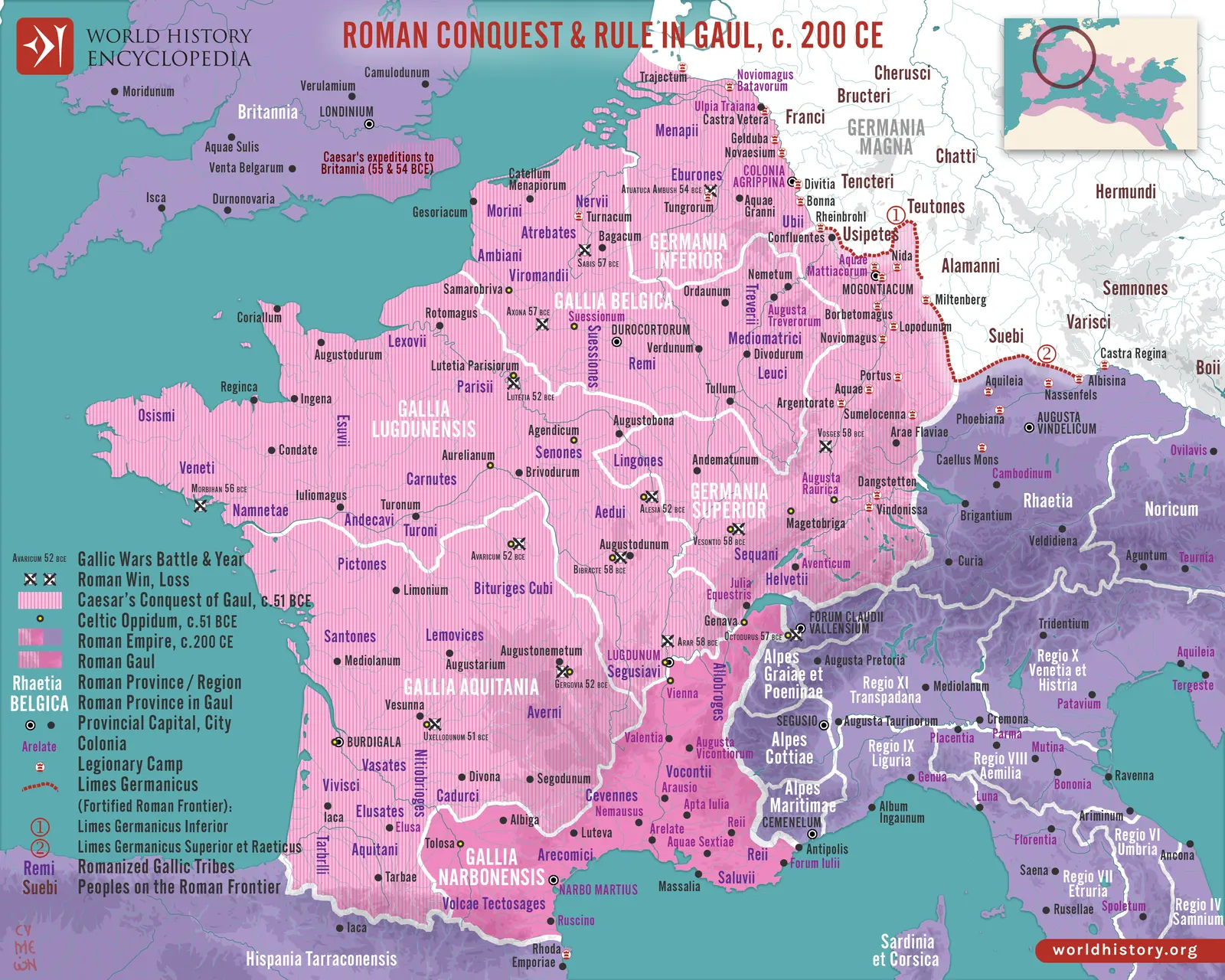
A frontier with depth
Germania Superior was more than a strip of forts beside the Rhine. Its jurisdiction included agricultural hinterlands, towns, roads, and, during its period of greatest eastern extension, territories between the Rhine and the upper Danube. The Black Forest, Neckar basin, upper Rhine crossings, and approaches towards the Jura made its geography complex. A frontier fort depended on this interior network for food, animals, equipment, labour, and transport.
Mogontiacum grew around a major military concentration, while Argentorate, Vindonissa, and other installations belonged to changing deployments. Civilian settlements developed near bases, but they were not all simply barracks with attached shops. Families, veterans, traders, craftspeople, and people from distant parts of the empire created settled communities with their own religious and economic lives.
From army command to territorial province
The upper Rhine command acquired an institutional identity before Domitian’s provincial organization. The distinction matters because military authority could operate across a zone whose civil relationships were still developing. Domitian’s campaigns and the enlargement of the frontier brought new territory into sustained Roman use, while administration followed through roads, surveying, taxation, and the creation or recognition of civic districts.
The revolt of Saturninus in 89 showed the political danger of concentrated frontier armies. Loyalty, patronage, imperial succession, and the personal authority of commanders could turn provincial garrisons into participants in civil conflict. Measures taken after revolts therefore affected more than one defeated commander; they could reshape appointments, deployments, and relationships with the court.
The frontier economy
Agricultural estates and villages supplied forts and towns. Timber, stone, ceramics, metalworking, and transport were important to construction and maintenance. The frontier required continuous investment in roads, watchtowers, installations, animals, and supplies. Military demand created opportunities for some producers while imposing burdens through taxation, requisition, and labour obligations.
The limes regulated movement rather than sealing the empire hermetically. Merchants, envoys, migrants, recruits, and hostile raiders crossed the frontier under different conditions. Contacts with communities beyond Roman control could include trade, tribute, service, marriage, and violence. The frontier’s social geography was therefore broader than the formal provincial outline.
Religious life and provincial communities
Military and civilian cults overlapped without being identical. Jupiter, imperial cult, local deities, Mithras, and a wide variety of personal dedications reveal the diversity of the population. Votive monuments could express recovery from illness, fulfilment of vows, professional identity, or the success of service. The familiar representation of the frontier as exclusively masculine and martial misses households, women, children, freedpeople, and rural communities.
Contraction and late transformation
Third-century civil wars and external pressure made the eastern salient increasingly difficult to defend. Withdrawal from the Agri Decumates around 260 changed both the military line and the provincial hinterland. Some communities moved, some settlements declined, and relationships across the new frontier continued in different forms.
Germania Prima and Maxima Sequanorum emerged from the later reorganization of the region. The upper Rhine remained strategically important in the fourth century, with emperors rebuilding defences and campaigning beyond the river. Alemannic power, Roman military recovery, local settlements, and later Frankish expansion transformed the landscape in stages. Germania Superior’s history therefore contains both territorial expansion and a long process of contraction and reorientation.
Settlement geography
| Ancient place | Modern location |
|---|---|
| Mogontiacum | Mainz, Germany |
| Argentorate | Strasbourg |
| Augusta Raurica | Augst, Switzerland |
| Aventicum | Avenches, Switzerland |
| Vindonissa | Windisch, Switzerland |
| Aquae Mattiacorum | Wiesbaden, Germany |
| Nida | Frankfurt-Heddernheim, Germany |
| Borbetomagus | Worms, Germany |
| Andematunnum | Langres |
| Vesontio | Besançon |
| Arae Flaviae | Rottweil, Germany |