Provinces · Gaul and the Rhine
RP-10 Gallia Lugdunensis
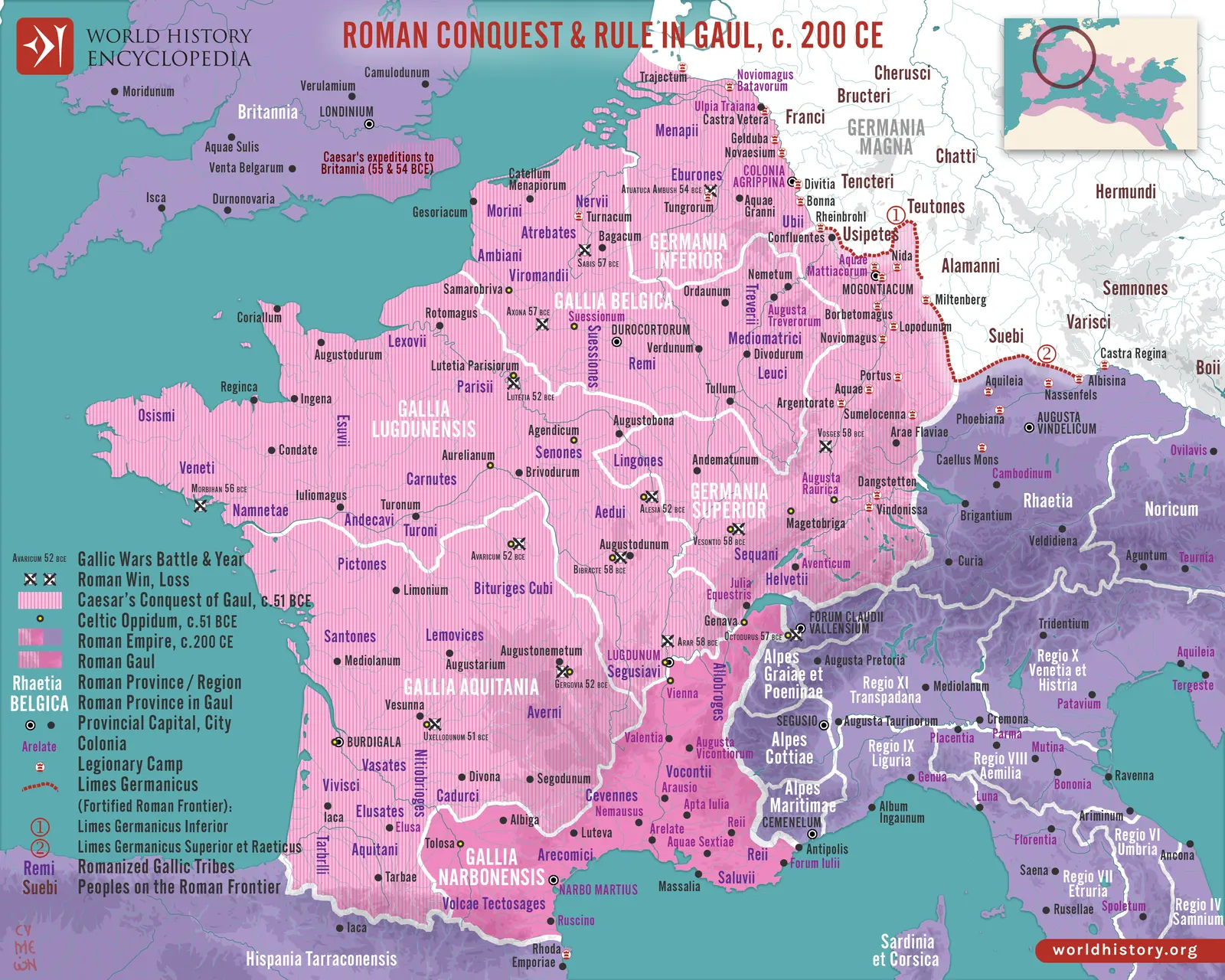
The province between several seas
Lugdunensis extended from the strategic confluence at Lyon across central and northwestern Gaul. It included communities whose access to the Atlantic, Channel, Loire, Seine, and interior road systems gave them different orientations. The province was consequently a network of civic territories rather than a single compact basin governed only through its capital.
Its peoples included the Aedui, Parisii, Carnutes, and many other communities reorganized within Roman civic structures. Older centres and identities remained influential, but some towns shifted location or acquired new public forms. Augustodunum’s development near the older Aeduan centre of Bibracte exemplifies the creation of a Roman-style civic capital associated with an established regional people.
Lyon and the Three Gauls
Lugdunum’s foundation in 43 BCE and its subsequent Augustan development gave it a privileged place within the new order. Roads radiated from its strategic position, linking the Rhône valley to the Rhine, Atlantic, and northern districts. Its mint, official functions, merchants, and imperial connections made it a major centre of power and movement.
The sanctuary at the confluence served the collective assembly of the Three Gauls. Delegates and priests participated in a supra-provincial religious and political institution, providing opportunities for local elites to represent their communities and cultivate wider influence. The arrangement did not abolish separate governors or make all Gallic taxation and justice pass through one office.
Civic territories and productive countryside
The civitas provided the essential local framework. Its town served as a centre for council business, markets, public worship, and legal affairs, while its territory contained farms, villages, estates, and sanctuaries. Town and countryside therefore belonged to one political-economic system. Municipal elites drew resources from rural property and used public benefaction to convert wealth into status.
Crafts, agricultural production, pottery distribution, and transport supported regional commerce. River navigation reduced the burden of moving some bulky goods, while roads carried officials, messages, travellers, and merchandise between basins. Associations of merchants and boatmen reveal the organized social interests involved in making communications work.
Religion, persecution, and urban culture
Traditional cults persisted in local sanctuaries while the imperial cult offered a common language of political loyalty. Religious life included combinations of local and Roman divine forms, household observances, and cults transmitted through migration and service. Christianity took root in urban communities before becoming dominant.
The persecution of Christians at Lyon in 177 CE became an important event in Christian memory. It also reveals an urban setting in which provincial authority, civic crowds, legal status, and religious identity could intersect violently. The later Christian city grew within a landscape already rich in public ritual and social competition.
Civil war and the multiplication of provinces
The battle near Lyon in 197, between Septimius Severus and Clodius Albinus, brought a major imperial civil war into the provincial heartland. The consequences extended beyond the battlefield through confiscation, punishment, and the reconfiguration of political patronage. Third-century upheavals and rival imperial regimes further exposed the region’s connection to military politics.
Late subdivision separated Lyon-centred Lugdunensis Prima from jurisdictions associated with Rouen, Tours, and Sens. Those divisions gave governors more localized responsibilities and made the old province’s breadth visible through its descendants. Under successor rulers, bishops and urban elites continued to organize regional life. Lugdunensis thus left several political and ecclesiastical landscapes rather than one uniform territorial inheritance.
Settlement geography
| Ancient place | Modern location |
|---|---|
| Lugdunum | Lyon |
| Augustodunum | Autun |
| Lutetia | Paris |
| Rotomagus | Rouen |
| Caesarodunum | Tours |
| Cenabum | Orléans |
| Agedincum | Sens |
| Condate | Rennes |