RP-04 Hispania Citerior and Hispania Ulterior
Two commands in a peninsula still being conquered
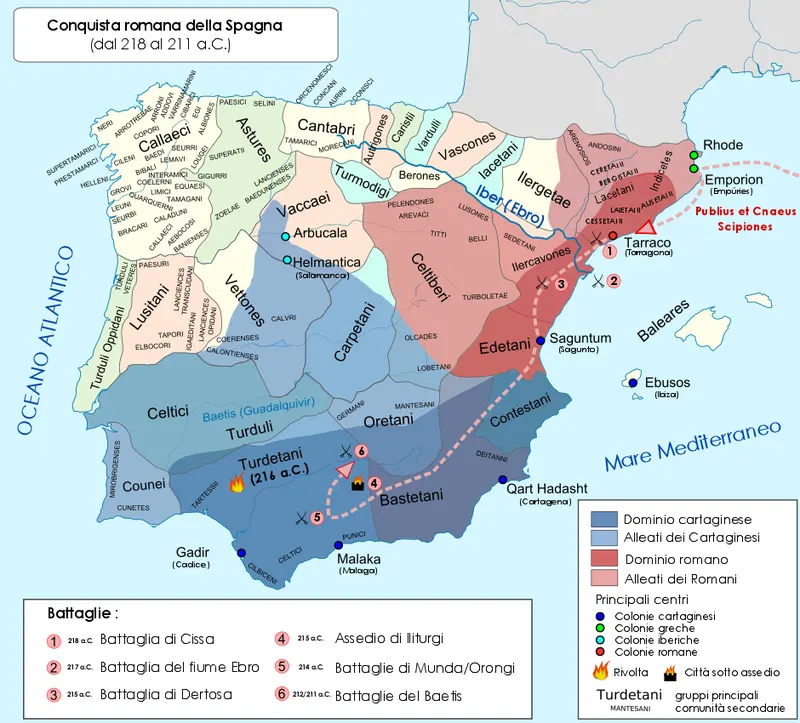
Roman Spain began as a theatre of war against Carthage. Coastal footholds, allied communities, and access to mineral and agricultural resources helped sustain operations, but success in the Punic War did not produce control of the entire peninsula. When Citerior and Ulterior became regular provincial commands in 197 BCE, they administered territories whose boundaries expanded with campaigns, treaties, and submissions.
The terms nearer and further referred to their relationship to Rome’s approaches, not to a fixed division between two homogeneous peoples. Iberian-speaking communities, Celtiberian groups, Lusitanian populations, Turdetanian cities, and numerous other communities possessed their own political histories. Some towns negotiated agreements, others resisted, and local factions could align differently with Roman commanders. The peninsula never faced Rome as one centralized opponent.
Warfare, agreements, and coercion
Early governors combined campaigning with the collection of money and supplies. Commanders such as Cato and Tiberius Sempronius Gracchus pursued different mixtures of intimidation, settlement, and regulation. Agreements could stabilize districts, but a new governor’s demands or interpretation of a treaty might reopen conflict. The short duration of many commands created incentives for visible victory and immediate revenue.
The Lusitanian war exposed the mobility of resistance in difficult country. Viriathus used local knowledge, negotiation, and flexible campaigning to frustrate Roman forces. His killing in 139 BCE did not make the preceding wars a minor policing operation. In the Celtiberian interior, Numantia became the focal point of a prolonged struggle. Its destruction in 133 BCE followed an investment designed to isolate the settlement rather than a single decisive open battle.
Provincial society under the Republic
Mines, tribute, booty, military supply, and the activities of Roman and Italian merchants tied the provinces to the Roman economy. Silver-working around southeastern districts was especially important. Indigenous elites could gain influence through cooperation, while communities faced requisitions, enslavement, land loss, or restrictions after defeat. The resulting society cannot be reduced to either uninterrupted resistance or effortless assimilation.
Local mints, inscriptions, and changing urban forms show communities adapting to a larger political environment. Roman legal institutions developed alongside older languages and traditions. Military service and commercial migration created new relationships between the peninsula and Italy. Even before universal citizenship, some individuals and communities obtained privileged positions through grants and political connections.
Civil wars and the Augustan settlement
The Sertorian war transformed provincial communities into participants in Roman civil conflict. Sertorius built support through alliances and alternative claims to Roman legitimacy; Pompey and other commanders fought a difficult war that relied on local manpower, resources, and loyalties. Later, Caesar’s struggles against Pompeian forces again made Spain a decisive arena of Roman politics.
Augustus’s reorganization did not simply rename the Republican provinces. It redistributed territory and authority while northern conquest was still being completed. Baetica, Lusitania, and Tarraconensis inherited different parts of the old system and acquired distinct political, military, and economic characters. The Republican two-province arrangement belongs to the history of an expanding and contested jurisdiction, not a stable map awaiting only a change of labels.