Provinces · Anatolia and the Aegean
RP-33 Cappadocia
A royal plateau turned frontier province
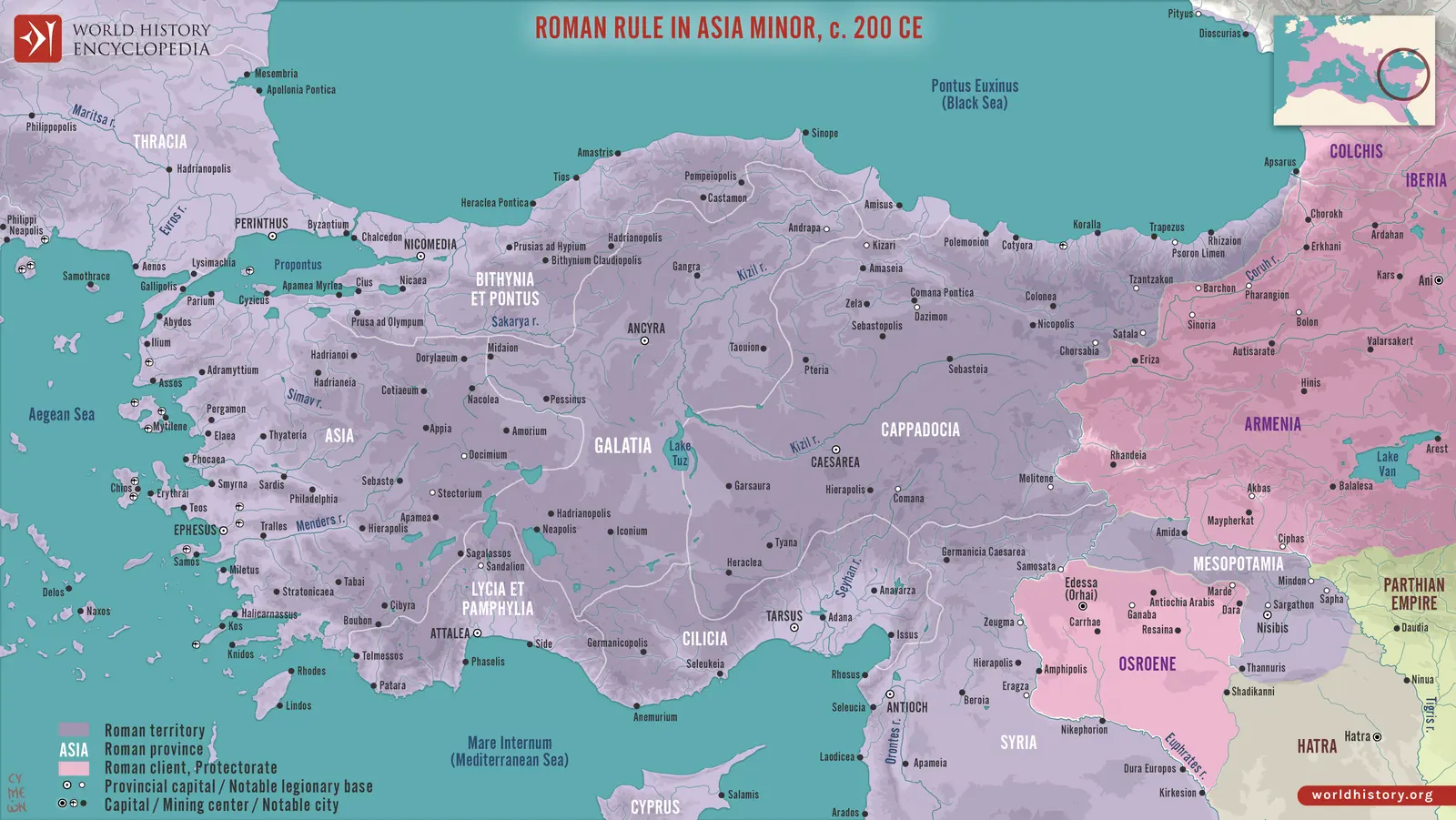
Cappadocia’s uplands, valleys, volcanic landscapes, and routes towards Armenia made it strategically valuable before annexation. Its monarchy had long negotiated with Rome and neighbouring powers. Archelaus’s removal brought the kingdom into direct rule, but royal estates, local elites, religious centres, and settlement patterns continued to shape the province.
Caesarea Mazaca stood near Mount Argaeus and became the leading city. Tyana controlled a different southern regional setting. As Roman command extended towards the upper Euphrates and northeastern approaches, Melitene, Satala, and related military centres acquired great importance. The larger command’s geography therefore exceeded the older Cappadocian royal heartland.
The Armenian and Euphrates approaches
Cappadocia guarded routes by which armies, envoys, traders, and supplies moved between Anatolia and Armenia. Roman influence over Armenian kingship made the province a base for diplomacy as well as war. Control of roads, mountain passages, river crossings, and storage points was essential to sustaining operations beyond the plateau.
Flavian changes strengthened the military establishment and transformed the governor’s position. Legionary bases supported a frontier system whose composition changed with eastern campaigns and redeployments. A legion’s association with Satala or Melitene must therefore be tied to a period rather than treated as an eternal local identity.
Horses, estates, and provincial society
The plateau supported grain cultivation, livestock, and horse-breeding, with conditions varying between districts. Large estates and imperial interests were important in parts of the region. Local villages and smaller communities remained central to production and taxation even where the most visible political institutions were urban.
The army generated demand for animals, food, transport, equipment, and accommodation. Routes towards the Euphrates brought movement and opportunity but also requisition and wartime strain. Provincial prosperity and frontier security were closely related without being identical: an effective campaign could still impose heavy costs on supplying communities.
Languages, cults, and Christian leadership
Greek became prominent in civic and Christian intellectual life, while local traditions and older cult centres persisted. Religious institutions associated with places such as Comana had histories predating annexation and continued to influence regional society. Roman government often adapted to such institutions rather than replacing every sacred authority immediately.
The fourth-century prominence of Basil of Caesarea, Gregory of Nazianzus, and Gregory of Nyssa placed Cappadocian Christianity at the centre of theological and institutional development. Their world included episcopal competition, monastic communities, charity, elite education, and relations with imperial authority. This was a provincial society participating directly in empire-wide debates.
Subdivision and the long eastern war
Cappadocia Prima and Secunda separated the Caesarean and southern jurisdictions. The late Armenian provinces reflected related but distinct frontier reorganizations. These divisions changed offices and responsibilities without erasing the older web of roads and regional relationships.
Persian wars, military movements, and seventh-century conflict placed renewed pressure on the plateau. Unlike Syria and Egypt, much of the region remained within the reorganizing eastern empire. Later military-administrative districts emerged from a different institutional setting; they were not simply Cappadocia Prima and Secunda with new names. The province’s enduring significance lay in its combination of productive plateau resources, Christian institutions, and access to the eastern frontiers.
Settlement geography
| Ancient place | Modern location |
|---|---|
| Caesarea Mazaca | Kayseri, Turkey |
| Melitene | Malatya, Turkey |
| Satala | Sadak, Turkey |
| Trapezus | Trabzon, Turkey |
| Tyana | Kemerhisar, Turkey |