Figures · Guide
Geography and theaters
The regions below connect people across different centuries. They are not a claim that provincial boundaries remained fixed. Italy was not an ordinary province under the early principate; Armenia was not continuously a Roman province; Assyria under Trajan is disputed. Roman control must be considered through dated commands, cities, routes, allied rulers, taxation, forts, and actual ability to enforce decisions.
Rome Latium and central Italy
A city and its neighboring communities became the institutional and symbolic center of a Mediterranean state. Assemblies, courts, the Senate, public buildings, priesthoods, and aristocratic households shaped authority. Later emperors could rule elsewhere without removing Rome's exceptional symbolic weight. The sack of 410 and deposition of 476 altered different things and should not be collapsed into one event.
Connected dossiers: Romulus, Tarquinius Superbus, Gaius Julius Caesar, Augustus, Honorius, Odoacer.
Iberia
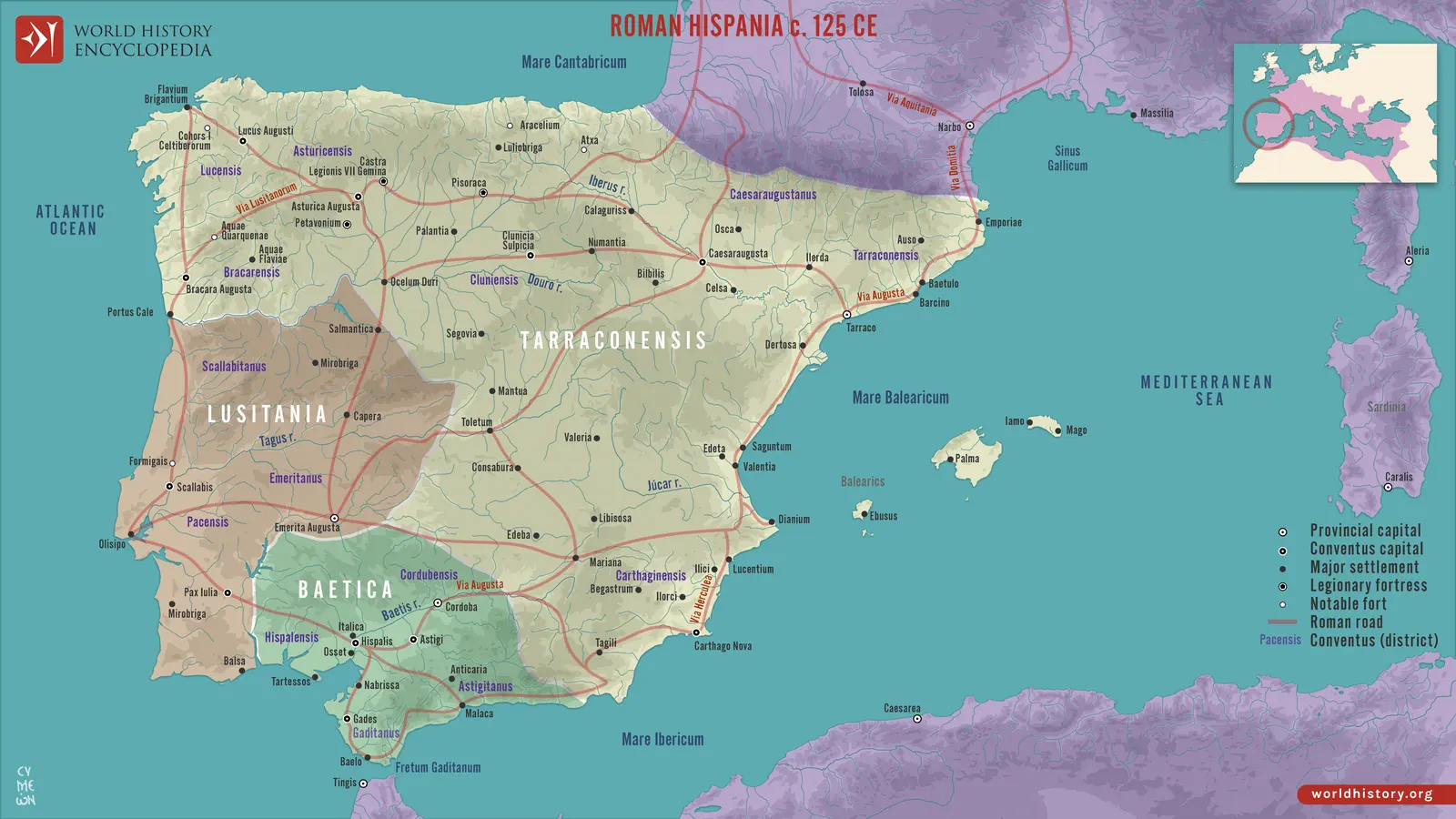
Ports and mining regions connected the peninsula to the wider Mediterranean; mountains and dispersed communities made control uneven. The destruction of Carthaginian power did not complete conquest. Lusitanian resistance, Numantine warfare, Sertorius's coalition, and Caesar's civil-war campaigns represent different struggles in the same broad theater. Later provinces and legal statuses must not be projected backward onto all of them.
Connected dossiers: Publius Cornelius Scipio Africanus, Viriathus, Publius Cornelius Scipio Aemilianus, Quintus Sertorius, Gaius Julius Caesar.
Gaul and the Rhine
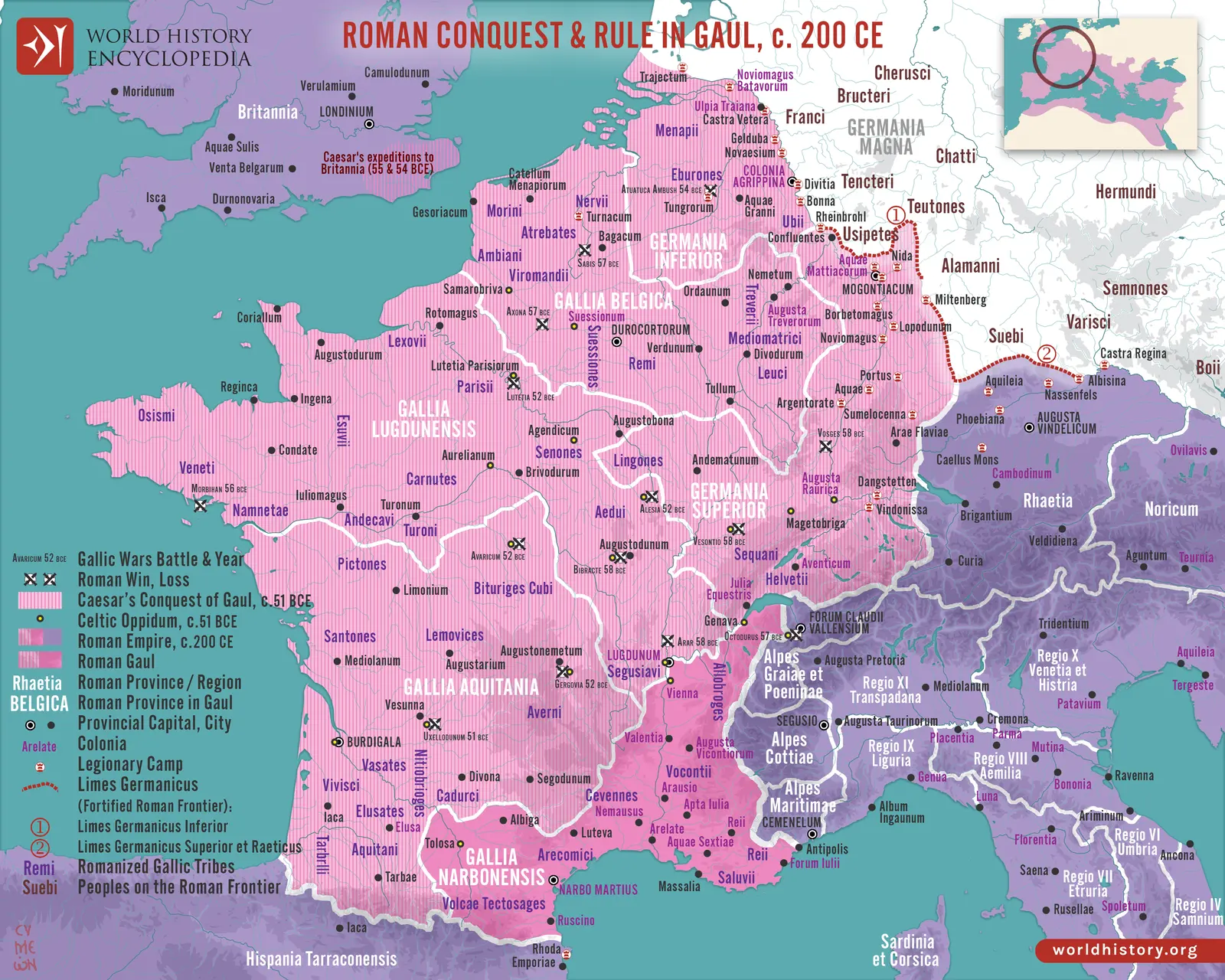
The Rhône-Saône corridor, Atlantic and Channel connections, and the Rhine military zone linked commerce, command, and recruitment. Caesar's conquest preceded the familiar provincial structure. The Rhine could be a base for campaigns beyond it, a frontier of exchange, and the source of armies that selected emperors. Late Gallic power centers often continued Roman institutions after effective control from Italy weakened.
Connected dossiers: Gaius Julius Caesar, Vercingetorix, Titus Labienus, Germanicus, Julian, Postumus, Flavius Aetius, Aegidius.
Britain and the northern frontier
Sea crossings, port access, road networks, fortresses, local communities, and military provisioning connected the island to imperial government. Conquest, revolt, northward advance, withdrawal, and successive frontier lines were separate phases. Soldiers lived within wider communities of families, traders, craftspeople, and laborers. A wall controlled movement within a larger military system; it was not the modern boundary between England and Scotland.
Connected dossiers: Claudius, Boudica, Gaius Suetonius Paulinus, Gnaeus Julius Agricola, Hadrian, Antoninus Pius, Septimius Severus, Constantine III.
North Africa
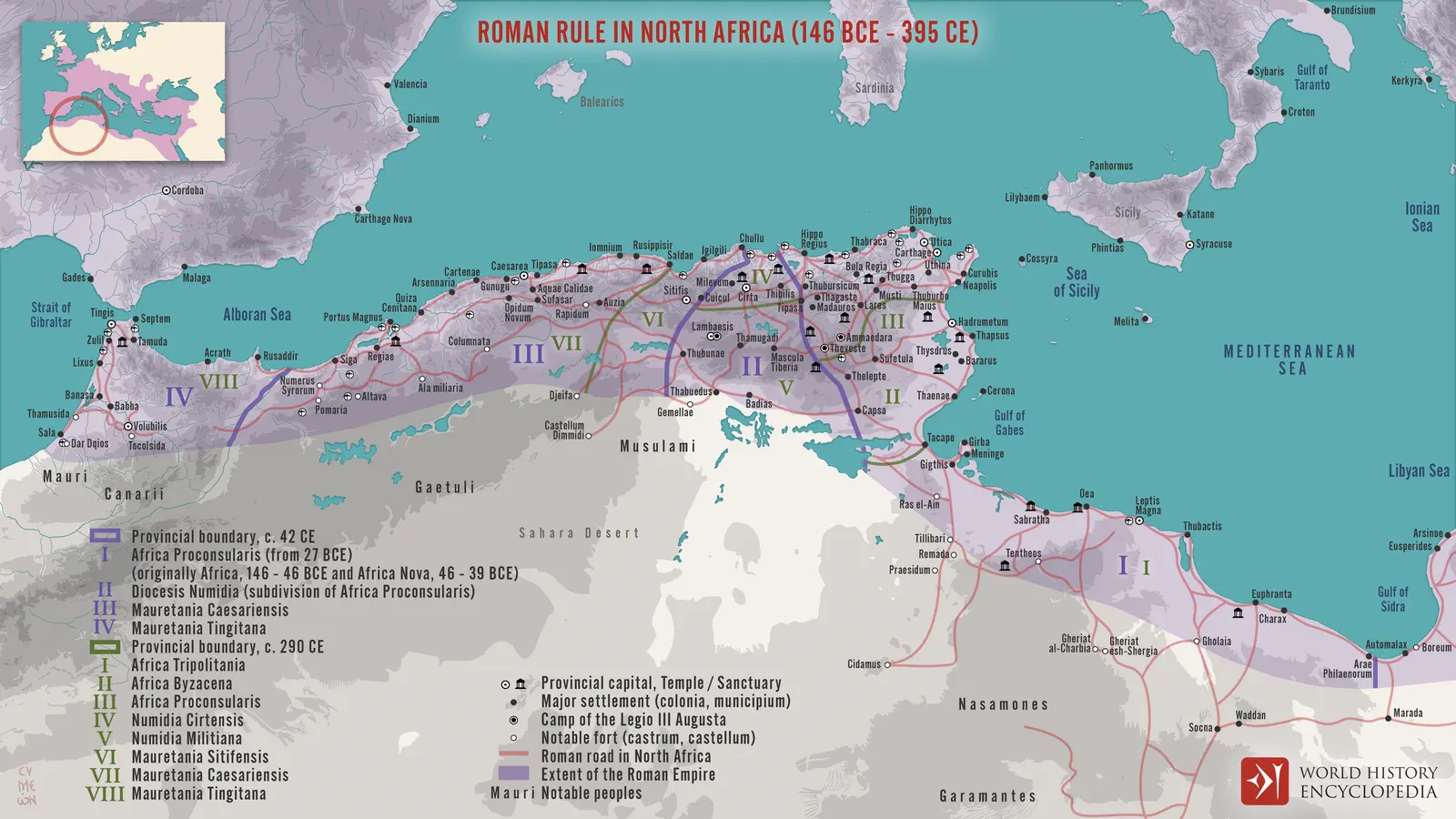
Carthage, Numidian royal territories, ports, estates, and southern routes supplied armies, cities, and the Mediterranean market. Grain and oil linked provincial production to the capital's survival. Roman conquest did not erase local identities, nor did the Vandal takeover end every Roman economic practice. Control of Africa repeatedly changed the strategic possibilities of whoever governed Italy.
Connected dossiers: Masinissa, Jugurtha, Publius Cornelius Scipio Africanus, Publius Cornelius Scipio Aemilianus, Septimius Severus, Bonifatius, Gaiseric, Belisarius, Augustine of Hippo.
Sicily and the central Mediterranean
Sicily connected North Africa, Italy, and routes through the western sea. Food supply, naval bases, siege warfare, and the movement of fleets repeatedly made the island strategically decisive. Syracuse and Sextus Pompey's maritime regime belong to different periods but expose the same principle: controlling a harbor or grain route could produce political leverage far beyond the island.
Connected dossiers: Marcus Claudius Marcellus, Pyrrhus of Epirus, Sextus Pompey, Marcus Vipsanius Agrippa, Belisarius.
Greece Macedonia and the Adriatic approaches
Passes, leagues, cities, royal strongholds, and seaborne routes connected Roman intervention to local political competition. The language of freedom could accompany growing dependence on Roman arbitration. In civil war these regions offered armies, supplies, fleets, and positions from which to challenge Italy. They were active political landscapes, not merely scenic backdrops to famous battles.
Connected dossiers: Titus Quinctius Flamininus, Lucius Aemilius Paullus, Lucius Cornelius Sulla, Gnaeus Pompeius Magnus, Marcus Junius Brutus, Marcus Antonius.
Danube Balkans and Dacia
The river linked fortified bases, roads, garrisons, provincial cities, and relationships with peoples beyond direct rule. Dacia north of the Danube was a particular conquest and later withdrawal; the later province bearing its name lay south of the river. Recruitment and military promotion made the wider region central to imperial leadership. The events of 376–378 also expose the decisive importance of provisioning and administration before battle.
Connected dossiers: Trajan, Decebalus, Marcus Aurelius, Aurelian, Diocletian, Valentinian I, Valens, Attila.
Anatolia and the province of Asia
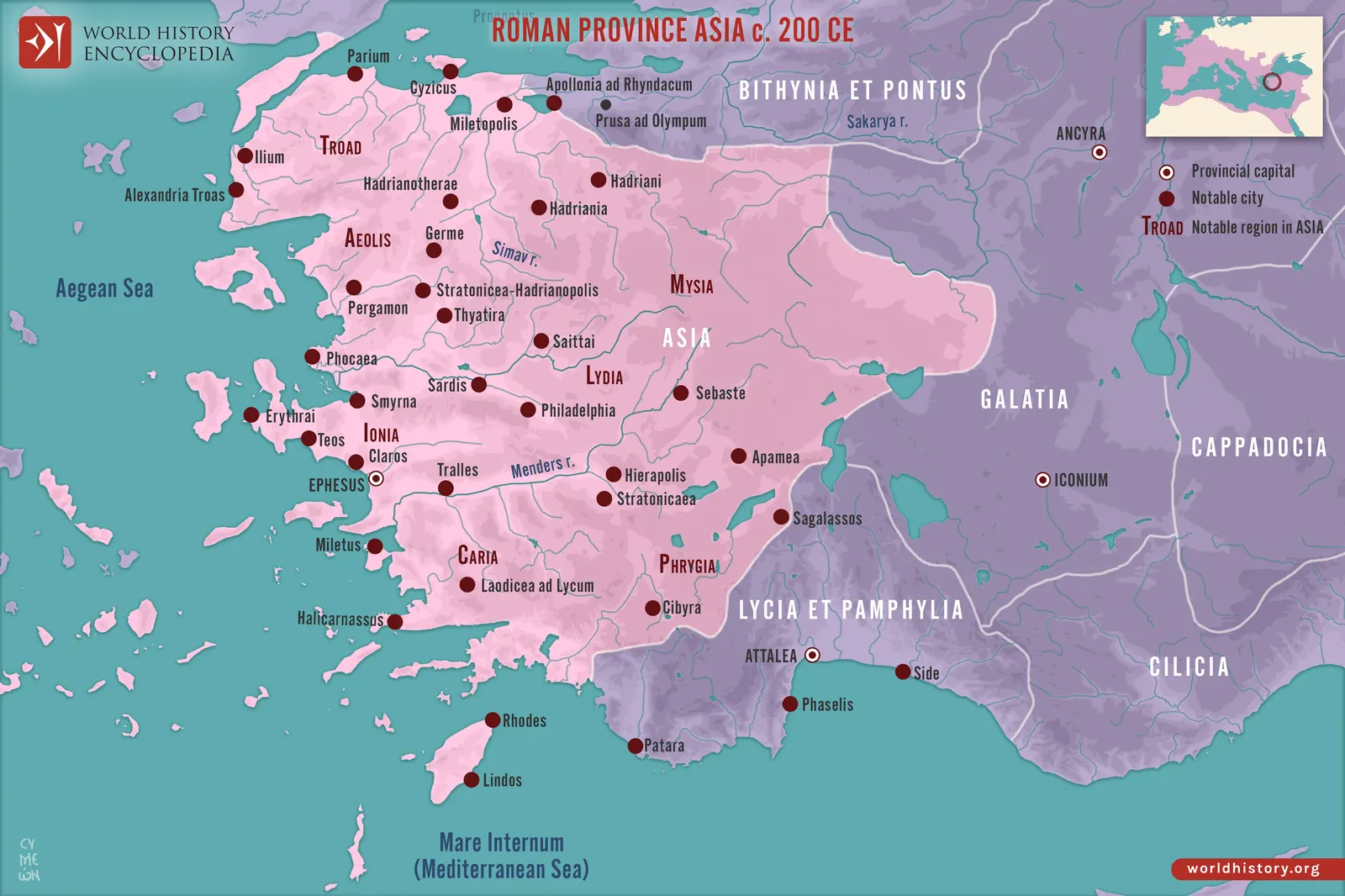
Western Anatolian cities were centers of wealth, civic competition, cult, and imperial patronage. Pontus, Bithynia, Galatia, Cappadocia, Cilicia, and Armenia had distinct and changing political histories. Routes through the peninsula connected the straits with Syria and the eastern armies. The Roman province of Asia must be distinguished from the much larger modern continent.
Connected dossiers: Mithridates VI Eupator, Lucius Licinius Lucullus, Gnaeus Pompeius Magnus, Trajan, Hadrian, Cassius Dio.
Armenia and the Caucasian approaches
Armenian kingship, aristocratic houses, routes, and fortified positions stood within the competing interests of Rome and successive Iranian empires. Influence often worked through the recognition of rulers rather than continuous annexation. A crown received at Rome could coexist with Arsacid dynastic connections. Such settlements were negotiated balances, not evidence that one imperial system had permanently absorbed the other.
Connected dossiers: Marcus Antonius, Gnaeus Domitius Corbulo, Trajan, Khosrow I.
Syria Judaea and the Levant
Antioch, the Syrian military commands, coastal cities, Jerusalem, and inland routes gave the region exceptional fiscal and strategic weight. Religious and civic communities had distinct interests that cannot be reduced to one provincial identity. Roman campaigns, revolts, Sasanian invasions, and Palmyrene expansion repeatedly altered the relationship between cities and central government.
Connected dossiers: Gnaeus Pompeius Magnus, Vespasian, Titus, Flavius Josephus, Septimius Severus, Odaenathus, Zenobia, Khosrow I.
Egypt and Alexandria
The Nile's agricultural cycle, tax administration, river transport, Alexandria's harbor, and routes toward the Red Sea made Egypt a complex imperial resource. It was not simply an emperor's private farm. The end of Ptolemaic kingship transformed sovereignty while leaving much local administrative and social life operating through inherited practices. Control of Egypt could support a claim to imperial supremacy elsewhere.
Connected dossiers: Cleopatra VII, Gaius Julius Caesar, Marcus Antonius, Augustus, Vespasian, Zenobia.
Mesopotamia and the Iranian imperial frontier
Fortified cities, river crossings, supply, diplomacy, and the limits of campaigning shaped Roman-Arsacid and Roman-Sasanian warfare. Ctesiphon could be reached or captured without permanently removing the rival monarchy. Edessa, Nisibis, Dara, and other centers changed significance across different settlements. A successful expedition and a durable province are separate achievements.
Connected dossiers: Marcus Licinius Crassus, Trajan, Septimius Severus, Shapur I, Valerian, Julian, Jovian, Belisarius, Khosrow I.
Ravenna Constantinople and courts beyond Rome
Imperial government traveled and concentrated in defensible, connected residences. Ravenna's lagoons and maritime links and Constantinople's position at the straits supported different governing systems. Palace access, troops, legal offices, bishops, merchants, and supply networks made these cities political engines. The movement of a court changed routes of opportunity without automatically abolishing older centers of prestige.
Connected dossiers: Galla Placidia, Odoacer, Theodoric the Great, Theodosius II, Pulcheria, Anastasius I, Justinian I, Theodora, Cassiodorus.