Wars · IV. The Republic at war with itself
W037 The Sertorian War
Quintus Sertorius built a durable challenge to the Sullan order by combining Roman political claims with local support in Iberia. His forces used mobility, knowledge of the country and allied networks against armies sent under Metellus Pius and Pompey. Towns, river corridors and recruitment relationships mattered more than a neat division into two states.
Roman government in exile is a useful description of one dimension of the movement, but not its whole character. Iberian allies had their own interests, and Sertorius' Roman collaborators did not always share his position. His assassination by associates under Perperna in 72 BC weakened the resistance, which Pompey then defeated.
Command, forces and military problem
| Field | Dossier |
|---|---|
| Roman leadership | Metellus Pius and Pompey for the Roman government |
| Opposing or rival parties | Sertorius and Roman collaborators with Iberian allies |
| Forces and capabilities | Mixed Roman and Iberian forces using towns, local networks and mobile campaigning |
| Operational problem | Defeat a rival political organization without secure control of all local support systems. |
Campaign geography and operational plates
Hispania: resources, cities and military geography
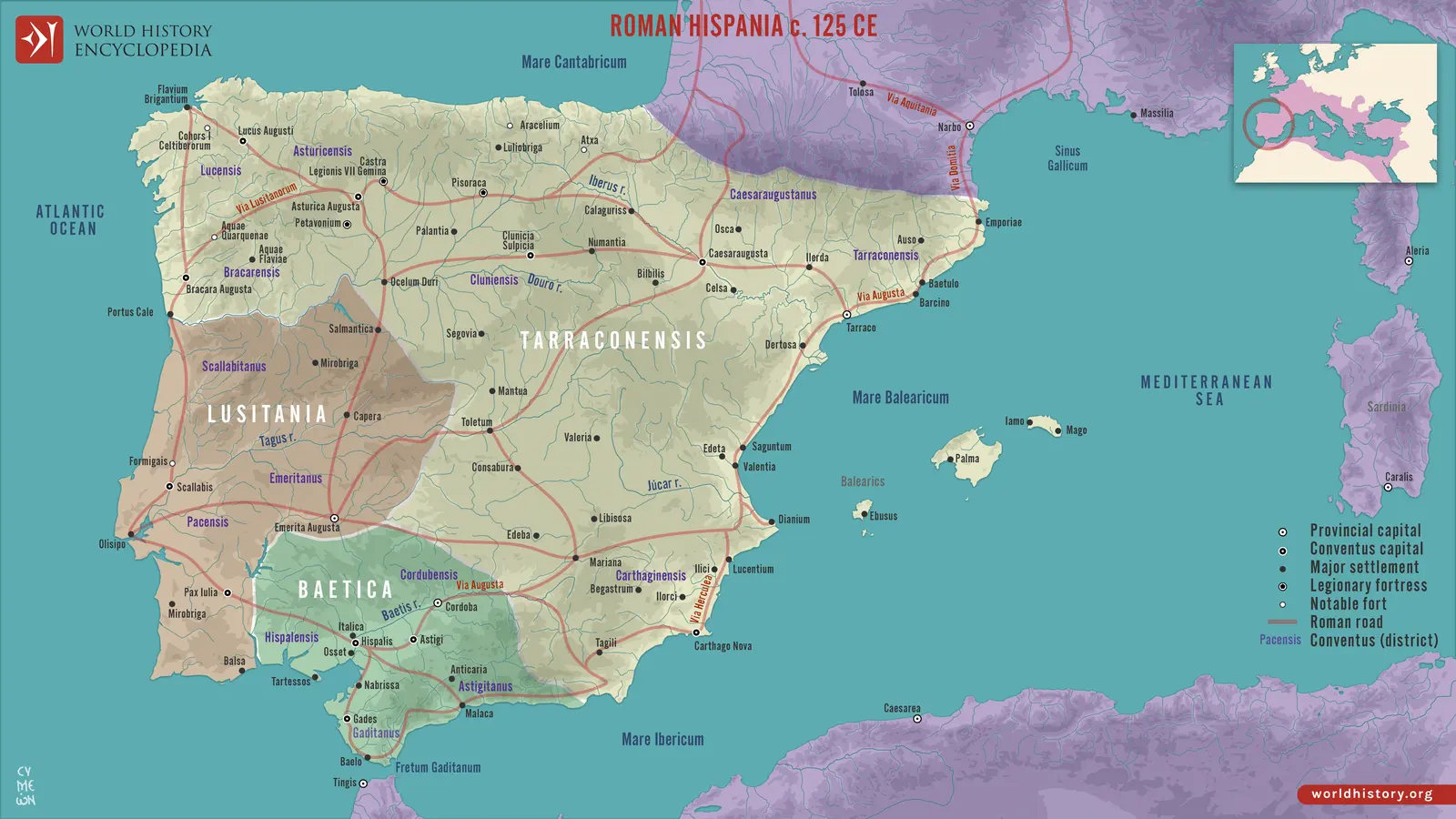
The mature city and road network shows the scale of what Roman rule eventually connected. It should be compared with the much less secure operational situation faced by Sertorius' opponents and by Augustan armies in the north. Mineral resources and later infrastructure help explain the value of control without proving that conquest was driven by one uniform economic plan.
Extended campaign study
The account below develops the operations and their interpretation. Reported numbers and reconstructed tactical details retain the uncertainties described in the dossier.
Sertorius: The Republic in Exile (80–72 BC)
The Sullan settlement's first great war was fought against the best soldier the Marian cause ever produced. Quintus Sertorius — Sabine, novus homo, the officer whose conscience had ended the Bardyaei and whose eye had been lost in the Cimbric war (he alone of Roman commanders, Plutarch notes, wore his mutilation as an ornament) — had taken the praetorian province of Nearer Spain in 83, been proscribed and driven out in 81, and returned in 80 at the invitation of the Lusitanians to become, for eight years, the most dangerous man in the Roman world: an outlaw proconsul governing half the peninsula through a counter-state of his own construction. He gave the exiled Marians a senate of three hundred; he gave the Spanish nobility a school at Osca where their sons learned Latin and the toga — education and hostageship in one institution, the boys' fate a lever he would eventually, in his decline, use with a cruelty that stained him; he gave the tribes his justice, his charisma, and the white fawn of Diana that followed him like a dog and through which, he let it be believed, the goddess whispered intelligence — the fawn's disappearances and returns stage-managed, Plutarch says frankly, to schedule revelations whose real sources were his scouts. And he gave the Roman government a military education. Metellus Pius, the ponderous and competent proconsul sent against him, was run ragged for years by a war of ambush, feint, and vanished columns — Sertorius lecturing his Spanish levies, in the parable the tradition loved, with the two horses: the strong man exhausting himself tearing at the sound horse's tail, the weak man plucking the feeble horse's hairs one by one until the tail was gone. When the government reinforced with Pompey in 77 — twenty-nine years old, never a magistrate, granted proconsular imperium by a Senate that swallowed the irregularity with the epigram of the consul-elect Philippus, that he went out not in place of a consul but in place of both of them — Sertorius handed the young conqueror his tuition at Lauron, luring him to spectate the town's siege and then revealing, once Pompey stood committed before the walls, the six thousand men posted behind him, so that Pompey watched the town burn — the phrase went around — as an audience rather than an army. The campaigns of 76 and 75 in the eastern river valleys were the war's hard center: at the Sucro Pompey, attacking without waiting for Metellus, was beaten on his own wing and escaped capture only by abandoning to the Spaniards a horse caparisoned in gold, which they paused to fight over; at Saguntum the allied armies bled each other through a drawn day; and in the winter of 75–74 Pompey's dispatch to the Senate — preserved in substance by Sallust — announced that his unpaid, unfed army had conquered the passes and the coast, and that if the treasury did not act, the war and the army would come home to Italy together: the client-army logic of the age, stated for the first time as fiscal policy.
Rome paid; the attrition told; the Roman exiles around Sertorius, despising the Spanish war they could not win and the Spanish loyalty they could not command, curdled into conspiracy under Marcus Perperna, the well-born mediocrity whose army had joined Sertorius over his objection in 77; and the guerrilla king's last years darkened — the hostage-school's pupils punished for their fathers' defections, the drinking noted by a tradition hostile enough to invent it, the fawn's oracles wearing thin. In 73 Perperna's faction murdered Sertorius at a banquet staged for the purpose, the assassins' signal a dropped cup, the one-eyed man dying under the couches where he had been invited as a guest. The sequel was brief and instructive: Perperna, inheriting the war, was out-generaled by Pompey within weeks, taken in ambush, and — playing his last card — offered up Sertorius's captured correspondence, letters from named men of consular rank in Rome inviting the outlaw to Italy.
Outcome and critical assessment
Result and caution: the challenge was suppressed and Pompey's standing increased. "Guerrilla" and "republic in exile" are interpretive labels, not complete descriptions. Anecdotes about Sertorius' white fawn illustrate the construction of authority and memory; they cannot substitute for evidence about every campaign's operations.
Historical record: IR-V, chapter 5; Plutarch, Sertorius; Appian, Civil Wars 1 and Iberian references.