Wars · IV. The Republic at war with itself
W035 The Second Mithridatic War
The settlement ending the first war left competing claims and suspicion in Anatolia. Lucius Licinius Murena undertook attacks against Mithridates while Sulla was occupied elsewhere. Mithridates resisted and defeated Murena's forces; Roman instructions eventually brought the conflict to an end.
This brief war is valuable to the archivist because it exposes the gap between a treaty and its enforcement. A governor's or commander's initiative could reopen hostilities without an entirely new grand strategy authorized and directed from Rome.
Command, forces and military problem
| Field | Dossier |
|---|---|
| Roman leadership | Murena; Sulla as the authority eventually ordering termination |
| Opposing or rival parties | Mithridates VI and Pontic commanders |
| Forces and capabilities | Raiding and field forces in a disputed postwar frontier |
| Operational problem | Control a subordinate commander's initiative and prevent a local war redefining a treaty. |
Murena and the unfinished first settlement
The agreement at Dardanus had left Mithridates ruling Pontus. Roman power had been reasserted in Asia, but the first war had not removed the king, settled every Cappadocian issue or produced unquestioned confidence between the parties. Sulla's return to Italy also left subordinate commanders with room for initiative far from his immediate direction.
Murena interpreted Mithridates' preparations as a threat and advanced into the king's sphere. Mithridates appealed to Roman authorities while trying to avoid accepting further encroachment. The resulting clash illustrates how a treaty could be undermined by competing interpretations of military preparation: a force assembled for one concern could be represented by an opponent as preparation for renewed aggression.
The campaign and reversal
Roman raids and seizure of resources did not force Mithridates into submission. The king's counterstroke defeated Murena and restored his position. The conflict's relatively small place in later grand narratives should not obscure its meaning to communities subject to raids, requisitions and uncertain authority.
Sulla's intervention brought the fighting to an end. The outcome depended on Rome's internal hierarchy as well as the balance of armies in Anatolia. A commander who could initiate a damaging local war was not necessarily able to redefine the entire eastern settlement permanently.
Why the short war deserves a separate record
The second war interrupts any picture of an uninterrupted Roman march from Sulla to Pompey. It had its own opening, command problem, military reverse and termination. Its immediate outcome favored Mithridates more than the customary summary "Rome won the Mithridatic wars" suggests. The third war required a new mobilization and a new strategic contest, not merely the completion of Murena's successful work.
The surviving evidence does not support detailed troop tables or a precisely traced itinerary of every raid. Its strength lies in revealing the contested operation of a settlement. The absence of a famous named battle makes a separate dossier more, not less, useful: it preserves a real war that is otherwise easily erased by the fame of Chaeronea, Tigranocerta and Pompey's final victories.
Campaign geography and operational plates
Bithynia and Pontus: the northern Anatolian corridor
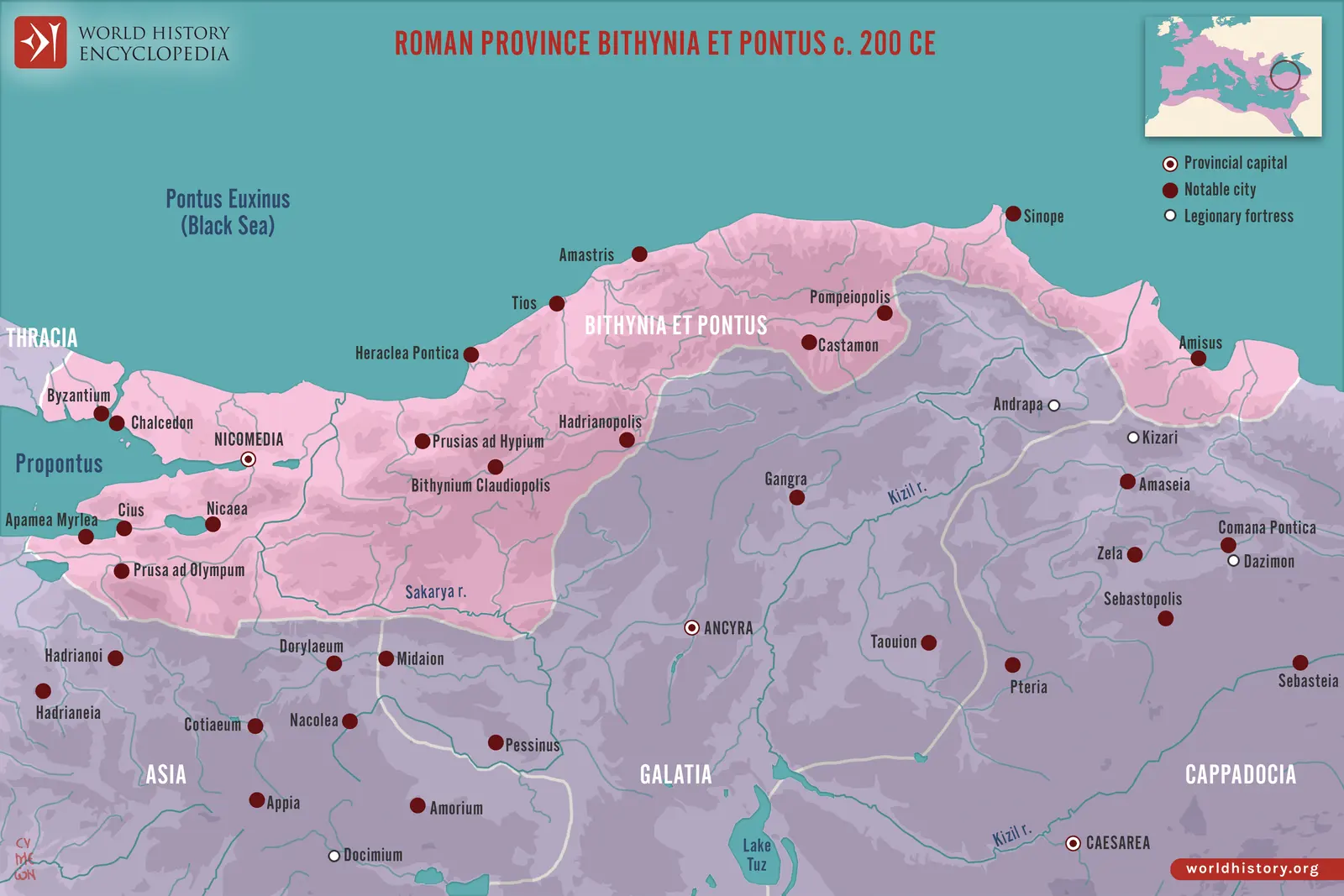
The southern Black Sea coast and inland connections give the Mithridatic wars a more specific geography than a single outline of Asia Minor. The cities shown survived in changing political frameworks. Provincial boundaries and Roman administrative details on this later map are not the borders that Mithridates inherited or controlled.
Outcome and critical assessment
Result and caution: the fighting produced no decisive conquest of Pontus. It should be separated from both Sulla's first war and Lucullus' later campaigns. A table that presents the Mithridatic wars as a single continuous forty-six-year conflict obscures distinct wars, intervals and settlements—and does not match the normal 88–63 BC chronology.
Historical record: Appian, Mithridatic Wars, Murena episode; IR-V, Mithridatic context. Primary reading is especially important because brief wars are easily lost in compressed timelines.