Wars · IV. The Republic at war with itself
W036 The Third Mithridatic War and the Armenian campaigns
Battles and sieges
Tigranocerta 69 BCThe Roman acquisition of Bithynia and Mithridates' renewed challenge led to another major war. Lucullus relieved the pressure around Cyzicus and drove the campaign into Pontus. Mithridates' refuge with Tigranes II drew Roman forces into Armenia, including the campaign at Tigranocerta in 69 BC.
Distance, difficult country, winter conditions, troop resistance and political opposition at Rome limited Lucullus' ability to turn victories into a final settlement. Pompey received the command in 66 BC, reorganized operations and diplomacy, and extended Roman influence across the region. Mithridates died in 63 BC after retreating to his Bosporan power base.
Command, forces and military problem
| Field | Dossier |
|---|---|
| Roman leadership | Lucullus and then Pompey |
| Opposing or rival parties | Mithridates VI, Tigranes II and associated rulers |
| Forces and capabilities | Roman expeditionary forces against royal armies across Anatolia and Armenia |
| Operational problem | Sustain distant campaigning and translate victories into a politically durable settlement. |
Campaign geography and operational plates
Anatolia: plateaus, cities and the southern mountain barrier
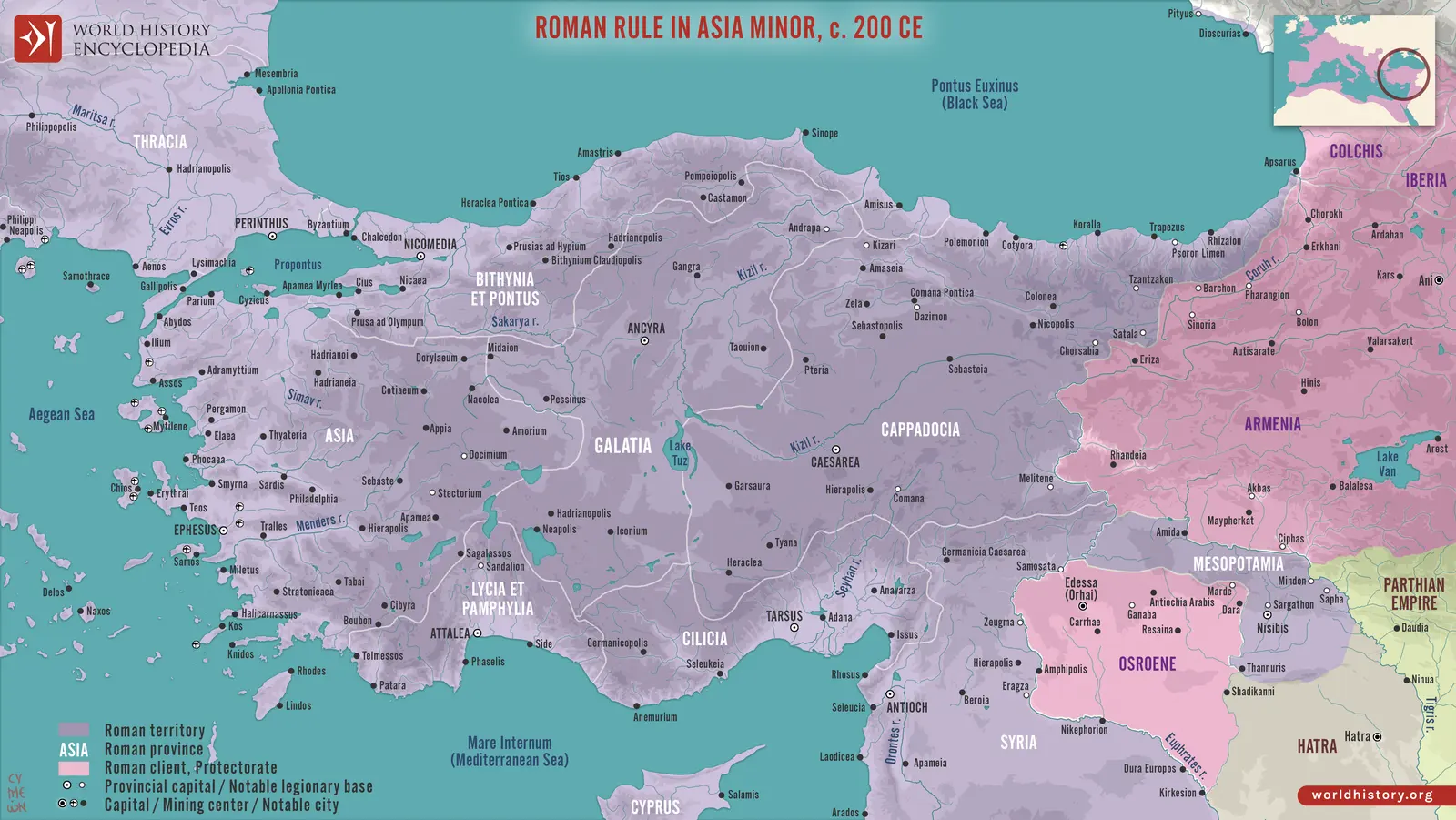
The Taurus region and the distinction between the coastal approaches and the interior help explain both large eastern expeditions and prolonged stronghold resistance. A later provincial map can orient the reader without reconstructing the legal borders of the Mithridatic or Isaurian wars. Routes and dates must still come from their individual dossiers.
Bithynia and Pontus: the northern Anatolian corridor
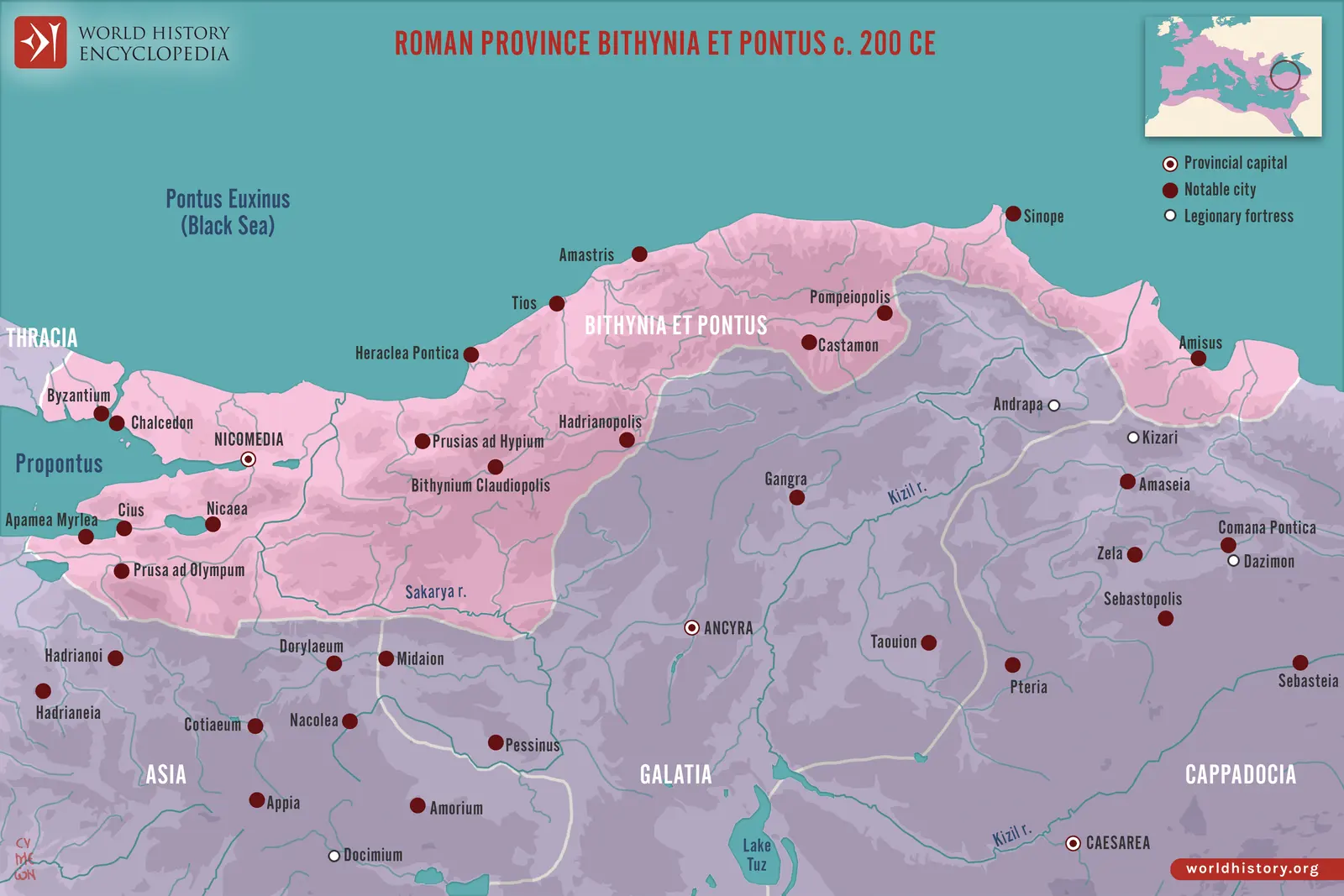
The southern Black Sea coast and inland connections give the Mithridatic wars a more specific geography than a single outline of Asia Minor. The cities shown survived in changing political frameworks. Provincial boundaries and Roman administrative details on this later map are not the borders that Mithridates inherited or controlled.
Extended campaign study
The account below develops the operations and their interpretation. Reported numbers and reconstructed tactical details retain the uncertainties described in the dossier.
Lucullus (74–66 BC)
The final reckoning with Mithridates opened in 74 BC, when the childless king of Bithynia died and willed his realm to Rome in the Attalid manner, planting a Roman province on the Pontic doorstep. Mithridates — who had spent the peace rebuilding his army on Roman lines, re-equipping the phalanx-mass of the first war as legionary-style cohorts, and negotiating with Sertorius, whose renegade officers now drilled Pontic infantry — struck first, overran Bithynia, and penned the consul Cotta in Chalcedon with the loss of the Roman fleet. His army then fixed itself upon the great Propontic city of Cyzicus, loyal to Rome, and the war's shape was set by the response of the other consul of 74: Lucius Licinius Lucullus — Sulla's old quaestor, the only officer who had marched on Rome with him, now a commander of consummate patience in his mid-forties — who declined battle against the king's enormous host, seized instead the single ridge commanding its supply roads, and announced to his impatient officers that he would defeat Mithridates without fighting him. He did. The winter of 74–73 before Cyzicus consumed the royal army — which ate its baggage animals, then its dead — while the city's defenders held every assault from sea and mole; the spring breakout was harried into the flooding rivers with losses the sources put near two hundred thousand men from all causes; and Lucullus, following the wreck eastward, spent 72 and 71 dismantling the Pontic heartland, destroying the king's last field army at Cabira in a campaign of maneuver among the river gorges, until Mithridates — his baggage-train's gold scattered behind him to slow the pursuit, his sisters and wives sent the executioner's order that royal households might not fall to the enemy — crossed the mountains a fugitive, to the court of his son-in-law Tigranes of Armenia.
Tigranes, styled King of Kings, ruled at that hour the greatest power in western Asia — an Armenia swollen by the Seleucid collapse to reach from the Caspian to the Levant, its captive populations concentrated in the new royal city of Tigranocerta — and he kept the Roman envoy waiting while declining, with imperial languor, to surrender his guest. Lucullus's answer was the boldest march in Republican history: in 69, with two legions and change — perhaps fifteen thousand men, unauthorized by any senatorial vote — he crossed the Euphrates and the Tigris and appeared before Tigranocerta. The king, returning with a relief host the sources number at over two hundred thousand and delivering upon the small Roman force the most quoted sneer of the age — too many for an embassy, too few for an army — was destroyed on the sixth of October in the battle that stands as the tactical masterpiece of the period: Lucullus, refusing the numbers a static defense, led his cohorts personally through a ford and up an unregarded hill onto the plateau behind the Armenian cataphract wing, took the armored cavalry in the rear before it could wheel, and drove it through its own unformed infantry masses, which dissolved without ever engaging; the Roman casualty return — five dead, a hundred wounded, against uncounted tens of thousands — belongs with Sulla's at Chaeronea in the museum of victors' arithmetic, but the disproportion of the field is not in doubt. The instrument of his fall, though, was his own army: unpaid in the spectacular manner of the age, marched beyond the maps, wintered in Armenian snows, and worked upon by the young aristocrat Publius Clodius — Lucullus's own brother-in-law, calling himself the soldiers' friend — the legions refused, after one further victory at Artaxata and the hardest marching of the war, to go further; the mutinies of 68–67 dissolved the conquest; Mithridates re-entered Pontus over the ruin of a Roman detachment at Zela; and Lucullus, superseded piecemeal by the Manilian arrangements below, went home to his gardens, his library, his fishponds, and his cherry trees — he had brought the cherry from Pontus to Europe — to become, in retirement, the proverb of luxury the tradition prefers to the general who had broken two empires with five legions.
Pompey's Settlement of the East (66–62 BC)
The war itself, against an enemy Lucullus had twice broken, was brief. Pompey — commanding, with the combined authorizations, the largest force Rome had ever deployed in Asia — refused the aging king's negotiations (the terms demanded were surrender entire), maneuvered him out of successive river-lines in Lesser Armenia, and in a night action along the Lycus in 66, near the site where the city of victory, Nicopolis, would rise, caught the Pontic army by moonlight in a defile with the moon at the Roman backs — the lengthened shadows drawing the enemy's missile-aim short, the sources say — and annihilated it.
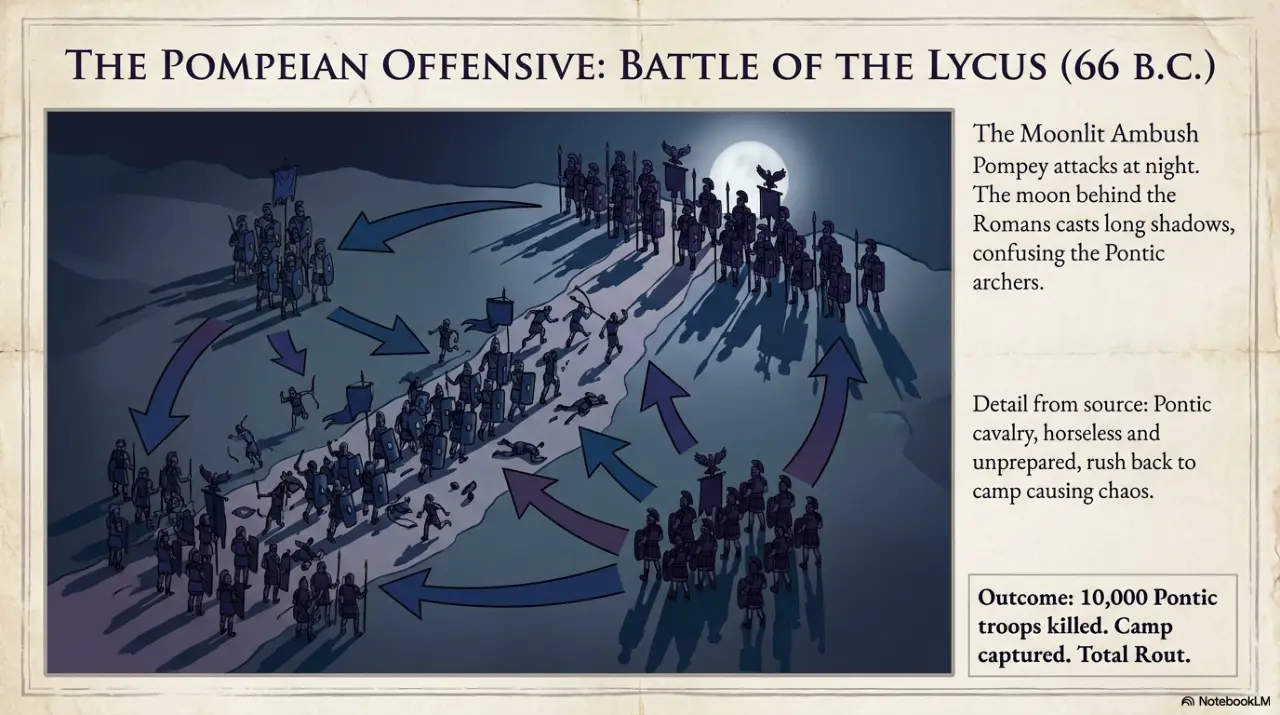
Mithridates escaped the field with a bodyguard, was refused by Tigranes (who set a price on his head, having his own peace to make), and performed then the last astonishment of his life: a fugitive march around the eastern Black Sea, through the Caucasus, to his Crimean kingdom, where the old king — now past sixty-five — set about levying Scythian armies for a descent on Italy by the Danube, an Alexander-project in a mirror, until his own cities and his own son Pharnaces revolted at the prospect. Besieged by his child in his own palace at Panticapaeum in 63, Mithridates took the poison that had been his life's study and found himself — the tradition's irony is too apt to be safe, and too early to dismiss — proof against it; the sword of a Gallic officer of his guard, Bituitus, finished what forty years of antidotes prevented. Pompey, receiving the news amid his Judaean operations, granted the body royal burial in the Pontic tombs at Sinope. Tigranes had already made his peace — riding into the Roman camp, dismounting, and laying his diadem at the proconsul's feet, to receive it back with Armenia proper and the title of friend, minus the empire and six thousand talents; his heir, who had guided the Romans in, objected to the arithmetic and adorned the triumph instead.
What occupied Pompey thereafter was not war but architecture. The campaigns of 65–63 — the Caucasian expeditions against Iberi and Albani to the edge of the Caspian; the descent into a Syria vacant of Seleucids, annexed by a sentence; the intervention in the Hasmonean civil war that ended with the three-month siege of Jerusalem's Temple mount and the storm of it on a Sabbath, ten thousand defenders dying and Pompey walking — the act echoed for a century in Jewish memory — into the Holy of Holies, where he touched, with deliberate publicity, nothing — were the punctuation of an administrative reconstruction of half the ancient world. Four new provinces (Bithynia-Pontus, Cilicia enlarged, Syria, Crete from the parallel war of Metellus); a client periphery ordered in depth — Armenia, Cappadocia, Galatia, Judaea under the high priest Hyrcanus, the Bosporan kingdom under the parricide Pharnaces, a dozen lesser tetrarchies — each dynast graded, taxed, and bound to Rome by the person of Pompey; thirty-nine cities founded or refounded; and the Roman public revenue raised, Plutarch's figures, from fifty million denarii to eighty-five, with twenty thousand talents brought to the treasury besides the donatives that made his veterans small gentry. He had done it all — the constitutional point was not missed at Rome — by his own discretion, without a senatorial commission, treating with kings as a king; and in December 62 he landed at Brundisium, the most powerful Roman who had ever lived, master of an army that worshiped him and an East that obeyed him — and disbanded the army at the dock, asking of the Republic only ratification of his acts in gross and land for his soldiers.
Behind the chariot, unadvertised, rode the facts of the new age: that Rome's East was one man's clientele; that six eastern legions' worth of veterans awaited their farms upon his word; and that the constitution possessed no category for what Pompeius Magnus now was, except the one nobody would yet speak.
Of the domestic convulsion that filled the interval of his absence — the debt-crisis conspiracy of the ruined patrician Lucius Sergius Catilina in 63, detected and denounced in Cicero's consulship through the four extant Catilinarian orations; the executions without trial of the arrested conspirators under the senatus consultum ultimum, carried in the Senate against the argued opposition of the praetor-elect Julius Caesar by the intervention of Marcus Porcius Cato, in the paired speeches Sallust made the moral centerpiece of Roman historiography; and the end of Catiline himself in January 62 at Pistoria, dying far forward among the enemy dead with his wounds in front — the episode had important consequences: the execution vote would follow Cicero into exile a decade later; the clemency argument would follow Caesar to the Ides; and the ultimum decree had now killed citizens under four different constitutions, and had one deployment left.
Outcome and critical assessment
Result and caution: Pontic power was broken and the eastern political map changed profoundly. The settlement involved provinces, allied rulers and negotiated relationships, not uniform annexation. The identification of Tigranocerta has a scholarly history; its gazetteer point does not settle every problem in reconstructing Lucullus' battle.
Historical record: IR-V, chapter 6; Appian, Mithridatic Wars; Plutarch, Lucullus and Pompey; Dio, surviving Republican narrative.