Wars · I. The making of Roman Italy
W007 The Latin War
The Latin communities' relationship with Rome was no longer a stable partnership between comparable powers. The war tested who would control the alliance's manpower, diplomacy and political benefits. Rome fought with Samnite support against a shifting coalition of Latin and Campanian opponents.
Tradition places major fighting near Vesuvius and Trifanum. The lasting strategic transformation, however, was the differentiated settlement after victory. Communities received varying relationships with Rome: citizenship, restricted citizenship, treaties, obligations and loss of autonomy. The former Latin organization could no longer function as an independent counterweight.
Command, forces and military problem
| Field | Dossier |
|---|---|
| Roman leadership | Titus Manlius Torquatus and Publius Decius Mus |
| Opposing or rival parties | Latin and Campanian opponents; Samnites supporting Rome |
| Forces and capabilities | Related Italian military traditions on both sides; changing allied contributions |
| Operational problem | Break a rival coalition and redesign the legal and military relationships of Latium. |
Extended campaign study
The account below develops the operations and their interpretation. Reported numbers and reconstructed tactical details retain the uncertainties described in the dossier.
The Latin War (340–338 BC)
The Latin League, with which Rome had been associated since the Cassian treaty of 493 BC, had originally been a federation of city-states of roughly equal weight, organized for mutual defense against the Aequi and Volscians and bound by ceremonies on the Alban Mount. By the mid-fourth century the equality had become a fiction. Rome alone had grown faster than her allies; she alone had emerged strengthened from the wars of the fifth century; she alone controlled the principal cult sites and a disproportionate share of the spoils of joint campaigning. The Latins had grown to resent the dominance and to fear, with reason, that their own civic independence would not long survive Rome's continued ascendancy. The Samnite war had exposed Roman strain and Roman manpower demands; the Latins concluded that the moment for a final assertion of their independence had come.
The principal grievance the Latins put forward was specific and constitutional: they demanded full incorporation into the Roman state, with one of the two consulships reserved annually for a Latin and half the Senate to be drawn from Latin cities. The Roman consul Titus Manlius Torquatus reportedly replied that if the demand were ever heard in the Capitoline temple itself he would kill the speaker with his own sword. The reply, if it was made, reveals the depth of the Roman determination not to share power with the cities she had come to regard as subordinates. The Latins, having received no satisfaction, took the field. The Volscians and several Campanian cities (including, treacherously from the Roman point of view, Capua herself) joined the Latin coalition. The Samnites, in a development the Romans had hoped for and apparently negotiated, remained neutral or even supported Rome — the Samnite-Latin enmity over Campanian influence proving stronger than any anti-Roman solidarity.
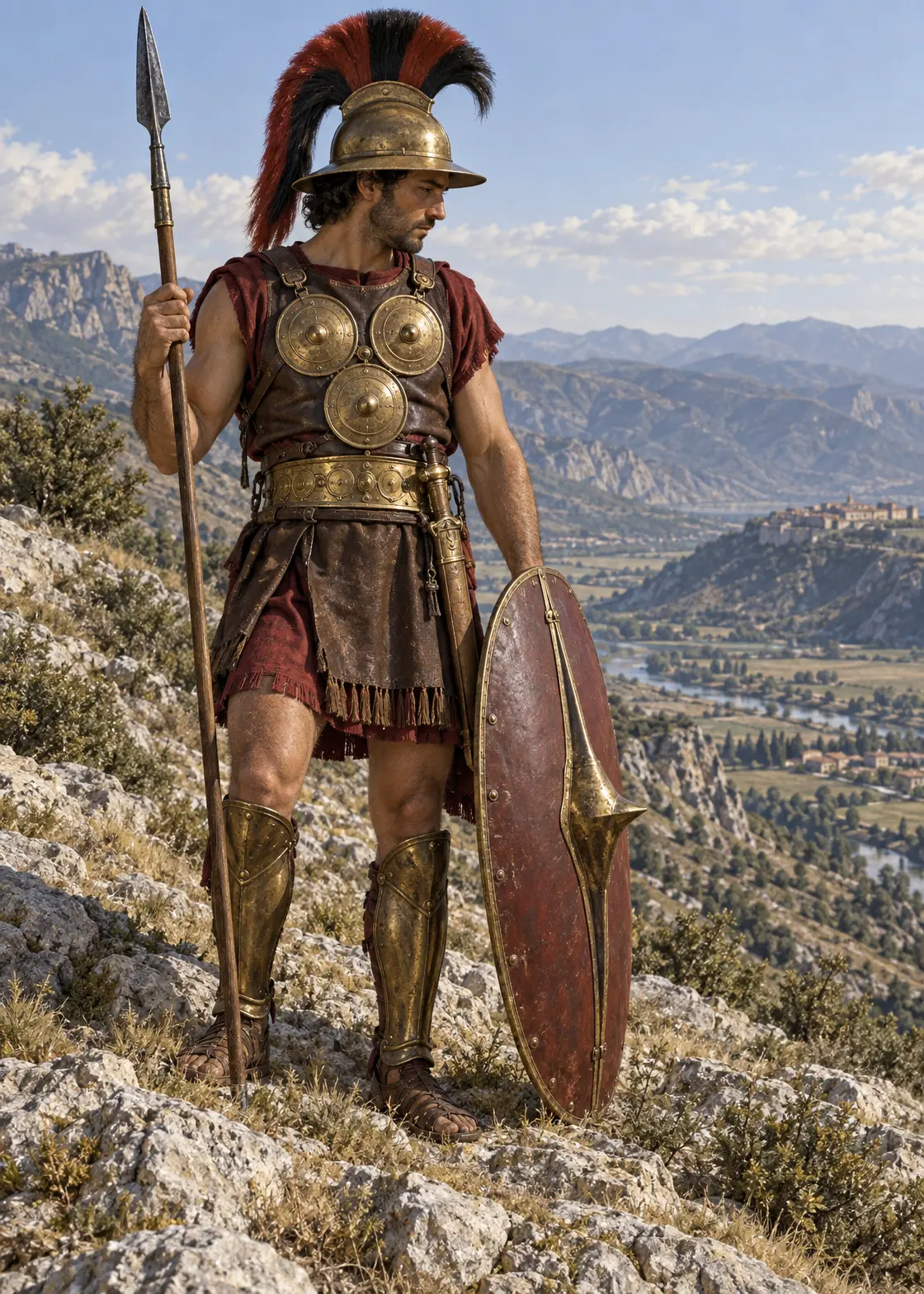
The Battle of Vesuvius (340 BC), the first of the two, was fought on the plain north of the volcano (which was, at this date, dormant and not yet recognized as a volcano at all). The Roman army was commanded by the two consuls of the year: Titus Manlius Torquatus and the younger Publius Decius Mus — son of the Decius Mus of Saticula and father of yet another Decius Mus who would die at Asculum. The Latin army was commanded by their own collegial leadership, with the Campanian and Volscian contingents supporting. The two armies, drawn up against each other on level ground, presented an unusual problem: the Latins fought in exactly the Roman style. Their language, their equipment, their tactical organization, even their drill and their command vocabulary were all but identical to the Roman. The combat, when it came, would be one Roman army against a near-mirror image of itself.
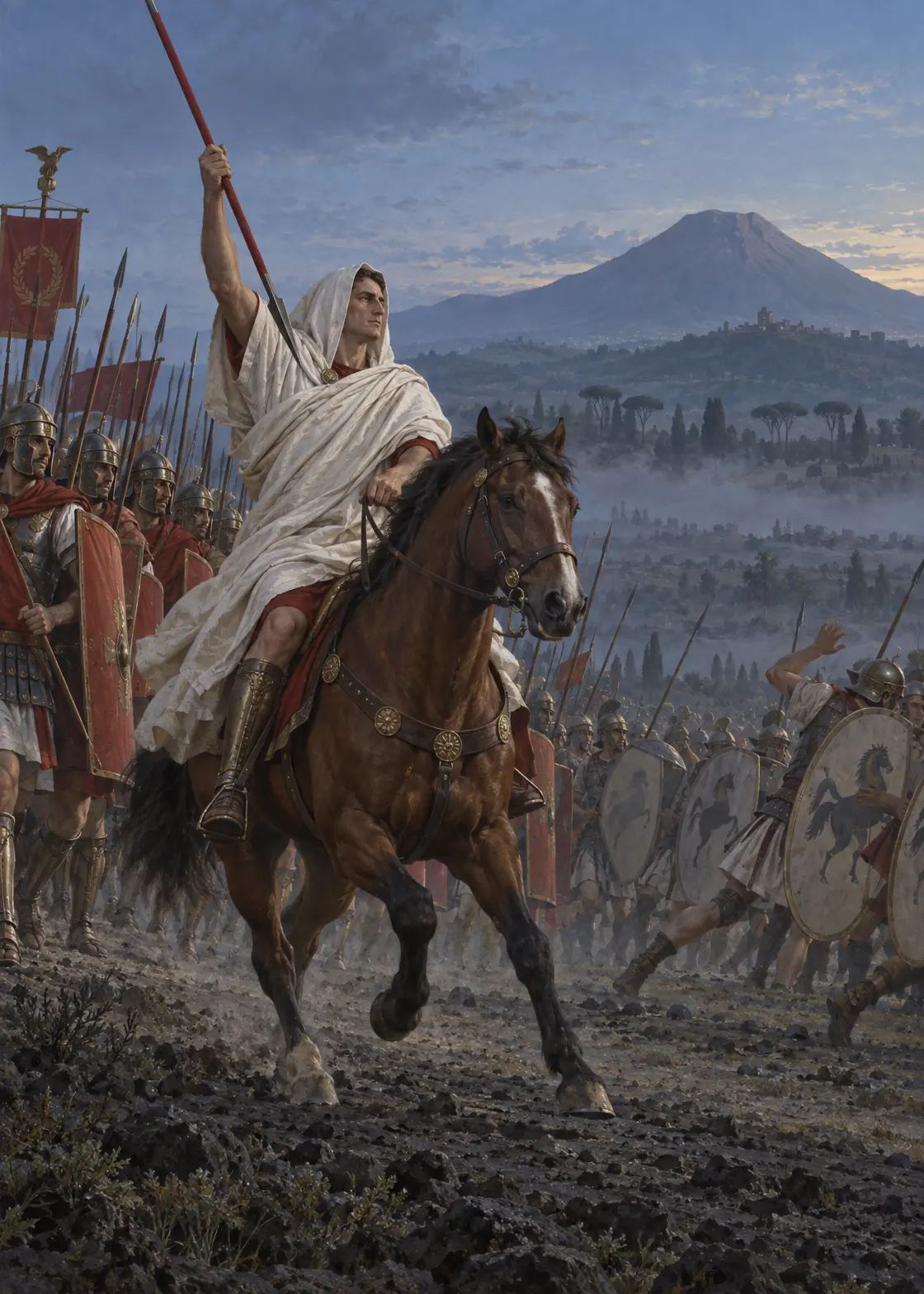
It was on the eve of this battle that the two consuls received, according to the tradition Livy follows, a shared portent in their sleep: a vision in which it was revealed that the army whose general devoted himself to the gods of the underworld would win, and the army whose general was so devoted would lose. The consuls agreed between themselves that whichever wing first showed signs of giving way, the commander of that wing would perform the ritual of devotio — devoting himself and the enemy army to the gods below — and ride into the enemy line to die.
The devotio of the Decii is the single most extraordinary tradition in the early Republican military record. The formula consigned the speaker and the enemy army to the gods of the underworld. The speaker would then ride against the enemy unarmed or fighting recklessly until killed. If the ritual was performed correctly and the devotus fell, the gods were bound to deliver the enemy army to destruction. If the devotus survived, an effigy had to be buried in his place and the man was forever after disqualified from religious office. The ritual was, evidently, archaic; it preserved something of the deep substrate of Italic religion at a moment when Greek and Etruscan rationalism had not yet wholly displaced the older formulations.
At Vesuvius, Decius Mus performed the devotio. The Roman left, where Decius commanded, had begun to give way; he summoned the pontifex Marcus Valerius to dictate the formula, mounted his horse, and charged the Latin line until killed. The Latins, the tradition reports, faltered in superstitious dread at the sight; the Roman line stiffened and held; Manlius Torquatus, commanding the right, pressed his advantage; and the Latin army broke and was destroyed. The casualties on both sides were severe — Livy gives a figure of seventy-five percent loss for the Latins, which is doubtless inflated but reflects the Roman memory of the engagement as a battle of annihilation.
But Manlius Torquatus's own contribution to the day's discipline was no less remarkable. Before the battle, his own son — Titus Manlius the younger — had violated explicit orders by accepting single combat with a Latin champion named Geminus Maecius. The son had won the combat and brought the spoils to his father. The father, in the most famous act of disciplina militaris in the Roman military tradition, had his son executed on the spot. Imperia Manliana — Manlian commands — became the proverbial expression for orders enforced with absolute and unbending severity. Livy reports the episode at length and with evident discomfort, recognizing that the Roman tradition celebrated it as an exemplary act while finding it personally horrifying. The combination of the devotio of Decius and the execution of the younger Manlius gave the Battle of Vesuvius an exemplary force in Roman memory disproportionate to its purely military significance.
The Latin Settlement of 338
What followed in 338, after two further years of mopping-up operations, is one of the most important political-military decisions in Roman history. The Romans had to determine what to do with the defeated Latins. The available models were familiar from Greek practice: outright annexation; vassalage with tribute; expulsion of populations; the establishment of garrisons. The Romans chose none of these, or rather they chose all of them, in a graduated arrangement matched to the specific circumstances of each defeated community.
The Latin League itself was dissolved as a political entity. The principal Latin cities — Tusculum, Aricia, Lanuvium, Pedum, Nomentum — were granted full Roman citizenship and incorporated directly into the Roman state. Their populations became Roman citizens with all rights and obligations; their territories became Roman territory; their magistrates were absorbed into the Roman political class. Other Latin communities, less central or less reliable, received a status known as civitas sine suffragio — citizenship without the vote — which gave them the protections of Roman law and the obligation of Roman military service but withheld the franchise. Some communities (Tibur, Praeneste) were left as nominally independent allies but bound to Rome by treaty. The Latin colonies — settlements founded jointly by the League — were preserved but were now Roman colonies under Roman supervision. Capua and the Campanian cities, despite their defection, were given civitas sine suffragio on remarkably generous terms, the Romans evidently calculating that goodwill in Campania was worth more than punishment. Velletri and Antium, however, the most stubborn of the Volscian cities, were treated harshly — their walls torn down, their fleet's prows ripped off and brought to Rome to decorate the speaker's platform in the Forum that would forever after be called the Rostra.
The genius of the settlement was not in any single one of its provisions but in their combination. The Romans had invented, or perfected, a political technology unknown to the Greek world: a graduated alliance system that combined incorporation, partial citizenship, and treaty alliance in proportions matched to the particular history of each defeated community. The system gave every defeated party a stake in the Roman order, varying levels of obligation, and varying levels of privilege, without surrendering Roman strategic control of any of them. It also produced, almost immediately, a vast expansion in Roman military manpower: the Latin allies became contingents in the Roman army, fighting alongside the legions under Roman command but recruited and equipped at allied expense. The Roman army of the late fourth century, the army that would fight and win the Samnite wars and would face Pyrrhus, was institutionally an army of Romans and socii — Romans and allies — in roughly equal proportions. Without the manpower mobilized by the Latin Settlement, the conquest of Italy could not have proceeded.
The settlement of 338 BC dismantled the Latin coalition as an independent political framework and differentiated Rome's relationships with the defeated communities. Citizenship, restricted citizenship, colonies and separate obligations created several forms of incorporation rather than one uniform status. These arrangements helped sustain the alliance network through later wars, although individual communities' rights and obligations changed over time. The settlement's long-term significance lies in that capacity to join military subordination to different degrees of political inclusion.
Outcome and critical assessment
Result and caution: Roman predominance in Latium became more institutionalized. The postwar system helped mobilize Italy but should not be described as a single uniform grant of citizenship. The execution of Manlius' son and the self-sacrifice of Decius Mus are moral and religious narratives requiring a different evidentiary treatment from the broad political settlement.