Wars · I. The making of Roman Italy
W006 The First Samnite War
Livy's account makes the Campanian appeal, especially the position of Capua, the trigger for Roman intervention against the Samnites. Fertile lowlands and routes between the coast and the interior brought Roman ambitions into contact with powerful central Italian communities. The conflict challenged the boundaries of an earlier Roman–Samnite relationship.
The annalistic sequence includes Roman victories and moral episodes involving commanders and soldiers. Its unusually neat presentation should be treated carefully: modern reconstructions differ over how much of the short war can be recovered and how its events relate to subsequent Latin fighting.
Command, forces and military problem
| Field | Dossier |
|---|---|
| Roman leadership | Marcus Valerius Corvus and other magistrates in Livy's account |
| Opposing or rival parties | Samnite forces; Campanian communities as parties to the dispute |
| Forces and capabilities | Roman and allied levies in a contested lowland and upland theater |
| Operational problem | Intervene in Campania without losing control of the wider alliance environment. |
Extended campaign study
The account below develops the operations and their interpretation. Reported numbers and reconstructed tactical details retain the uncertainties described in the dossier.
The Italy of the Mid-Fourth Century
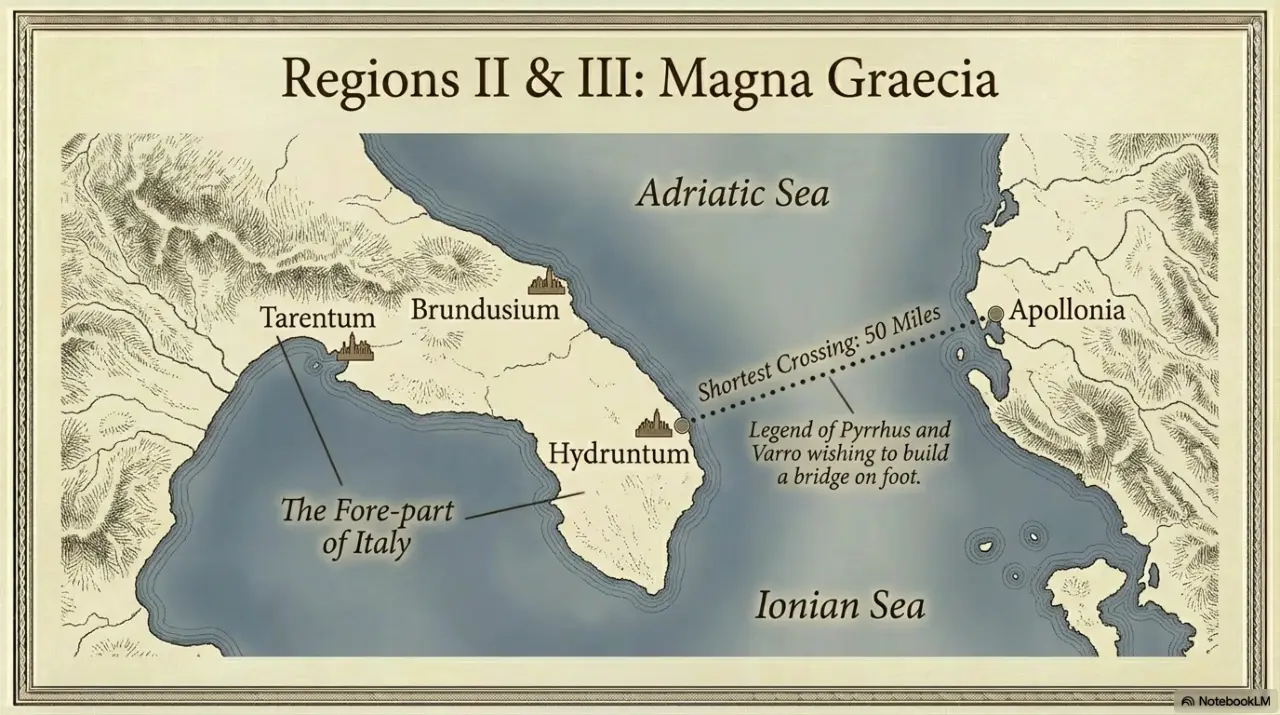
The unified Italy of the Augustan age — Latin-speaking, Roman-administered, organized into regions with the cursus publicus running through it — lay nearly three centuries in the future. The Italy of 350 BC was an Italy of perhaps two dozen distinct peoples speaking eight or nine different languages, organized into political units that ranged from the federated city-leagues of the Etruscans and Latins, through the tribal confederations of the Samnites and the Lucanians, to the Hellenic city-states of Magna Graecia on the southern coast.
Rome at this moment was a city-state of perhaps thirty to forty thousand citizens controlling, with her Latin allies, a territory of some five thousand square kilometers. She was the largest single power in central Italy, but she was not yet dominant. The Etruscans to her north remained capable of fielding substantial armies, though the loss of Veii in 396 had broken their southern frontier and they were increasingly preoccupied with the Gallic threat above them. The Volscians and Aequi to the southeast continued the chronic frontier warfare with Rome that had marked the entire fifth century, gradually losing ground but not yet beaten. The Hernici and the various peoples of the central Apennines had relationships with Rome that fluctuated between alliance and hostility.
Beyond this immediate ring of neighbors lay the Samnites. The Samnites are the most underestimated of all Rome's Italian opponents, in part because they did not produce a literary tradition of their own and are known to us almost entirely through their enemies. They were a federation of four tribal cantons — Pentri, Caraceni, Caudini, and Hirpini — occupying the rough mountain country of the central-southern Apennines from the Sangro valley in the north to the upper Calore in the south. Their political organization was looser than that of the Roman or Latin city-states but more cohesive than the loose Volscian or Aequian arrangements: each canton had its own assembly and its own meddix (a chief magistrate), and in time of major war the four cantons could be coordinated under a single supreme meddix tuticus.
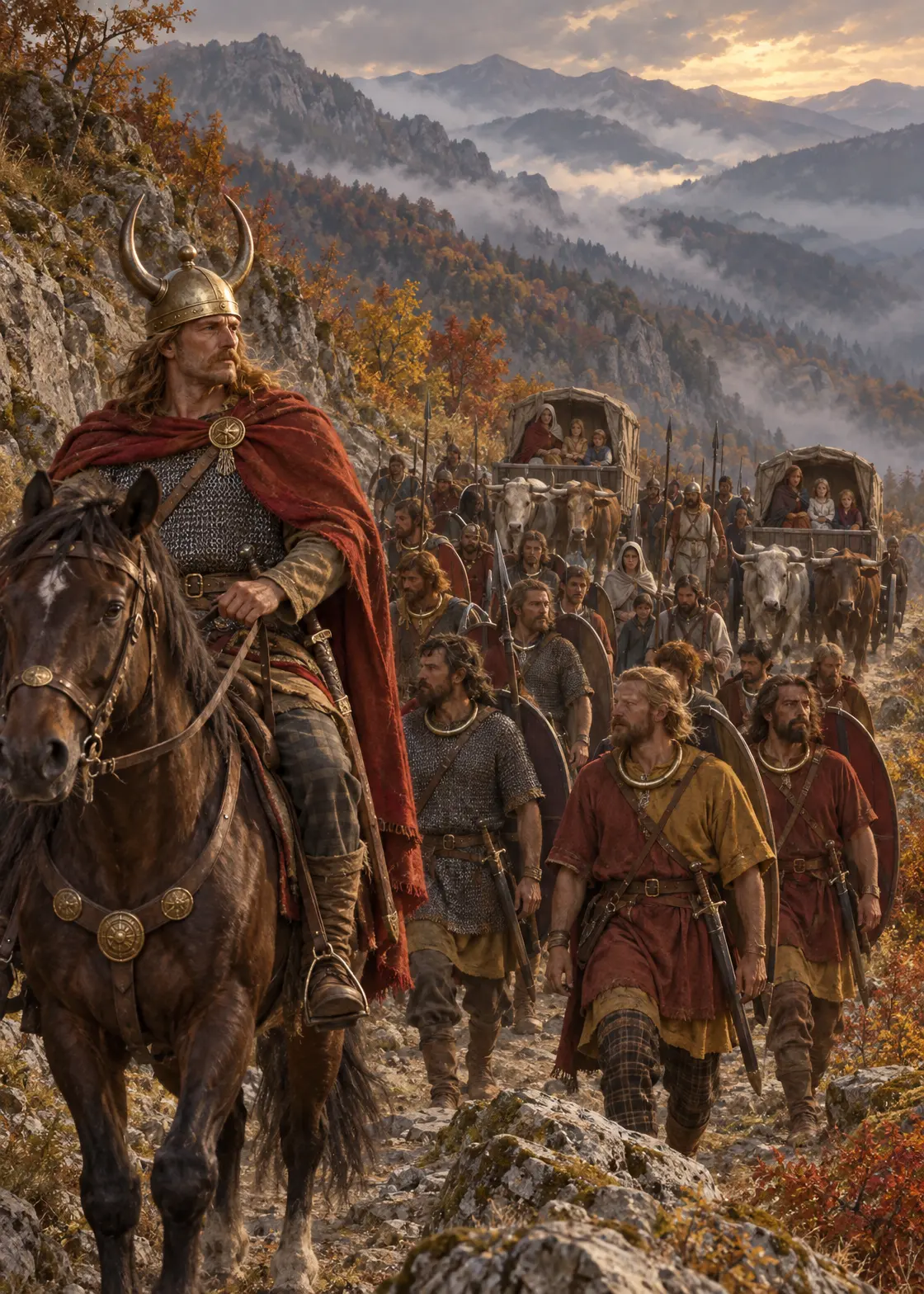
Their population was probably between four and five hundred thousand, perhaps half a million, comparable to Rome's after her Latin alliances are added. They could field, when fully mobilized, armies of forty or fifty thousand men. They fought, by preference, in their mountains. And they regarded the rich plain of Campania, lying between their highlands and the sea, as a legitimate sphere of their own expansion.
In Campania lay the third pole of fourth-century Italian politics: the city of Capua, second only to Rome in size and wealth in the peninsula, occupying the volcanic plain north of Vesuvius and dominating a confederation of Campanian cities (Cumae, Suessula, Acerrae, and the rest) that had originally been Greek and Etruscan but had passed in the fifth century into the hands of Oscan-speaking Italic peoples — Campanians who were, ethnically and linguistically, related to the Samnites of the highlands. The Campanian relationship to the Samnites was therefore that of a wealthier, more urbanized cousin to a poorer, more warlike one. The cousins did not get on. The Samnites of the highlands periodically came down to raid Campania; the Campanians, lacking the manpower to repel them indefinitely, sought outside assistance.
It was the Campanian appeal to Rome in 343 BC that produced the First Samnite War. This was not the only possible casus belli the Romans might have found in Italy at that moment — they were simultaneously engaged with the Volscians and the Aurunci — but it was the one that mattered, because it brought Roman and Samnite into direct collision over a prize both wanted.
The First Samnite War (343–341 BC)
The opening of the war was a piece of political theater whose exact mechanics Livy reports with greater care than they perhaps merit. The Campanians, attacked by the Samnites and unable to defend themselves, sent ambassadors to Rome seeking alliance. The Romans, who had recently concluded a treaty with the Samnites, were embarrassed and refused. The Campanians thereupon offered an unconditional deditio — surrender of themselves and all their territory to Rome — which placed Rome in a position to defend what was now technically her own. The Senate accepted, sent an embassy to inform the Samnites, and, when the Samnites would not agree to leave Campania alone, declared war. The legalistic care with which Livy reports this transaction suggests that he is following a tradition in which Roman aggression had been carefully repackaged as Roman fidelity to a surrendered ally. The underlying reality was simpler: Rome saw a chance to extend her influence into the richest agricultural plain in central Italy, and took it.
The Battle of Mount Gaurus (343 BC), fought near the volcanic crater of the Phlegraean fields on the northern flank of the Campanian plain, between the consul Marcus Valerius Corvus and a Samnite force. The Romans had the better of it after a long day's fighting, though the casualties (Livy gives no figures) were heavy. The engagement is notable principally because it gave Valerius Corvus the cognomen Corvinus, from a famous earlier episode in which a raven (corvus) was reputed to have alighted on his helmet during a single combat against a Gallic champion. The Mount Gaurus engagement is the first recorded clash between Roman and Samnite arms, and Livy's account suggests that the Samnites fought in a manner the Romans found unsettling — neither in compact phalanx nor in the headlong charge of the Gauls, but in a fluid, dispersed style adapted to broken country.
The Battle of Saticula (343 BC), fought near the eastern edge of Campania between the consul Aulus Cornelius Cossus and a Samnite army. The engagement is famous chiefly for the deed of the military tribune Publius Decius Mus — father of the man who would die at Sentinum forty-eight years later — who saved the army from envelopment by seizing a hilltop with a small detachment and forcing the Samnites to choose between continuing their attack on the main Roman position (which they had nearly carried) and turning to deal with the troops on the hill. They turned; the Roman main body was thus relieved; and Decius and his men, attempting a night withdrawal, broke through the Samnite encirclement and rejoined Cossus's army with the loss of only a fraction of their number. The episode is the first appearance of a name — Decius Mus — that will recur with singular significance in the wars to come.
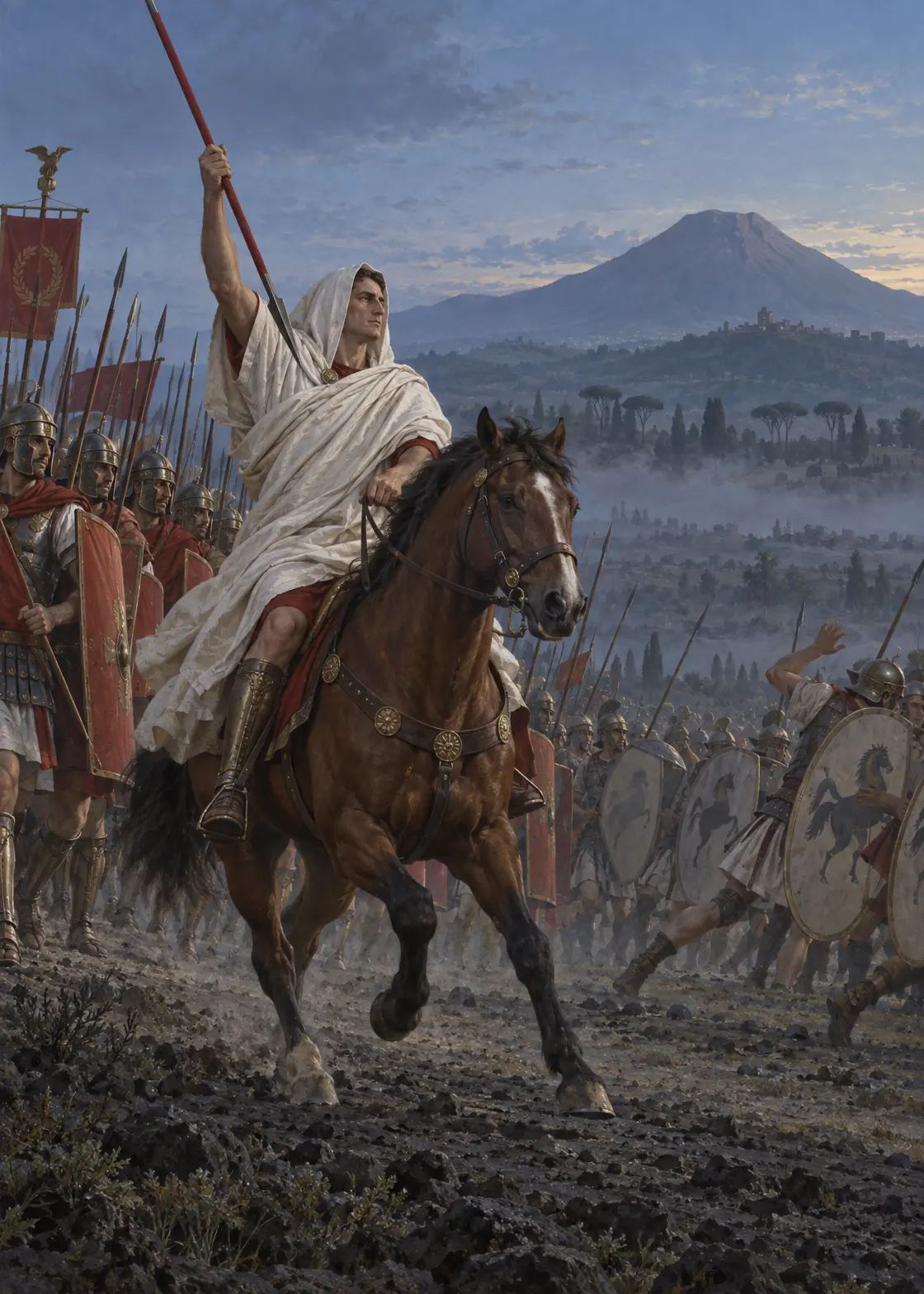
The Battle of Suessula (343 BC), fought later in the same year between Valerius Corvus and a regrouped Samnite army, in which the Romans were victorious after a flank attack by a body of Roman cavalry concealed behind a wood. The Samnites broke and fled, the Roman victory was significant but not decisive, and the campaigning season closed with both sides claiming the year.
The war ended in 341 BC not because either side had achieved decisive military success but because circumstances changed elsewhere. The Roman army in Campania, restive from extended service and underpaid (the stipendium — soldier's pay — was a recent innovation and not yet reliable), mutinied. The mutiny was suppressed by political concessions including the appointment of Valerius Corvus, who was popular with the troops, as dictator. Meanwhile, the Latins — Rome's nominal allies — had begun to make common cause with the Volscians against Rome herself, and a far more serious war loomed to her south. Rome therefore concluded a hasty peace with the Samnites — restoring the prewar status quo, retaining the alliance with Capua, and ceding nothing of substance — in order to free her hands for the Latin crisis. The First Samnite War was, in retrospect, a probing engagement: each side had taken the measure of the other, and neither had liked what it found.
Outcome and critical assessment
Result and caution: the settlement restored accommodation with the Samnites while leaving Rome more deeply involved in Campania. This is not yet the decisive conquest of Samnium. Keep the conventional opening date 343 BC distinct from the 342 BC date used by some inherited summary rows, and avoid using legendary battlefield speeches as evidence of command practice.
Historical record: IR-I, chapter 2; Livy, 7.29 onward and the opening of book 8.