Wars · II. Carthage and the connected Mediterranean
W017 The Iberian theater of the Hannibalic War
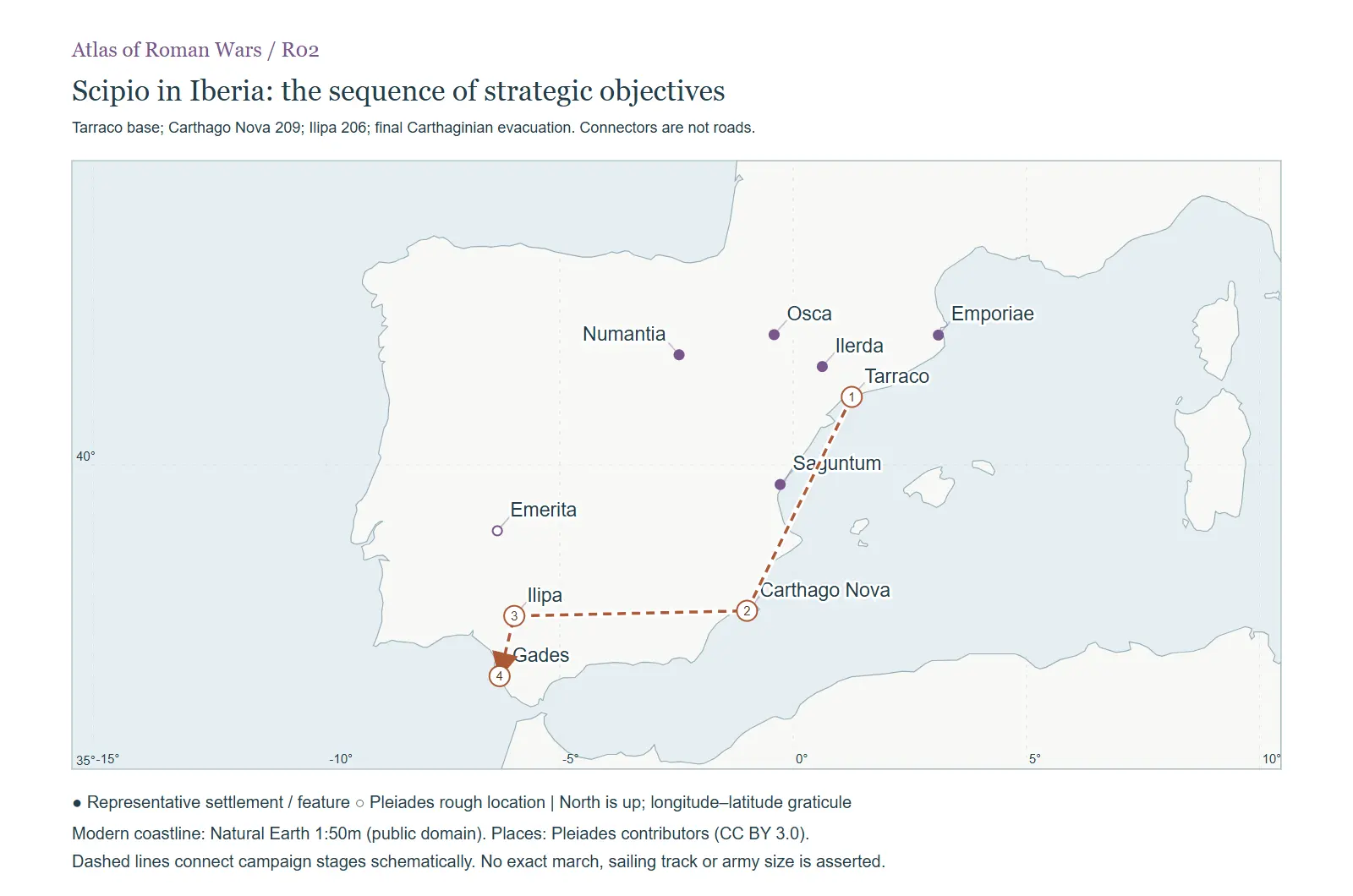
The elder Scipios established a Roman foothold in northeastern Iberia and contested Carthaginian power there. Their deaths and the defeat of their armies in 211 BC threatened that position. Publius Cornelius Scipio, later Africanus, rebuilt the Roman effort and captured Carthago Nova in 209 BC.
The port's value lay in its military stores, hostages, connections and political effect as well as its physical defenses. Operations at Baecula in 208 and Ilipa in 206 BC reduced Carthaginian power in the peninsula. Alliances with local communities remained essential and unstable; Iberians were political actors rather than passive resources belonging automatically to one side.
Command, forces and military problem
| Field | Dossier |
|---|---|
| Roman leadership | Publius and Gnaeus Scipio; later Scipio Africanus and subordinates |
| Opposing or rival parties | Hasdrubal Barca, Hasdrubal son of Gisco, Mago and local leaders |
| Forces and capabilities | Field armies linked to coastal bases, hostages, revenues and shifting Iberian alliances |
| Operational problem | Remove the enemy's resource base while preserving local support and Roman communications. |
Campaign geography and operational plates
Iberia in the opening Hannibalic campaigns, 218–211 BC
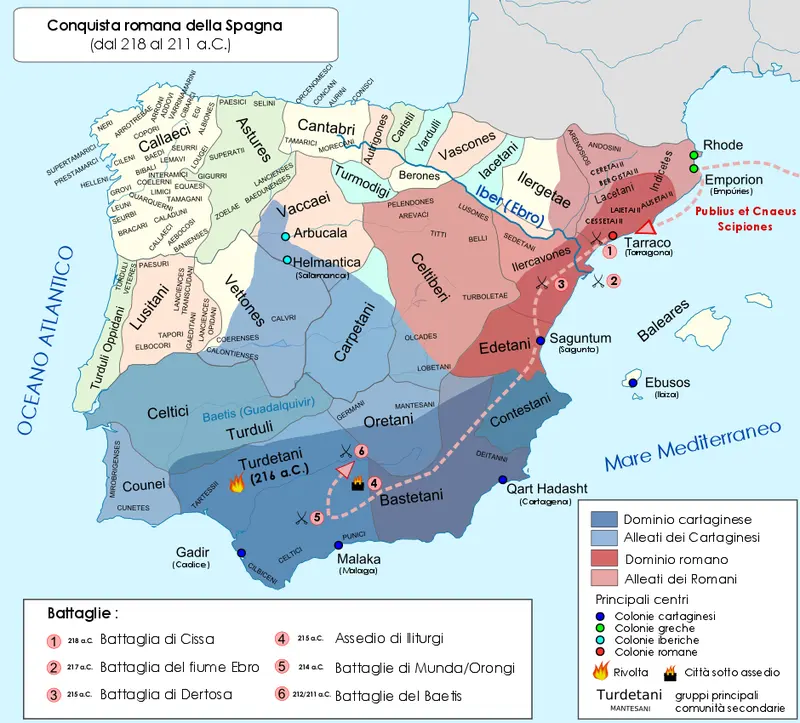
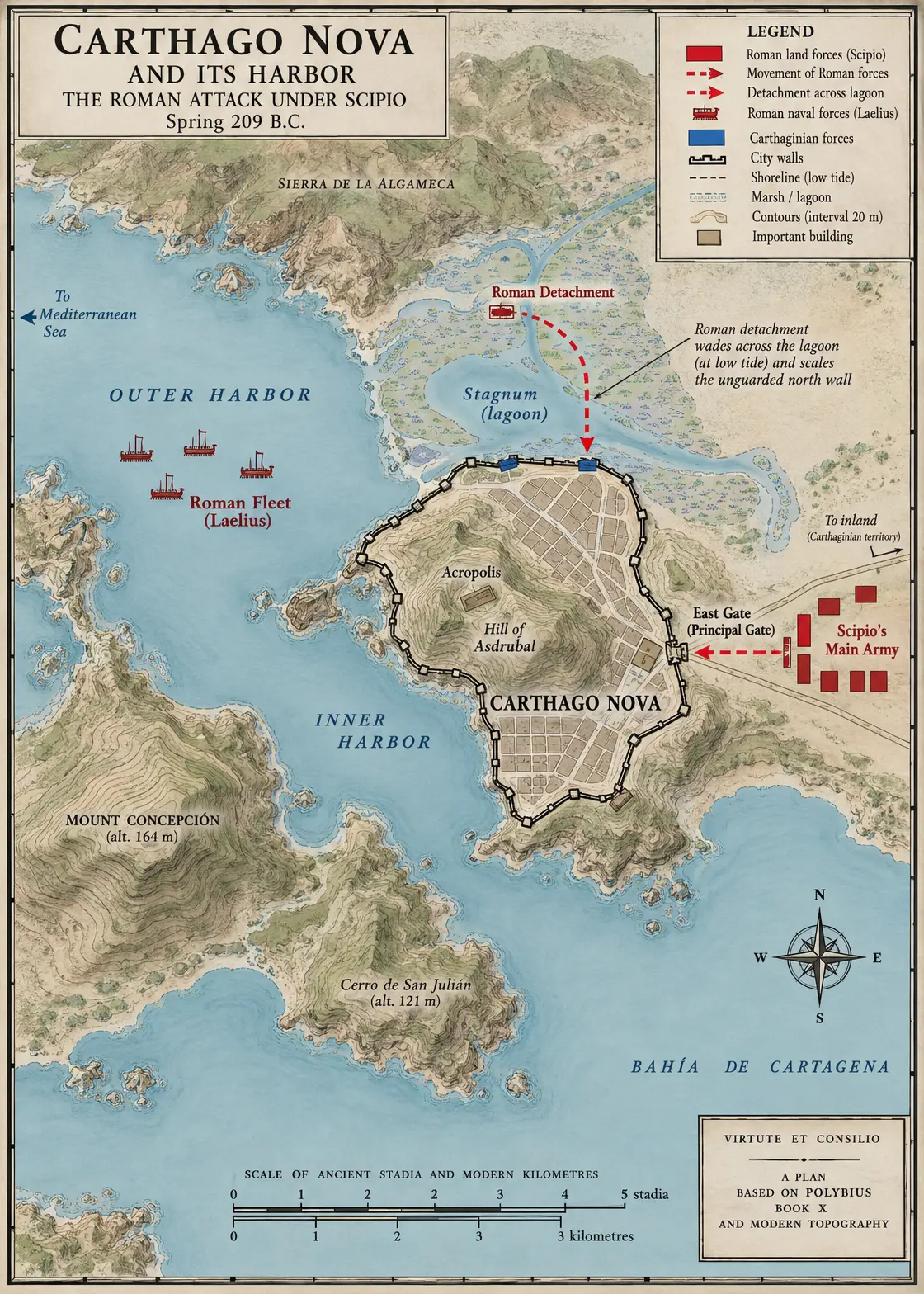
The contrasting coastal positions, inland communities and axes of movement place the Scipio brothers' campaigns within the peninsula. Its chronology ends before the younger Scipio captured Carthago Nova and before the final Carthaginian defeat in Iberia. Numantia and the Lusitanian wars belong to later dossiers and are not shown here.
Extended campaign study
The account below develops the operations and their interpretation. Reported numbers and reconstructed tactical details retain the uncertainties described in the dossier.
The Strategic Significance of Spain
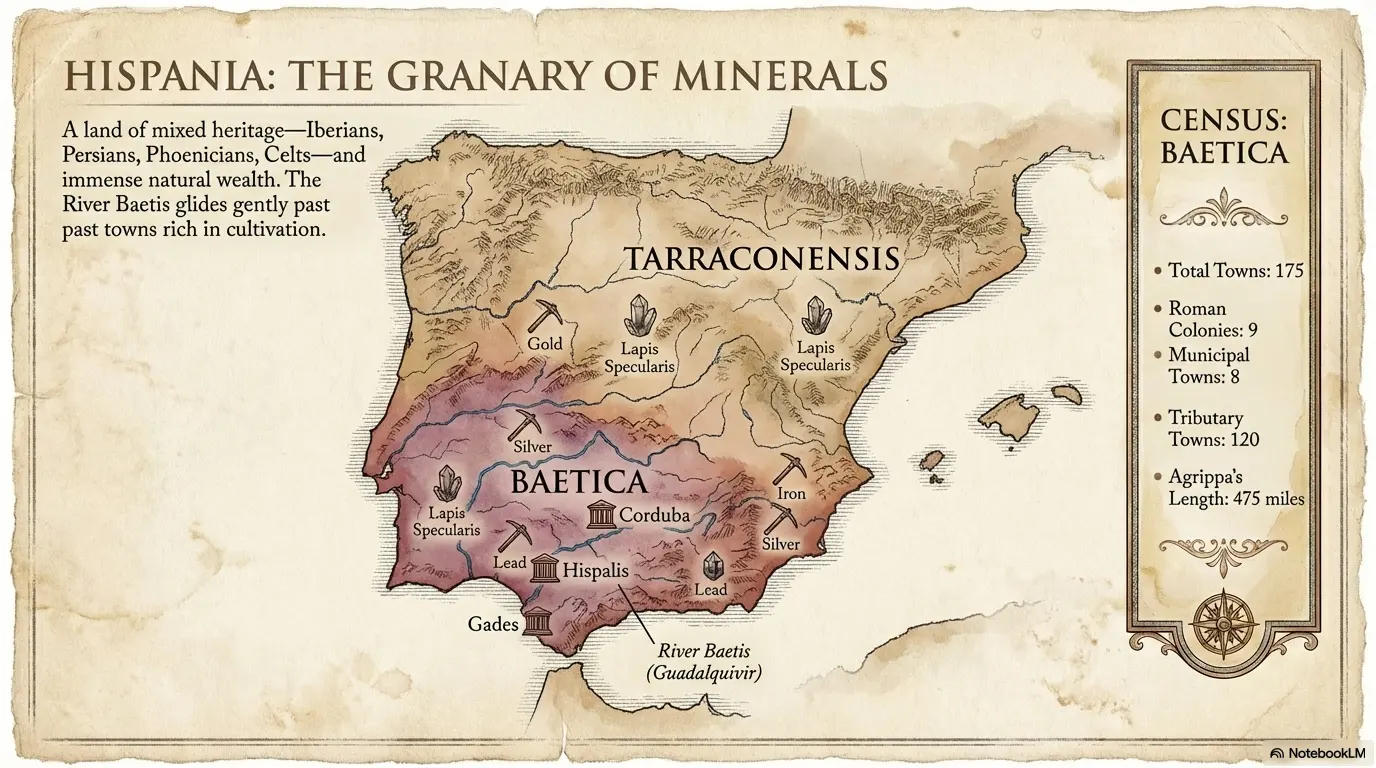
The Spanish theater of the Hannibalic War is the theater that most modern readers know least about, partly because the campaigns there were conducted at a distance from the Italian heartland of the war and partly because the source state is conspicuously weaker than for the Italian campaigns. It was, however, the theater whose outcome ultimately determined the war's resolution. The Carthaginian strategic position in 218 BC had depended fundamentally on the Iberian power-base that Hamilcar Barca had constructed after the First Punic War and that his son-in-law Hasdrubal the Fair and his son Hannibal had developed across the subsequent generation. The Spanish silver mines provided the fiscal foundation of Carthaginian military operations; the Spanish manpower (Iberian heavy infantry, Celtiberian troops, Lusitanian skirmishers, Balearic slingers) provided the principal recruitment base for Carthaginian armies; the Spanish geographic position gave Carthage strategic depth in the western Mediterranean and a route by which reinforcements could potentially reach Hannibal in Italy by the same overland route Hannibal himself had pioneered. If Spain could be detached from Carthaginian control, the strategic foundations of the Carthaginian war effort would be progressively eroded; if Spain remained under Carthaginian control, the war could in principle continue indefinitely.
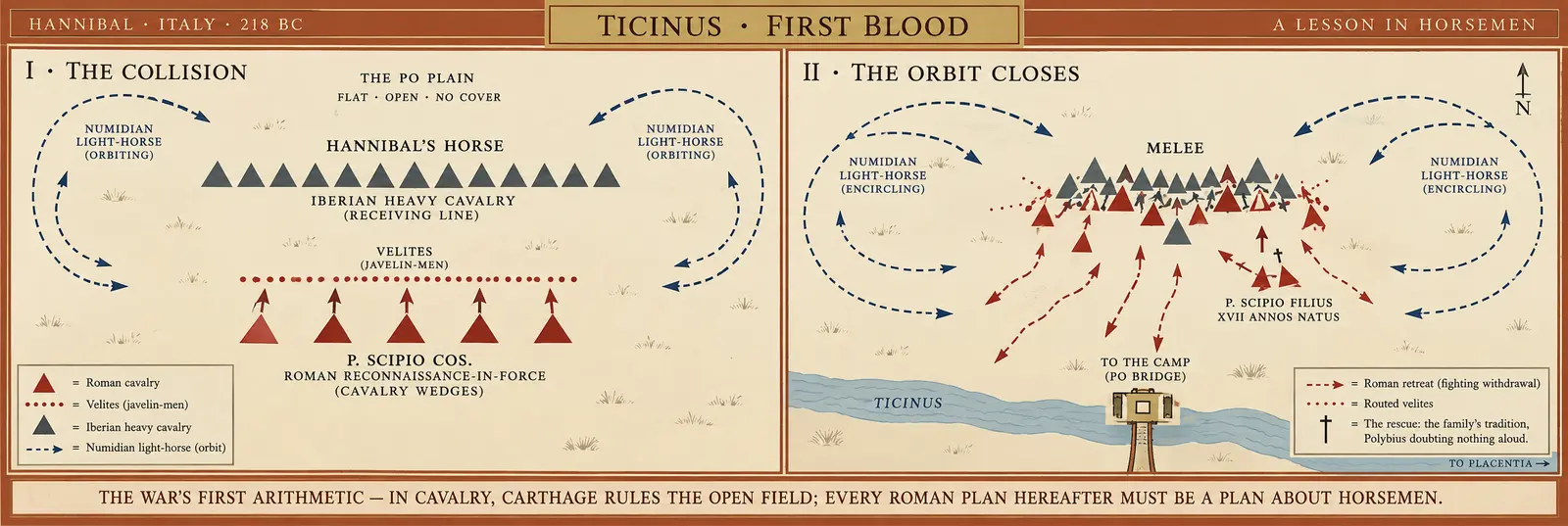
The Roman strategic response to this situation had been articulated in 218 BC by the elder Publius Cornelius Scipio (the same who would be wounded at Ticinus and rescued by his teenage son) when he detached his brother Gnaeus Cornelius Scipio Calvus with the bulk of his original army for Spain while he himself returned to Italy to confront Hannibal. The elder Scipios' Spanish command — Gnaeus from 218 BC, Publius joining him after his recovery from the Ticinus wound and his subsequent service in the early Italian campaigns — would constitute one of the most sustained extraordinary commands in Roman military history to that date, lasting from 218 until their deaths in 211. The two brothers operated jointly across most of this period, dividing their forces between separate theaters when strategic conditions required and combining them for major engagements when possible.
Their accomplishment was substantial: they prevented major Carthaginian reinforcement of Hannibal's army across the entire decade of his Italian campaign, they tied down approximately three to four Carthaginian armies in the peninsula across the period, they conducted offensive operations that gradually reduced Carthaginian control of northern Spain, and they constructed a Roman political-military presence on the peninsula that would survive their own deaths and provide the foundation for the eventual Roman conquest under their son and nephew.
The Elder Scipios in Spain (218–212 BC)
The early campaigns of the elder Scipios are preserved in fragments principally through Livy (21.60–22.22, 23.26–29, 24.41–49, 25.32–39) and through fragments of Polybius. The pattern that emerges is one of slow Roman advance, conducted from a base at Tarraco (modern Tarragona) on the northeastern Spanish coast, with the principal operations directed at preventing the consolidation of Carthaginian political control in central and eastern Spain. The major engagements of the period were:
The Battle of Cissa (218 BC), in which Gnaeus Scipio Calvus, shortly after his arrival in Spain, defeated a Carthaginian army under Hanno (one of the several officers of that common name in the period) and captured Hanno himself along with the Spanish chieftain Indibilis who would feature significantly in subsequent campaigns. The engagement was relatively small but its strategic significance was substantial: it established Roman military credibility in the peninsula at a moment when the Carthaginian command had assumed that no significant Roman force would arrive in Spain in the war's first year.
The Naval Battle of the Ebro (217 BC), in which a combined Roman and Massiliote fleet under Gnaeus Scipio engaged the Carthaginian fleet under Hasdrubal Barca (Hannibal's brother, who held the principal Carthaginian command in Spain across most of this period). The Roman victory secured naval control of the northeastern Spanish coast and prevented the Carthaginian fleet from operating in support of Hasdrubal's land campaigns against the Roman position at Tarraco.
The Battle of Dertosa or the Ebro (215 BC), in which the combined Roman armies of both Scipios engaged Hasdrubal Barca's army in a major engagement near the Ebro river. The battle is preserved by Livy (23.28–29) with insufficient tactical detail for a full reconstruction, but the outcome was a Roman victory of substantial proportions: Hasdrubal's army was defeated and forced to retreat southward, the Roman position in northeastern Spain was consolidated, and (most significantly for the broader strategic picture) the Carthaginian plan to send substantial reinforcements to Hannibal in Italy across the Pyrenees was indefinitely postponed. The Battle of Dertosa was, in this sense, one of the strategic turning points of the entire Hannibalic War, even though the engagement itself was conducted at a scale far below that of the great Italian battles and is known to us in only fragmentary detail.
Across 214 and 213 BC the elder Scipios continued their campaigns with steady if unspectacular success, recovering Saguntum (the city whose siege had been the casus belli of the war eight years earlier) in 212 BC and establishing forward bases as far south as Castulo on the upper Baetis (modern Guadalquivir). The Carthaginian position in central Spain had been reduced to a series of fortified cities (Carthago Nova on the southeastern coast, Castulo as a tenuous frontier post, Gades on the Atlantic, and various inland positions) connected by an alliance system whose loyalty depended significantly on Carthaginian military success in the field. The strategic momentum had shifted to the Romans across the seven years of the elder Scipios' command, and by the end of 212 BC the Carthaginian position in Spain appeared to be progressively eroding.
The Catastrophe of 211 BC
The catastrophe that overwhelmed the elder Scipios in 211 BC is among the most poorly attested major military events of the Hannibalic War, a fact that itself testifies to the strategic dislocation it produced: the Roman command structure that survived the disaster was unable to reconstruct the full circumstances even for the senatorial archive, and Polybius's account (which we lack for this episode) must have depended on indirect testimony filtered through several intermediaries. The principal narrative we possess is in Livy 25.32–39 and in fragmentary parallels.
What can be reconstructed: in the spring of 211 BC, with the war in Italy at the critical phase of the Capuan siege and the Sicilian war concluding with the fall of Syracuse, the elder Scipios undertook an ambitious offensive intended to deliver a decisive blow against the remaining Carthaginian positions in Spain. The strategic conception was to engage the three Carthaginian armies then in Spain (under Hasdrubal Barca, Mago Barca, and Hasdrubal son of Gisgo respectively) in a coordinated operation before they could combine. To accomplish this, the Roman army was divided: Publius Scipio took the larger portion (approximately two-thirds of the Roman force, with substantial Spanish allied contingents) against Hasdrubal Barca and Mago; Gnaeus Scipio took the smaller portion against Hasdrubal son of Gisgo. The division of forces would prove fatal.
Hasdrubal Barca, recognizing the operational opportunity, executed a complex coordinated maneuver with his fellow commanders that concentrated all three Carthaginian armies against the divided Roman forces in sequence. Publius Scipio, engaged separately, was attacked simultaneously by Mago's Numidian cavalry (which had been detached for the purpose and rode hard to reach the engagement) and by reinforcements that arrived from Hasdrubal Barca's main army; his Spanish allied contingents, evidently bribed by Carthaginian agents in advance of the engagement, defected during the battle; Publius's army was destroyed and Publius himself was killed. The date was approximately late spring or early summer 211 BC.
Gnaeus Scipio, hearing of his brother's death and recognizing that the Carthaginian armies were now free to concentrate against his own smaller force, attempted to withdraw northward toward Tarraco. He was overtaken by the combined Carthaginian force near a town that the sources name as Ilorca, approximately a month after his brother's death. His army was surrounded and destroyed; Gnaeus himself was killed; the Roman position in southern and central Spain was effectively eliminated; only the small garrison forces at Tarraco and at the northeastern coastal positions remained as a Roman presence on the peninsula. The Roman strategic position in Spain had been reduced, within a few months, from gradual ascendancy to near-total collapse.
The proximate cause of the disaster was the defection of the Spanish allied contingents — a defection that almost certainly reflected effective Carthaginian diplomatic and financial work over the preceding period, exploiting the inherent instability of the Spanish alliance system. The deeper cause was strategic: the elder Scipios had over-extended their forces by undertaking offensive operations on three fronts simultaneously when the available Roman manpower could have safely supported operations on only one. The miscalculation may have reflected the strategic pressure of the broader war situation (the Roman command in Spain was being asked to deliver a decisive blow at a moment when decisive blows were being sought in every theater) or may have reflected the personal confidence that seven years of generally successful operations had built up in the elder Scipios' assessment of their tactical capacity. Either way, the failure was substantial and the cost was nearly total.
The strategic salvage of the Spanish position was conducted in the immediate aftermath by a Roman knight named Lucius Marcius Septimius, who had been one of the surviving officers of Publius's army and who, by what Livy describes as a spontaneous election of the survivors in the field, took command of the remaining Roman forces and conducted a defensive operation that held the Ebro line through the late summer and autumn of 211 BC.
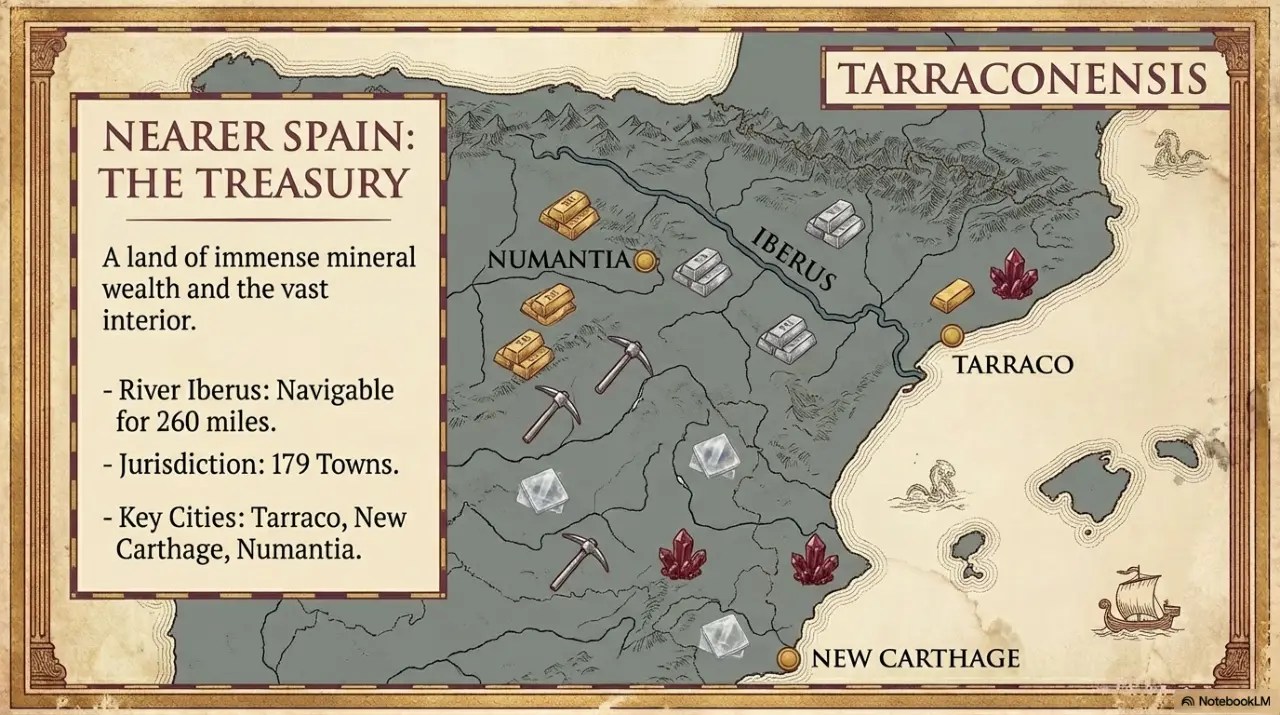
Marcius's improvised command — eventually approved retroactively by the Senate, though with the unprecedented complication that he was technically of equestrian rank and would normally not have been entitled to legionary command — prevented the Carthaginian armies from pursuing their victory across the Ebro into the Roman base areas on the northeastern coast. The strategic position in Spain by late 211 BC was therefore precarious but not yet hopeless: the Romans held a coastal strip in the northeast (Tarraco, Emporion, and the line of the Ebro); the Carthaginians had recovered nearly all of central and southern Spain but had been unable to drive the Romans completely from the peninsula.
The Young Scipio Takes the Spanish Command (210 BC)
The Senate's response to the Spanish catastrophe was, after some hesitation, the appointment to the Spanish command of the most unlikely figure available — the young Publius Cornelius Scipio, son of the elder Publius and nephew of Gnaeus, who at twenty-five years of age was below the legal minimum age for any of the senior magistracies and who had held only the curule aedileship in the previous year. The political circumstances of his appointment are preserved by Livy (26.18–19) with the kind of dramatic detail that suggests a real political crisis being resolved by an unconventional measure. The Senate had attempted to recruit a senior consular figure to take the Spanish command; no consular had been willing to accept the assignment, on the grounds that the strategic situation was hopeless and the appointment would be a career-ending exposure to a catastrophe already in progress. The popular assembly was then asked to elect a commander from among the available volunteers; the young Scipio came forward, volunteered, and was elected by acclamation.
The historicity of the dramatic political moment has been doubted by some modern scholars (Münzer, Scullard) who have argued that Scipio's appointment was orchestrated by the political faction associated with the Cornelii Scipiones as an extraordinary measure to maintain the family's strategic position; on this reading, the dramatic popular acclamation was political theater concealing a relatively conventional senatorial decision. The dispute does not affect the substantive point: Scipio, at twenty-five, was granted extraordinary command in Spain by the popular assembly with senatorial concurrence, was given imperium proconsular in rank (a constitutional novelty for a man who had not been consul), and was dispatched to Spain in the late spring of 210 BC with reinforcements amounting to two legions and substantial allied contingents. The total Roman force in Spain after Scipio's arrival was approximately 28,000 foot and 3,000 cavalry — not large by the standards of the war's principal Italian theaters, but adequate for the kind of operational mission Scipio was contemplating.
What Scipio was contemplating was not the conservative defensive operation that the Spanish strategic situation might have seemed to require. Scipio had spent the winter of 211/210 preparing for his command with the analytical care characteristic of his subsequent generalship: he had interviewed surviving veterans of the elder Scipios' campaigns; he had reviewed his father's papers and intelligence reports; he had taken into his confidence Gaius Laelius, a young officer of his own generation who would become his lifelong friend and operational partner; and he had constructed a strategic conception that was unconventional in the extreme. Rather than attempting to reconstruct the gradual offensive of the elder Scipios — which would have required years and substantial reinforcements — Scipio proposed to strike directly at the strategic center of the Carthaginian position in Spain: the great fortified city of Carthago Nova, which served as the principal Carthaginian naval base, supply magazine, and political capital on the peninsula.
The strategic logic was: Carthago Nova was geographically isolated from the three main Carthaginian field armies, which were operating in central and western Spain at distances of ten to twenty days' march. A rapid Roman attack on Carthago Nova, executed before the field armies could converge to relieve the city, could capture the strategic center of the Carthaginian Spanish position before the Carthaginian command had time to react. The operational risk was substantial: Carthago Nova was a fortified city of considerable scale, with defensive works developed by Hasdrubal Barca during his Spanish governorship, and would not be easily taken by storm if its garrison held firm. The strategic prize, if the operation succeeded, was equally substantial: the loss of Carthago Nova would deprive the Carthaginian armies of their principal supply base, their naval anchor, their treasury (the Spanish silver was held there in substantial quantities), and the political-symbolic center of their position in the peninsula.
The Capture of Carthago Nova (209 BC)
Scipio's operation against Carthago Nova in the spring of 209 BC is one of the most carefully planned and tactically creative military operations of the entire Hannibalic War, and it is preserved by Polybius (10.6–15) in a narrative of unusual clarity that almost certainly reflects access to Scipio's own subsequent military memoirs (now lost) and to the testimony of his close associate Laelius, with whom Polybius was personally acquainted through the Scipio Aemilianus circle.
The operation was executed with a deliberate combination of speed, deception, and tactical innovation. Scipio departed Tarraco in early spring 209 BC with the bulk of his army (approximately 25,000 foot and 2,500 cavalry, leaving a garrison force at Tarraco under his lieutenant Marcus Junius Silanus) and marched south along the coast. The march was conducted with unusual speed — approximately seven days from Tarraco to Carthago Nova, a distance of perhaps 425 Roman miles, with the army covering more than 50 miles a day in places, a pace exceeding any other recorded Roman army's march of the period. The speed was deliberate: Scipio recognized that the Carthaginian field armies would receive intelligence of his march within days of its commencement, and that the strategic window between his departure from Tarraco and the convergence of the Carthaginian armies on Carthago Nova was approximately ten to fourteen days. He had to be at Carthago Nova and in possession of the city before that window closed.
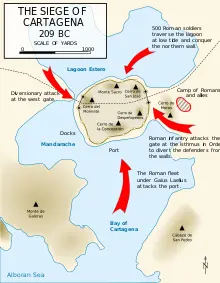
The siege itself was conducted in approximately a single day. Scipio established his camp on the eastern approach to the city on the evening of his arrival; on the following morning he conducted a frontal assault on the eastern walls with the main body of his army, supported by Laelius's naval forces attacking the seaward walls from the harbor. The frontal assault was costly but, as Scipio had calculated, sufficient to draw the defenders' attention. While the principal assault was in progress, Scipio personally led a detachment of approximately 500 picked troops to the northern side of the city, where the lagoon appeared to provide a natural defensive obstacle. Scipio had been informed by local fishermen — Polybius emphasizes the local-intelligence origin of this knowledge — that the lagoon was crossable on foot at low tide under certain combinations of wind and tidal conditions; he had timed his attack for the day on which these conditions were predicted to occur.
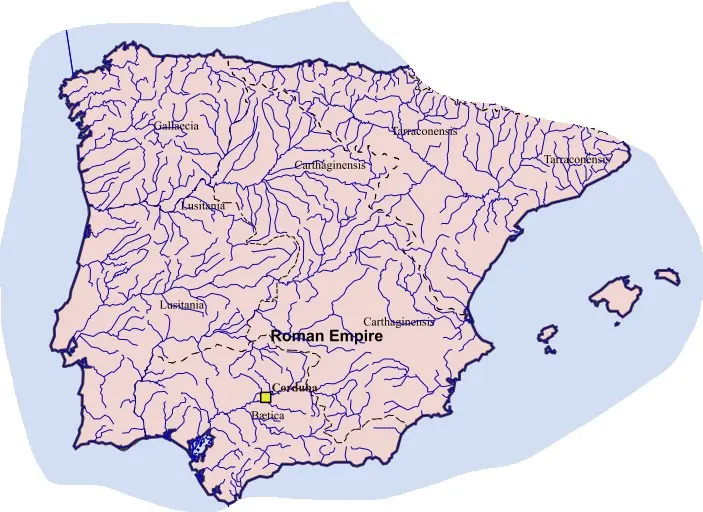
As the lagoon water level dropped, the Roman detachment waded across, reached the unguarded northern wall of the city, scaled it with prepared ladders, and entered the city from the rear while the defenders were engaged with the frontal assault. The defense collapsed; the city fell that afternoon; the garrison surrendered; and Scipio entered the principal Carthaginian base in Spain on the same day he had begun the assault.
The strategic and material results were spectacular. Scipio captured the entire Carthaginian treasury at Carthago Nova (approximately 600 talents of silver, a substantial fraction of the Carthaginian Spanish war-chest); he captured eighteen Carthaginian warships in the harbor; he captured the principal Carthaginian arsenal in Spain (machines, weapons, supplies for several armies); he captured approximately 10,000 prisoners including the Carthaginian commander Mago (a different Mago from Mago Barca; the name was common in Carthaginian senior officer ranks) and the principal Spanish hostages whom the Carthaginians had held to ensure the loyalty of their Spanish allies. The hostages were a particularly significant prize: Scipio's treatment of them — he assembled them after the city's fall and announced that they would be returned to their families and their tribes without ransom, as a gesture of Roman friendship toward the Spanish peoples — produced an immediate political effect on the Spanish alliance system. The hostage tribes, whose loyalty to Carthage had depended on the threat to their hostages held at Carthago Nova, were now free of that constraint; many transferred their alliance to Rome within the following weeks; the Spanish political-military balance shifted permanently in Roman favor.
The most famous individual episode of the Carthago Nova operation, the so-called "continence of Scipio," is preserved by Polybius (10.19), by Livy (26.50), and by several later writers. After the city's fall, the Roman soldiers brought to Scipio's tent a captured young woman of exceptional beauty, presumably as a portion of his commander's share of the spoils. Scipio learned that the woman was the betrothed of a Spanish nobleman named Allucius, leader of one of the Celtiberian tribes; he ordered the woman returned to her family unharmed, refused any ransom for her, and added to the gesture a wedding gift drawn from the spoils of the city. Allucius, when he received his betrothed back, attached himself and his tribe to the Roman alliance; the political effect of the episode, propagated by Roman official communications and by subsequent Roman storytelling, was substantial. The historicity of the incident has been doubted by modern scholars (the "continence of the general" was a stock topos in Hellenistic biographical literature, with parallels in the Alexander tradition and elsewhere), but the broader pattern of Scipio's deliberate use of political-symbolic generosity as an instrument of alliance-building is consistent with the rest of his career and probably authentic in outline even if the specific Allucius episode is a literary elaboration.
Baecula and the Strategic Decision (208 BC)
The Carthaginian response to the loss of Carthago Nova was the convening, in the winter of 209/208 BC, of what amounted to a Carthaginian Spanish strategic conference attended by the three principal commanders on the peninsula: Hasdrubal Barca (Hannibal's brother and the senior Carthaginian commander in Spain), Mago Barca (Hannibal's younger brother, commanding the secondary army), and Hasdrubal son of Gisgo (the third Carthaginian commander, of a different family).
The strategic question was how to recover the position lost at Carthago Nova. The answer that emerged from the deliberations was the most strategically significant single Carthaginian decision of the entire war after the original march to Italy in 218: Hasdrubal Barca would lead the bulk of his army northward across the Pyrenees and the Alps to reinforce Hannibal in Italy, leaving the defense of Spain to Mago and Hasdrubal son of Gisgo. The strategic conception was that the reinforcement of Hannibal in Italy was the only path to Carthaginian victory in the war; the Spanish position, however valuable in itself, was secondary to the Italian operation. Hasdrubal Barca would attempt what Hannibal had accomplished a decade earlier — the long march from Spain to Italy — with the objective of joining his brother's army for a coordinated operation against the Roman alliance system in the Italian theater.
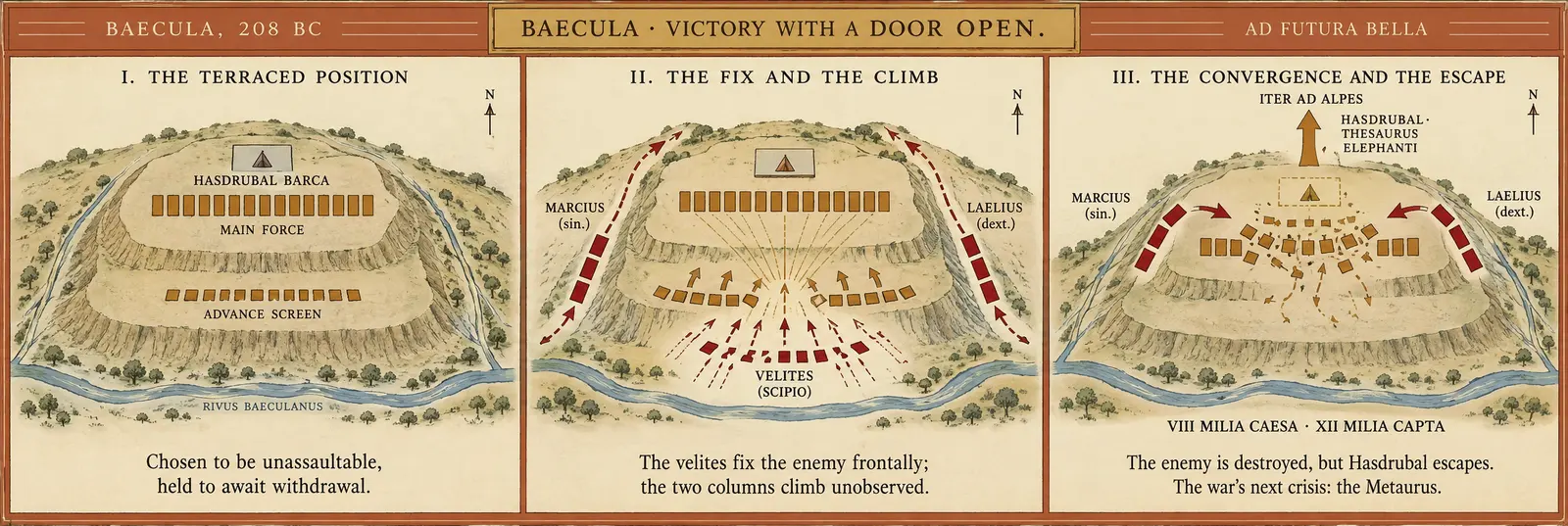
The strategic decision required, before it could be executed, the disengagement of Hasdrubal Barca's army from Scipio's force in central Spain. The young Scipio, having spent the winter consolidating his position at Carthago Nova and reorganizing the Spanish alliance system in Roman favor, marched south in the spring of 208 BC to engage Hasdrubal Barca before the Carthaginian commander could begin his northward march. The two armies met near Baecula (modern Bailén) on the upper Baetis (Guadalquivir) in early summer 208 BC. Hasdrubal Barca had taken up a defensive position on a high ridge with two terraces, with his main force on the upper terrace and an advance screen on the lower terrace; the position appeared to be unassailable by frontal attack, and Hasdrubal's evident strategic intention was to fight a holding action sufficient to permit his northward escape with the bulk of his army intact.
Scipio's tactical solution at Baecula was characteristic of the operational creativity that had been demonstrated at Carthago Nova. He committed his velites and light infantry to a frontal attack on the lower terrace, drawing Hasdrubal's attention to the obvious axis of approach; meanwhile, he sent two columns of his heavy infantry — under Laelius and under Lucius Marcius (the same officer who had rallied the survivors of the elder Scipios' disaster the previous year) — around the flanks of Hasdrubal's position to attack the upper terrace from the sides. The flank attacks, executed simultaneously and with the timing that had characterized Hannibal's own use of similar maneuvers, broke the Carthaginian position. Hasdrubal's army was thrown into disorder; his Spanish and Numidian troops in particular suffered heavily; the casualties on the Carthaginian side were approximately 8,000 dead and 12,000 captured.
The strategic significance of Baecula, however, was less clear than the tactical victory might have suggested. Hasdrubal Barca, in the face of Scipio's flank attack, had executed a controlled withdrawal that preserved the core of his army (approximately 25,000 men) and that took the withdrawing force in the direction it was already going to go — northward, toward the Pyrenees. Scipio chose not to pursue. The decision has been criticized by some modern historians (notably by Liddell Hart) as a strategic failure that allowed Hasdrubal to execute the northward march that would shortly produce the Metaurus crisis in Italy; it has been defended by others (Scullard, Goldsworthy) on the grounds that the pursuit would have over-extended Scipio's army, would have exposed his rear to Mago and Hasdrubal son of Gisgo (both of whom had armies still operational in southern Spain), and might have resulted in a tactical victory pursued into a strategic disaster. The argument is unresolvable from the available evidence, but the operational fact is clear: after Baecula, Hasdrubal Barca was free to march northward, while Scipio remained in central Spain to consolidate his position and to confront the remaining Carthaginian armies.
The Strategic Situation in Spain After Hasdrubal's Departure
The departure of Hasdrubal Barca's army from Spain in the late summer of 208 BC had left the Carthaginian position on the peninsula in the hands of two commanders of conspicuously different temperaments: Hasdrubal son of Gisgo, a competent but not exceptional general of the second generation of the Barcid military establishment, and Mago Barca, Hannibal's younger brother and the most aggressive of the surviving Carthaginian commanders. The two were not natural collaborators; Hasdrubal son of Gisgo's strategic temperament favored consolidation and defensive operations, while Mago preferred offensive maneuver and the pursuit of decisive engagement. The strategic situation they confronted across 207 BC was, however, deteriorating: the loss of Carthago Nova in the previous year had deprived them of their principal base, the Roman alliance system among the Spanish tribes was steadily expanding at Carthaginian expense, and the strategic news arriving from Italy — first of the dispatch of Hasdrubal Barca's army northward, then of his death at the Metaurus in June 207 — indicated that no further reinforcement could be expected from either the Italian theater or from Carthage itself.
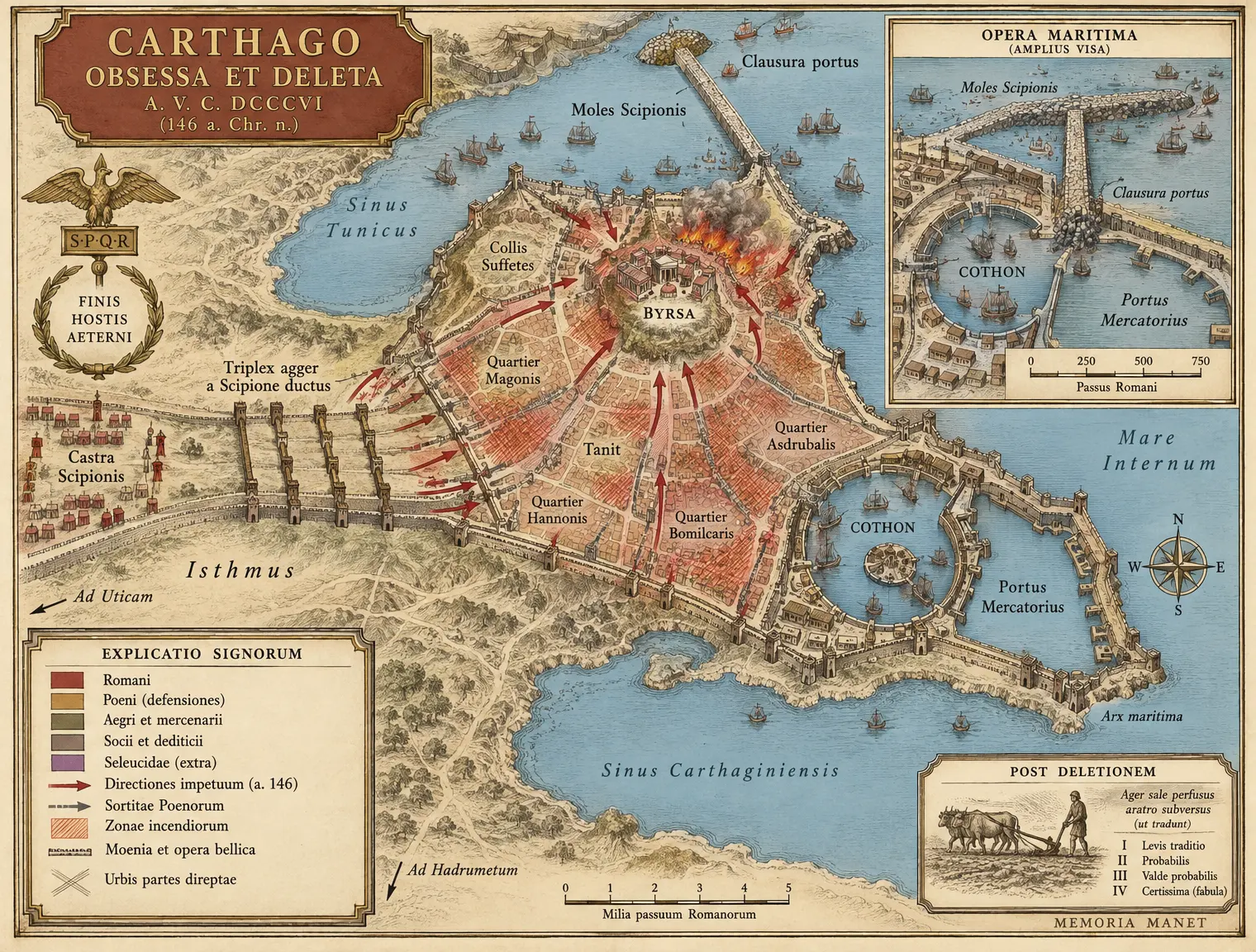
The Carthaginian response was a substantial recruitment effort across central and southern Spain during the winter of 207/206 BC, designed to assemble a field army large enough to engage Scipio's force on terms approaching numerical equality. By the spring of 206, the combined Carthaginian army assembled under Hasdrubal son of Gisgo and Mago numbered approximately 50,000 foot and 4,500 cavalry, with 32 war elephants. The composition was substantially Spanish: perhaps 35,000 of the foot were Iberian or Celtiberian troops recently recruited, with the African and veteran Carthaginian core constituting perhaps 15,000. The relatively small core of veteran troops, with the great mass of recently recruited and tactically untested allies, would prove the central weakness of the Carthaginian position at the engagement that followed.
Scipio's Roman force in Spain at the same moment was approximately 45,000 foot and 3,000 cavalry, of whom approximately half were Roman and Italian troops and half were Spanish allies recruited under Scipio's expanding alliance system. The numerical balance therefore favored the Carthaginians slightly in infantry and substantially in cavalry. The qualitative balance, however, favored Rome: Scipio's army included a substantial veteran core of troops who had served through three campaigning seasons in Spain, with the recently recruited Spanish allied contingents stiffened by the experienced Roman and Italian heavy infantry. The Carthaginian numerical advantage, in other words, was a function of recently raised troops; the Roman qualitative advantage was a function of accumulated operational experience.
The Battle of Ilipa (Spring 206 BC)
The engagement took place near the town of Ilipa (also called Silpia in some sources, modern Alcalá del Río near Seville) on the lower Baetis river in southern Spain, in the spring of 206 BC. The terrain was relatively open: a level plain extending several kilometers between two low ridges, with the Carthaginian camp on the southern ridge and the Roman camp on the northern ridge approximately five kilometers distant.
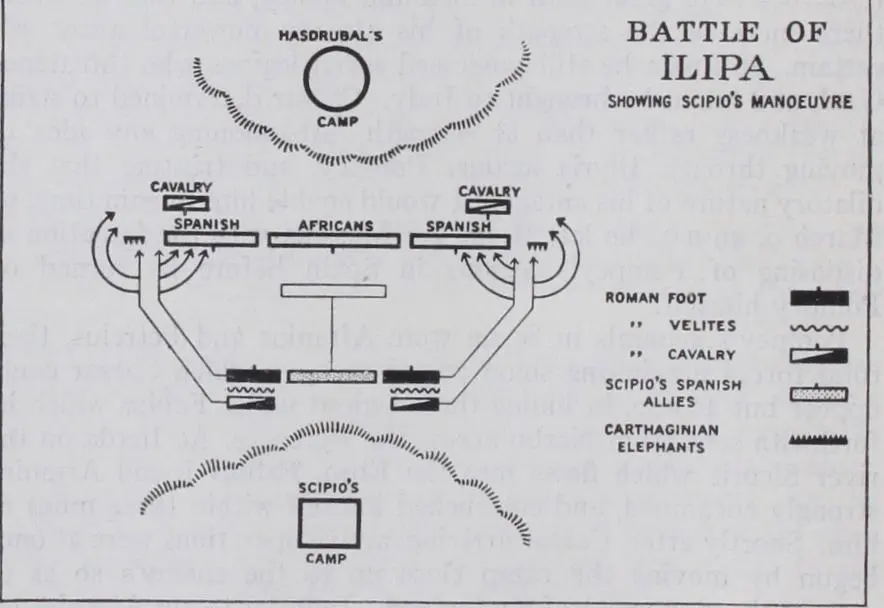
Scipio's tactical plan for the engagement, which he had been developing across the winter, was based on his analytical assessment of the Carthaginian army's composition. He recognized that the Carthaginian veteran core — the Africans and the older Iberian troops — would necessarily be deployed in the center of the line, where they could exert decisive influence on the engagement; the wings would be held by the recently recruited Spanish allied contingents, of inferior quality and morale. The conventional Roman approach to such a deployment would have been to place the Roman heavy infantry opposite the Carthaginian center, attempting to defeat the Carthaginian veterans by main force. Scipio's plan, however, was the opposite: he would deploy his Roman heavy infantry on his wings, opposite the inferior Carthaginian Spanish troops, and would place his Spanish allies in the center, opposite the Carthaginian veterans. The Roman wings would press their attack with full force against the weak Carthaginian wings, breaking them rapidly; the Roman center, holding defensively against the Carthaginian veteran center, would hold position without engaging decisively. The intended result was the destruction of the Carthaginian wings by Roman wing pressure, followed by the envelopment of the now-isolated Carthaginian veteran center by the victorious Roman wings.
The plan was, in effect, the inverse of the Cannae plan: where Hannibal at Cannae had used a weak center to draw the Romans forward into an enveloping pocket, Scipio at Ilipa would use a weak center to hold position while the strong wings broke the enemy wings and then enveloped the enemy center. The conceptual sophistication was high: Scipio had identified the operational logic of the most famous Carthaginian battle of the war and had inverted it to produce a tactical scheme appropriate to the specific conditions of his current engagement. The execution required several supporting innovations.
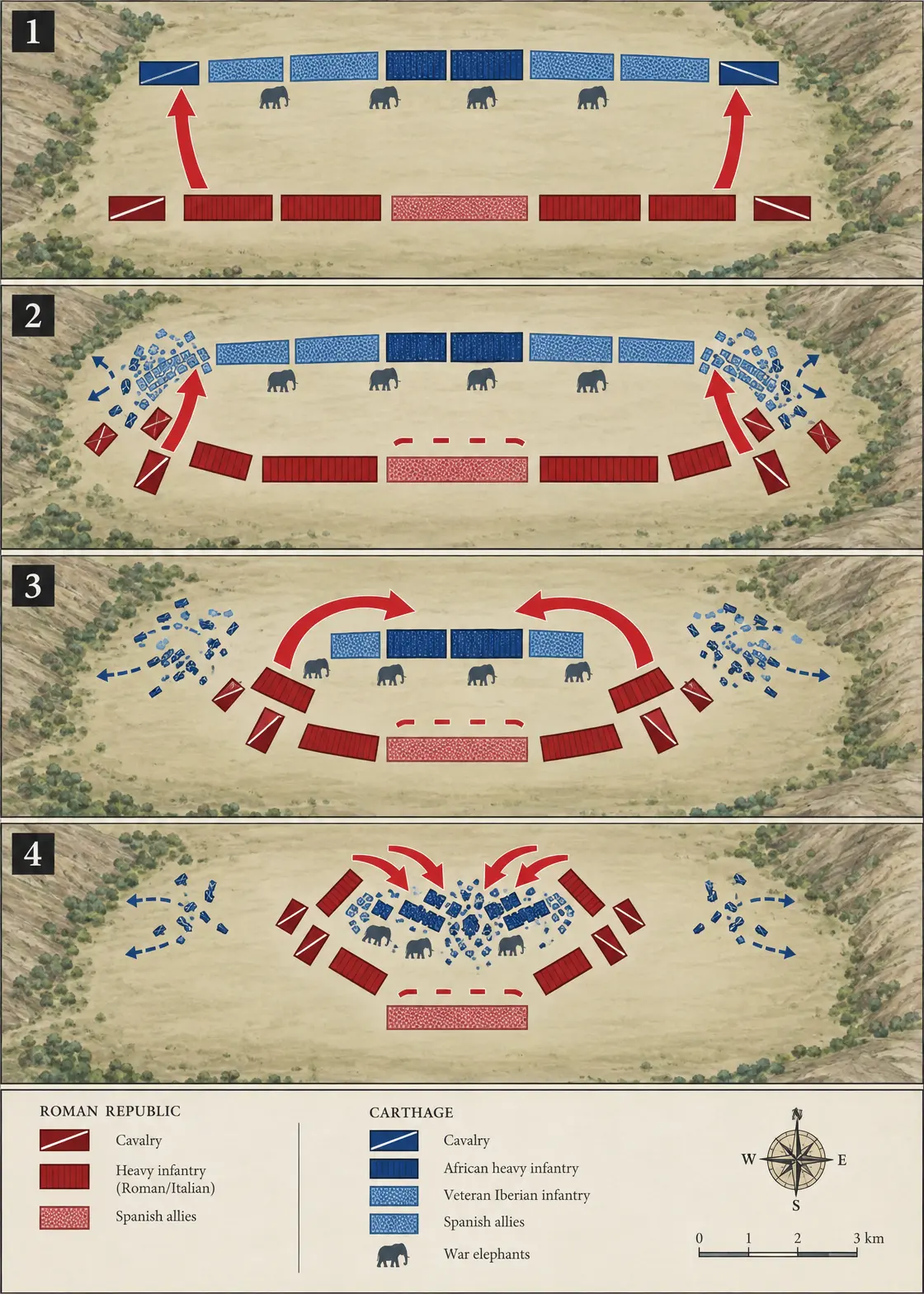
The engagement opened with a tactical surprise of Scipio's design. For several days before the engagement, the two armies had been deployed each morning in their conventional formations (Carthaginian veterans in the center, Romans in the center) for skirmishing along the line between the ridges; the troops on both sides had become accustomed to the daily deployment pattern. On the day Scipio had chosen for the decisive engagement (the date is not preserved in the sources but was probably in late April or early May 206 BC), he had his army deployed at dawn — earlier than the usual time — and in the inverted configuration, with the wings holding the heavy infantry and the center holding the Spanish allies. He sent his light troops and cavalry forward to engage the Carthaginian camp at first light, compelling Hasdrubal son of Gisgo to deploy his army for battle without the time to assess and respond to the Roman tactical change. The Carthaginians deployed in their conventional formation; Scipio's inverted deployment, which would have been visible to careful Carthaginian observation in time to permit response, went unnoticed in the haste of the morning's mobilization. The Carthaginian commanders found themselves committed to an engagement in which their veteran center faced inferior Roman opposition and their inferior wings faced veteran Roman opposition — exactly the conditions Scipio had designed the engagement to produce.
The engagement that followed unfolded substantially as Scipio had planned. The Roman wings advanced rapidly against the Carthaginian Spanish allied contingents; the Carthaginian wings, outclassed in equipment and training, gave way under the pressure within perhaps an hour of the engagement's beginning. The Roman center, holding defensively against the Carthaginian veteran center, did not advance to engage; the Carthaginian veterans, deployed for a frontal infantry contest, found themselves with no opponent to engage decisively and were unable to commit to forward movement without exposing their already-thinning flanks. When the Roman wings, having broken the Carthaginian wings, wheeled inward to attack the Carthaginian center from both sides, the Carthaginian veteran troops found themselves enveloped while still standing in their original formation. The engagement turned within the next hour into a battle of attrition in which the Carthaginian veteran center was destroyed in place by Roman flank attacks, with no possibility of orderly withdrawal because the broken Carthaginian wings had ceased to exist as a coherent formation behind the center.
The Reduction of Remaining Carthaginian Positions (206 BC)
The summer and autumn of 206 BC were spent by Scipio in the reduction of the remaining Carthaginian strongholds in Spain. Hasdrubal son of Gisgo withdrew with the surviving Carthaginian forces to the great commercial city of Gades (modern Cádiz) on the Atlantic coast — the original Phoenician foundation on the Iberian peninsula, dating to perhaps the eleventh century BC, and the principal naval base of the Carthaginian Atlantic operations. Mago Barca attempted independent operations in the Balearic Islands and on the Mediterranean coast but was unable to threaten the consolidating Roman position. Across the summer of 206 BC, Scipio's troops reduced one Carthaginian-allied city after another in southern Spain: Castulo surrendered without resistance, Iliturgi (the city that had reportedly betrayed the elder Publius Scipio to his enemies in 211) was stormed and destroyed with exemplary severity, several other communities of varying loyalty accepted Roman alliance on terms.
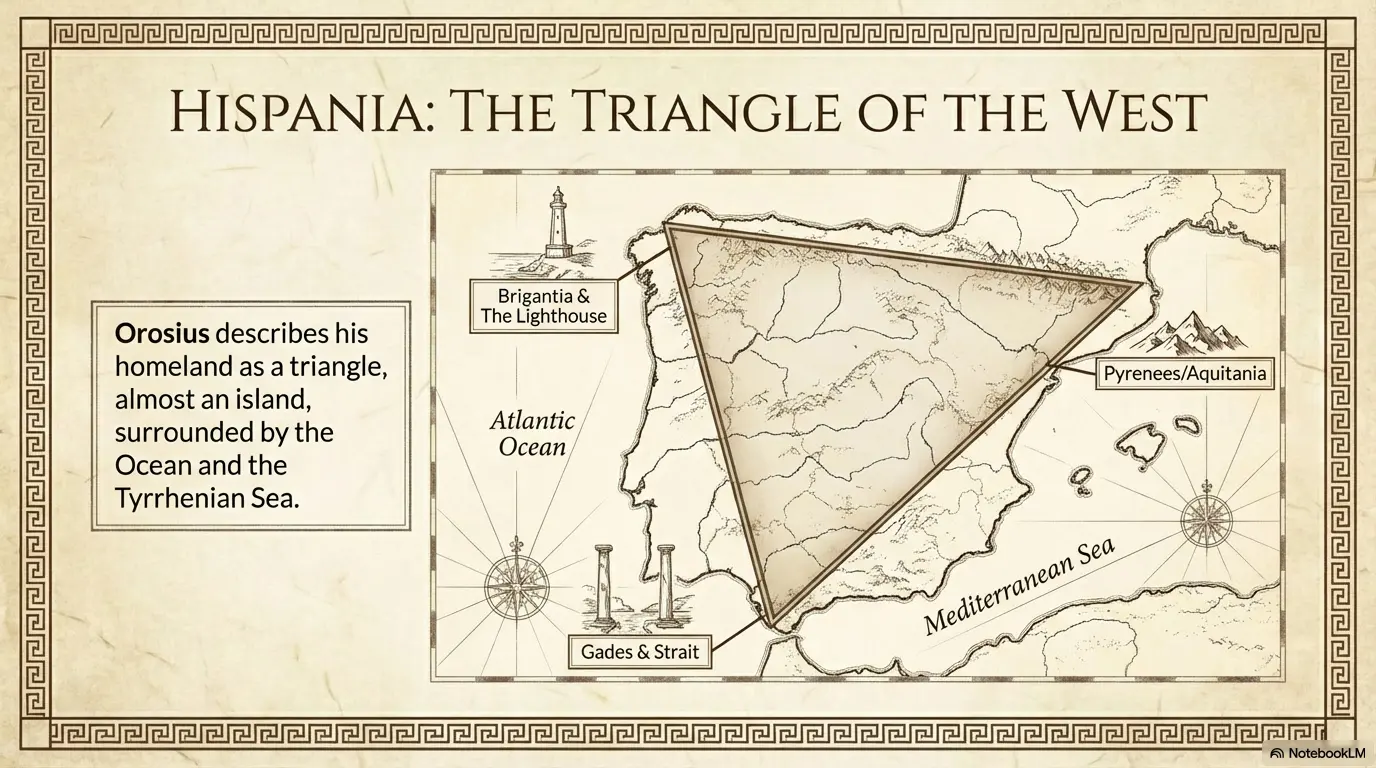
The most operationally interesting episode of the closing Spanish campaign was the recovery of the Spanish chieftain Indibilis (whose name has already appeared in connection with the early operations of the elder Scipios) into the Roman alliance, and his subsequent attempt — after Scipio's brief illness in late 206 BC, when rumors that Scipio had died briefly produced political instability in the alliance system — to lead a Spanish revolt against the Roman position. The revolt was suppressed by Scipio's army upon his recovery, in two small engagements that need not detain the present narrative. The political point of the episode is that the Roman alliance system in Spain, established across the previous four years of Scipio's command, was not yet sufficiently institutionalized to survive the death (or even the rumored death) of its principal Roman architect. The construction of a durable Roman administrative system in Spain — the provincial framework that would, across the following century, transform the peninsula into one of the principal sources of Roman wealth and military manpower — was not the achievement of Scipio's Spanish campaign; it was the long subsequent achievement of the second-century provincial governors and of the slow institutionalization of Roman administrative practice. What Scipio accomplished was the strategic destruction of the Carthaginian position in Spain; the political consolidation of what had been gained would be the work of others, over decades.
The siege of Gades was the final operation of the campaign. The city held out across the winter of 206/205 BC under Mago's command, but with no prospect of relief and with its commercial interests in tension with the requirements of military defense, Gades opened negotiations with Scipio's representatives in the spring of 205. The city eventually surrendered on terms that preserved its civic and commercial institutions in exchange for transition to Roman alliance. Mago Barca evacuated with the remaining Carthaginian forces (perhaps 8,000 men, with some elephants and a small fleet) and sailed eastward — initially to the Balearic Islands, where he wintered, and then in 205 BC to the Ligurian coast, where he attempted to open a fourth front against Rome by operations in northern Italy. The Magonian campaign in Liguria would continue until 203, when Mago was wounded in a small engagement and died en route to North Africa where he had been recalled. He was the third of Hamilcar Barca's three sons to die in the Carthaginian war effort, after Hasdrubal at the Metaurus and Hannibal's continuing operations in Italy.
The Spanish theater was, after the surrender of Gades in spring 205 BC, definitively a Roman possession. Scipio departed Spain in the same period, returning to Rome to seek the consulship and to argue for the next strategic step — the African expedition that would carry the war to Carthage itself. The Spanish achievement was: in five years (210–205), starting from a position of near-collapse, Scipio had recovered Roman territory, captured the Carthaginian strategic capital at Carthago Nova, defeated three Carthaginian armies in successive engagements (Baecula, Ilipa, and the smaller operations of the late campaign), destroyed the Carthaginian political-military presence in the peninsula, and constructed (in outline) a Roman alliance system that would mature, over the following century, into the Roman provincial administration of Hispania Citerior and Hispania Ulterior. The strategic foundation of Carthaginian military power in the western Mediterranean — the Iberian fiscal-recruitment base constructed by Hamilcar Barca after the First Punic War — had been irrevocably broken. The war could no longer be supported by Carthaginian resources from Spain; what remained was the operational task of compelling Carthage herself to acknowledge defeat.
Tactical illustrations
Outcome and critical assessment
Result and caution: Carthaginian military dominance in Iberia ended. Roman possession of coastal bases was not the conquest of the entire peninsula; the wars cataloged under W026–W027 and W046 show how long resistance continued. Details of individual battlefield locations and maneuvers require archaeological and textual work beyond this locator atlas.
Historical record: IR-III, Spanish campaigns; Polybius, books 10–11; Livy, books 25–28; Appian, Iberian Wars.