Wars · II. Carthage and the connected Mediterranean
W016 Hannibal in Italy
Battles and sieges
Trebia 218 BCLake Trasimene 217 BCCannae 216 BCCapture of Syracuse 212 BCRecovery of Capua 211 BCMetaurus 207 BCHannibal's early victories at the Trebia in 218, Lake Trasimene in 217 and Cannae in 216 BC destroyed or badly damaged successive Roman armies. His strategic aim required more than their defeat: Rome's political and allied system had to fracture enough to force negotiation. Important southern communities changed allegiance, but the break was incomplete.
Rome alternated caution, local operations and renewed concentration. The recovery of Capua in 211 and Tarentum in 209 BC narrowed Hannibal's support. Hasdrubal's separate approach to reinforce him ended at the Metaurus in 207 BC. Hannibal continued to campaign in the south until recalled to Africa.
Command, forces and military problem
| Field | Dossier |
|---|---|
| Roman leadership | Fabius, Marcellus, Varro, Paullus, Nero, Salinator and others |
| Opposing or rival parties | Hannibal and the separate reinforcing army of Hasdrubal |
| Forces and capabilities | Roman replacement armies against an experienced, mixed Carthaginian field army |
| Operational problem | Protect the alliance, contain mobility and prevent effective reinforcement after severe defeats. |
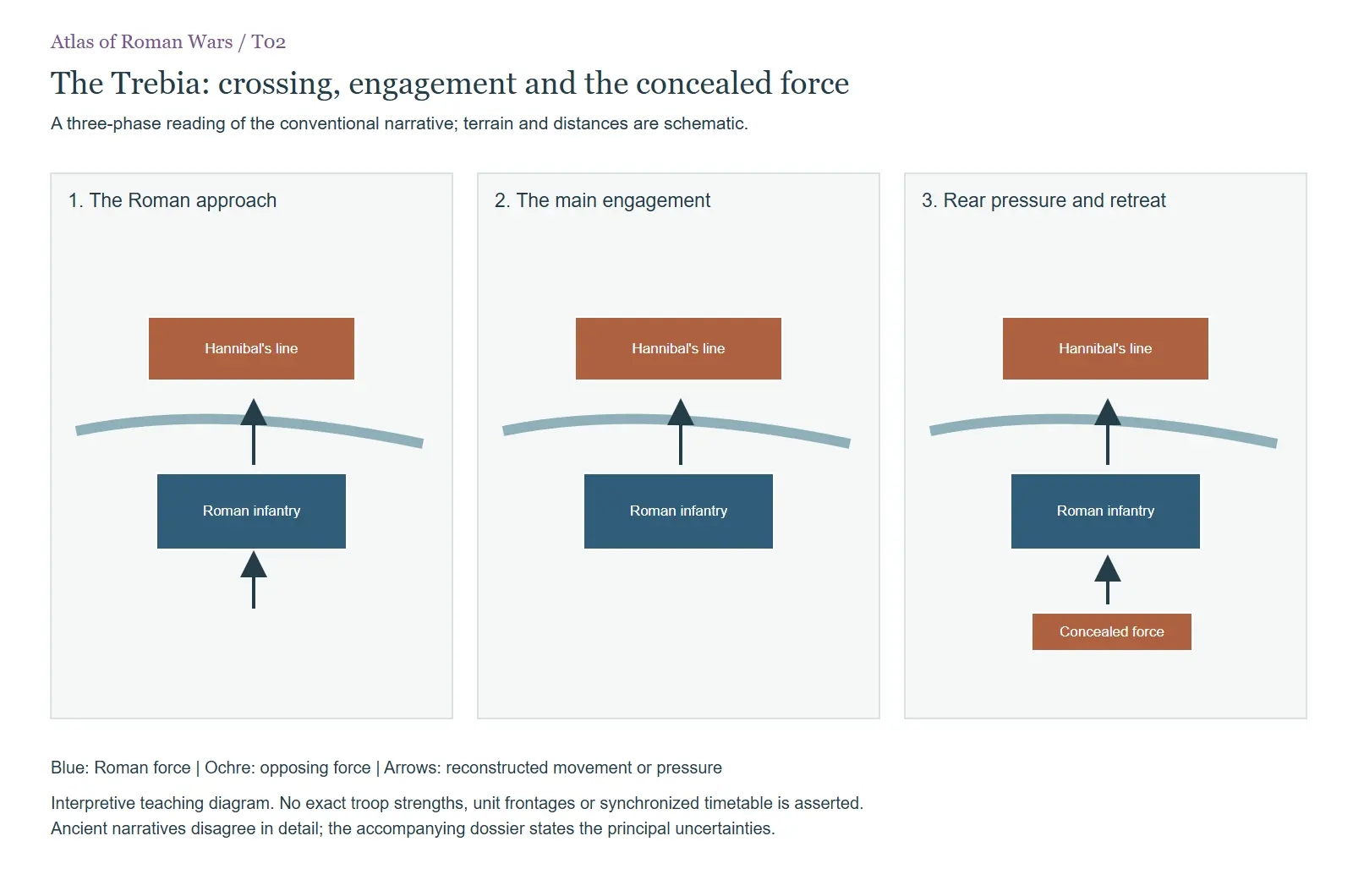
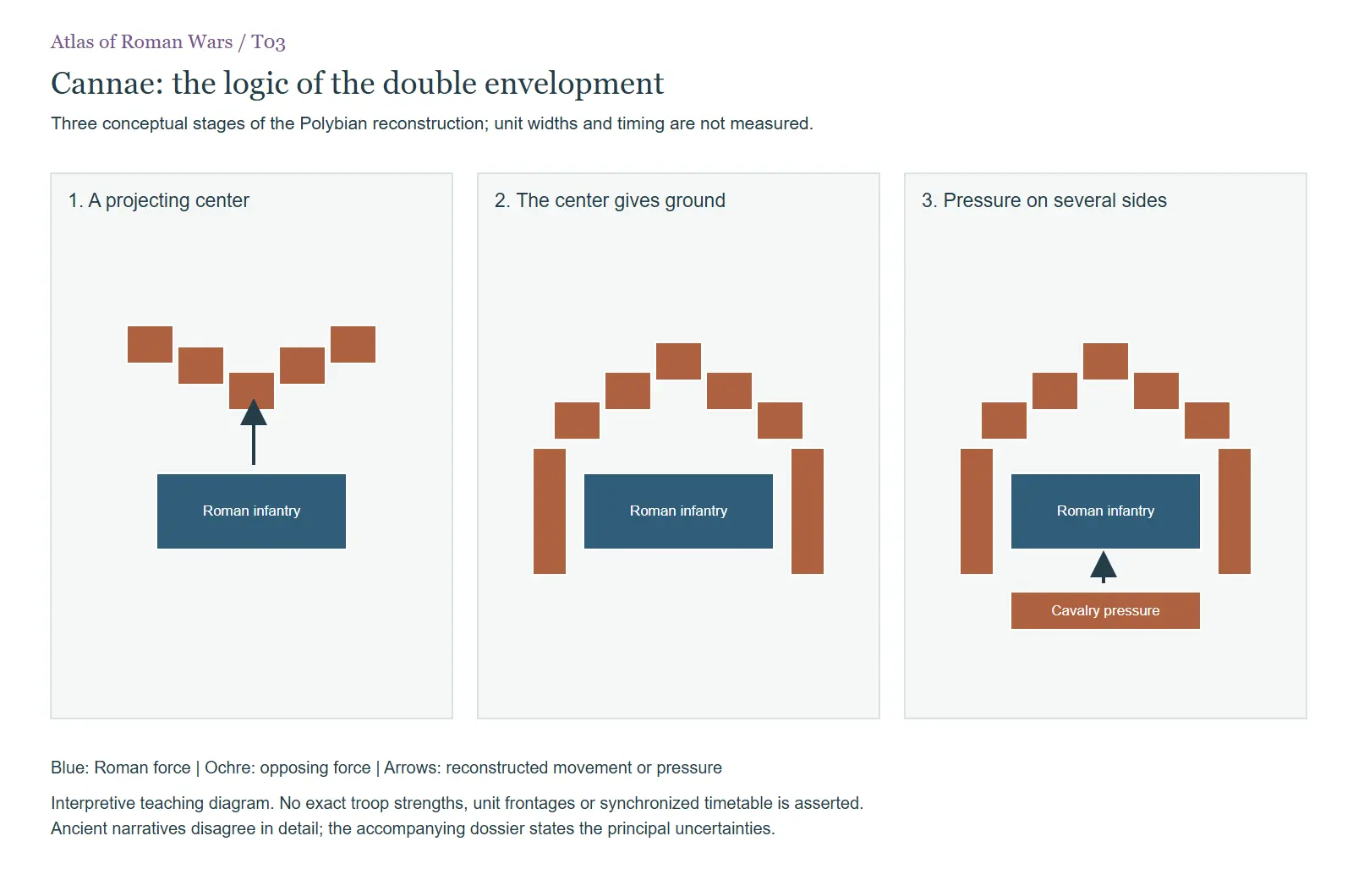
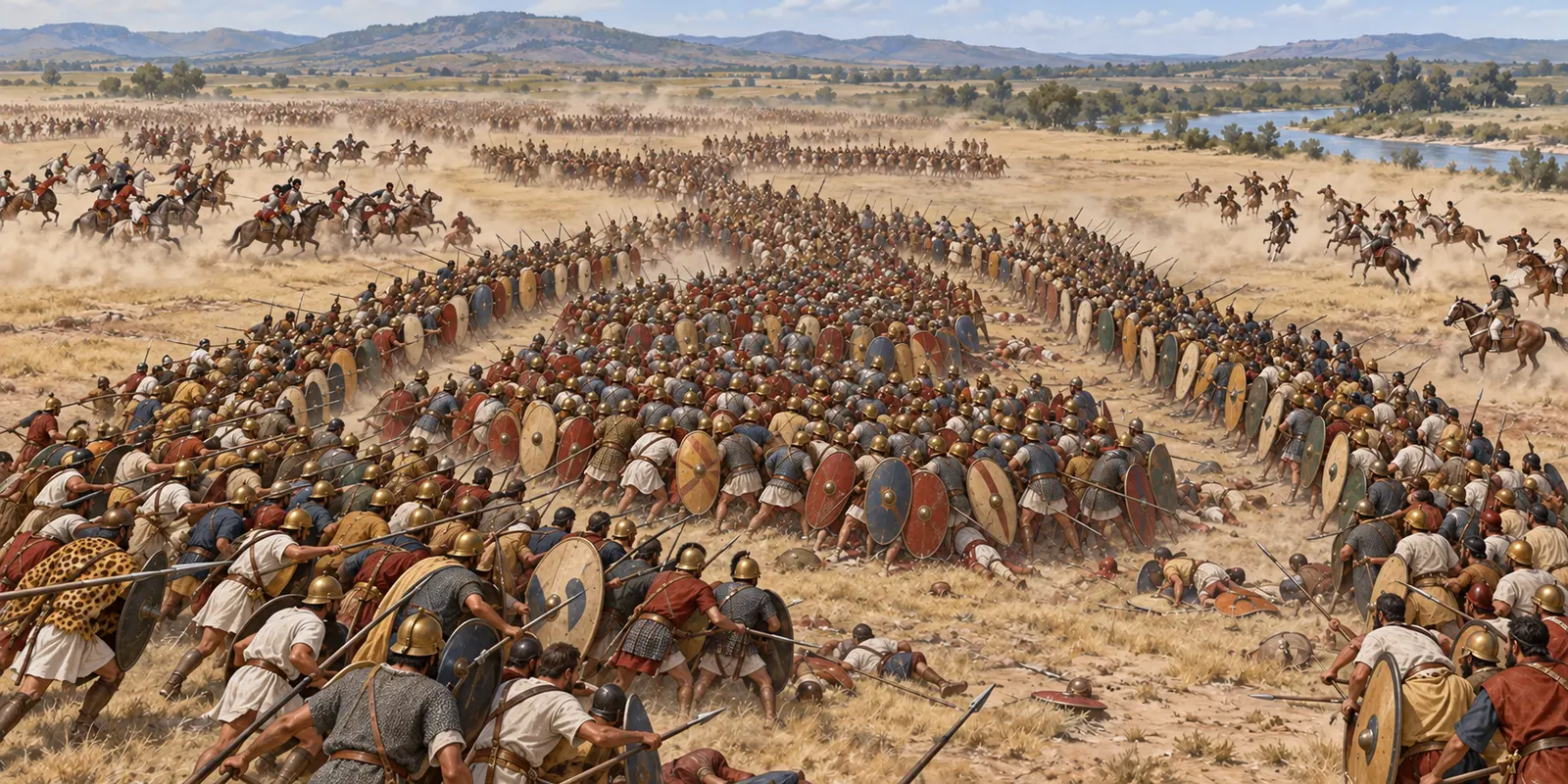
Campaign geography and operational plates
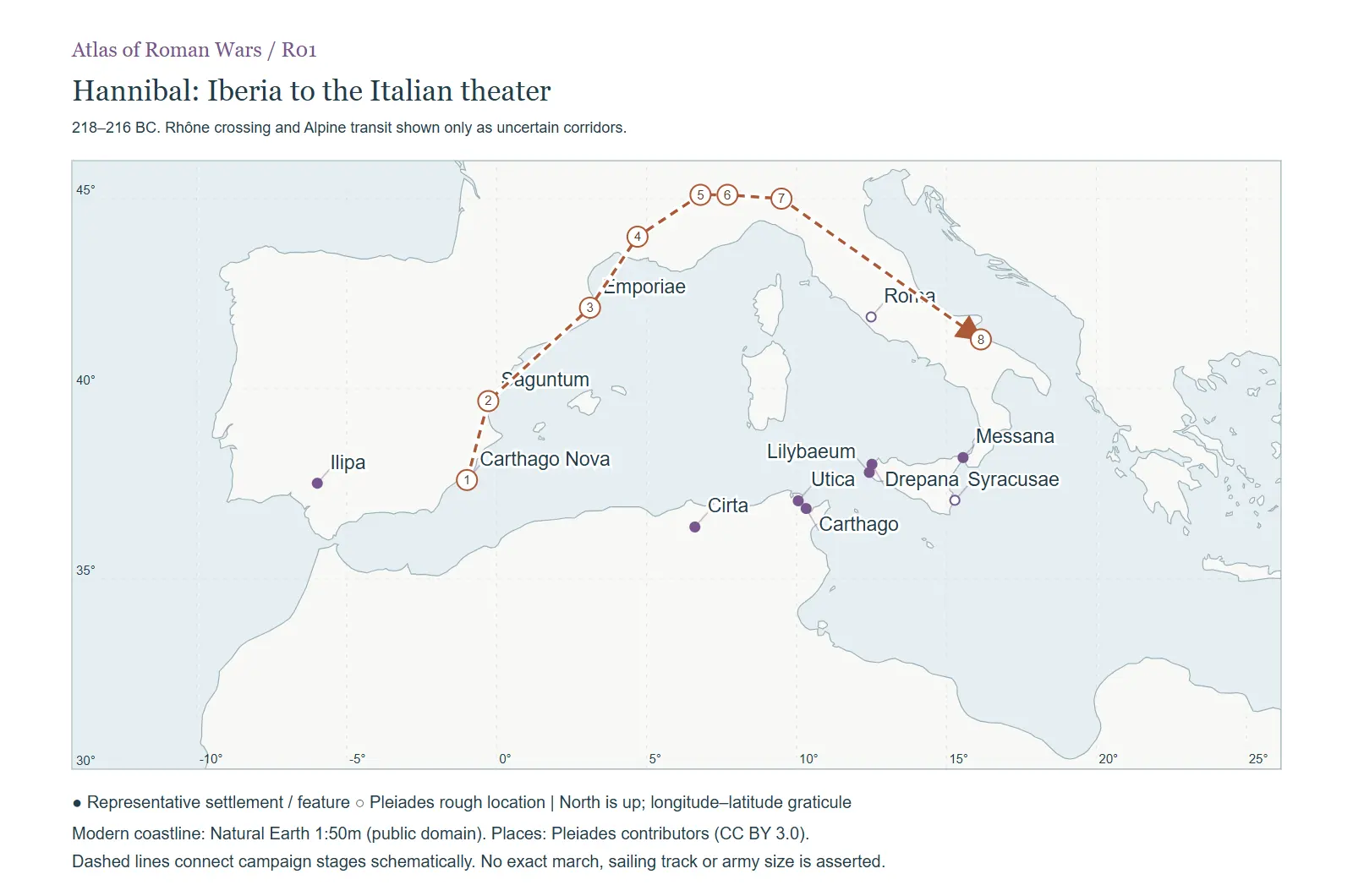
Hannibal: the long approach to the Italian war
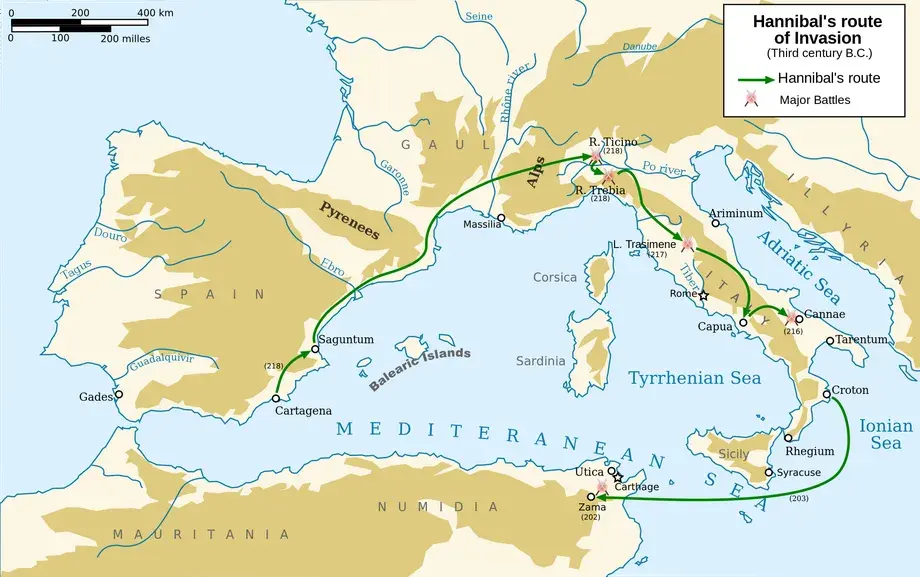
Read the arrow as a sequence of strategic transitions: Iberian bases, the southern Gallic corridor, an Alpine crossing and the Italian theater. The map makes the length of the approach visible; it does not establish how many troops crossed a particular pass or reconstruct the route of every baggage element.
Campania in the Hannibalic war
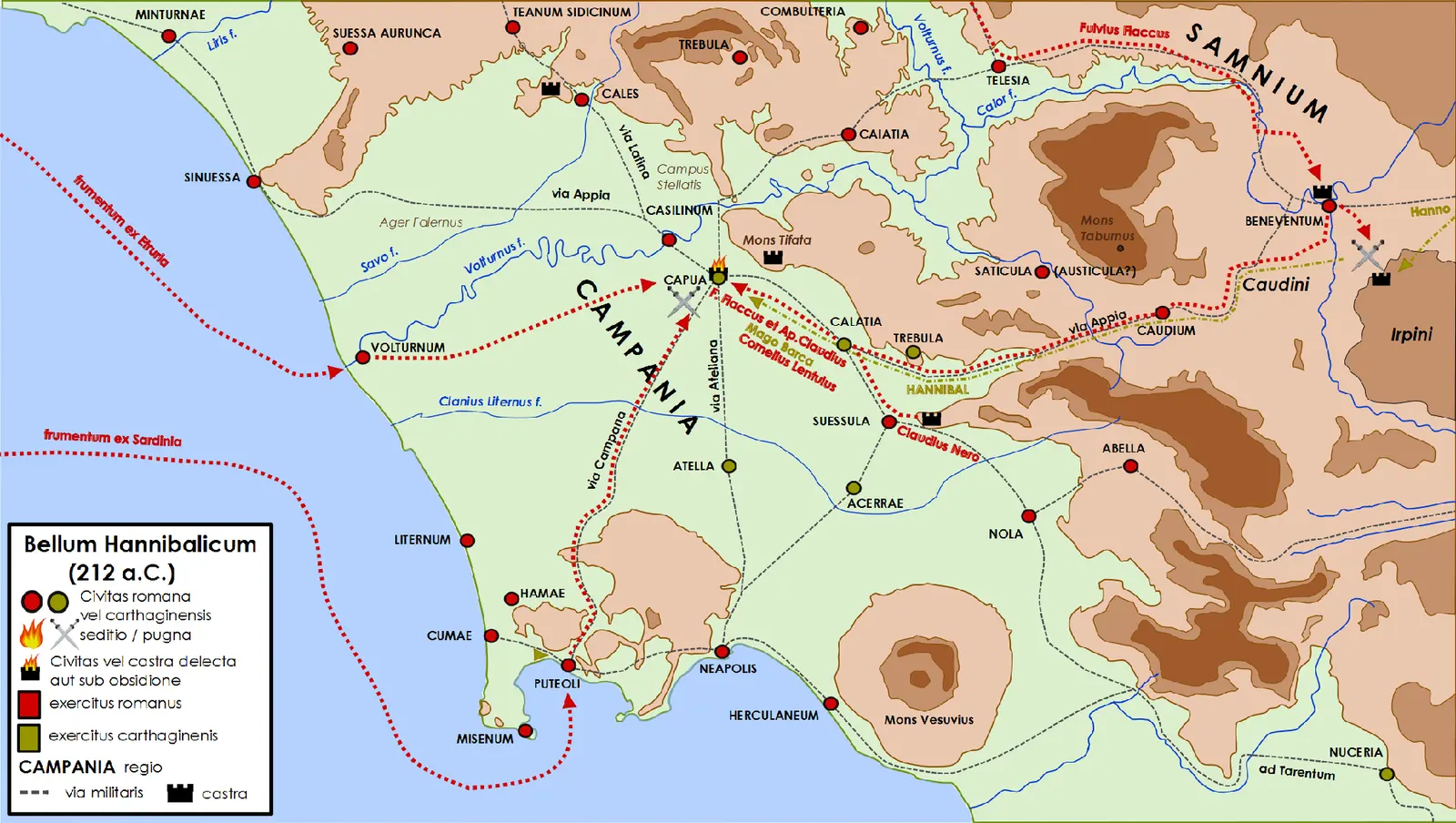
Capua's importance lay in its relationships with nearby roads, towns and ports as well as its political standing. The concentration of competing routes and fortified places helps explain why relief operations and local allegiance mattered after Cannae. Arrows connect selected operations rather than documenting a single uninterrupted march.
Extended campaign study
The account below develops the operations and their interpretation. Reported numbers and reconstructed tactical details retain the uncertainties described in the dossier.
The Departure and the Spanish Crossing (Spring–Summer 218 BC)
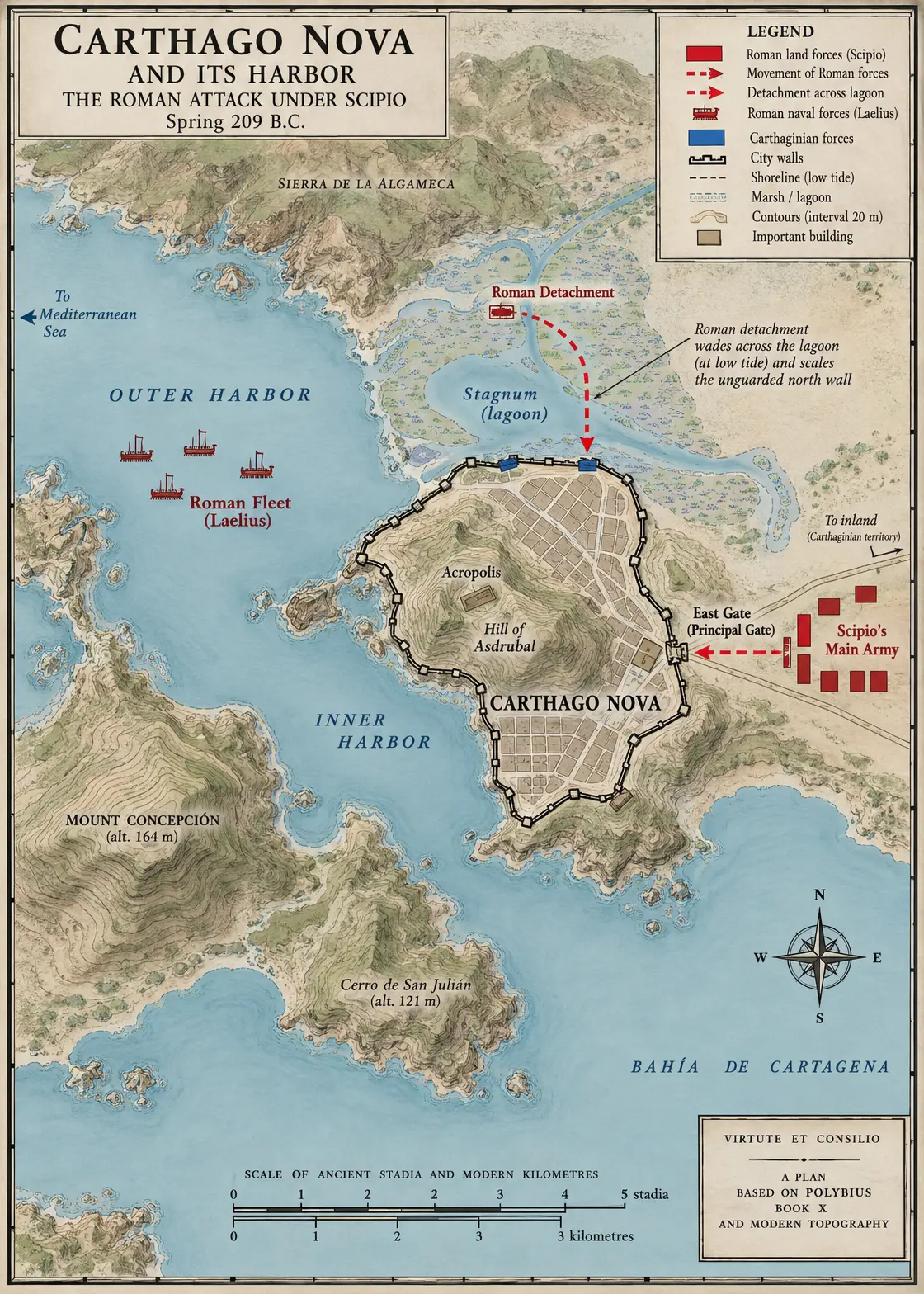
Hannibal departed from Carthago Nova in the spring of 218 BC with a field army of approximately 90,000 foot and 12,000 cavalry, including 37 war elephants. The composition of the army is preserved with unusual detail by Polybius, who appears to have drawn his information from a bronze inscription that Hannibal himself erected at the Lacinian promontory in Italy (the temple of Juno Lacinia, near the modern Crotone) recording the army's composition; Polybius read this inscription personally during his Mediterranean travels, and his preservation of its content is one of the few cases in which an ancient historian was able to consult contemporary primary documentation for the events he described.
Hannibal's first operation was to leave a substantial portion of his force in Spain under his brother Hasdrubal (a different Hasdrubal from Hasdrubal the Fair: this was Hannibal's younger brother, who would command in Spain throughout the war and would eventually attempt to bring reinforcements through southern Gaul into Italy, only to be intercepted at the Metaurus in 207 BC). The Spanish garrison force was approximately 15,000 foot and 2,000 cavalry, with about 20 elephants. Hannibal's mobile field army for the march was therefore reduced from the original 90,000 to approximately 75,000 foot and 10,000 cavalry, with 17 elephants. This was still a substantial force — larger than any single field army Carthage had previously deployed in any war — but the reductions from natural attrition, garrison detachments, and the eventual march casualties would bring the force entering Italy down to approximately 26,000 fighting men.
The Spanish-Gallic crossing was conducted in the late spring and early summer of 218 BC. The Ebro was crossed in early summer; the Iberian populations between the Ebro and the Pyrenees were either subdued or bypassed; the Pyrenees were crossed in mid-summer; the army entered southern Gaul in late June or early July. The Roman embassies that had been dispatched to negotiate with the Gallic tribes of southern France against Hannibal's passage had been notably unsuccessful — the Gallic populations were generally indifferent to the Roman cause and were prepared to receive Hannibal as a passing power rather than a permanent presence. Several Gallic tribes provided guides and supplies; others remained neutral; only a few attempted resistance, and these were generally defeated in small engagements that did not significantly delay the march.
The Crossing of the Rhône (Late August 218 BC)
The first major obstacle of the march was the Rhône river, crossed at a point that Polybius locates approximately four days' march from the sea — probably in the vicinity of the modern Tarascon or Avignon, though the exact ford is debated. The river at this point is approximately 250 meters wide, with strong current. The crossing presented two problems: the river itself, and a body of Gallic warriors (Volcae, perhaps fifteen thousand strong) gathered on the eastern bank to dispute the passage.
Hannibal's solution to the second problem was characteristic of his operational creativity. He dispatched a detachment of about ten thousand picked troops under Hanno son of Bomilcar on an upstream march to a crossing point about thirty miles north of his main position, with orders to cross the river at that upstream point and to march down the eastern bank to attack the Volcae from behind. While Hanno's detachment was making this circuit (which took perhaps three days), Hannibal had his main army construct rafts and boats from local timber under the noses of the Volcae, who took this preparation as the standard preparation for a frontal river crossing. On the morning of the planned crossing, the smoke signals from Hanno's detachment — now established on the eastern bank south of the Volcae position — were the signal for Hannibal's main army to launch its assault. The Volcae, attacked from the rear by Hanno's force just as they were preparing to repel Hannibal's frontal crossing, broke and were dispersed; Hannibal's army crossed the river in good order, with the only difficulty being the transportation of the elephants.
The elephant crossing of the Rhône is one of the more technically interesting episodes in the ancient military record and is described by Polybius (3.46) with the kind of detail that suggests it had attracted contemporary discussion. The Carthaginian engineers constructed two great rafts each large enough to support several elephants, covered them with earth and turf to make them resemble dry ground, and led the elephants onto the rafts as if they were continuing along the bank. Once the elephants were aboard, the rafts were detached from the bank by tug-boats and rowed across the river. Some of the elephants, recognizing they were on water, became frightened and either jumped into the river (where they could partially walk along the bottom with their trunks above water, a fact contemporary observers were impressed to discover) or were brought across with their mahouts. By Polybius's account, all thirty-seven elephants made the crossing without loss — a fact which, given the scale of the operation and the inherent risks, is itself a remarkable testament to the technical competence of Hannibal's army.
The Ascent of the Alps (September–October 218 BC)
With the Rhône successfully crossed, the army turned eastward toward the Alps. The specific route Hannibal followed across the mountains has been debated by classical scholars and Alpine geographers for over two thousand years, with at least four major candidate passes (the Col de Clapier, the Col du Mont-Cenis, the Col du Petit Saint-Bernard, and the Col de Larche) having been proposed at various times. Polybius (3.50–56) describes the crossing in detail but with topographical references that do not unambiguously identify the route. The modern consensus, supported by the recent geochemical work of Mahaney and others (who in 2016 identified deposits of horse dung at the Col de la Traversette consistent with the passage of a large army in the autumn of 218 BC), tends toward a southern route via the Col de la Traversette or the Col du Clapier. The matter is not entirely settled.
What is firmly preserved by the sources is the general character of the crossing: it was conducted in the early autumn (September and early October 218 BC), at the very edge of the season when Alpine passes are still negotiable for large forces; it was bitterly cold for the African and Iberian troops in Hannibal's army; it was conducted under intermittent harassment by the Alpine Gallic populations (Allobroges in the lower foothills, various smaller tribes higher up) who attacked the column at narrow points and inflicted significant casualties before being dispersed or bought off; it was punctuated by the kind of physical difficulties (snow on the high passes, the necessity of cutting paths through rocks frozen with ice, the difficult management of pack animals on narrow tracks) that the Polybian description captures in detail.
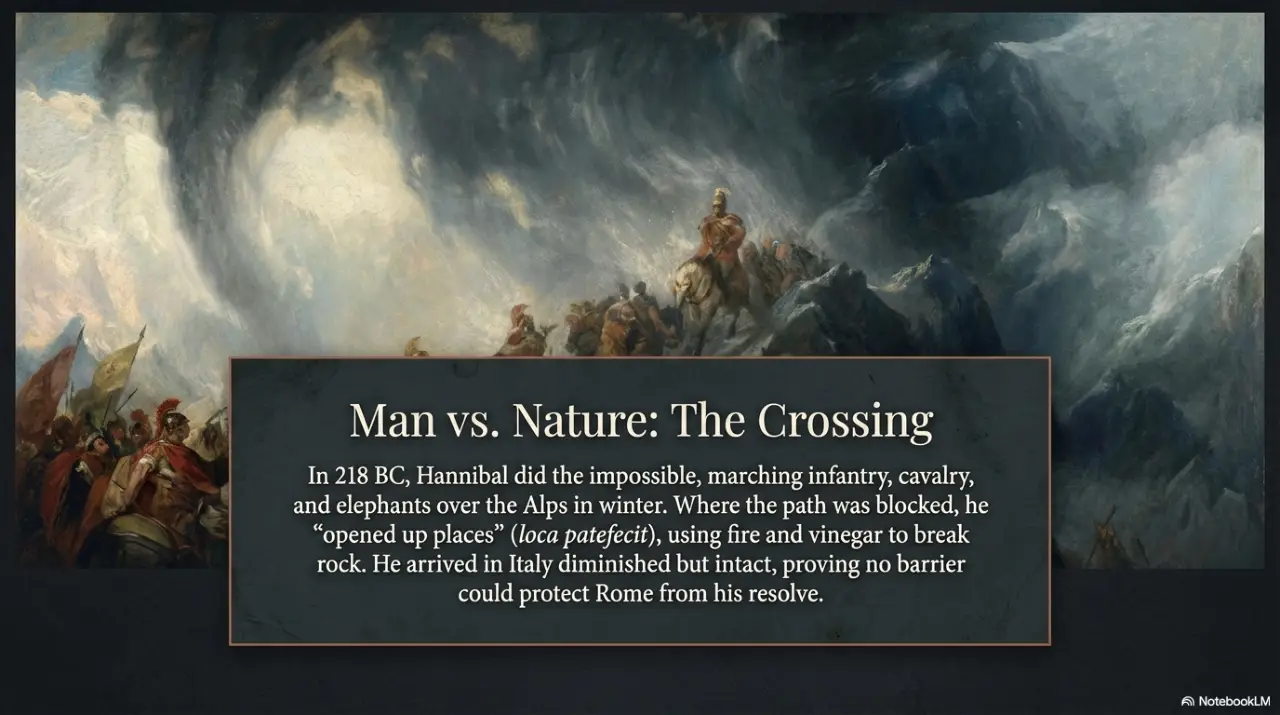
The most dramatic single moment of the ascent, in Polybius's account, was the engineering operation by which Hannibal's army descended from the highest pass into the Po valley. The descending track, narrow and steep, was found to be blocked at one point by a major rockfall (recent or ancient is uncertain) that could not be passed by men and certainly not by elephants. Hannibal's troops, with rations and time running short and the elephants in particular suffering severely from the cold and altitude, attacked the rockfall directly: they built fires against the rocks, heated them through the night, then poured sour wine (vinegar, the only acidic liquid available in quantity) over the heated stone to crack it. Polybius reports that by this method the rocks were reduced to a passable state in three days of continuous work, the path was opened, and the army made its descent. The technical credibility of the procedure has been variously assessed by modern engineers (the vinegar's specific role is doubtful, but the heating-and-quenching technique is consistent with traditional rock-breaking methods of the period), but the underlying narrative of an emergency engineering operation under extreme conditions is preserved with consistency in the source tradition.
Arrival in Italy
Hannibal's army emerged from the Alps into the territory of the Insubres in late October or early November 218 BC. The army that arrived in Italy was substantially smaller than the army that had departed Spain. Polybius's figures — drawn, again, from Hannibal's own Lacinian inscription — record the arrival force as approximately 20,000 foot and 6,000 cavalry: about 26,000 men in all, of whom 12,000 were African and 8,000 Iberian heavy infantry, the remainder Numidian cavalry and miscellaneous detachments. Of the 37 elephants that had begun the crossing, perhaps 20 (the sources vary somewhat) survived the descent. The army had lost approximately two-thirds of its strength on the march from Carthago Nova, principally to desertion in southern Gaul (mercenary contingents who had refused to continue at the Rhône or in the Alps), to casualties in the Alpine fighting, and to attrition from cold and exhaustion in the high passes.
What Hannibal had brought to Italy, however, was an army of unprecedented quality. The 26,000 men who had survived the march were the most resilient elements of his original force, hardened by months of campaigning under extreme conditions and bound to their commander by a degree of personal loyalty that no other ancient army of the period possessed. They were now in central position to attack the Roman alliance system; they were resupplied immediately by the Cisalpine Gauls of the Boii and Insubres, who joined Hannibal's army with substantial reinforcements (perhaps 14,000 Gallic foot and cavalry in the first weeks); they would shortly be tested against the Roman armies that had been hastily redirected from their original Spanish destination to confront the unexpected Italian invasion.
The Roman Response to the Alpine Crossing
The news that Hannibal had crossed the Alps and was in the Po valley reached Rome in November 218 BC, arriving as a strategic surprise of the first magnitude. The Roman war plan had assumed that the war would be fought principally in Spain and Africa, with the Italian theater serving as supply base and recruitment ground rather than as the principal arena of operations. The consul Publius Cornelius Scipio, dispatched in the early autumn with his consular army to Spain, had paused at Massalia to discover that Hannibal had already crossed the Rhône north of his position; he had then conducted a brief reconnaissance, found the Carthaginian army gone into the mountains, and made the strategically decisive judgment that he could not now reach Spain in time to interfere with Carthaginian operations there. He sent the bulk of his army on to Spain under his brother Gnaeus Cornelius Scipio Calvus (which decision would prove, in the long run of the war, one of the most consequential of the period: the elder Scipio's command in Spain would establish a Roman foothold on the peninsula that Hannibal had failed to suppress before his march, and would tie up Carthaginian resources for the remaining decade of the war). Publius Cornelius Scipio himself returned by sea to northern Italy with a small detachment, taking command of the legions that had been raised in Cisalpine Gaul to defend against the Gallic risings of the previous year and that were now to be redirected against Hannibal's invading army. The other consul, Tiberius Sempronius Longus, who had been preparing his army at Lilybaeum for the African expedition, was recalled by Senate decree to march north to join Scipio. The combined Roman force assembled in the Po valley by mid-December would amount to approximately four legions and the corresponding allied contingents — perhaps 40,000 men in all, against Hannibal's somewhat smaller but more cohesive 26,000 plus the new Gallic reinforcements.
The Cisalpine political situation, however, was strongly in Hannibal's favor. The Insubres and Boii — the principal Gallic peoples of the Po plain — had risen against Rome in 218 BC in a coordinated revolt that the Senate had attributed to Carthaginian instigation and that had certainly been at least encouraged by Carthaginian diplomatic agents in the years before the war. Two Roman colonies that had been founded in the area in 218 (Placentia and Cremona) were under siege or threat; the praetor commanding the Cisalpine garrison had been ambushed and his army badly mauled. The arrival of Hannibal's army was, for the Cisalpine Gauls, the signal for a general rising: tribes that had previously hedged their bets between Rome and revolt now committed openly to Hannibal, supplying reinforcements, supplies, and intelligence on Roman movements. The strategic environment in the Po valley by the time Scipio's combined army reached it was, to the Roman commander's evident dismay, no longer the friendly home territory of Roman colonies and reliable Latin allies but a hostile theater in which Hannibal enjoyed local advantage even before the first set-piece engagement.
The Skirmish at the Ticinus (Late November 218 BC)
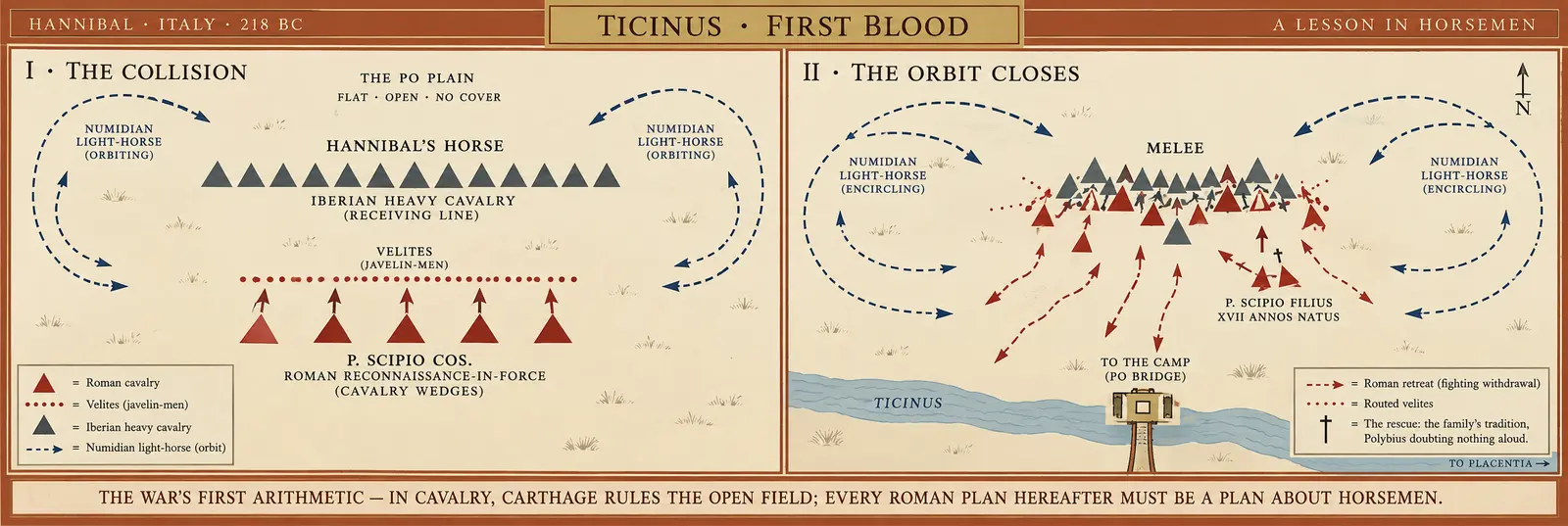
The first contact between the Roman and Carthaginian main armies occurred at the river Ticinus, a tributary of the Po that runs from the Alpine foothills southward through the western Po plain. Scipio had established his camp on the south bank of the Po; Hannibal's army was advancing eastward across the plain. Both armies were probing for information about the other's position and intentions; both commanders elected to lead substantial reconnaissance forces personally — Scipio with about 4,000 mostly Roman cavalry, supported by light infantry, and Hannibal with a comparable force of mixed Numidian and Iberian cavalry. The two reconnaissance forces met on level ground west of the modern town of Pavia, and the engagement that resulted was the first taste of Carthaginian operational tempo that the Roman army experienced in the Italian theater.
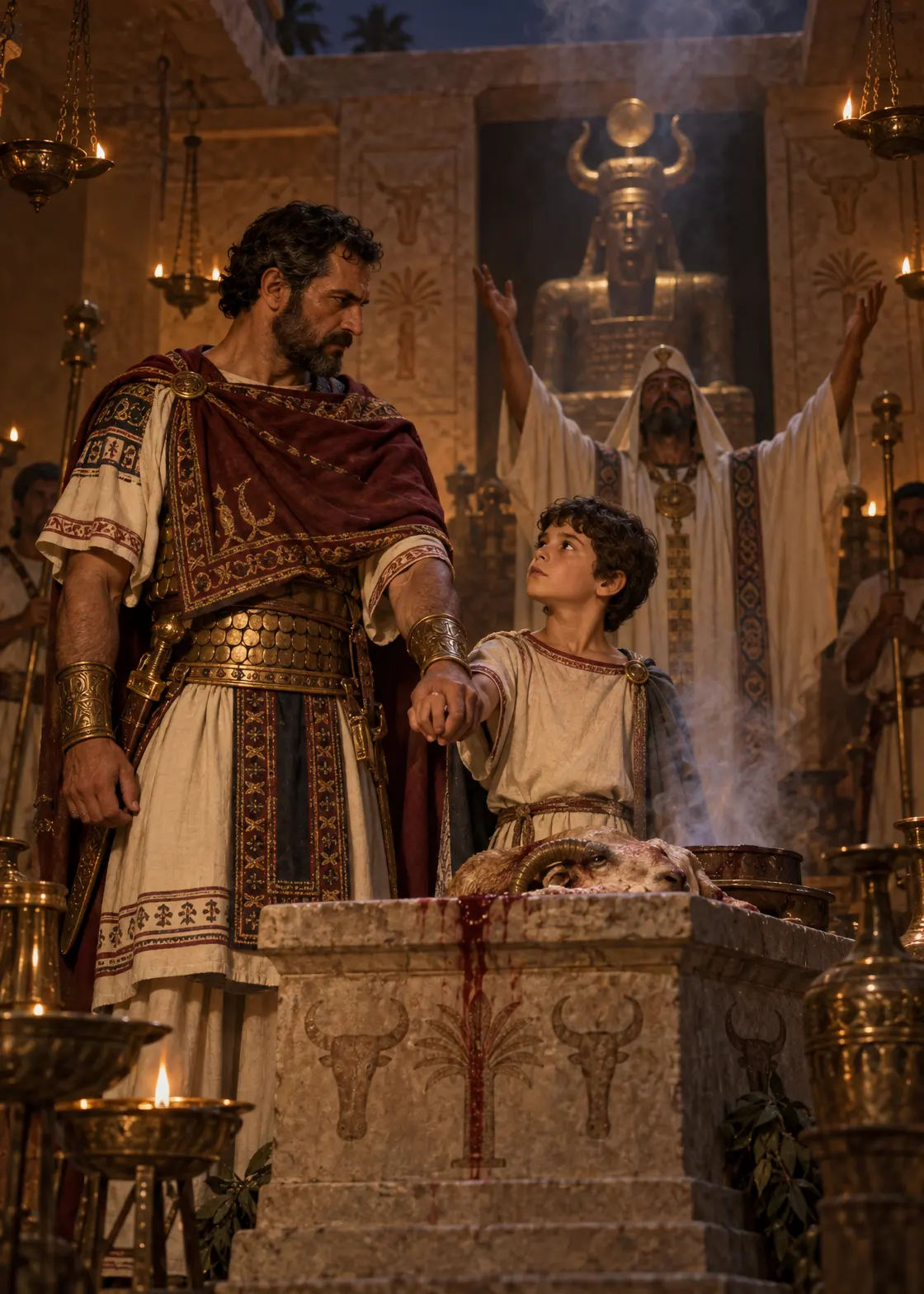
The action was sharp and brief. The Roman cavalry charged with their accustomed shock tactic; the Numidian cavalry on Hannibal's wings circled and engaged the Roman flanks while the heavy Iberian cavalry held the Roman center; the engagement degenerated into the kind of fluid cavalry-versus-cavalry melee that the Romans had little experience of conducting and at which the Numidians, in particular, excelled. After perhaps two hours of fighting the Roman cavalry began to give way; Scipio himself was wounded — by some accounts severely — and was extracted from the field only by what the Roman tradition would later commemorate as an act of filial heroism. His young son Publius (the future Scipio Africanus, then about seventeen years old and serving on his father's staff as a junior officer), seeing his father wounded and surrounded, charged into the melee with his personal squadron and brought the elder Scipio out of danger. The episode is preserved by Polybius (10.3) and by Livy (21.46) with the kind of family-historical care that suggests it was preserved by the Scipionic family tradition and may not be a complete invention even if the dramatic details have been improved.
Scipio's reconnaissance force withdrew to the Roman main camp; the Roman army's first engagement with Hannibal had been a tactical defeat of modest scale but considerable strategic significance, because it had demonstrated that the Carthaginian cavalry was substantially superior to the Roman, and that the Roman army in the field would have to find ways to compensate for this deficit if it was to fight Hannibal on anything like equal terms.
Scipio, recognizing that his army was now strategically vulnerable on the western bank of the Po, made the decision to withdraw south of the river to a position where he could await the arrival of Sempronius's army from the south. He executed the withdrawal at night, in good order, breaking down the bridge over the Po behind him. Hannibal, finding the Roman army gone in the morning, marched some way up the Po to find another crossing, and by mid-December had brought his army south of the river as well. The two armies were now within a day's march of each other, both encamped near the small river Trebia, a tributary of the Po that runs through the foothills south of Placentia.
The Battle of the Trebia (Late December 218 BC)
The Battle of the Trebia is the first set-piece engagement of the Hannibalic War and the first occasion on which Hannibal's tactical genius was demonstrated to the Roman command system in unambiguous form. The engagement was determined as much by Hannibal's operational understanding of his opponent — specifically, of the temperament of the consul Sempronius Longus — as by the dispositions on the day of battle itself. Hannibal recognized that Sempronius, whose army had recently arrived from the south and who had not yet engaged Hannibal personally, was both ambitious for a victory and inclined to act independently of his more cautious colleague Scipio (who was still recovering from his Ticinus wound and had been counseling delay). Hannibal also recognized that Sempronius's consular year was almost over — the new consuls would take office at the Ides of March — and that Sempronius would therefore be under pressure to seek battle before he was superseded.
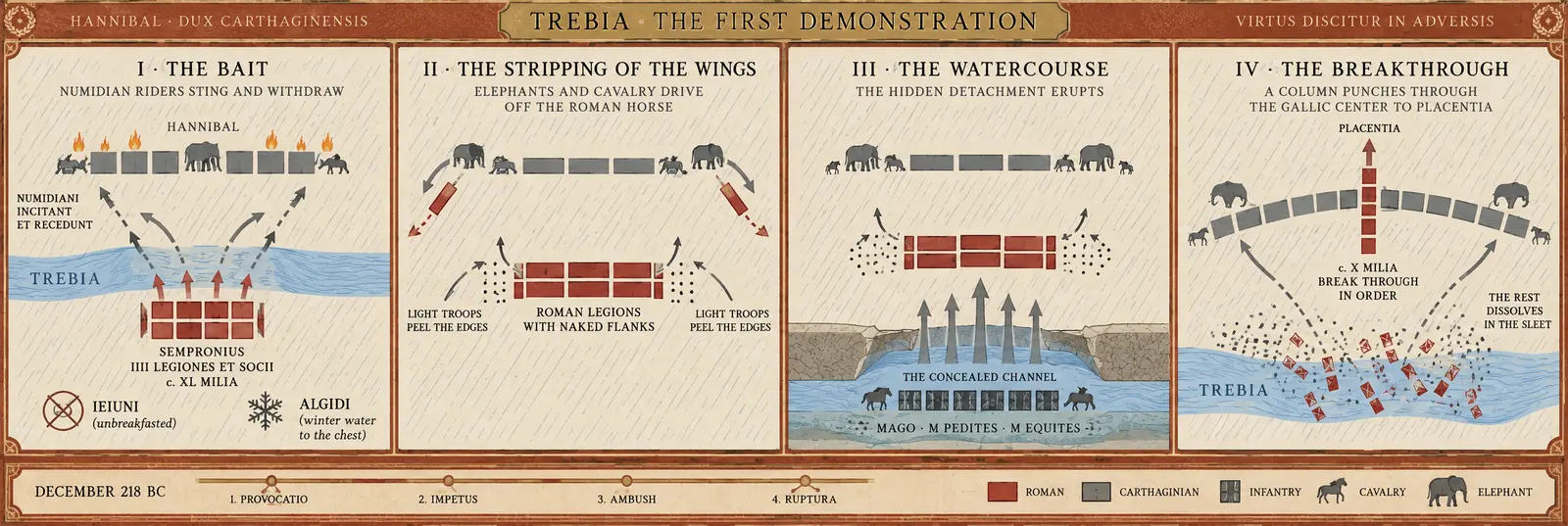
Hannibal accordingly set about provoking the Roman army into engagement on terms of his own choosing. He dispatched his Numidian cavalry to raid Roman foraging parties along the Trebia and to insult the Roman camp; he placed a substantial detachment of his light troops in concealment behind a ridge of the lower Trebia, in a fold of dry watercourse that ran into the river from the south; he prepared his main army to march out at first light on the chosen day and to draw up across the river from the Roman camp.
The choice of ground was characteristic. The plain on the Carthaginian side of the Trebia was firm and dry; the plain on the Roman side was marshy and broken by the Trebia's lesser tributaries. Hannibal had selected ground on which his cavalry could maneuver and his elephants could be deployed effectively, while the Roman heavy infantry would have to advance across cold water and broken ground to reach him. The morning of the battle was bitterly cold — Polybius (3.72) reports a sleet storm, a winter wind from the Apennines, and the men of both armies suffering from the cold — and the Roman troops were called out of their warm tents to fight without breakfast on Sempronius's order, because Hannibal's Numidians had begun their morning provocations early and Sempronius had committed himself to immediate engagement.
The Roman army crossed the Trebia in column and formed in the manipular triplex acies on the western bank: four legions and the corresponding allied wings, perhaps 36,000 fighting men with about 4,000 cavalry. Hannibal's army was approximately 28,000 foot and 10,000 cavalry, with the surviving elephants in his center. Sempronius's deployment was conventional and his tactical intentions transparent: the Roman heavy infantry would advance frontally against Hannibal's center, the cavalry on the wings would protect the infantry flanks, and the engagement would be decided by the customary contest of legionary infantry against an opponent expected to be inferior in close combat.
The engagement opened with the cavalry actions on the wings. Hannibal's Numidian and Iberian cavalry, substantially superior in numbers and quality, drove the Roman cavalry from the field within perhaps an hour of the engagement's beginning. The Roman infantry's wings were now exposed, but the legion had been designed to fight in conditions where the wings could be threatened, and the triplex acies could redress flank pressure by maneuver. Hannibal's plan, however, was more sophisticated than a frontal infantry engagement supported by cavalry envelopment. He had concealed in the dry watercourse south of the battlefield, before the engagement began, a detachment of approximately 1,000 picked infantry and 1,000 cavalry under his youngest brother Mago Barca. This detachment had been ordered to remain absolutely concealed until the main infantry engagement was at its height, and then to attack the Roman rear from the unexpected direction.
When Mago's detachment emerged from concealment and attacked the Roman rear, the Roman line — already engaged frontally with Hannibal's infantry and elephants and unable to disengage — broke under the converging pressure. The Roman left wing dissolved first; the right, where the allied contingents had borne the brunt of the elephant attack, dissolved next; the center, the hastati and principes of the Roman legions, was the last to give way. A substantial portion of the Roman center — perhaps 10,000 men, by Polybius's account — cut through the Carthaginian line in front of them by a furious frontal attack and escaped northward toward Placentia. The rest of the army — the broken wings, the cavalry, the camp servants and supply troops — was destroyed in the rout or driven into the cold Trebia, where many drowned.
Hannibal's Crossing of the Apennines (Spring 217 BC)
The winter of 218–217 BC was spent by both armies in recovery and reorganization. Hannibal wintered his army in the Cisalpine plain among the Insubres and Boii, who provided substantial supplies and reinforcements. He himself, according to Polybius and Livy, fell ill during the winter and lost the use of one eye through a severe infection of the conjunctiva — a fact preserved in the source tradition and confirmed by later coin portraits which represent him in profile from the right side only. The disability did not impair his command capacity, but it was the kind of small physical detail that gave subsequent tradition material for the portrait of Hannibal as a man marked by personal suffering as well as by the strategic ferocity of his campaign.
The strategic situation in the spring of 217 BC had two principal features. First, the Roman Senate had elected two new consuls — Gaius Flaminius and Gnaeus Servilius Geminus — to whom the prosecution of the war was now formally entrusted. Flaminius, a man with strong popularis political affiliations and a strained relationship with the senatorial aristocracy, had been elected consul on a platform that included aggressive prosecution of the war against Hannibal. Servilius was a more conventional senatorial figure. The two consular armies were to operate separately: Flaminius would hold central Etruria with his army at Arretium (modern Arezzo), Servilius would hold the eastern approach at Ariminum (modern Rimini). The strategic conception was that Hannibal, blocked at both Apennine passes, would be unable to penetrate into central Italy without giving one of the consuls a chance to engage him on favorable terms. Second, Hannibal's strategic intention — though it could not yet be confirmed by Roman intelligence — was to move into central Italy as soon as the Apennine passes opened in the spring, with the objective of detaching the Italian allies from Rome by demonstrating Roman incapacity to protect Italian territory from invasion.
Hannibal's choice of route into central Italy was characteristic of his preference for the unexpected. Rather than crossing the Apennines by one of the well-known eastern or central passes that the consular armies were watching, he chose a route that took his army across the Arno marshes and through wet ground that the Roman command system had not regarded as a likely passage for a major army. The march across the marshes — Polybius (3.78–79) describes it with vivid detail — was conducted in the spring of 217 BC under conditions of extreme physical hardship. The army spent three days and four nights wading through standing water (in some places, Polybius reports, up to chest-deep), with the men unable to lie down or rest properly and many of the pack animals dying of exhaustion. Hannibal himself, suffering from his recent ophthalmia, was reportedly carried on the back of one of his surviving elephants — the last of the elephants to die, which expired shortly after Hannibal dismounted on the southern side of the marshes. The army emerged from the marshes onto firm ground in central Etruria, having bypassed both consular armies and placed itself in a position from which it could threaten Rome's central Italian alliance system directly.
The Roman command system was thrown into disarray. Flaminius, at Arretium, learned of Hannibal's appearance south of the Apennines only after the Carthaginian army was firmly established in Etruria and was beginning to raid Roman allies in the area. The strategic options now available to the Roman command were narrow: Servilius's army at Ariminum could not reach Hannibal's position in less than several weeks; Flaminius's army at Arretium was the only Roman force in position to engage. The senate's instructions to Flaminius, in so far as they can be reconstructed from Polybius and Livy, were that he should remain at Arretium, await reinforcement from Servilius, and avoid a decisive engagement until the combined Roman forces could be brought to bear. Hannibal, however, calculated that Flaminius — politically vulnerable, aware that the Roman political class would not forgive a perception of military passivity, and personally ambitious for the kind of decisive victory that would secure his political position — could be drawn into pursuing the Carthaginian army by being insulted in the appropriate way. Hannibal marched his army past Arretium toward the south, deliberately wasting the territory along his line of march, allowing Flaminius to see the smoke of burning Italian farmsteads and to hear the reports of devastated allied communities. Flaminius, exactly as Hannibal had calculated, broke camp and pursued.
The Battle of Lake Trasimene (21 June 217 BC)
Hannibal's selection of ground at Lake Trasimene was the most perfect tactical disposition of his entire Italian campaign. The lake is approximately seventeen kilometers long and lies in a depression bounded on the north by a range of hills that fall away in a series of spurs and re-entrants to the lake shore. The road from Cortona to Perugia — the road on which Flaminius's army was marching in pursuit of Hannibal — ran along the narrow strip of land between the lake on the south and the hills on the north. At the western end of this strip, where the road entered the defile between lake and hills, was a narrow passage; at the eastern end, where the road emerged into more open country, was another. The defile in between was approximately five kilometers long, and at its narrowest perhaps two hundred meters wide. An army caught in this defile by a force holding both ends would be unable to deploy from column into line, would have its flanks pinned against the lake to the south and the hills to the north, and would have no possibility of strategic withdrawal.
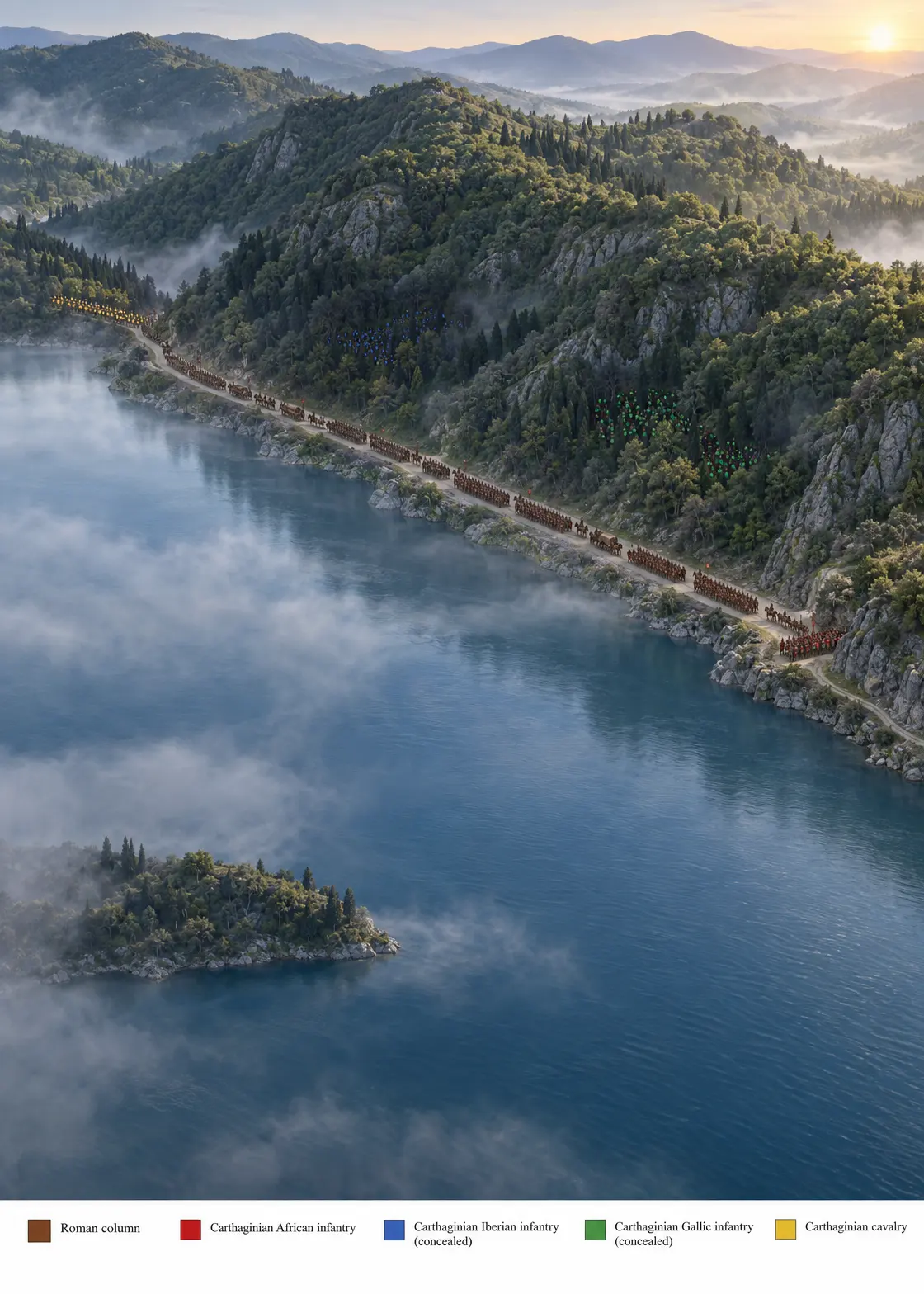
Hannibal arrived at the eastern end of the defile on the evening of 20 June 217 BC. He deployed his army with characteristic precision. His African heavy infantry he placed in plain sight at the eastern end of the defile, in such a way that they could be seen from a distance as the Roman vanguard approached, presenting the appearance of the Carthaginian main army drawn up for battle. His Iberian and Gallic infantry he concealed along the wooded slopes of the hills north of the road, in detachments hidden by trees and folds of ground, with strict orders to remain motionless until his signal. His cavalry — the Numidians and the Iberian heavy horse — he stationed at the western end of the defile, in a position from which they could ride down the road behind the Roman army once it had committed itself fully to the passage. The trap was therefore set on two axes: the Roman army would be drawn into the defile by the visible main body at the eastern end; once fully committed, it would be attacked simultaneously by the concealed forces on the northern flank and the cavalry at the western end.
The Roman army approached the defile in the early morning of 21 June 217 BC. Polybius (3.83) reports that a heavy mist was rising from the lake — characteristic of summer mornings on Trasimene — which limited visibility severely on the road itself but left the higher ground above the mist relatively clear. From Hannibal's elevated position the Roman column could be observed as it advanced into the defile; from the Roman column's position, however, the slopes north of the road and the eastern end of the defile were both obscured. Flaminius's vanguard advanced into the defile in standard marching order, with the consul himself in the center of his army; the rear elements of the column had not yet entered the defile when the leading elements were within a kilometer of the eastern end. The army was thus extended in a column perhaps five kilometers long along a narrow passage, with no part of it in a position to deploy properly into line.
Hannibal gave his signal at the moment of maximum Roman extension. The concealed infantry on the slopes north of the road poured down the hillsides into the column, attacking the Roman flank simultaneously along the entire length of the defile. The African heavy infantry at the eastern end advanced to engage the Roman vanguard frontally. The cavalry at the western end rode forward to close the trap from the rear. The Roman column had perhaps fifteen minutes to recognize what was happening before it was simultaneously attacked from front, both flanks, and rear.
The destruction of Flaminius's army at Trasimene was the most complete tactical annihilation of a Roman army on a single day before Cannae, and it was conducted with a kind of cold operational precision that has very few parallels in ancient military history. The Roman army was unable to form line; its maniples could not coordinate; its officers could not communicate above the noise of attack from all directions; the legionary discipline that had won the Italian wars proved inadequate to the conditions imposed by the surprise. The fighting lasted perhaps three hours, principally because the Roman vanguard fought with the discipline characteristic of a beaten army that has not yet given up; but the outcome was determined within the first hour. Flaminius himself, attempting to rally his troops at the head of his army, was killed in the fighting — the sources differ as to whether by a chance javelin or by a deliberate attack from an Insubrian Gaul named Ducarius who reportedly recognized Flaminius from his consular regalia and had personal vengeance to take for some prior offence Flaminius had committed in his consulship during the Cisalpine war of 223 BC. The sources are consistent that Flaminius died fighting in the front line, which is creditable to him personally even if his strategic and operational judgment is to be condemned.
The Fabian Strategy
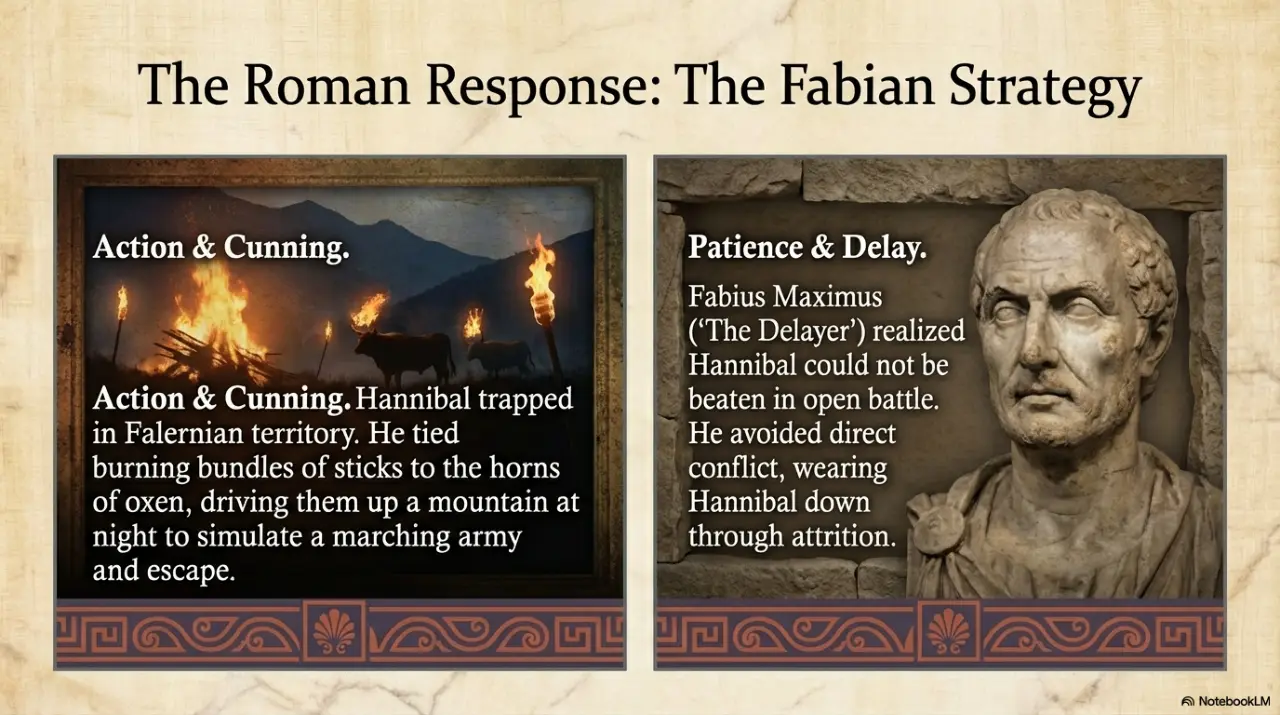
What Fabius designed in the summer of 217 BC was the strategic doctrine that would eventually win the Hannibalic War, though its full effects would not be visible until many years had passed and the war had passed through several further phases. The doctrine had two principal elements. First, the Roman army would avoid set-piece battle with Hannibal. Hannibal's tactical superiority had been demonstrated three times in succession (Ticinus, Trebia, Trasimene); a fourth engagement on terms of his choosing would produce a fourth catastrophe; the Roman state could absorb perhaps two more such defeats before the strategic balance shifted irrecoverably against her.
Second, the Roman army would shadow Hannibal's force at close range, occupying high ground in parallel to his line of march, attacking only when local conditions made an isolated detachment vulnerable, intercepting Carthaginian foraging parties, and denying Hannibal the strategic objective of unconstrained operation in the Italian theater. The strategy was, in modern strategic vocabulary, that of deterrence by denial: Rome would not seek to destroy Hannibal in the field, but to prevent him from achieving his strategic objective (the dissolution of the Italian alliance system) while waiting for the conditions that would eventually allow his defeat at lower cost.
The strategy was deeply controversial within the Roman political system, for reasons both legitimate and ignoble. The legitimate criticism was that the Fabian strategy ceded the Italian countryside to Carthaginian depredation: while Hannibal's army was being shadowed but not engaged, his troops were burning Italian farms, taking Italian cattle, and demonstrating to the Italian allies that Rome could not protect them from harm. The political consequence of this — over time — would be the very alliance defection that the strategy was designed to prevent. The ignoble criticism was the senatorial-aristocratic resentment of the unconventional senior figure whose personal authority Fabius's command implied: the Roman political system was organized around the annual consular magistracies, and the appointment of a dictator with extended powers, while constitutionally provided for in emergencies, was inherently in tension with the normal operation of the political order. Fabius's prestige and authority during his dictatorship made him a target of political resentment from senatorial figures who would, in normal circumstances, have been his peers and competitors.
Across the summer of 217, Fabius implemented his strategy with discipline. Hannibal's army marched south through Umbria into Picenum, then crossed the Apennines into Apulia, then turned westward into Samnium and finally into Campania, looking continuously for an opportunity to bring Fabius to battle. Fabius's army shadowed the Carthaginian column at a distance of one or two days' march, occupying defensible positions on the ridges parallel to Hannibal's line of march, declining engagement at every opportunity. Hannibal's strategic objective — to detach the Italian allies — was being achieved only partially: some isolated communities suffered Carthaginian raids and were not relieved by Roman action, but no major Italian city defected during the campaign of 217. The strategic patience of the Fabian doctrine appeared, on balance, to be holding.
The Cassilinum Campaign and the Geronium Incident
The most dramatic episode of the Fabian dictatorship — and the moment at which the doctrine's logic was most clearly demonstrated — was the so-called Cassilinum campaign of late summer 217. Hannibal, after spending some weeks raiding the fertile Falernian plain in northern Campania, found his army caught in a strategic cul-de-sac: the only practicable exit from the Falernian plain to the north was a single mountain pass that Fabius had occupied with the main Roman army. Hannibal could not retreat the way he had come without abandoning a substantial quantity of plunder; he could not break through Fabius's position without giving battle on the disadvantageous terrain Fabius had selected; he could not remain in the Falernian plain indefinitely, as his food supplies would be exhausted before winter. The Roman strategic position had, for the first time since the war's beginning, brought Hannibal to a moment of real operational difficulty.
Hannibal's solution was characteristic of his operational creativity. He gathered approximately two thousand head of cattle from the plundered countryside, tied bundles of dry brush to their horns, set the brush on fire at nightfall, and drove the panicked cattle in a great mass up the slopes of a ridge near Fabius's blocking position. The Roman troops on the ridge, seeing what appeared to be a Carthaginian army advancing under torches across an unexpected approach, moved to engage; while their attention was thus diverted, Hannibal led his main army out of the trap by the unguarded route his ruse had created. The episode is preserved in detail by Polybius (3.93–94) and is one of the more famous tactical inventions of the war.
The political consequence of Hannibal's escape was, however, more damaging than the operational consequence. The Roman political class — already restive under Fabian discipline — regarded the Cassilinum episode as a humiliation that vindicated the criticism of the Fabian strategy. Within a short period, the master of horse Marcus Minucius Rufus, who had been chafing under Fabius's authority and who represented the popularis faction at the level of senior military command, was granted by an extraordinary act of the popular assembly co-equal authority with the dictator. The army was divided between Fabius and Minucius — a decision unprecedented in Roman constitutional history and almost certainly catastrophic in operational terms. Minucius, given his own half of the army to command independently, immediately sought to demonstrate by aggressive action the superiority of his approach to Fabius's.
The result was an ambush near Geronium in central Italy in late autumn 217. Hannibal, recognizing that the political division within the Roman command had produced an opportunity, drew Minucius into an engagement on terrain of his (Hannibal's) choosing. Minucius's army was on the verge of complete destruction when Fabius, abandoning his strategic shadowing position and marching the rest of the Roman army to the field, intervened in time to extract Minucius's force from the trap. The intervention saved Minucius's army but cost it perhaps three to four thousand casualties; the political vindication of Fabius was complete; Minucius, in a public scene preserved by Livy with appropriate dramatic detail, restored his command to Fabius and acknowledged the dictator as his superior in both rank and judgment. The remainder of the campaigning season passed without further engagement; Hannibal wintered in northern Apulia, the Roman army in the central Italian foothills, and the two sides prepared for the campaign of 216.
The Strategic Situation in the Spring of 216
The Roman political response to the dictatorial year of 217 BC was a return to constitutional normality combined with an unmistakable political decision to abandon the Fabian doctrine. The consuls elected for 216 were Gaius Terentius Varro and Lucius Aemilius Paullus, men of contrasting political background and military temperament whose joint command would produce the catastrophe of the year and would furnish the Roman tradition with a permanent type for the dangers of divided authority in war.
Varro was the candidate of the popularis faction — a man of relatively low senatorial standing (the tradition has him the son of a butcher, which is probably an aristocratic insult rather than literal genealogy, but the political point is real) elected on a platform of aggressive prosecution of the war against the temporizing of the senatorial establishment. Paullus was a senatorial conservative, a veteran of the Illyrian campaigns, a man whose strategic instincts were closer to those of Fabius than to the popular demand for decisive engagement. The two consuls were temperamentally incompatible from the moment of their election; their joint command would be exercised through the device of alternating supreme authority on each successive day, with command passing from one to the other at dawn — a constitutional arrangement that, while in form symmetrical, in practice produced the operational result that the day on which battle was offered would be the day on which the more aggressive of the two consuls held command. Hannibal, as the campaign would shortly demonstrate, was capable of waiting until that day arrived.
The Roman military mobilization for 216 BC was the largest single-year mobilization in the entire history of the Republic to that date. The Senate, recognizing that the Fabian doctrine had become politically unsustainable and that a decisive engagement with Hannibal could be undertaken only with overwhelming force, authorized the levy of eight Roman legions (twice the standard consular establishment) supplemented by eight legions' worth of Italian allied contingents. The total Roman force assembled for the campaign of 216 was therefore approximately 86,000 men — 80,000 infantry and 6,000 cavalry — under the joint command of the two consuls. By comparison, Hannibal's army by the early summer of 216 was approximately 40,000 foot and 10,000 cavalry, supplemented by a substantial body of Gallic, Lucanian, and Italian irregular reinforcements that brought his total mobilizable strength to perhaps 55,000. The Roman numerical advantage was therefore in the order of 3:2 in infantry, with the Carthaginian cavalry holding a numerical advantage that the Romans had not yet learned to compensate for tactically.
The strategic objective of the Roman campaign was the recovery of central Italy and the restoration of Roman strategic credibility. Hannibal had wintered his army at the agriculturally rich town of Gerunium in northern Apulia and had spent the early spring of 216 in foraging operations and small-scale skirmishing. In May, he made the operationally bold decision to march his army southward to the Apulian coast and to seize the great Roman supply magazine at Cannae — a town on a low ridge overlooking the lower Aufidus river (modern Ofanto), about ten kilometers from the Adriatic coast. The seizure of Cannae served three strategic purposes: it deprived the Roman army of a critical forward supply position; it placed the Carthaginian army in a region whose flat terrain favored the cavalry-based tactical doctrine Hannibal preferred; and it offered Hannibal a strategic position from which he could threaten the Greek and Italian cities of the southern Adriatic coast, the political consolidation of which would be a major step toward the dissolution of the Italian alliance system. The Roman army, by the time Cannae fell to Hannibal in early June, was already on the march south to confront him, and was now obligated to do so on terrain that strongly favored the Carthaginian tactical disposition.
The Approach to Battle (June–July 216 BC)
The Roman army marched from Apulian Lucera south to the upper valley of the Aufidus, where it took up position on a ridge overlooking the river some miles upstream from Cannae itself. The march had been conducted in characteristic Roman style: a single combined army moving in column, with the two consular commands operating in nominal unison. The disagreement between Varro and Paullus, however, became visible immediately upon the army's arrival in the Aufidus valley. Paullus, surveying the terrain, recommended that the army take up a defensive position on the higher ground north of the river, in country broken enough to limit the effectiveness of Hannibal's cavalry. He recognized — correctly, as the battle would prove — that the Roman tactical doctrine could not be expected to succeed against Hannibal's cavalry-cooperated infantry on level terrain.
Varro disagreed, arguing that the political mandate under which the army had been mobilized required decisive engagement and that the level ground on the south bank of the Aufidus was the terrain on which the Roman numerical advantage could be brought to bear most effectively. The dispute was not resolved.
What followed was a brief operational sequence that perfectly illustrated the inadequacy of the alternating-command system. On the day Paullus held command, the Roman army moved to the higher ground; on the day Varro held command, the army moved back to the level plain. Across several days of this oscillation, with the Roman army moving back and forth between two positions while Hannibal observed from the south bank of the Aufidus, the strategic patience that the Fabian doctrine had achieved across the previous year evaporated. Hannibal, deploying his army in deliberate provocation at the edge of the Roman camp each morning, was able to wait for the day on which Varro held supreme command and would commit the army to engagement on terms favorable to the Carthaginians.
The Disposition of the Armies
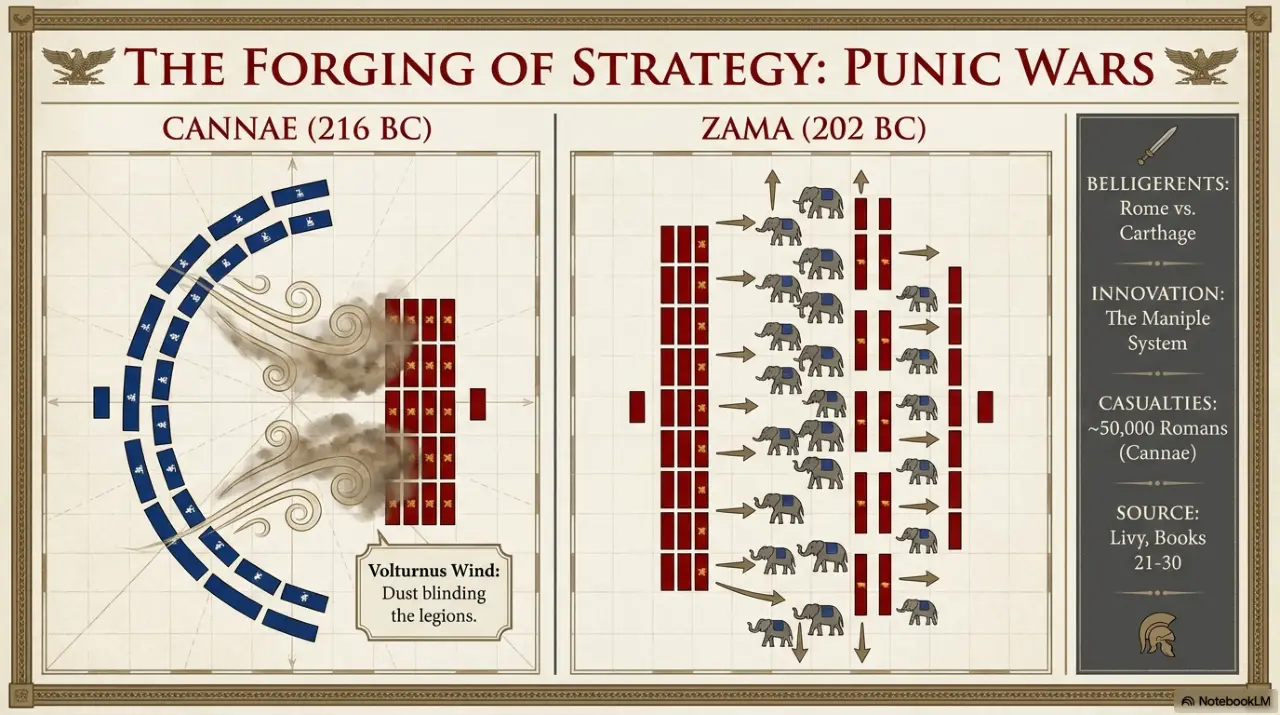
The Roman army on the morning of 2 August 216 BC was deployed in a manner that has been the subject of scholarly debate for two and a half millennia. The principal feature of the Roman disposition was its unusual depth: the infantry was drawn up in a formation deeper than the standard manipular triplex acies, with the hastati, principes, and triarii compressed into a narrower front than was customary. The intent of the disposition, as Polybius (3.113) explains it, was to use the Roman numerical advantage in infantry to deliver an overwhelming frontal blow against the Carthaginian center, breaking through Hannibal's line by main force. The deep formation was, in this conception, a kind of human ram designed to convert numerical superiority into kinetic concentration. The corresponding sacrifice was tactical flexibility: the deeper the infantry formation, the more difficult it became for individual maniples to operate independently, and the more the legion's characteristic capacity for tactical maneuver was sacrificed to the priority of frontal mass.
The Roman cavalry was disposed on the wings of the army in the conventional manner: Roman citizen cavalry on the right wing (against the river Aufidus), allied cavalry on the left wing. The total Roman cavalry was approximately 6,000 — substantially outnumbered by the Carthaginian cavalry on the field. The Roman command was held that day by Varro, with Paullus on the right wing in tactical command of the citizen cavalry and the right of the infantry line. The two former consuls of 217 BC — Servilius Geminus and Atilius Regulus — were also present in subordinate command positions, having been retained in army command for the campaign in recognition of their experience.
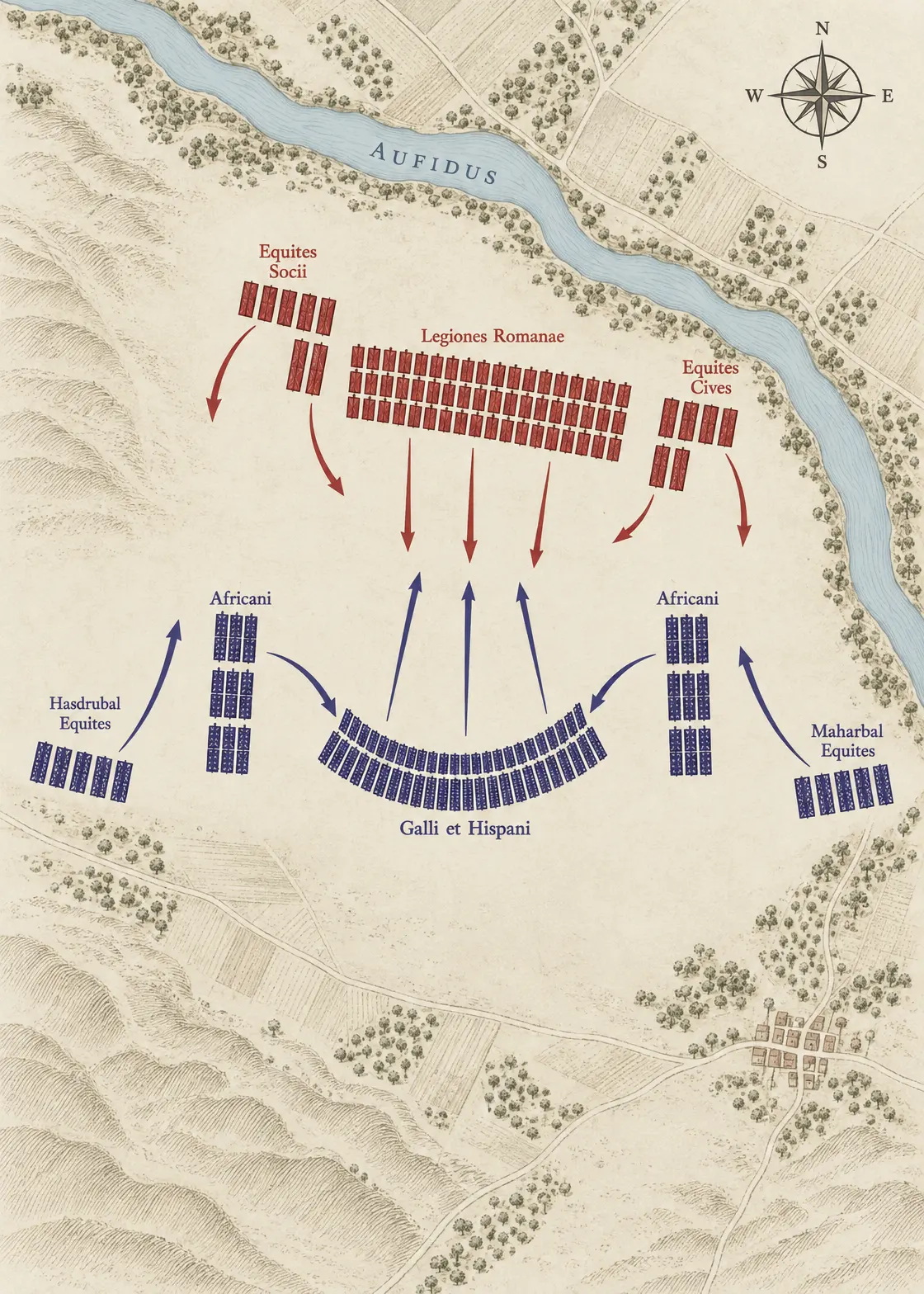
Hannibal's disposition was the masterpiece for which the battle is principally remembered. The Carthaginian commander deployed his army in a configuration that combined three distinct tactical elements into a single integrated whole. The center of his line was held by his Gallic and Iberian heavy infantry — the troops least reliable in close combat against Roman heavy infantry, but the most numerous of his infantry contingents and the most expendable from the standpoint of the long-term Carthaginian war effort. The Gauls and Iberians were placed in a convex crescent projecting forward from the main Carthaginian line — that is, the center of the line was thrown forward, while the wings of the infantry line were drawn back from the front. This was a most unusual disposition by ancient standards; the conventional Hellenistic and Roman disposition was either a straight line or, more rarely, a slightly concave line designed to draw an attacker into a partial envelopment. The convex disposition was a tactical innovation specific to Cannae.
On the wings of the Carthaginian infantry line, drawn back from the center, were Hannibal's African heavy infantry — the elite of his army, equipped (after their hard service in the Italian campaigns) substantially with Roman-style armor and weapons captured at Trebia and Trasimene, so that they appeared at first glance to be Roman troops. The African contingents were drawn up in column rather than in line — that is, in deeper formations with narrower frontages than the standard infantry deployment — and positioned at the rear of the wings in such a way that they could wheel inward toward the center of the battle when the Roman infantry had pressed forward into the Carthaginian crescent.
On the wings of the army proper, beyond the infantry, was Hannibal's cavalry. The heavy Iberian and Gallic horse under Hasdrubal (Hannibal's lieutenant, not his brother of the same name) was placed on the Carthaginian left wing, facing the Roman right where Paullus commanded the citizen cavalry. The Numidian light horse under Maharbal was placed on the Carthaginian right wing, facing the Roman left where the allied cavalry was deployed. The total Carthaginian cavalry on the field was approximately 10,000 — somewhat outnumbering the Roman cavalry by a substantial margin and possessing both tactical superiority and the operational initiative.
The Battle (Morning to Mid-Afternoon, 2 August 216 BC)
The battle opened in the conventional manner with the engagement of light troops between the armies, followed by the advance of the cavalry on the wings to engage. The cavalry actions developed quickly and produced the decisive operational consequence that Hannibal had planned. On the Carthaginian left, Hasdrubal's heavy cavalry engaged the Roman citizen cavalry under Paullus's direct command and, after a sharp action of perhaps forty-five minutes, drove the Roman horse from the field. The terrain on the right wing — squeezed between the Roman infantry line and the river Aufidus — left the outnumbered and outclassed Roman cavalry with little room for maneuver; the engagement was therefore concluded quickly and with substantial Roman casualties. Paullus himself was wounded — by a slingstone, according to Livy — and was carried to the rear, where he would continue to command the right of the infantry line for the rest of the day until killed in the final phase. On the Carthaginian right, the Numidian cavalry under Maharbal engaged the allied cavalry of the Roman left wing in a longer and less decisive engagement, with the Numidian skirmishing tactics keeping the allied cavalry occupied without producing decisive results. (The Numidians' role in the broader battle plan, however, was less to defeat the allied cavalry than to keep it occupied; the decisive cavalry stroke would be delivered by Hasdrubal's heavy horse, which after defeating the Roman right cavalry would ride around behind the Roman army to attack the allied cavalry from the rear.)
While the cavalry actions on the wings were developing, the infantry lines engaged in the center. The Roman infantry — eight legions deep, with their compressed mass behind them — advanced against the Carthaginian crescent with the disciplined frontal pressure for which the manipular legion had been designed. The crescent itself, projecting forward from the Carthaginian main line, met the Roman advance first; the Gallic and Iberian infantry holding the apex of the crescent were the principal targets of the Roman attack. As the Roman pressure built up, the crescent gave way slowly — exactly as Hannibal had intended. The Gallic and Iberian troops were not, however, breaking; they were being pressed back by the Roman advance, but in good order, fighting hard as they retired, their backward movement compressing them into a steadily reducing space behind the original line of contact. From the convex crescent the formation was being transformed by the Roman pressure into a concave pocket — a hollow in the Carthaginian center into which the Roman infantry was advancing, with the Carthaginian wings (the African heavy infantry) now flanking the Roman advance on both sides.
The moment Hannibal had constructed the battle to achieve was the moment at which the African heavy infantry, drawn up in column at the rear of the Carthaginian wings, would wheel inward against the Roman flanks. The timing of this wheel was the critical operational decision of the battle. Too early, and the Roman infantry would not yet have advanced deeply enough into the pocket; too late, and the Gallic and Iberian center would have given way completely and the Roman advance would have broken through. Hannibal, observing the developing engagement from his command position in the center of the line, judged the moment with what the Greek historians would later describe with admiration. The African columns wheeled inward — by some accounts at a controlled pace, by others at the run — and struck the Roman infantry mass on both flanks simultaneously, while the Roman infantry was still pressing forward into the Carthaginian center.
The Roman infantry now found itself attacked on three sides: by the Gallic and Iberian troops of the center (still giving ground but not broken), and by the African heavy infantry on both flanks (advancing inward, attacking exposed Roman maniples that had been formed for frontal combat and could not easily redress their lines to face the side). The deep Roman formation that had been intended to deliver overwhelming frontal force now became a liability: the troops in the interior of the formation could not effectively fight, while the troops at the edges of the formation — the only ones capable of meeting the African flank attacks — were progressively destroyed and replaced by troops drawn from the interior who were themselves immediately destroyed in their turn. The Roman tactical doctrine, designed around the assumption that a legion would always be capable of operating with all its troops engaged simultaneously, had no answer to a battle in which most of the army could not fight at all.
The Killing
What followed across the late afternoon and into the evening of 2 August 216 BC was the most concentrated military slaughter in the prior history of the western Mediterranean and a strong candidate for the most concentrated in the entire ancient world. The Roman army, surrounded on all sides, with no possibility of orderly withdrawal, with the terrain constricting and the Carthaginian forces converging, became a single great mass of men into which weapons could be inserted with mechanical efficiency. Polybius's description (3.116) emphasizes the awful nature of the killing: the Carthaginian and African troops, attacking inward on every front, found a target so densely packed that their swords and spears could scarcely miss; the Roman soldiers in the interior of the mass, unable to fight and unable to flee, stood waiting for the killing to reach them; the Roman commanders, attempting to rally what could be rallied, fell one after another in the front lines.
The casualty figures for Cannae are preserved by multiple sources with substantial agreement, which is itself an indication of the scale and the consequent unusual care with which the data were recorded. Polybius (3.117) gives Roman dead at approximately 70,000 — a figure most modern historians regard as somewhat high, partly because it appears to include allied troops in a way the contemporary Roman casualty conventions did not always specify. Livy (22.49) gives 45,500 infantry and 2,700 cavalry, or about 48,200, with a further 10,000 captured. The modern consensus is that Roman and allied dead at Cannae were probably between 45,000 and 55,000, with a further 10,000 to 20,000 captured. The dead included the consul Aemilius Paullus (killed in the final phase, fighting on foot after his horse had been killed), the proconsul Servilius Geminus, the master of horse Marcus Minucius Rufus (the same who had been Fabius's controversial deputy the previous year), 80 men of senatorial rank, 29 military tribunes, and a substantial fraction of the equestrian order serving in the cavalry and in junior command positions. The political losses were the equivalent of a generation of senior Roman aristocracy in a single afternoon. Varro himself, the surviving consul, fled the field with about 70 horsemen at the moment of the army's final collapse and escaped to the nearby town of Venusia; he would survive to be received at Rome on his return with what the tradition has agreed to call magnanimous restraint (the Senate met him at the gates and thanked him for not despairing of the Republic, an act of constitutional courtesy that the Romans would remember as one of the finest of the period).
The Carthaginian losses at Cannae were heavy by any normal standard but light compared to the Roman: Polybius gives 5,700 dead, including 4,000 Gauls (the contingent that had held the apex of the crescent and had borne the brunt of the initial Roman attack), 1,500 Iberians and Africans, and 200 cavalry. The casualty ratio of about 1:10 against the loser is among the most extreme in recorded ancient military history; Cannae stands with Granicus, Issus, Gaugamela, and the great Hellenistic battles of annihilation as one of the model tactical engagements in which the loser's losses approached total destruction.
The dimensions of the catastrophe at Rome may be illustrated by a single comparative observation. The total Roman and allied male population of military age in 216 BC was approximately 770,000. Of these, between 45,000 and 55,000 had been killed at Cannae alone — about six to seven percent of the total mobilizable manpower of the Roman state in a single afternoon. The 80 senators killed represented approximately one-quarter of the total senatorial order of the period; the 29 military tribunes represented a substantial fraction of the year's command class. The dead included men from virtually every aristocratic gens in the Roman political class. There was, by the late summer of 216, scarcely a senatorial family in Rome that had not lost a son, a brother, a nephew, or a father at Cannae.
The Aftermath at Rome
The news of Cannae reached Rome in the third week of August 216 BC. Over the following days, as further dispatches arrived, the full scale of the catastrophe became known.
The Roman political and emotional response to Cannae has been preserved by the sources with what one is tempted to call religious care, because the tradition treats it as a moment of national near-extinction from which the Roman political order recovered by an act of institutional and ethical will. The principal features of the response, as Polybius (3.118) and Livy (22.55–61) describe them, were as follows. First, the Senate met in continuous session for three days, suspending the normal political business of the Republic to address the strategic emergency. Second, the matrons of Rome were ordered to confine their public mourning to thirty days, after which all public expressions of grief were prohibited as inconsistent with the state's continued military prosecution of the war — a remarkable decree which reveals more about the Roman tradition's understanding of state morale than perhaps any other single document of the period. Third, the Senate appointed Marcus Junius Pera as dictator with full emergency powers, with Tiberius Sempronius Gracchus (a man of considerable energy and political conviction) as master of horse. Fourth, the recruitment laws were extended to permit the enlistment of younger men (down to age seventeen), slaves (purchased by the state from their owners and freed upon enlistment, the so-called volones who would form two new legions), debtors and criminals (relieved of their obligations in exchange for military service), and even the cavalry of those normally exempt from foot-soldier service. Fifth, the city walls were manned and the citizens prepared for siege — though, as it turned out, no siege would be undertaken.
The decision that more than any other determined the survival of the Roman state in the aftermath of Cannae was, however, made not at Rome but in the Carthaginian camp at Cannae itself, by Hannibal and his senior officers. The decisive question was whether the Carthaginian army should march immediately on Rome, exploit the strategic shock of the victory to compel a Roman surrender, and end the war before the Roman state could recover.
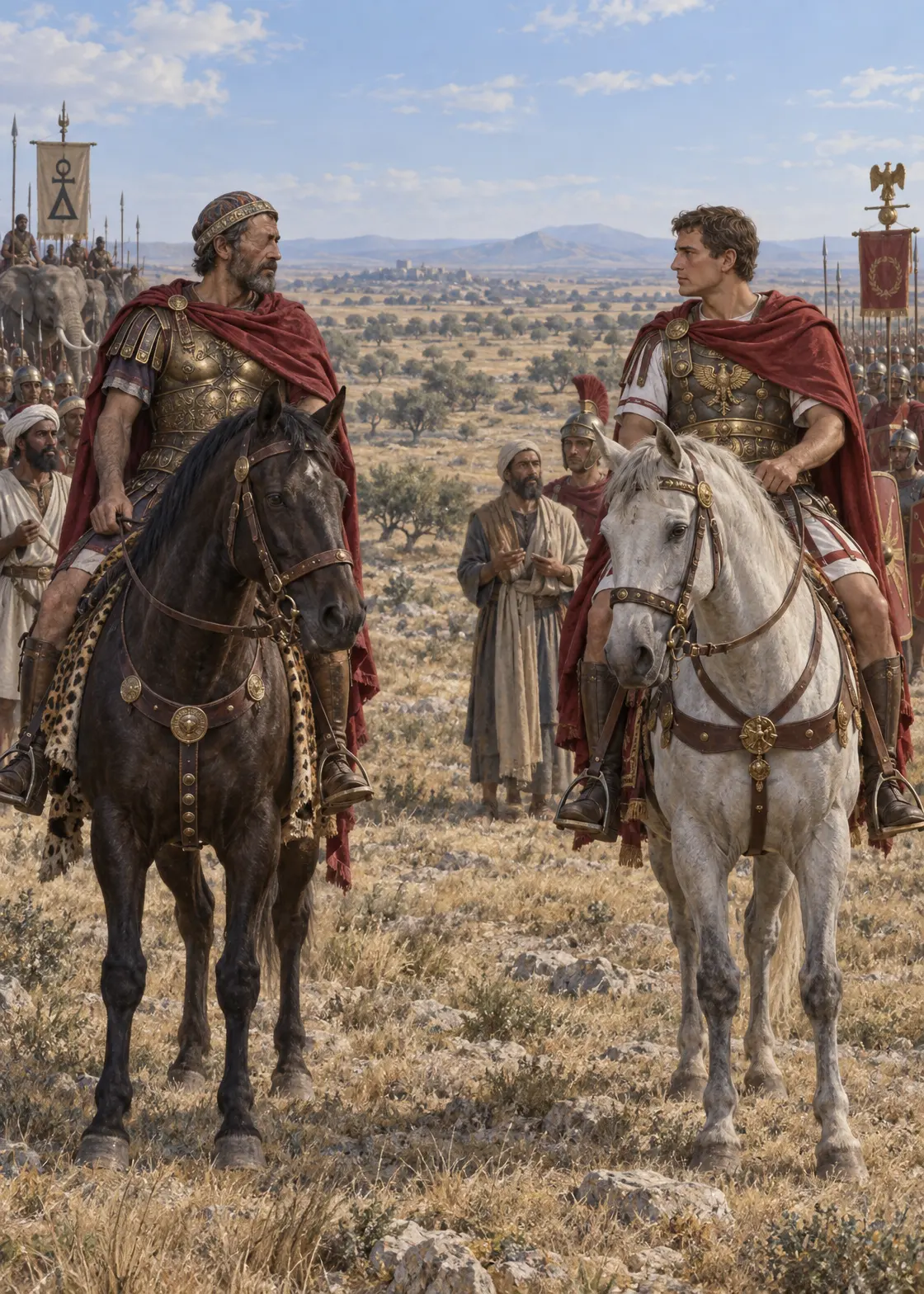
The case for the immediate march was made most forcefully by Maharbal, the Numidian cavalry commander, who is reported by Livy (22.51) and by Cato (in a fragment preserved by Aulus Gellius) to have said to Hannibal that within five days Hannibal could be dining on the Capitoline if he would only march at once. Hannibal, after consideration, declined. His reasons — preserved imperfectly but with consistent themes across the sources — were several. The Carthaginian army, though victorious, was tired and reduced; the cavalry's horses had been ridden hard for two days; the infantry needed rest and resupply. The siege of Rome itself would be a major undertaking against a city of substantial fortification and considerable garrison resources; the kind of siege equipment such an operation would require was not in the Carthaginian field train, and would have to be constructed or imported. The strategic logic of Hannibal's entire campaign was the dissolution of the Italian alliance system by demonstration of Roman military weakness; the immediate march on Rome, if it failed (and it might fail, however weak the city's military position appeared), would have squandered the strategic capital of Cannae for an uncertain operational gain. Better, Hannibal calculated, to consolidate the political effect of the victory — to receive the Italian and Greek cities that would now defect, to organize a southern Italian alliance system as a counterweight to Rome's central Italian one, to prepare for further engagements at moments and on terrain of Carthaginian choosing. The march on Rome would not be made.
Maharbal's reported response is one of the most quoted single sentences from any ancient source: Vincere scis, Hannibal; victoria uti nescis — "You know how to win a victory, Hannibal; but you do not know how to use one." Whether or not Maharbal actually said this, the historical question it raises has been debated by military historians and strategists ever since. The dominant modern view — held by most twentieth-century military theorists who have addressed the question, including Liddell Hart and Hans Delbrück — is that Maharbal was wrong: that a siege of Rome in the late summer of 216 BC, with the resources Hannibal then possessed, would have failed, and that Hannibal's actual strategic decision (to consolidate his gains in southern Italy and to await the Italian alliance system's progressive disintegration) was the correct one, even though it eventually led to defeat for reasons that could not have been foreseen in 216.
The minority view holds that the immediate post-Cannae moment was the one strategic window in which the Hannibalic War could have been won, and that Hannibal's failure to exploit it doomed his campaign to ultimate failure. The question is unresolvable from the available evidence, but it has the merit of focusing attention on the strategic logic by which wars are actually decided — which is rarely the logic of single battles, however dramatic.
The Italian Alliance System Holds
What Hannibal had not predicted, and what the post-Cannae weeks would reveal, was the resilience of the Italian alliance system in the face of Roman military catastrophe. The strategic logic of the Hannibalic campaign had been built on the assumption that a sufficient demonstration of Roman military weakness would produce mass defection of the Italian allies; the alliance would dissolve, Rome would be left with her bare citizen base, and the strategic and demographic foundations of Roman power in the Mediterranean would be broken. This assumption now received its definitive test, and it failed — though not completely.
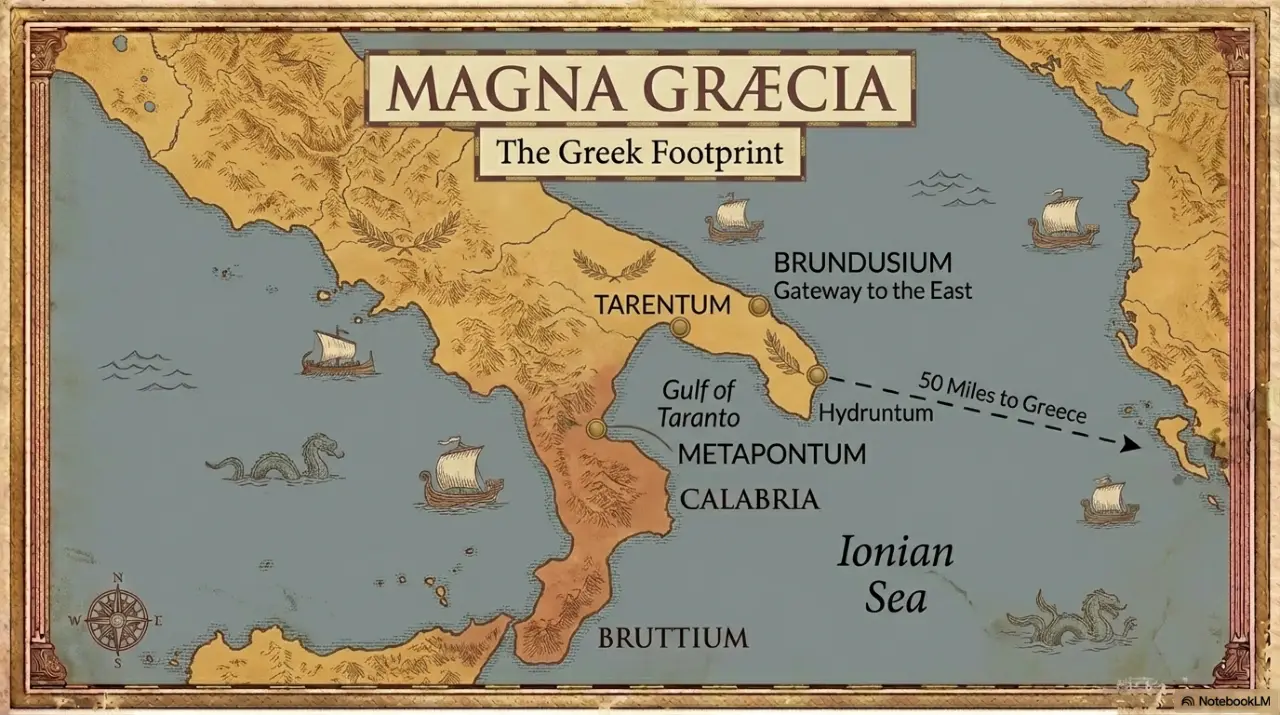
A substantial number of Italian and Greek cities did defect to Carthage in the months following Cannae. Capua — the second city of Italy, the great prize of Campania, the city whose defection from Rome during the Latin War had nearly broken the Roman alliance system in the fourth century — declared for Hannibal in late autumn 216 and admitted a Carthaginian garrison. The cities of Bruttium and most of Lucania defected during the same period. The Greek cities of Magna Graecia — Tarentum, Croton, Locri, Heraclea, Thurii — declared variously for Hannibal across 216 and 215. Several Samnite communities — though not the Pentri Samnites, who remained surprisingly loyal — joined the Carthaginian alliance. The Italian and Greek south, by the spring of 215, was largely outside the Roman alliance system and within the Carthaginian.
But the central and northern Italian alliance system — the core of Roman manpower and political support — did not defect. The Latin colonies remained loyal to Rome with virtually no exception; the cities of Etruria, Umbria, Picenum, and the Sabine country remained loyal; the Latin and Campanian coloniae civium Romanorum held their walls and sent their contingents to the new Roman armies being raised in the post-Cannae mobilization. Hannibal's strategic gain from the southern Italian defections was therefore real but partial: he had acquired allies and resources in the south, but the central and northern manpower base of Rome was intact, and the war would continue.
The post-Cannae Roman recovery would prove the matter on which the entire Hannibalic War would eventually be decided. Across the four years from 215 to 211, Rome would raise army after army from the available manpower base — at peak nearly twenty-five legions in simultaneous service, an unprecedented mobilization that exceeded by half again the previous Roman record — and would deploy them in a long war of attrition across Italy, Sicily, Spain, and Africa. Hannibal's army, never reinforced from Africa in significant numbers (the Carthaginian state's failure to support its general's Italian campaign with the scale of resources his strategic position required is one of the great underconsidered factors in the war's outcome), would gradually be worn down by the Roman strategic patience that had been provisionally established by Fabius and that, after Cannae, became the unchallenged official doctrine of the Roman state. The war's eventual conclusion — at Zama in 202 BC, in Africa, with Hannibal facing Scipio Africanus across a battlefield Hannibal had not chosen — would come fourteen years after Cannae. The story of how it was reached belongs to Book III.
The Recovery at Rome
The political and military response of the Roman state to Cannae in the late summer and autumn of 216 BC was, in retrospect, the moment at which the war was decided. Not, to be sure, because Cannae was reversed — it was not, and could not have been — but because the institutional response demonstrated that the Roman state was not, in fact, structurally incapable of absorbing the catastrophe. Hannibal's strategic conception had been built on the assumption that a sufficient demonstration of Roman military weakness would produce political dissolution; what occurred at Rome in September and October of 216 BC was the demonstration that no demonstration of military weakness, short of the literal destruction of the city, would produce such dissolution. The strategic asymmetry of the war was thereby reversed: where Hannibal had previously possessed the operational initiative and Rome had been on the strategic defensive, the post-Cannae mobilization meant that Hannibal would henceforth be the one fighting a war whose underlying logic was against him.
The institutional measures taken at Rome across the autumn of 216 are themselves worth recapitulating in some detail, because they constitute the institutional foundation upon which the entire post-Cannae war would be conducted. The dictatorship of Marcus Junius Pera, with Tiberius Sempronius Gracchus as master of horse, was the first measure: a constitutional emergency response that placed the state under unified military direction without the divided-command difficulties that had produced both the Fabius–Minucius conflict of 217 and the Varro–Paullus catastrophe of 216. The recruitment of the volones — eight thousand slaves, purchased by the state from their owners and freed upon enlistment — was the second: an unprecedented broadening of the citizen-soldier base that signaled the state's willingness to draw upon resources previously regarded as inadmissible for legionary service. The recruitment of younger men down to age seventeen and of debtors and criminals (granted relief of their obligations in exchange for service) further extended the manpower base. The Senate's own contribution was substantial: senators contributed their personal silver and gold for the war effort, with the temple treasuries opened to public use under emergency procedures that the religious authorities approved with what was, by Roman standards, unusual dispatch. By the late autumn of 216, the new armies were being formed: two new urban legions for the immediate defense of Rome itself, four legions under Marcus Claudius Marcellus to be deployed against Hannibal in Apulia, two additional legions under Gracchus to be raised from the volones and other irregular recruits, and reinforcements for the Spanish, Sicilian, and Sardinian theaters.
The institutional decision that most distinguished the post-Cannae Roman political order from any contemporary Hellenistic state was the refusal of negotiations. Hannibal, in the days immediately following Cannae, dispatched a Carthaginian officer named Carthalo to Rome with a Roman officer-prisoner under safe-conduct, offering to release the surviving Roman prisoners on payment of moderate ransom and presumably (the sources are not fully explicit, but the intent is clear) to enter into discussions on the terms of a peace. The Senate refused even to receive the embassy. The Roman ambassadors who had been part of the captured group sent their own delegation seeking authorization to negotiate their ransom; the Senate refused this as well, in a debate that Livy preserves at length (22.58–61) and that Polybius confirms in substance. The argument carried by Titus Manlius Torquatus and the senatorial conservatives was the argument that became Roman doctrine for the remainder of the war and remained Roman doctrine throughout the imperial period: Rome did not negotiate with armed enemies on Italian soil. The captured prisoners — between eight and ten thousand Romans and Italian allies — were left to whatever fate Hannibal chose for them. (He sold them into slavery in due course, partly to defray his army's expenses and partly because the political logic of holding them indefinitely had ceased to apply.) The Roman political class had committed itself, definitively, to the proposition that the war would continue until one side or the other could not continue it.
The Defection of Capua (216–215 BC)
The most strategically significant of the post-Cannae Italian defections to Hannibal — and the one whose recovery would prove the principal Roman political-military achievement of the next five years — was the defection of Capua. Capua was the second city of Italy by population and probably the first by per-capita wealth: a Campanian city of approximately one hundred and fifty thousand inhabitants, with a fertile agricultural hinterland, a substantial commercial economy, and the strategic position dominating the road network of northern Campania. The Capuan defection was therefore not the defection of a peripheral or marginal community; it was the defection of one of the principal pillars of the Roman alliance system in the south, with consequences that the Roman political order felt as a personal humiliation and that the strategic situation required to be reversed at whatever cost.
The political mechanics of the Capuan defection are preserved by Livy (23.2–10) with the kind of detail that suggests he had access to substantial documentary sources, including possibly the senatorial decrees and Capuan civic records that survived into the late Republican antiquarian tradition. The Capuan civic order had been internally divided between a pro-Roman aristocratic faction (associated with the city's senatorial families and with the Magii in particular) and a popularis faction (associated with the urban commercial class and with the Calavii) since at least the mid-third century. The Capuan disasters during the post-Cannae period — the loss of substantial numbers of Capuan citizens in the Roman armies of 218 through 216, the disruption of trade with Roman-controlled territories, the appearance of Hannibal's victorious army within marching distance of the city — radicalized the popularis faction and weakened the aristocratic one. The decisive figure was Pacuvius Calavius, the principal popularis leader, who in late summer 216 BC orchestrated a sequence of political moves that ended with the Capuan civic assembly voting to admit a Carthaginian alliance and to expel the Roman garrison.
The terms of the Capuan alliance with Carthage, as preserved in summary by Livy (23.7), were unusually favorable to Capua: the city would retain her own laws, her own magistrates, her own military forces; she would provide no troops to Hannibal's army; she would not be subject to Carthaginian taxation; she would be guaranteed by treaty as the head of the Campanian league after the war's conclusion, with the implication that Capua would replace Rome as the dominant power in central-southern Italy. The terms were so favorable, in retrospect, that they revealed how desperately Hannibal needed political success in Italy after the strategic disappointment of the post-Cannae weeks: he was prepared to grant terms that effectively created a competing major power in Italy in order to secure the alliance that would (he hoped) trigger the broader defection of the Italian alliance system.
The defection of Capua did not, however, produce the broader defection. Several smaller Campanian cities followed Capua (Atella, Calatia, Sabatia), but the principal Latin and Roman colonies of the area — Cales, Suessa Aurunca, Casinum, Venusia — remained loyal. Most of Samnium remained loyal (the Hirpini canton defected; the Pentri did not). The Lucanians divided; the Bruttians went over to Hannibal but had little military value; the Greek cities of the south defected one by one over the following two years, with Tarentum following in 212 as the major late addition. The Italian alliance system, taken as a whole, lost perhaps a quarter of its territory and a fifth of its manpower to Carthaginian alliance across the post-Cannae period. The loss was substantial but not catastrophic; the Roman strategic problem after 216 was not whether the alliance system could survive (it did), but how to reverse the defections that had occurred and to bring the lost territories back into the Roman political order.
The Battle of Nola (216 BC) and the Containment of Hannibal
While these political developments were unfolding, Hannibal's army was operating in Campania, attempting to consolidate the strategic gains of Cannae by securing the principal cities of the region. The Roman strategic response in the Italian theater was the assignment of Marcus Claudius Marcellus — who had been one of the senior consuls-designate for 215 BC and who, after a complex constitutional sequence involving omens and re-elections, was made the principal commander in the south with proconsular authority — to confront Hannibal in Campania. Marcellus was a figure unlike any other in the post-Cannae Roman command. Where Fabius represented the strategic patience of the senatorial conservatives, and Varro the aggressive popularis preference for decisive engagement, Marcellus represented a third tradition: the willingness to engage Hannibal in subordinate actions, to fight him in operations of limited scope, to accept tactical losses in exchange for strategic position. He was the consul who had taken the spolia opima at Clastidium in 222 BC by killing the Cisalpine Gallic chieftain Viridomarus in single combat — the third and last Roman general in history to win this supreme distinction — and he had a personal reputation for combative initiative that the conservative senatorial tradition viewed with some unease. In the post-Cannae period, however, Marcellus's combative initiative was exactly what the Italian theater required.
The first engagement between Marcellus and Hannibal occurred at Nola in late autumn 216 BC, while Hannibal was attempting to bring the city of Nola into the Carthaginian alliance through a combination of political pressure on the Capuan model and direct military threat. Marcellus, marching south from his base at Casilinum, reached Nola before the city could capitulate and installed a Roman garrison; when Hannibal arrived at the city walls and offered battle, Marcellus accepted on terms that gave him the advantage of fighting from a fortified position with the city's gates open behind him for retreat. The engagement that followed — Polybius does not describe it; Livy (23.16) gives a brief account — was a Roman tactical success on a small scale: Hannibal was repulsed, Roman casualties were lower than Carthaginian (though not by a substantial margin), and the city of Nola remained in the Roman alliance. The strategic significance was less in the engagement itself than in what it demonstrated: Hannibal's army, victorious in the great set-piece battles, could be checked in operations of limited scope by Roman commanders willing to engage on disadvantageous terms when the strategic situation required it. The Marcellan doctrine — engage Hannibal in subordinate actions, never in major set-pieces; accept tactical losses in exchange for strategic position; deny him the consolidation of his Italian gains by perpetual harassment — became, alongside the Fabian doctrine of strategic patience, the second pillar of the Roman approach to the Italian theater across the following years.
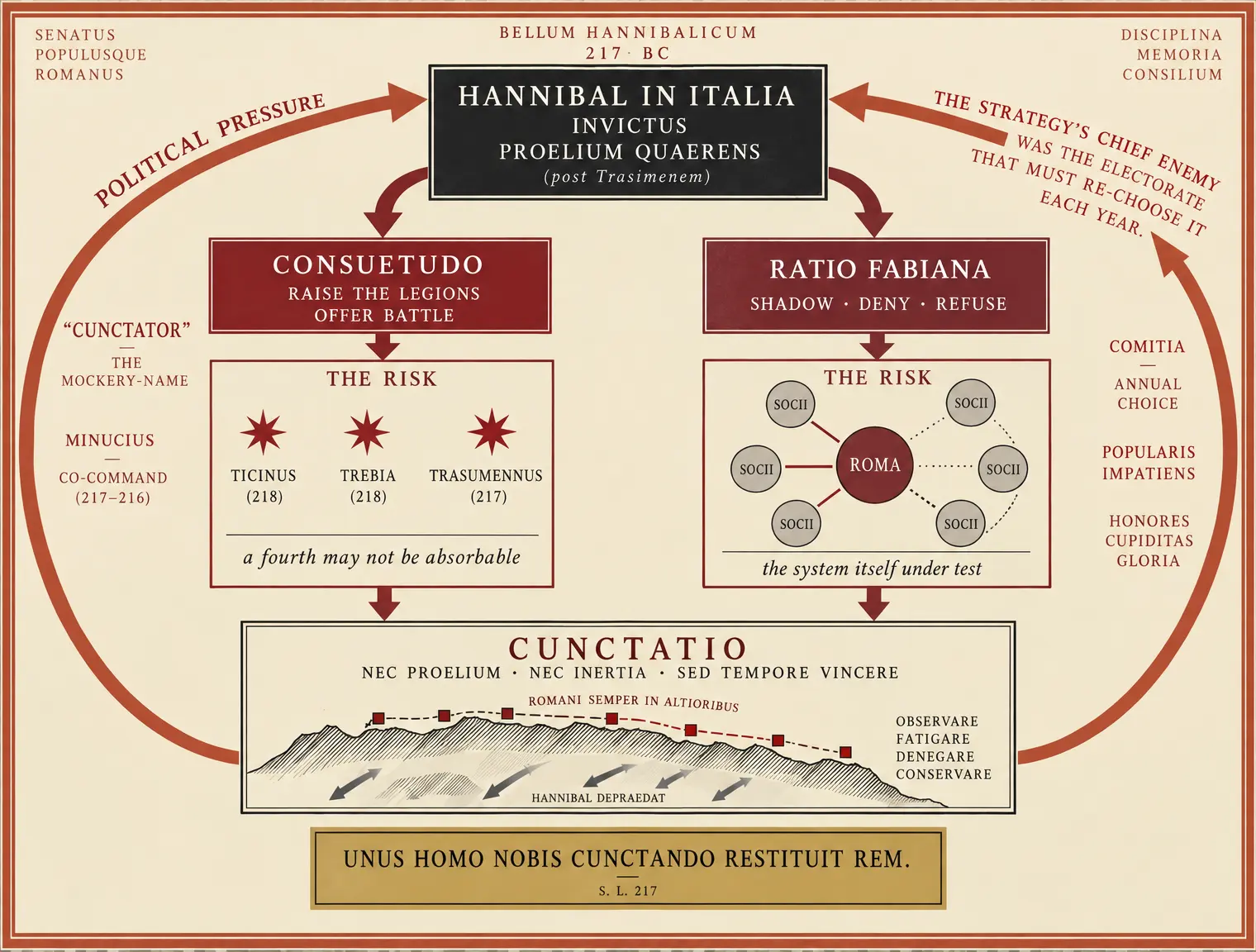
Two further engagements at Nola followed: a second in 215 BC, also a Roman tactical success on a small scale, and a third in 214 BC, which was inconclusive. The strategic effect of these engagements was cumulative: Hannibal's army was prevented from consolidating his post-Cannae gains in northern Campania, the Roman alliance system in the area held, and the strategic momentum that the catastrophe at Cannae had given the Carthaginian campaign was progressively dissipated by the slow grinding pressure of the Marcellan campaigns. By the spring of 214 BC, the strategic situation in the Italian theater had stabilized: Hannibal controlled southern Italy with substantial allied bases but could not consolidate the southern coalition into a unified force; Rome controlled central and northern Italy with the alliance system largely intact; the war in Italy had become, in effect, a strategic stalemate in which neither side could deliver a decisive blow but both sides were being slowly drained.
The Death of Hiero II and the Syracusan Revolution
The strategic stability of the Sicilian theater across the first six years of the Hannibalic War had depended on a single political fact: the alliance with Syracuse, concluded in 263 BC at the opening of the First Punic War, had been maintained without interruption by Hiero II across half a century of his long reign. Hiero, who had been a young officer in Pyrrhus's Sicilian expedition and had risen by political and military skill to the Syracusan kingship, was now in 215 BC approximately ninety years old, and his death (whether in late 215 or early 214 BC is uncertain) removed from the Sicilian political scene the figure whose personal commitment to the Roman alliance had held the theater stable since the days when Polybius's father might have been a young man.
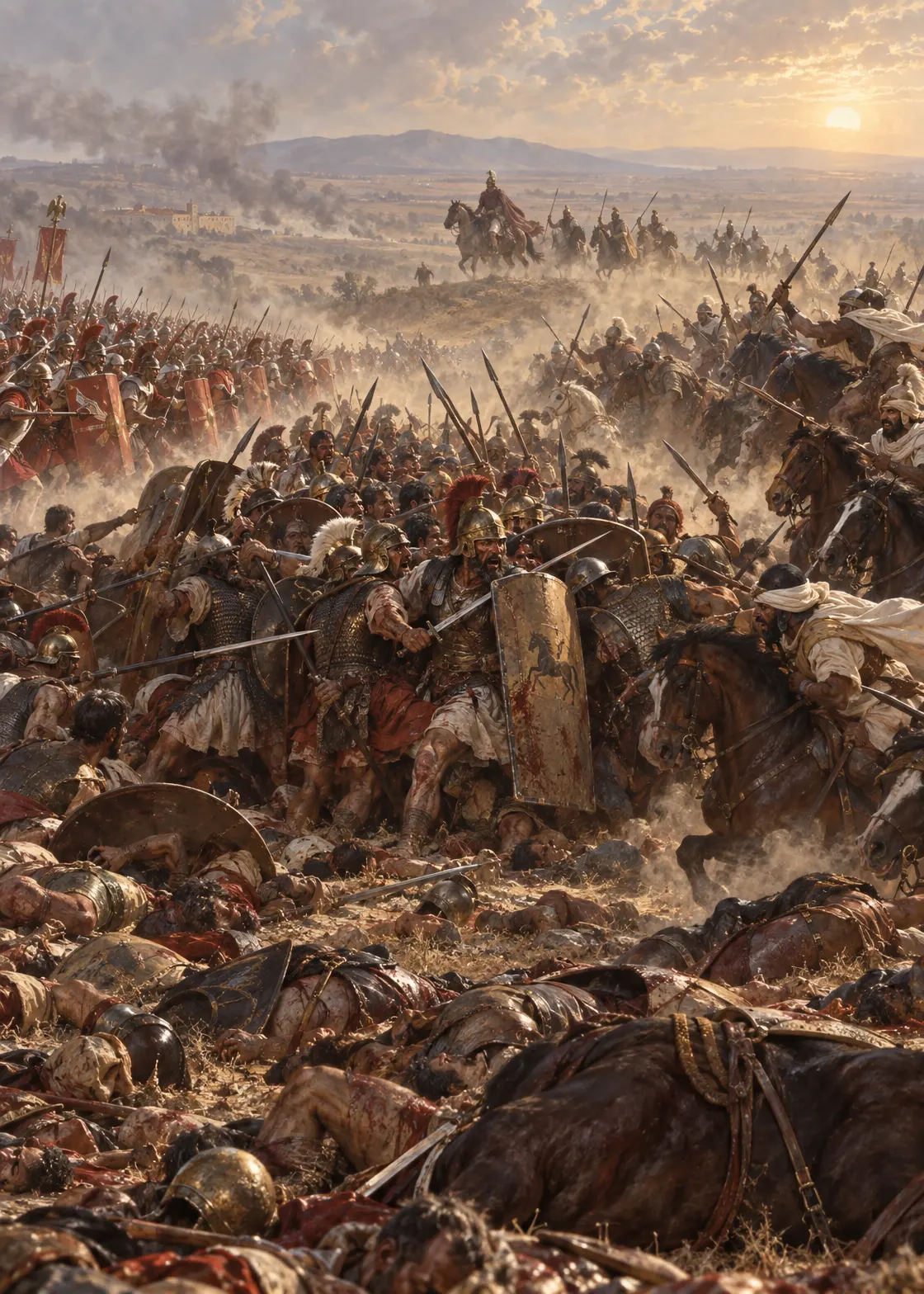
Hiero's grandson and chosen successor, Hieronymus, was a youth of fifteen at his grandfather's death — sufficient in Hellenistic monarchical practice to assume the throne, but inadequate in personal or political maturity to manage the strategic complexities of the moment. The Syracusan court had divided in Hiero's last years between a pro-Roman faction associated with the older councillors who had managed the alliance across his reign, and a pro-Carthaginian faction associated with younger figures who had calculated that the post-Cannae strategic momentum favored a Syracusan reorientation toward Carthage. The pro-Carthaginian faction, led by the brothers Hippocrates and Epicydes (half-Carthaginian by descent through their mother, raised at the Syracusan court but with Carthaginian political affiliations), gained the new king's confidence within months of his accession. The Carthaginians, recognizing the opportunity, dispatched embassies and probably substantial subsidies. By the spring of 214 BC, Hieronymus had openly broken with Rome and concluded a treaty with Carthage on terms that paralleled the Capuan treaty of two years earlier: Syracuse to be guaranteed independence and dominance over Greek Sicily, in exchange for opposition to Roman military operations on the island.
The Syracusan revolution was almost immediately compounded by a counter-revolution. Hieronymus, whose personal conduct as king displayed the kind of adolescent monarchical caprice that the Hellenistic world had seen too often, was assassinated by a conspiracy of disaffected Syracusan nobles in mid-214 BC, only a few months after concluding the Carthaginian treaty. The conspirators attempted to restore the Roman alliance, but the political process by which this restoration was to be effected — a democratic reorganization of the Syracusan constitution, the replacement of the Hieronian magistracies with a republican system — was hijacked by Hippocrates and Epicydes, who had been left in command of substantial Syracusan forces in the field at the moment of the assassination and who returned to the city at the head of their troops to seize control of the new democratic order. The result, by late 214 BC, was a Syracuse formally committed to Carthaginian alliance under the joint leadership of Hippocrates and Epicydes, with Hieronymus dead and the Hieronian dynastic line extinguished, and with the Roman strategic position in eastern Sicily — which had depended for half a century on the Syracusan alliance — now in active reversal.
The Roman response was the appointment of Marcus Claudius Marcellus to the Sicilian command. Marcellus, having distinguished himself at Nola, was elected consul for 214 BC and assigned the Sicilian provincia; he would hold the Sicilian command across the four years of the Syracusan war, eventually with proconsular extension of his authority, and his name would be permanently associated with the campaign that followed.
The siege of Syracuse (214–212 BC)
Syracuse became a hostile strategic center after the death of Hiero II, the short reign and assassination of Hieronymus, and the violent struggle over the city's alignment. Hippocrates and Epicydes, brothers associated with the Carthaginian interest, helped turn that struggle against Rome. The Roman seizure of Leontini and reports of Roman violence intensified the crisis. The war for Syracuse was therefore inseparable from a wider contest over Sicilian communities, their garrisons, grain and access to overseas assistance.
The Roman siege began in 214 BC under Marcus Claudius Marcellus and Appius Claudius Pulcher. Their initial plan combined pressure by land with an attack from the sea. Syracuse's harbors and the length of its defenses made naval cooperation necessary, but they also exposed ships approaching the walls to prepared defenders. Roman assault equipment could not remove the advantages of elevation, protected artillery and a fortified shoreline. The failed early attacks led to a much longer campaign of containment, raids, negotiation and attempts to exploit weakly guarded points.
The city was not a simple circular enclosure. Its inhabited quarters, the island of Ortygia, the harbor approaches and the plateau of Epipolae presented different military problems. An army that entered one sector had not automatically secured every defended quarter. The decisive question became whether the Romans could combine control of the surrounding countryside with a breach in the defensive system before Carthaginian intervention restored the balance. A map of the city can explain that problem; it cannot supply the precise positions of every ship, machine or assault party.
The principal literary controls are Livy 24.21–39 and 25.23–31, Polybius 8.3–7 and Plutarch, Marcellus 14–19. Their machinery descriptions and memorable episodes should be read alongside the extended chronology rather than used to reduce the whole siege to one spectacular attack.
Archimedes and the Defense of Syracuse
Archimedes' work for the Syracusan defense occupies an exceptional place in the surviving narratives. Polybius describes artillery adapted to different ranges and mechanisms that threatened ships close beneath the walls. Livy and Plutarch develop the picture of an assault checked by engineering. The common military point is clear: defenders had prepared overlapping ways to strike ships and troops as they approached, and Roman numerical or material resources did not guarantee a successful assault.
The mechanics are less certain than that strategic conclusion. Accounts of grappling devices and ships lifted or overturned do not provide a complete surviving workshop specification. The atlas therefore treats the devices as reported siege mechanisms and the illustrated defenses as interpretations of their function. A plausible machine drawing would still require decisions about anchorage, leverage, timber dimensions and the motion of a vessel that the narratives do not fully settle.
Burning mirrors belong to a different evidential category. They are absent from the principal near-event siege descriptions cited here and became prominent in later traditions. They should not be installed in a reconstruction as an established Roman-era weapon. Likewise, the famous image of a solitary inventor defeating an entire army can obscure the labor of garrison troops, sailors, carpenters and artillery crews who made the defensive system operate.
Archimedes illustrates a larger feature of ancient siegecraft: specialized knowledge could multiply the strength of a defended site, but machines remained embedded in walls, manpower, supplies and political endurance. Their immediate success delayed capture; it did not make Syracuse permanently secure.
The Long Siege and the Storm
After the initial assaults failed, the Romans had to sustain a siege while fighting elsewhere in Sicily. Carthaginian reinforcements under Himilco and operations involving Hippocrates prevented the contest from becoming a purely local blockade. Holding roads and grain supplies required garrisons and punitive expeditions; those operations in turn shaped whether Sicilian communities viewed Roman protection as preferable to resistance. The atrocity at Enna belongs to that coercive setting, rather than to a story of passive towns simply awaiting a change of masters.
In 212 BC the Romans exploited a weakness in the guarding of the northern defenses. Livy's account connects the opportunity with reconnaissance, a festival and an unexpected night entry. Roman troops gained access to Epipolae and other parts of the urban defensive system, but Achradina and Ortygia did not immediately capitulate. The sequence matters: the opening of a major sector transformed the siege without instantly ending organized resistance.
A relief effort failed amid disease in the forces outside the city. Livy describes a severe epidemic affecting the besiegers and their opponents, with particularly destructive consequences for the Carthaginian and associated forces; Hippocrates and Himilco died. This is not the same as Hippocrates being killed in an assault on the walls. Epicydes survived the collapse of this effort and left the immediate defense. Naval relief, weather and the decisions of Carthaginian commanders also affected what support could reach the remaining defenders.
Negotiation and betrayal completed what direct attack had not achieved. Livy gives the Spanish officer Mericus an important role in arranging Roman entry into a defended sector. The final capture and sack belong to 212 BC. Violence and plunder followed, while Marcellus' later representation as a protector of Greek culture coexisted uneasily with the consequences for the captured city. Syracuse's loss deprived the Carthaginian side of its most important Sicilian urban partner, but fighting on the island continued.
The episode is best understood as a sequence of unsuccessful assault, prolonged regional warfare, partial penetration, failed relief and final entry. A single arrow through a city gate cannot represent all those mechanisms. Livy 25.23–31 provides the sustained narrative, with the other surviving accounts contributing perspectives and famous episodes rather than an independently complete siege diary.
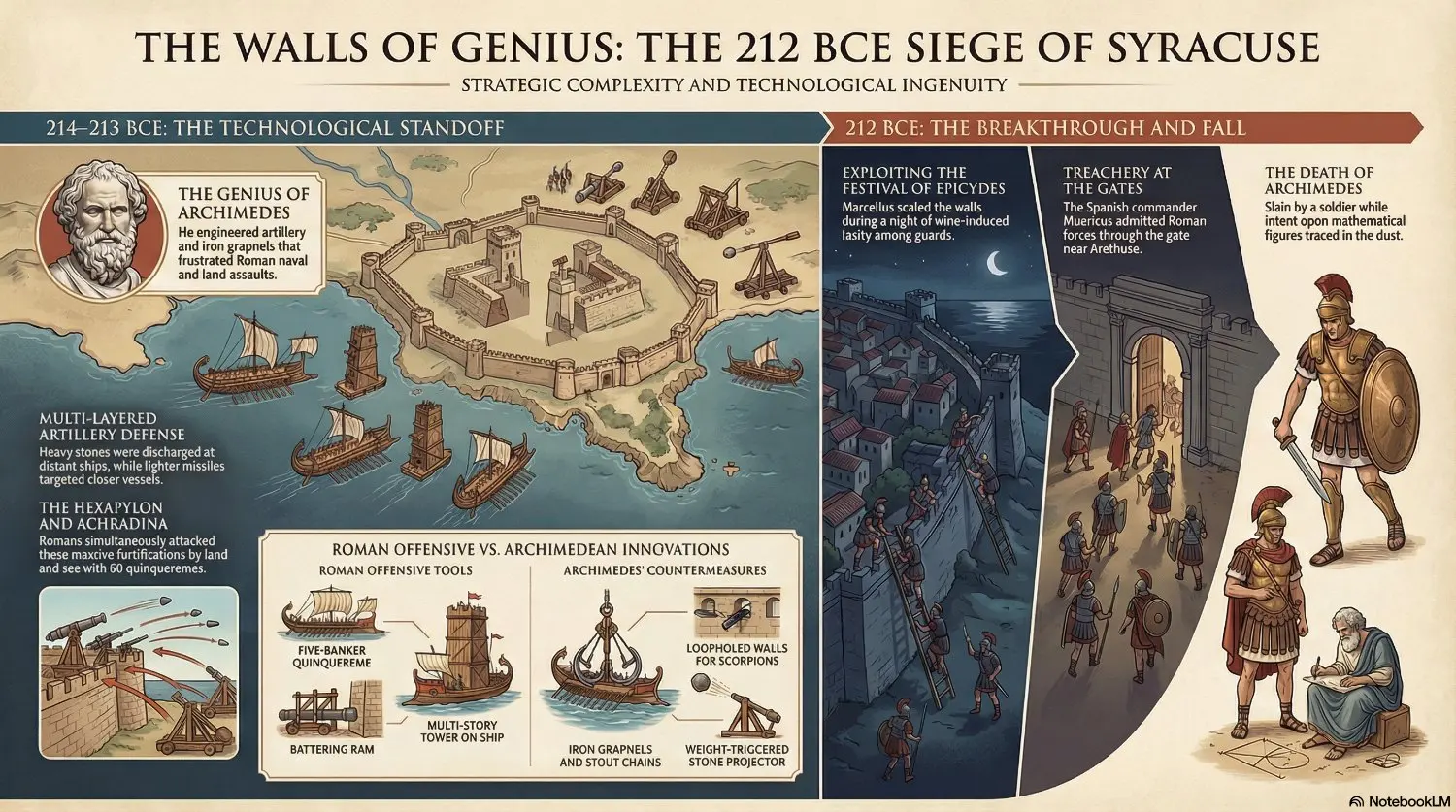
The Death of Archimedes
Archimedes was killed during the Roman capture of Syracuse. The circumstances survive in several versions. Plutarch, Marcellus 19, explicitly preserves alternatives: absorption in a mathematical problem, refusal or inability to comply with a soldier, or the mistaken interpretation of mathematical instruments. That variety warns against presenting one polished scene or famous last sentence as a transcript.
The accounts make Marcellus grieve for the scholar and distinguish the commander's wishes from the violence of the sack. That contrast is itself part of the historical representation of conquest. It can preserve a real death and a real concern for a celebrated intellectual while also serving a Roman moral narrative about cultivated command and undisciplined soldiers. It does not make the experience of the other inhabitants recoverable in equal detail.
Cicero's later account of locating Archimedes' tomb at Syracuse, in Tusculan Disputations 5.64–66, belongs to the afterlife of the scholar's memory. It is valuable testimony about commemoration, but it is not evidence for the exact place or moment of his death in 212 BC. The distinction allows the dossier to retain a powerful historical episode without confusing biography, later memory and the operational sequence of the siege.
The Recovery of Capua (212–211 BC)
While Marcellus was conducting the Syracusan siege, the principal Roman military operation in Italy was the long siege of Capua. Three Roman consular armies — eventually six legions under the joint command of the consuls Quintus Fulvius Flaccus and Appius Claudius Pulcher (the same Pulcher who had been Marcellus's naval colleague at Syracuse before being transferred to the Italian command) — invested Capua in 212 BC and conducted the siege across more than a year. The strategic objective was the recovery of the city that had defected so spectacularly in 216 BC; the operational challenge was the prevention of Hannibal's intervention to relieve the siege.
Hannibal, recognizing that the loss of Capua would represent a devastating reversal of the political-strategic gains of Cannae, conducted across 212 and 211 BC a series of operations designed to compel the Romans to lift the siege. He marched on Roman possessions in Lucania and Apulia, hoping to draw the besieging armies away by threatening Roman strategic interests elsewhere; he attacked the Roman positions around Capua directly in two engagements; and in the spring of 211 BC he conducted the most dramatic strategic maneuver of his Italian campaign: a march on Rome itself, intended to compel the Roman armies before Capua to abandon the siege and rush to the defense of the capital.
The march on Rome of 211 BC is preserved in the Roman tradition with the kind of mythic detail that Livy's narrative tends to attract. Hannibal's army crossed the Apennines, marched up the Latin Way, and arrived within sight of the walls of Rome in late spring 211 BC — the only occasion in Hannibal's seventeen-year Italian campaign on which the Carthaginian army approached the city of Rome itself. Hannibal personally rode up to the Colline Gate of the Servian Walls and (by some accounts) cast a javelin over the walls into the city as a gesture of defiance. The Romans, however, did not lift the siege of Capua. The two consuls before Capua sent only a small detachment back to reinforce the urban defenses; the main armies remained in position; the Capuan resistance, having anticipated relief from Hannibal's march, learned that no such relief would be forthcoming. Hannibal, having spent approximately a week in the vicinity of Rome and finding that his presence had not produced the strategic effect he had calculated for, withdrew southward without giving battle.
The Roman political response to Hannibal's appearance before the walls of Rome was characteristic: a public dinner was held in the Forum at which the senators dined ostentatiously while Hannibal's army camped within sight of the city; the property in Italy on which Hannibal's camp had been pitched was deliberately put up for sale in the Roman markets and sold for the price it would normally have commanded, as a demonstration that the Roman political order regarded the property as still securely Roman despite the temporary Carthaginian presence. These were gestures of political confidence rather than military substance, but their political significance — the demonstration that Rome refused to be intimidated by Hannibal's presence and that the institutional response to the strategic threat was, characteristically, business as usual — was understood by both sides to be considerable.
Capua surrendered shortly after Hannibal's withdrawal, in the late summer of 211 BC. The Roman terms were harsh: the principal Capuan senatorial leaders who had favored the Carthaginian alliance were either executed or committed suicide before they could be captured; the city was stripped of its political autonomy and reduced to civitas sine suffragio on terms that effectively destroyed Capua as an independent political community; the city walls were demolished; substantial Capuan territory was confiscated for Roman colonial settlement. The Capuan settlement of 211 was the harshest Roman treatment of any defeated Italian community in the period and was clearly intended both to punish the original defection and to deter any future Italian community contemplating a similar move. The deterrent effect, on balance, succeeded: no significant Italian community defected to Hannibal after the recovery of Capua.
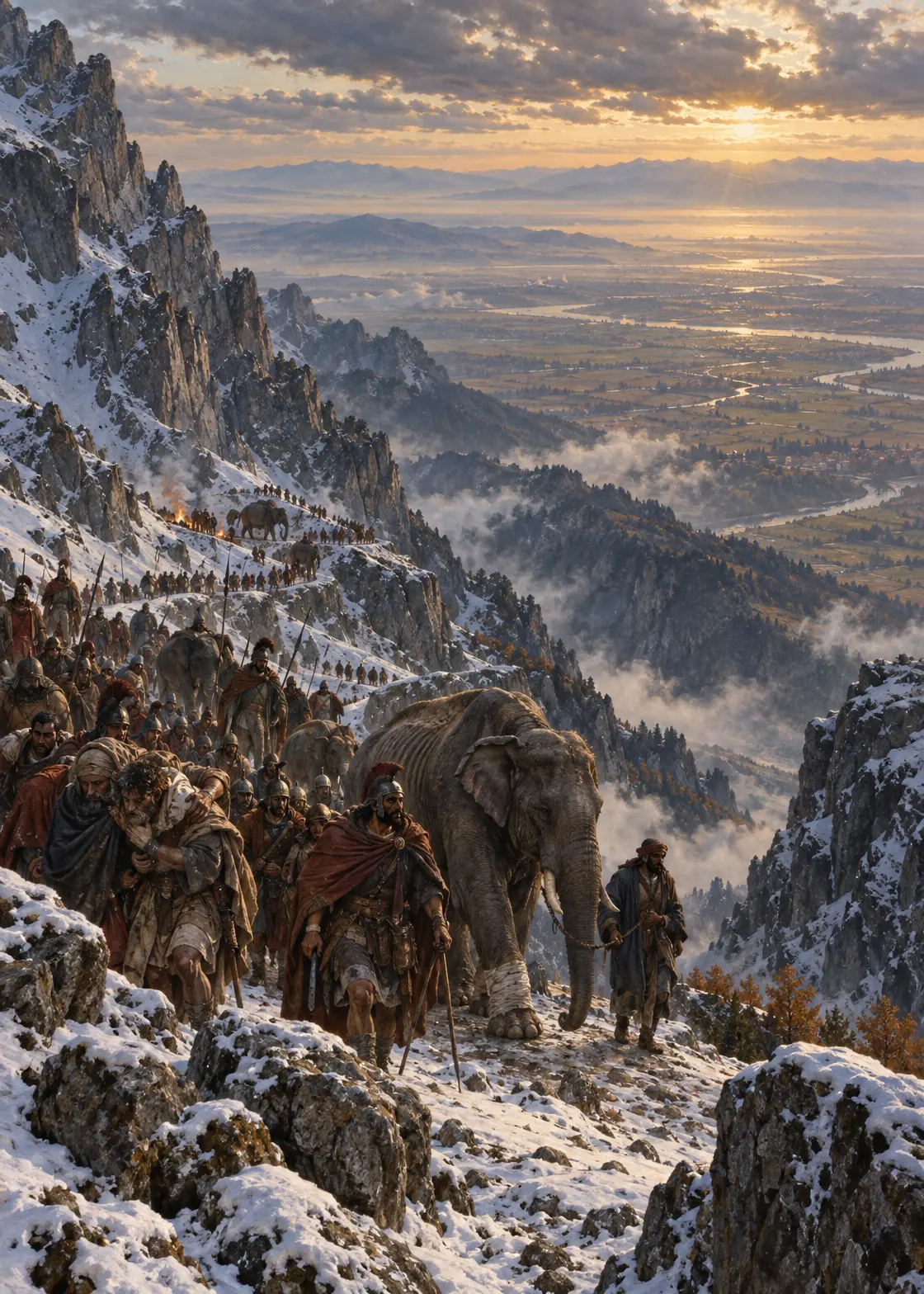
The Recovery of Tarentum (209 BC)
The recovery of Tarentum — the second-greatest of the post-Cannae Italian defections to Carthage — was accomplished two years after Capua, in 209 BC, under the command of the elderly Quintus Fabius Maximus, now serving his fifth consulship at approximately the age of seventy-five. Tarentum had been seized by Hannibal in 212 BC by a complex political-military operation in which a Tarentine faction (led by two brothers, Nicon and Tragiscus) had admitted Carthaginian forces into the city through a secretly opened postern gate; the citadel, however, had remained in Roman hands across the four years that followed, defended by a small garrison that resisted all Carthaginian assault attempts. The strategic situation by 209 was therefore one of divided control: Tarentum's city in Carthaginian hands, its citadel in Roman hands, with the Tarentine harbor disputed between the two.
Fabius's reduction of the city was accomplished by a combination of patience, political manipulation, and a brief decisive operation. He invested the city in the late spring of 209 BC; he conducted negotiations through agents with a Bruttian officer in the Carthaginian garrison whose wife was the sister of one of Fabius's soldiers; the Bruttian was bribed to admit a Roman detachment through a section of the wall he was responsible for. The Roman assault that followed was conducted by night, with the Bruttian-controlled section of wall opened to the assault, and the city was taken by surprise. The Carthaginian garrison and the Tarentine defection-leaders were killed in the night fighting; the city was sacked across several days; Tarentum was returned to Roman alliance as a civitas sine suffragio, with the political autonomy substantially reduced and Roman supervision established. The Roman recovery of Tarentum effectively ended the strategic significance of the post-Cannae southern Italian defections; with Capua and Tarentum both back under Roman control, the remaining Italian cities allied with Hannibal — the Bruttian communities, the lesser Greek cities of the south, the Hirpini Samnites — were either rapidly reduced or rendered strategically negligible across the following years.
The famous exchange between Fabius and his political critics about the manner of Tarentum's recovery is preserved by Plutarch (Fabius 23). Fabius had been criticized for taking the city by treachery rather than by force; he reportedly replied that the city had been lost by treachery (the original defection had been a political betrayal of the Roman alliance) and could properly be recovered by the same means. The remark is one of the more cynical observations preserved in the Roman tradition, and is consistent with the impression of Fabius the Cunctator that the sources cumulatively present: a man of considerable institutional patience and political skill, somewhat lacking in conventional military glory, whose contribution to the Roman victory in the Hannibalic War was substantial but indirect, and who recognized this himself with the kind of dry self-awareness that the Roman tradition both noticed and respected.
Hasdrubal's March to Italy (Late 208–Spring 207 BC)
Hasdrubal Barca's march from Spain to Italy was undertaken between late summer 208 and spring 207 BC, with the army crossing the Pyrenees in early autumn 208 and wintering in the lands of the Allobroges (the territory north of the modern Lyon) before completing the Alpine crossing in the spring of 207. The march was substantially easier than Hannibal's a decade earlier: the Gallic populations who had remembered Hannibal's passage now welcomed Hasdrubal's army, the route across southern Gaul was better known, the engineering challenges of the Alpine crossing had been mapped by the Hannibalic operation. Hasdrubal arrived in northern Italy in approximately April 207 BC with an army of approximately 30,000 men (including substantial Gallic reinforcements recruited during the march) and a smaller body of war elephants.
The strategic situation that Hasdrubal arrived to confront was, at first glance, favorable to a Carthaginian operation: Hannibal's army in southern Italy was still operational, Roman armies were dispersed across multiple theaters, and the Carthaginian reinforcement of Italy had been long expected by both sides. The operational challenge, however, was the coordination of the two Carthaginian armies. Hannibal's army was in Bruttium, at the southern end of the Italian peninsula; Hasdrubal's was in Cisalpine Gaul, at the northern end. The distance between them was approximately a thousand Roman miles. The two brothers needed to coordinate their northward and southward marches, respectively, in such a way that they would arrive at a common rendezvous point in central Italy before the Roman armies could prevent the junction.
The Roman strategic response to the Carthaginian opportunity was the deployment of two consular armies in 207 BC to intercept Hasdrubal before he could effect the junction with Hannibal. The consuls of the year were Gaius Claudius Nero (a member of the patrician Claudii Nerones, distinguished from his more famous later imperial namesakes by his consular career and his subsequent celebrated achievement at the Metaurus) and Marcus Livius Salinator (a senatorial figure whose career had previously been blighted by a political scandal that had resulted in his temporary withdrawal from public life, and who was now restored to office in recognition of his strategic competence).
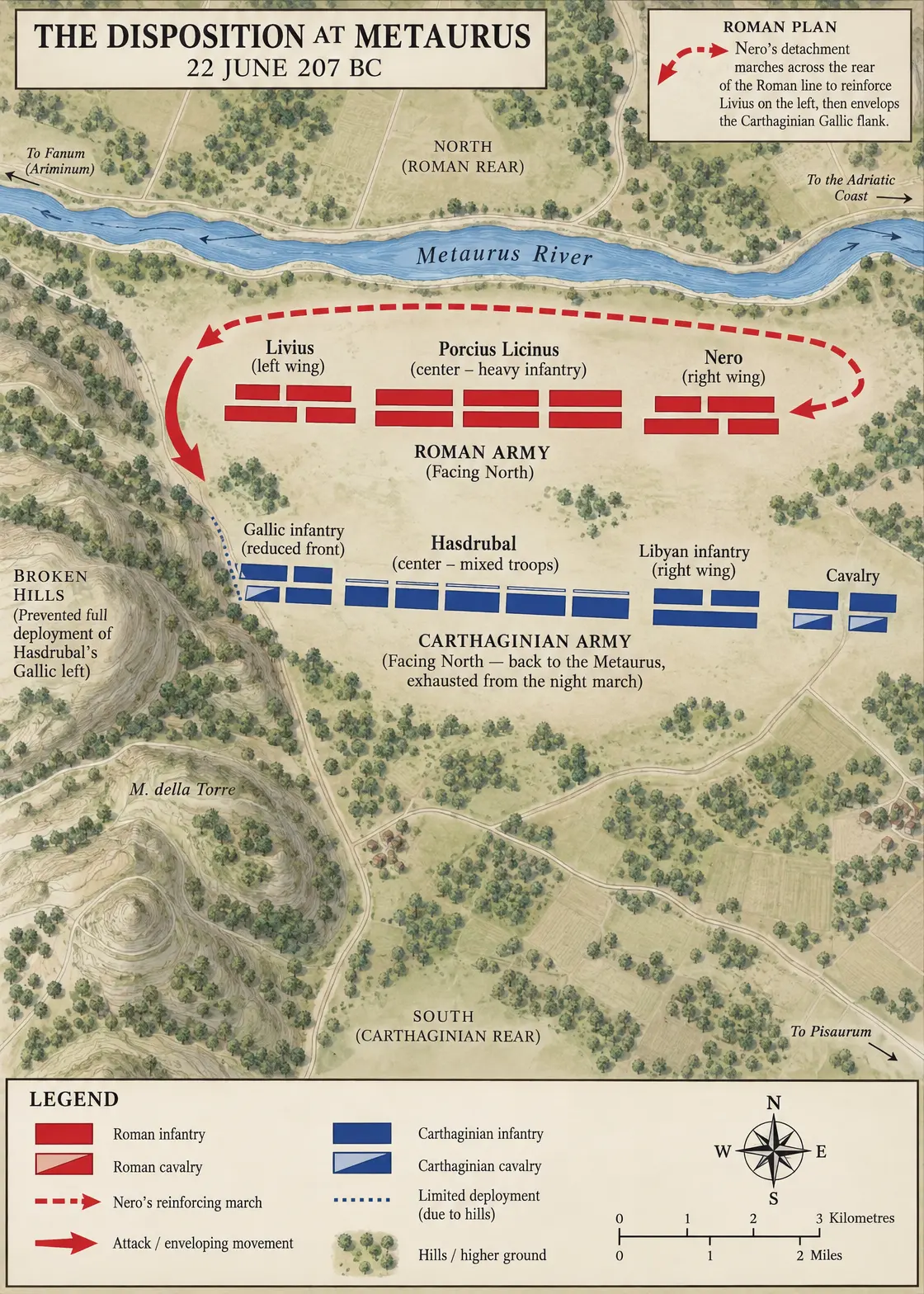
Nero was assigned the southern command, with the principal task of holding Hannibal in Bruttium; Livius was assigned the northern command, with the principal task of confronting Hasdrubal as he advanced southward through Italy. The combined Roman force in the field was approximately fourteen legions and the corresponding allied contingents, of which seven were under Nero's command in the south and seven under Livius's in the north.
The Coordination That Failed
The Carthaginian operational plan required precise coordination between the two brothers. Hannibal needed to know Hasdrubal's intended route and rendezvous point; Hasdrubal needed to know Hannibal's expected position and timetable. The coordination depended, in the absence of any direct communication between the two armies (which was operationally impossible given the Roman armies operating between them), on a messenger system. Hasdrubal dispatched six riders southward from his camp in Cisalpine Gaul in late June or early July 207 BC, carrying a sealed letter to Hannibal that specified the proposed rendezvous in Umbria, the timetable Hasdrubal proposed to follow, and the route he intended to take through central Italy. The letter was the operational hinge of the entire Carthaginian plan: without it, Hannibal could not know where or when to bring his army northward to meet his brother.
The six riders, traveling separately through Italy by what they hoped were inconspicuous routes, were intercepted by Roman scouts somewhere in Apulia, possibly near the town of Tarentum, in mid-July 207 BC. Five of the riders were killed in the interception; the sixth was captured alive, and Hasdrubal's letter was recovered from him intact. The letter was carried under guard to the consul Gaius Claudius Nero at his headquarters in southern Italy, who opened it, read it, and within a few hours made the most operationally consequential decision of the entire Hannibalic War.
Nero's decision was, in modern military vocabulary, an interior-lines operation of unusual audacity. He recognized that Hasdrubal's letter gave him precise information that Hasdrubal's army was advancing southward through central Italy, that Hasdrubal was unaware of Roman knowledge of his route and timetable, and that Hasdrubal expected to make the junction with Hannibal at a specific location in Umbria on a specific projected date. Nero further recognized that if Livius's army alone confronted Hasdrubal at the projected junction point, the engagement would be on roughly equal numerical terms and the outcome would be uncertain. If, however, Nero could detach a substantial portion of his own army, march it north with extraordinary speed, and arrive in Livius's camp before the engagement, the combined Roman armies would have overwhelming numerical superiority and could decisively defeat Hasdrubal before Hannibal could intervene. The operational challenge was the speed required: Nero's force would have to march from southern Italy to Umbria — approximately 250 Roman miles — in less time than it would take Hannibal to march north from Bruttium and Hasdrubal to complete his southward advance to the junction point. Nero would have to march, in effect, faster than Hannibal could march, and he would have to do it without Hannibal learning that he was doing it.
Nero detached approximately 7,000 men from his army — picked troops, light infantry, and cavalry, organized for rapid movement — and set out northward in mid-July 207 BC. The march that followed is preserved in the sources (principally Livy 27.43–48) with the kind of admiring detail that suggests it was recognized as exceptional by contemporary witnesses. Nero's column covered the 250 miles in approximately seven days, with the troops sleeping in shifts, marching twenty hours of the twenty-four, and being supplied by the rural Italian population along the route (the populations of central Italy, observing the column passing, voluntarily prepared food and supplied the marching troops; the moral economy of the post-Cannae alliance system was, by this point, sufficiently durable to support extraordinary operational measures). Nero's force arrived at Livius's camp near the Metaurus river in Umbria on approximately 21 or 22 June 207 BC.
The arrival was concealed with operational discipline. Nero's troops entered Livius's camp at night, were quartered among the existing tents to disguise the increase in total numbers, and were forbidden from displaying their separate standards. The strategic objective was to deny Hasdrubal any indication that the Roman force facing him was larger than he had expected. The deception, by the testimony of the sources, was substantially successful: Hasdrubal, observing the Roman camp opposite him on 22 and 23 June, noticed an unusual increase in cooking fires and an unusual concentration of horsemen, but interpreted these signals incorrectly — he attributed them to the presence of senatorial commissioners from Rome rather than to a doubled Roman army.
The Battle of the Metaurus (22 or 23 June 207 BC)
The Battle of the Metaurus was fought on terrain selected by Livius, who as the local Roman commander had had several weeks to study the country. The position was on the southern bank of the Metaurus river, with the Roman line drawn up perpendicular to the river and the Carthaginian line approaching from the north. Hasdrubal, evidently still under the impression that he faced only Livius's army, had attempted on the previous night to break contact and to march westward to a more favorable position, but his guides had become lost in the dark and his army had spent the night marching in confusion along the river bank; by dawn on 22 June Hasdrubal's army was in disordered formation along the northern bank of the Metaurus, with his troops exhausted from the night's march and his command structure imperfectly organized. The tactical conditions for the battle were thus in Roman favor before the engagement began.
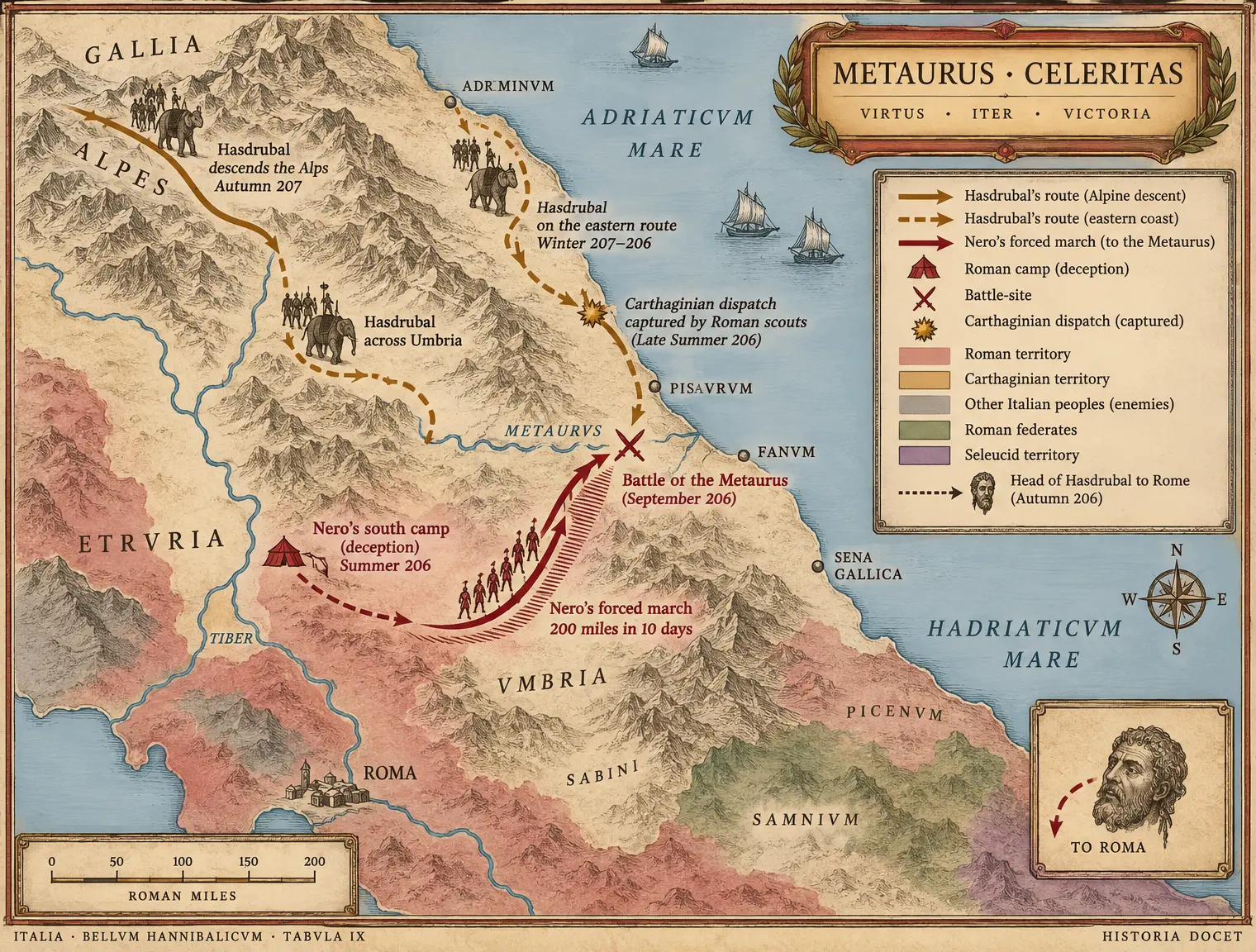
Hasdrubal's army drew up with his Spanish and Ligurian heavy infantry in the center, his Gallic infantry on the left wing (which was anchored on broken hill country to the west), and his cavalry on the right wing. His ten or twelve war elephants were stationed in the center, in front of the infantry line. The Roman army drew up opposite: Livius commanded the left, facing the Gallic infantry on Hasdrubal's left; Nero commanded the right, facing Hasdrubal's cavalry and Spanish infantry. The Roman center was under the praetor Lucius Porcius Licinus.
The engagement opened conventionally: the Roman heavy infantry advanced in the center, the cavalry actions began on the wings, the elephants in Hasdrubal's center caused initial disorder in the Roman line. The tactical innovation that decided the battle, however, was Nero's. Observing that Hasdrubal's Gallic left wing was poorly deployed because of the broken terrain on which it was anchored, Nero detached a substantial portion of his right-wing force, marched it across the rear of the entire Roman line (passing behind the Roman center and reaching the Roman left wing), and committed it to a flank attack on Hasdrubal's Gallic left. The maneuver was operationally unusual — Roman tactical doctrine of the period did not normally include cross-line redeployment in the middle of a battle — but it was decisive. The Gallic infantry, attacked simultaneously from front (by Livius's army) and flank (by Nero's detachment), broke; the breaking of the Gallic left exposed the flank of Hasdrubal's center; the entire Carthaginian line was rolled up from west to east.
Hasdrubal himself, recognizing that the battle was lost and that he could not return to Spain or even withdraw with his army intact, rode into the heaviest fighting and was killed in the action. His army was destroyed: approximately 10,000 Carthaginian dead, including most of the Spanish and African core troops; the surviving Gauls broke and dispersed into the surrounding country; the elephants were killed in the rout or captured. Total Carthaginian losses were perhaps 15,000; the Roman losses were approximately 2,000.
Nero's army began its march back to southern Italy on the morning after the battle. The return march was conducted at the same extraordinary pace as the outward march, with Nero's force covering the 250 miles back to its position opposite Hannibal in approximately six days. Nero brought with him a single item: Hasdrubal's head, which he caused to be thrown over the palisade of Hannibal's camp in southern Italy as the first communication of the Metaurus result. Hannibal, finding the head of his brother delivered to him in this manner, is reported by Livy (27.51) to have said that he saw the destiny of Carthage in the moment. The remark is one of the few preserved direct statements of Hannibal in the Roman tradition; whether or not it represents the actual sentiment of the moment, the strategic recognition it expressed was accurate. With the destruction of Hasdrubal Barca's army, the Carthaginian strategic plan that had underwritten Hannibal's entire Italian campaign — the long-projected reinforcement from Spain — was finally and definitively impossible. The war in Italy had become, after the Metaurus, a holding action whose outcome could no longer be in doubt; the Carthaginian state was no longer capable of supporting Hannibal's army adequately, and the Italian theater would eventually be reduced not by Roman tactical victory over Hannibal but by Roman strategic patience while the Carthaginian state's capacity to sustain the operation eroded to insignificance.
The strategic significance of the Metaurus was recognized at Rome with appropriate ceremony. Both consuls were granted triumphs — Livius the conventional triumph as the senior commander on the field, Nero an ovatio (a lesser triumph appropriate to a subordinate or proconsular role) that the Roman tradition recognized as substantively equivalent to a major triumph; the Senate decreed three days of public thanksgiving; the road on which Nero's column had marched northward and southward was reportedly lined for years afterward with monuments commemorating the operation. The Polybian and Livian narratives both treat the Metaurus as the strategic turning point of the war, and modern military historiography has generally agreed: the engagement that destroyed Hasdrubal Barca's army in Umbria in June 207 BC was the engagement that decided the Hannibalic War, even though the war itself would continue for another five years and would conclude at Zama on a different continent.
Tactical illustrations
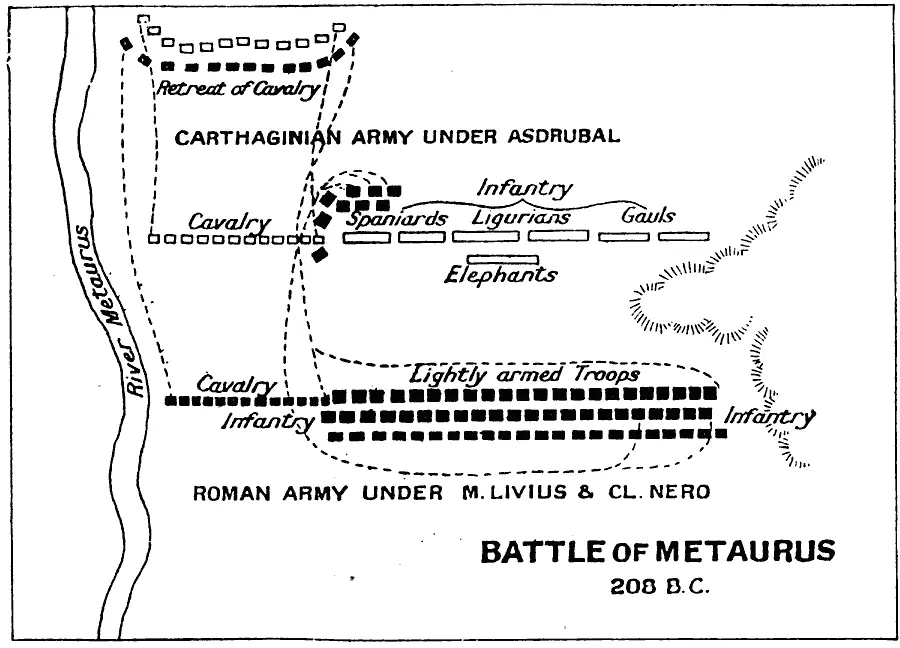
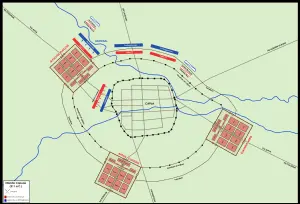
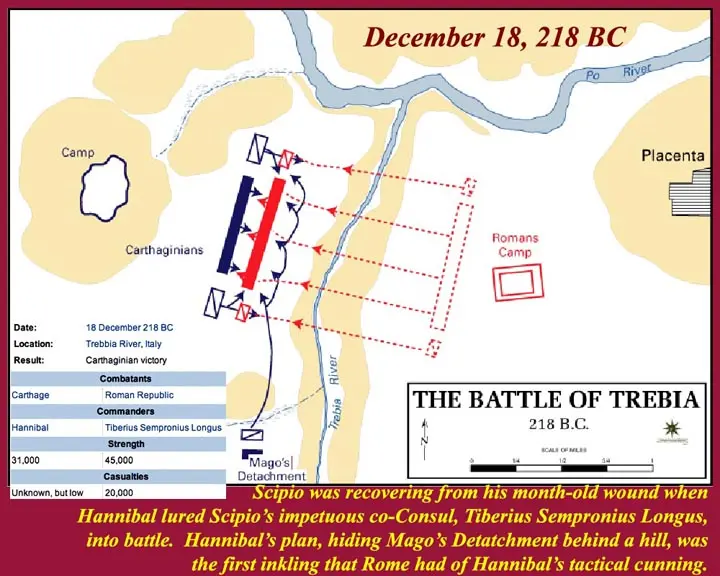
Outcome and critical assessment
Result and caution: the Roman state endured despite its battlefield disasters, and Hannibal's Italian position contracted. This is an explanation involving political endurance, resources and multiple theaters, not proof that a single universal "Fabian strategy" was followed without interruption. Hannibal's exact Alpine pass remains disputed and is not drawn as a known route.
Historical record: IR-II, later chapters; IR-III, Italian campaigns; Polybius, book 3; Livy, books 21–27.